TRON Industry Weekly Report: Stubborn Inflation and Oil Prices May Continue to Weigh on BTC Rebound


- Core Takeaways: This week's global macro environment reflects a stagflationary tug-of-war, characterized by "cooling inflation but weakening consumption, with high energy prices constraining monetary policy easing." The crypto market failed to sustain its rally despite favorable macro data, with BTC retreating to approximately $63,000. Market sentiment was dampened by weakening ETF demand and stalled regulatory progress. Industry hotspots focus on the convergence of AI Agents and on-chain financial execution stacks, as RWA, stablecoins, and high-performance public chains are coalescing into a unified infrastructure layer.
- Key Elements:
- U.S. July CPI fell to 3.4% year-over-year, while retail sales unexpectedly declined 0.6% month-over-month. WTI and Brent crude rose approximately 5.4% and 5.9% week-over-week, respectively, with energy prices creating imported inflationary pressure. The 10-year U.S. Treasury yield held near a high of 4.70%.
- BTC fell approximately 2.9% week-over-week to around $63,000, while ETH declined roughly 1.8% to approximately $1,880. Weak July non-farm payroll data briefly pushed BTC above $65,000, but softer CPI/PPI readings failed to further boost prices, indicating that the stimulative effect of macro tailwinds on risk appetite is diminishing.
- Regulatory developments: The U.S. CLARITY Act has been postponed to September due to the Senate recess. The SEC abruptly canceled its public meeting originally scheduled for August 14 to deliberate on the "Regulation Crypto Assets" framework. The UK's FCA and the EU's MiCA remain in the implementation preparation and review stages, with no significant new legislation introduced.
- Multipli.fi, which raised $21.5 million in funding, is building rwaUSD, a standardized collateral layer for RWAs. By leveraging highly liquid Treasury/gold collateral, the AlphaIQ strategy engine, and Lloyd's insurance mechanisms, it tokenizes institutional-grade Delta Neutral strategies, addressing the fragmentation problem in the RWA space.
- Re Protocol, which raised $21 million, employs a tiered capital structure consisting of reUSD (senior) and reUSDe (junior) tranches, providing capital to reinsurance companies via Surplus Notes. It introduces real premium income and combines Chainlink Proof of Reserve with a three-tier loss absorption mechanism, offering a yield source with low correlation to crypto market dynamics.
- On the technology trend front, x402-style protocols enable AI Agents to automatically complete pay-per-use transactions via APIs, supported by API Keys, Allowlists, KYA (Know Your Agent), and streaming settlement mechanisms. Competition in this sector has shifted toward a complete execution stack encompassing Agent Wallets, identity, Policy Engines, and stablecoin settlement.
1. Outlook
1.1 Macro Summary and Future Predictions
This week, the global macro trading narrative centered on "cooling US inflation and weakening consumption, though energy shocks continue to prevent monetary policy from shifting toward easing." The US July CPI rose 0.1% month-over-month, with the year-over-year figure declining from 3.5% to 3.4%, while core CPI fell from 2.6% to 2.5% year-over-year, indicating that underlying inflation continues to gradually moderate. Meanwhile, July retail sales unexpectedly fell 0.6% month-over-month, which, combined with previously weak employment data, suggests momentum in US demand and the labor market is fading. However, tensions in the Middle East and supply disruptions in the Strait of Hormuz remain the biggest macro variable: the IEA further lowered its 2026 global oil demand and supply forecasts, global inventories declined notably, and WTI and Brent settled at approximately $82.40 and $88.52, respectively, up about 5.4% and 5.9% on the week, with energy prices re-imposing imported inflationary pressures. Consequently, the Fed finds itself in a classic dilemma of "cooling growth but inflation still above target." The July meeting held the federal funds rate at 3.50%–3.75%, with clear internal disagreement over whether further hikes are needed. Following this week's inflation and consumption data, Treasuries and the dollar briefly weakened, but the 10-year Treasury yield ultimately remained near elevated levels around 4.70%. Overall, this week's macro environment does not fit the traditional "disinflation → rate cuts" playbook, but rather resembles a stagflationary tug-of-war where growth gradually slows and core inflation improves, yet energy and geopolitical risks keep global rates elevated.
Next week, macro markets are expected to remain focused on whether growth data can further support economic cooling, and whether energy-driven inflation forces central banks to maintain a hawkish stance. In the US, markets will closely watch the Fed's July meeting minutes, PMI data, industrial production, and housing figures. Against the backdrop of falling CPI and notably weaker retail sales, if subsequent economic data continues to underperform, expectations for further Fed hikes may continue to cool, putting downward pressure on short-end Treasury yields and the dollar. However, as long as oil prices remain elevated, markets are unlikely to quickly pivot to a clear rate-cut trade. Europe and the UK will focus on PMI data, UK employment and inflation figures. High energy costs mean the ECB and the Bank of England face similar policy constraints of "weakening growth and re-emerging inflation risks." Therefore, the base case for the coming week is that global macro conditions remain in a phase of high rates, high energy prices, and cooling growth, with major central banks more likely to adopt a wait-and-see stance rather than quickly pivoting to easing. The biggest upside risk remains a deterioration in the Strait of Hormuz situation causing oil prices to break higher rapidly again, thereby re-inflating global inflation expectations and long-end government bond yields. Conversely, if geopolitical tensions ease and energy prices decline significantly, the combination of "falling inflation + slowing growth" would strengthen market expectations for a future policy shift toward easing by central banks.
1.2 Crypto Market Movements and Warnings
This week, the crypto market exhibited a pattern of sustained pullback after failing to break higher, with BTC declining more than ETH and altcoins diverging. The core theme remained price pressure. BTC opened around $64,845 on August 10, briefly spiked to $65,322 that day, but then declined continuously, closing around $62,976 on August 14. As of August 15, it traded around $63,000, down approximately 2.9% from its August 10 open. ETH was around $1,880 as of August 15, down roughly 1.8% over the week. SOL was around $75.4, down about 0.7% weekly, XRP was around $1.00, down roughly 3.7% weekly, while TRX showed relative resilience at approximately $0.331, up about 0.7% on the week. Notably, this week's price action saw US July employment data unexpectedly decline by 23,000 jobs, which briefly dampened Fed rate hike expectations and helped BTC reclaim $65,000 around August 10. However, the subsequently released soft CPI/PPI figures failed to push prices higher, and BTC instead fell back toward $63,000, indicating that favorable macro data can no longer effectively stimulate risk appetite. Meanwhile, weakening demand for Bitcoin ETFs, the SEC's last-minute cancellation of a planned public meeting to discuss crypto financing rules, and the lack of progress on the CLARITY Act during the Senate recess further dampened market sentiment, with BTC sliding from around $65,000 at the start of the week to roughly $63,000 by the weekend.
Next week, the key level to watch is whether BTC can hold the $62,000–$63,000 zone. BTC has already fallen to approximately $62,970 and is trading near/below its 50-day moving average. If regulatory expectations continue to weaken and ETF inflows fail to recover, a break below recent lows could open up further downside. Conversely, reclaiming $64,000–$65,000 would suggest that this week's downward pressure is beginning to ease. For ETH, the key zone to watch is $1,850–$1,900; for SOL, the $75 level; and for XRP, the $1 psychological level. If these levels are decisively broken, volatility in altcoins could amplify significantly.
1.3 Industry and Sector Hotspots
The technological hotspot of AI Agent × Crypto is further converging on machine-native payments and programmable authorization. Protocols in the x402 category are enabling Agents to automatically complete pay-per-use transactions via APIs, complemented by mechanisms such as API Key/Session Key, Allowlists, per-transaction limits, KYA (Know Your Agent), and streaming settlements. This indicates that competition in this sector is shifting from "AI Agents issuing Tokens" to a complete execution stack of Agent Wallet + Identity + Policy Engine + Stablecoin Settlement.
Overall, the most notable technological trend this week is not a single new narrative, but rather the convergence of RWA, stablecoins, AI Agents, and high-performance public chains within the same "on-chain financial execution stack" — with AI Agents/institutions initiating programmable transactions at the top layer, identity, compliance, and authorization policies controlling execution in the middle layer, stablecoins settling value at the base layer, and higher throughput, sub-second finality, and atomic settlement infrastructure underpinning it all.
2. Market Hot Sectors and Promising Projects of the Week
2.1 Promising Project Overview
1.1. Multipli — On-chain yield infrastructure backed by $21.5 million in total funding from Base Ecosystem Fund, Pantera, and Sequoia, tokenizing institutional-grade arbitrage returns.
Overview
Multipli.fi is a decentralized, multi-chain yield infrastructure protocol focused on providing real, risk-adjusted yields for assets that traditionally generate little to no yield (such as BTC, ETH, stablecoins, and tokenized RWAs). The protocol aggregates and tokenizes institutional-grade Delta Neutral strategies — including cash-and-carry arbitrage (Contango) and funding rate arbitrage — into freely tradable xTokens, enabling users to access institutional-grade returns on-chain.
Its proprietary AlphaIQ engine dynamically allocates capital to the best-performing strategies, improving yield efficiency while maintaining liquidity and DeFi composability.
Protocol Mechanism Overview: The rwaUSD Mechanism
1. Collateral Selection Principles: Accepting Only Highly Liquid RWAs
rwaUSD exclusively uses institutional-grade, highly liquid real-world assets (RWAs) as underlying collateral, including:
- Short-duration US Treasury bills (T-Bills)
- Highly liquid tokenized gold
- Other publicly traded RWAs with continuous pricing and deep market liquidity
These assets offer price transparency, ample liquidity, and fast redemption capabilities, meeting the collateral requirements of DeFi liquidation mechanisms.
2. Insurance Mechanism for Enhanced Security
To further enhance stability and market trust, rwaUSD plans to integrate an insurance system underwritten by Lloyd's of London.
The insurance primarily covers:
- De-peg of underlying collateral assets
- Risks arising from specific regulatory policy changes
- Fraud and invalidity risks at custodians or collateral asset levels
Through the dual structure of "quality collateral + insurance protection," the system's resilience is enhanced.
3. Serving as a Universal DeFi Collateral Asset
Leveraging highly liquid RWAs and the insurance mechanism, rwaUSD is designed as a foundational collateral primitive (Collateral Primitive) broadly usable across the DeFi ecosystem, capable of supporting lending, leverage, yield strategies, and various other on-chain financial use cases.
4. No Mixing of Illiquid RWAs
Multipli does not pool all RWA assets into a single system.
The following assets are excluded from the rwaUSD collateral pool:
- Private Equity
- Private Credit
- Structured fund products
- Assets with long lock-up periods or extended redemption cycles
This is because these assets have poor liquidity under market stress and could affect overall solvency.
Therefore, Multipli routes highly liquid RWAs into the rwaUSD system, while illiquid RWAs are placed into segmented liquidity classes, preventing contagion across different risk tiers.
rwaUSD Architecture and Core Logic
1. rwaUSD's Positioning: A Unified Collateral Layer for RWAs
rwaUSD can be understood as a "Universal Collateral Adapter" for RWAs.
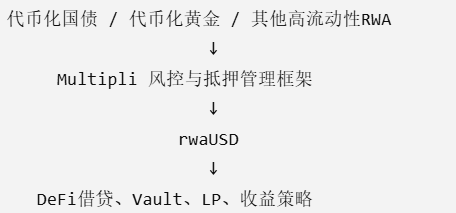
Its core objective is not to issue new RWAs, but rather to standardize high-quality RWAs from different issuers and asset types into a single collateral asset that can be widely adopted across DeFi.
2. Separation of Responsibilities
rwaUSD isolates complexity at the underlying layer through a unified interface.
Asset Issuers
- Responsible for asset issuance and compliant operations
- Manage underlying assets such as Treasuries and gold
Multipli
- Responsible for asset aggregation
- Risk standardization
- Solvency management
- Maintenance of the collateral framework
DeFi Protocols
- Focus on lending, liquidity, and yield strategies
- No need to individually adapt to each type of RWA
This design achieves separation of duties, enhancing scalability across the ecosystem.
3. Solving the RWA Fragmentation Problem
As more institutions bring assets on-chain:
- Treasury tokens from different issuers
- Various gold tokens
- A range of publicly traded RWAs
These create a growing number of independent liquidity pools.
If every DeFi protocol were to integrate each one individually:
- OUSG
- BUIDL
- TBILL
- Tokenized Gold
- Other RWAs
This would incur enormous integration and maintenance costs
4. rwaUSD's Solution
rwaUSD packages these underlying assets into a single composable, lendable, and tradable standardized asset.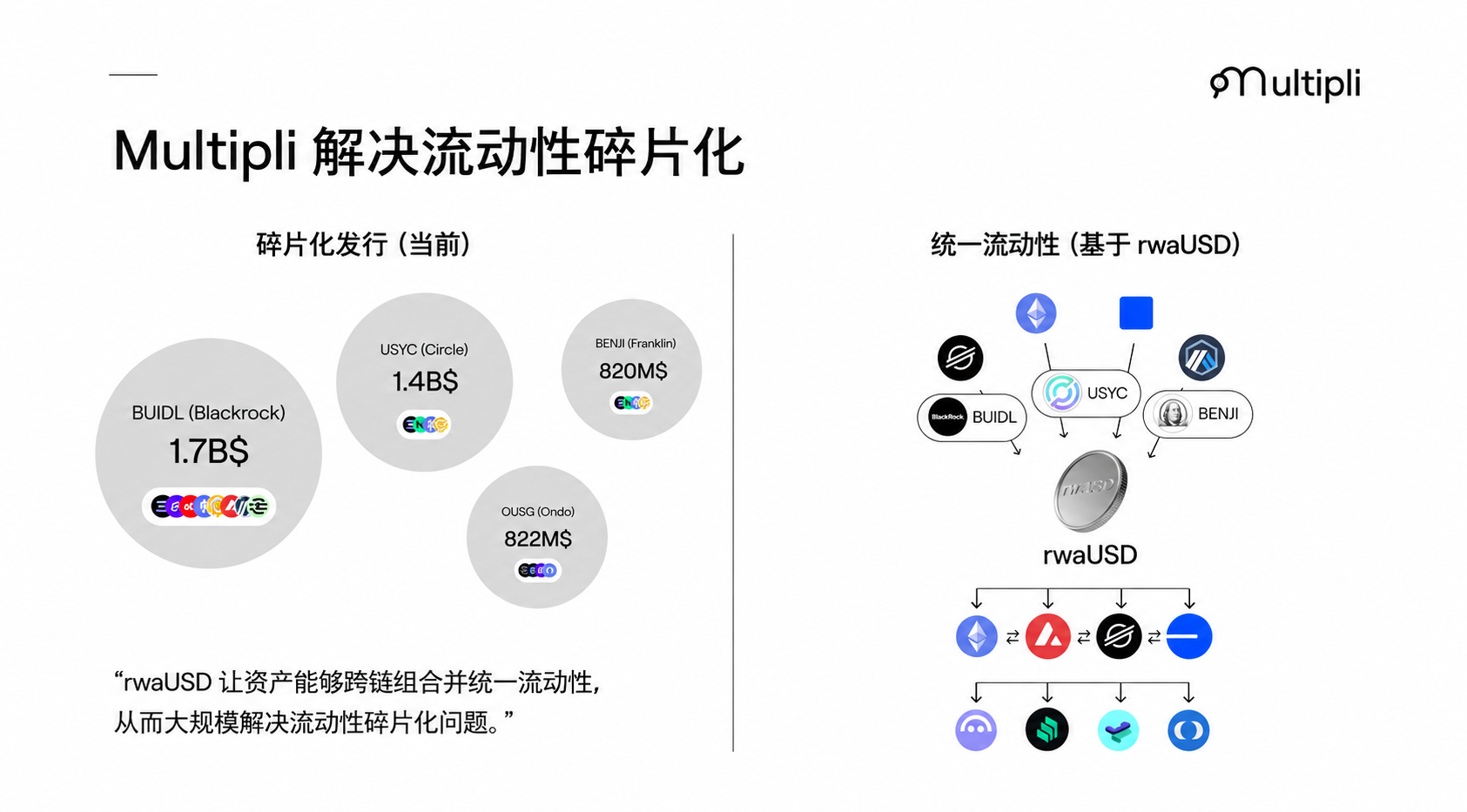
DeFi protocols only need to integrate rwaUSD once to indirectly access liquidity from the entire RWA market.
How rwaUSD Works
1. Project Positioning: A Standardized Gateway for RWAs into DeFi
There is already a large amount of:
- Tokenized Treasuries
- Money market funds
- Tokenized gold
on-chain, but liquidity is fragmented and risk standards are inconsistent, making direct integration into DeFi difficult.
rwaUSD transforms different RWAs into a standardized collateral asset through a unified risk framework.
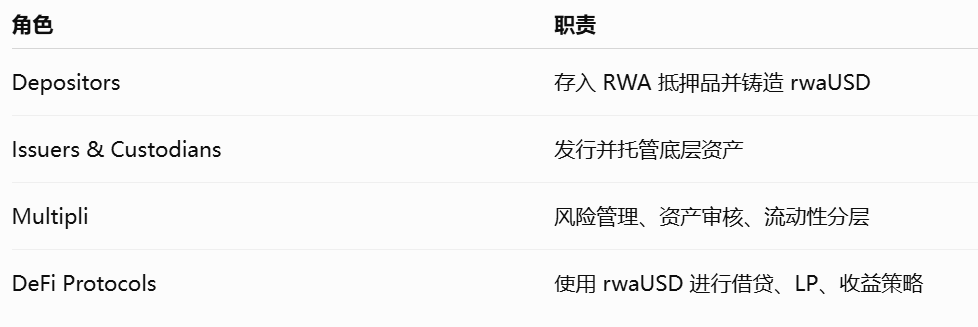
2. Key Actors
3. Core System Components
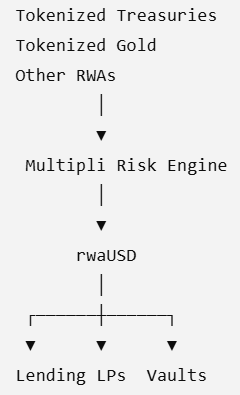
Collateral Vault
- Custodies underlying RWAs
- Manages assets by liquidity tier
Risk Engine
Responsible for:
- Asset admission review
- Haircut configuration
- MTV setting
- Risk buffer management
- Liquidity tier classification
Mint / Burn Module
Responsible for:
- rwaUSD minting
- rwaUSD burning
- Supply control
- Liquidation management
Transparency Layer
Discloses:
- Collateral composition
- Risk exposure
- Liquidity stratification
- Solvency metrics
4. Lloyd's Insurance Mechanism
rwaUSD plans to introduce:
Lloyd's of London
insurance support.
Covered risks include:
- Collateral de-peg
- Specific regulatory shocks
- Custodian fraud
- Underlying asset invalidity
However, insurance serves only as an additional layer of protection.
System security primarily relies on:
- Over-collateralization
- MTV limits
- Liquidity stratification
- Risk control mechanisms
rather than insurance alone.
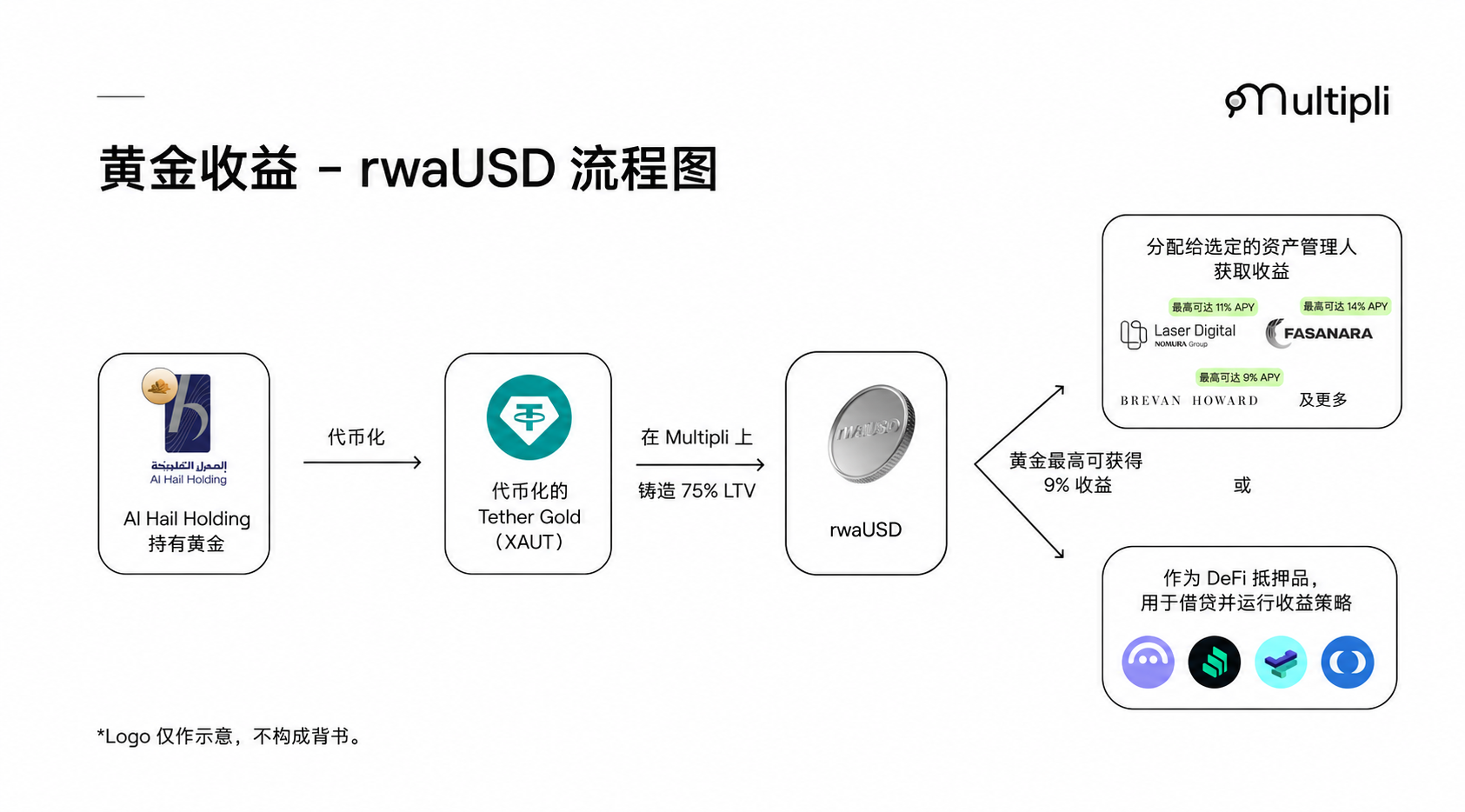
Lifecycle
Step 0: Asset Admission
Assets undergo review before entering the system:
- Token verification
- Issuer due diligence
- Custody review
- Liquidity analysis
- Redemption capability assessment
This is one of Multipli's core values.
Step 1: Deposit Collateral
Users deposit:
- Treasury tokens
- Gold tokens
- Compliant RWAs
into the collateral framework.
Step 2: Mint rwaUSD
The system generates rwaUSD based on risk parameters.
Key metric:
MTV (Mint-to-Value)
Determines the maximum amount of rwaUSD that can be minted.
Step 3: Deploy to DeFi
Once rwaUSD is obtained, it can be directly used for:
- Lending markets
- Liquidity pools
- Yield strategies
- Institutional allocation channels
At this point, otherwise static RWAs begin generating additional capital efficiency.
Step 4: Redemption and Exit
Users burn rwaUSD to receive:
- The original collateral asset
- Or
- An equivalent redemption asset
5. Liquidity Tier Design
Different assets employ different redemption mechanisms.
Highly Liquid Assets
Examples include:
- Short-term Treasuries
- Gold
Characteristics:
- Fast redemption
- Better suited for DeFi needs
Less Liquid Assets
Examples include:
- Assets with redemption windows
- RWAs with lower liquidity
Characteristics:
- Segregated liquidity pools
- No impact on overall system liquidity
Avoiding risk contagion.
Yield Mechanics for rwaUSD
rwaUSD itself is not a yield-bearing asset, but a yield-enabling primitive.
Its function is to:
- Standardize RWA collateral
- Aggregate on-chain liquidity
- Provide a unified yield vehicle for DeFi and institutions
Yield Source 1: Deployment in DeFi Markets
After minting, rwaUSD can enter various DeFi scenarios like a stablecoin:

Yield Source 2: Multipli Delegated Yield Management
For institutions, DAO Treasuries,