






CoreWeave营收翻倍后,AI云的「扩张账」开始显形


- 核心观点:CoreWeave 二季度收入同比增长 112.5% 至 25.75 亿美元,但经营端由盈转亏,资本开支远超经营现金流,且签约电力规模(3.7 吉瓦)显著高于活跃电力(1.5 吉瓦),反映出收入确认、建设投入与资源交付之间存在明显时间差。
- 关键要素:
- 二季度 GAAP 营业结果转为 4,900 万美元亏损,上年同期为 1,900 万美元盈利,收入增长尚未同步转化为营业利润。
- 净利息费用达 6.40 亿美元,同比增加 3.73 亿美元,融资成本上升显著。
- 经营活动净现金流入为 6.79 亿美元,但资本开支高达 64.22 亿美元,约为前者 9.5 倍。
- 融资活动净流入 100.71 亿美元,高于投资活动净流出 71.66 亿美元,外部资本在现金流结构中占主导。
- 收入积压订单约 1,040 亿美元,管理层预计三季度资本开支增至 115 至 135 亿美元,建设支出持续扩大。
- 已签约电力约为活跃电力的 2.5 倍,资源承诺与实际运行状态存在差距,不属于已交付能力。
On August 11, AI cloud service provider CoreWeave released its second-quarter results for the period ending June 30. According to the company's unaudited earnings release filed with the 8-K, quarterly revenue rose to $2.575 billion, up 112.5% year-over-year.
This is a report that could easily be condensed into "strong demand for computing power." The company disclosed on the same day that its revenue backlog stood at approximately $104 billion, with active power capacity at 1.5 gigawatts. But when you put the income statement, cash flow statement, and power resources together, the picture becomes far more complex. Revenue has been recognized, construction capital has been spent, and contracted power capacity exceeds active capacity — these resources exist in different states.
These three things don't happen simultaneously. The time gap between them is the real expansion ledger this earnings report lays bare.
Revenue Doubled — Why Didn't Operations Thicken in Sync?
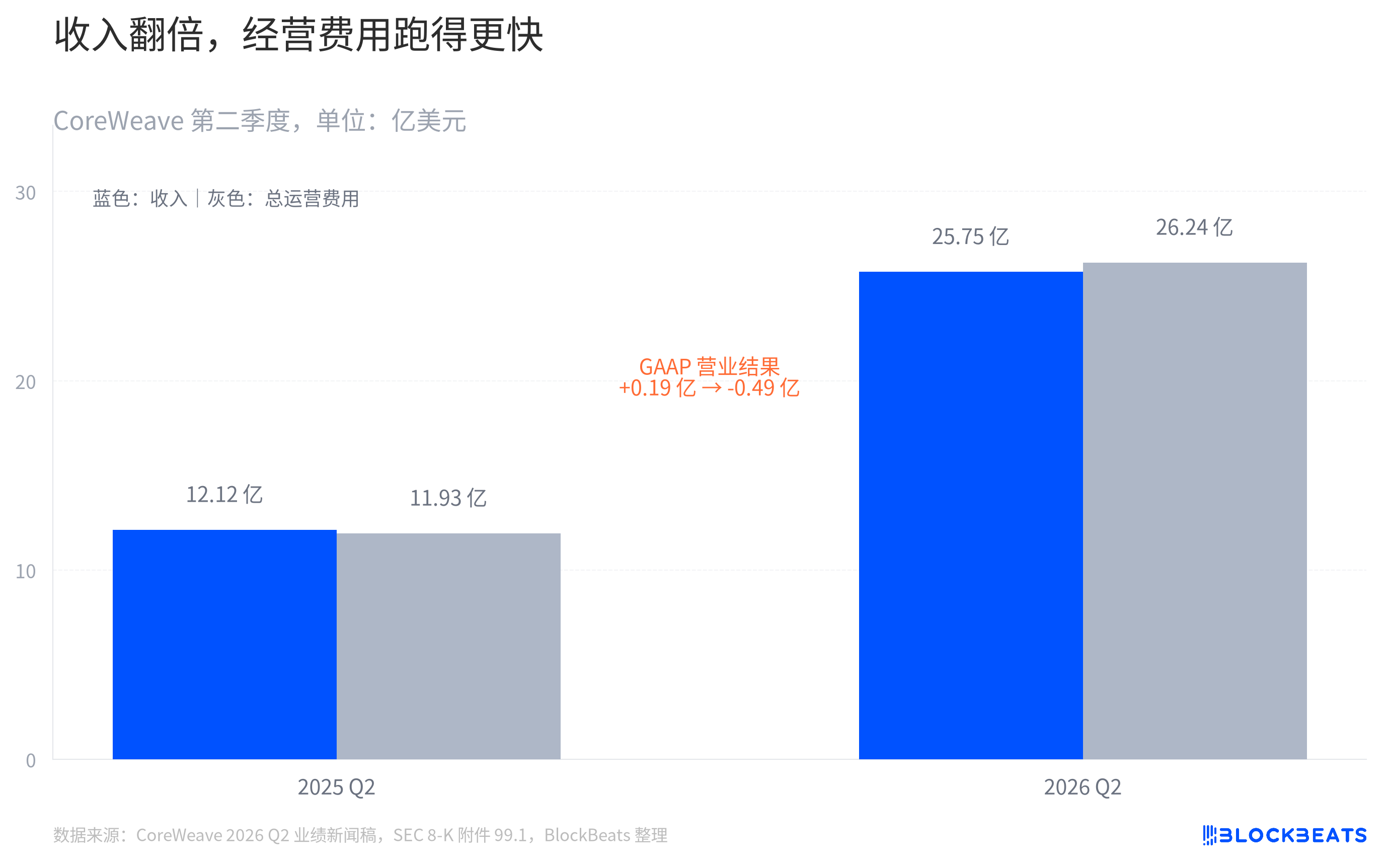
Let's look at the first chart first. CoreWeave's revenue bar did climb sharply, but total operating expenses rose even higher. According to the company's earnings release, GAAP operating results swung from a $19 million profit in the same period last year to a $49 million loss in the quarter.
On a net income basis, CoreWeave recorded losses in both quarters. The chart shows GAAP operating results, which are closer to the core business — revenue growth has not yet translated into operating profit in lockstep.
On the other end of the income statement, interest burden also rose notably. According to the company's earnings release, net interest expense for the second quarter was $640 million, up $373 million year-over-year. That's not the only driver of the widening net loss. Capital investment, financing interest, and revenue recognition from newly added capacity rarely fall neatly on the same timeline.
The company reported adjusted EBITDA of $1.510 billion, representing a 59% margin. This is a non-GAAP metric defined by the company — useful for observing its adjusted operational performance, but it cannot replace the GAAP operating results shown in the chart. Only by viewing both metrics side by side can you avoid misreading "revenue growth" as profits having already caught up with the pace of construction.
Operating Cash Flow Is Positive — But Where Does the Construction Money Come From?
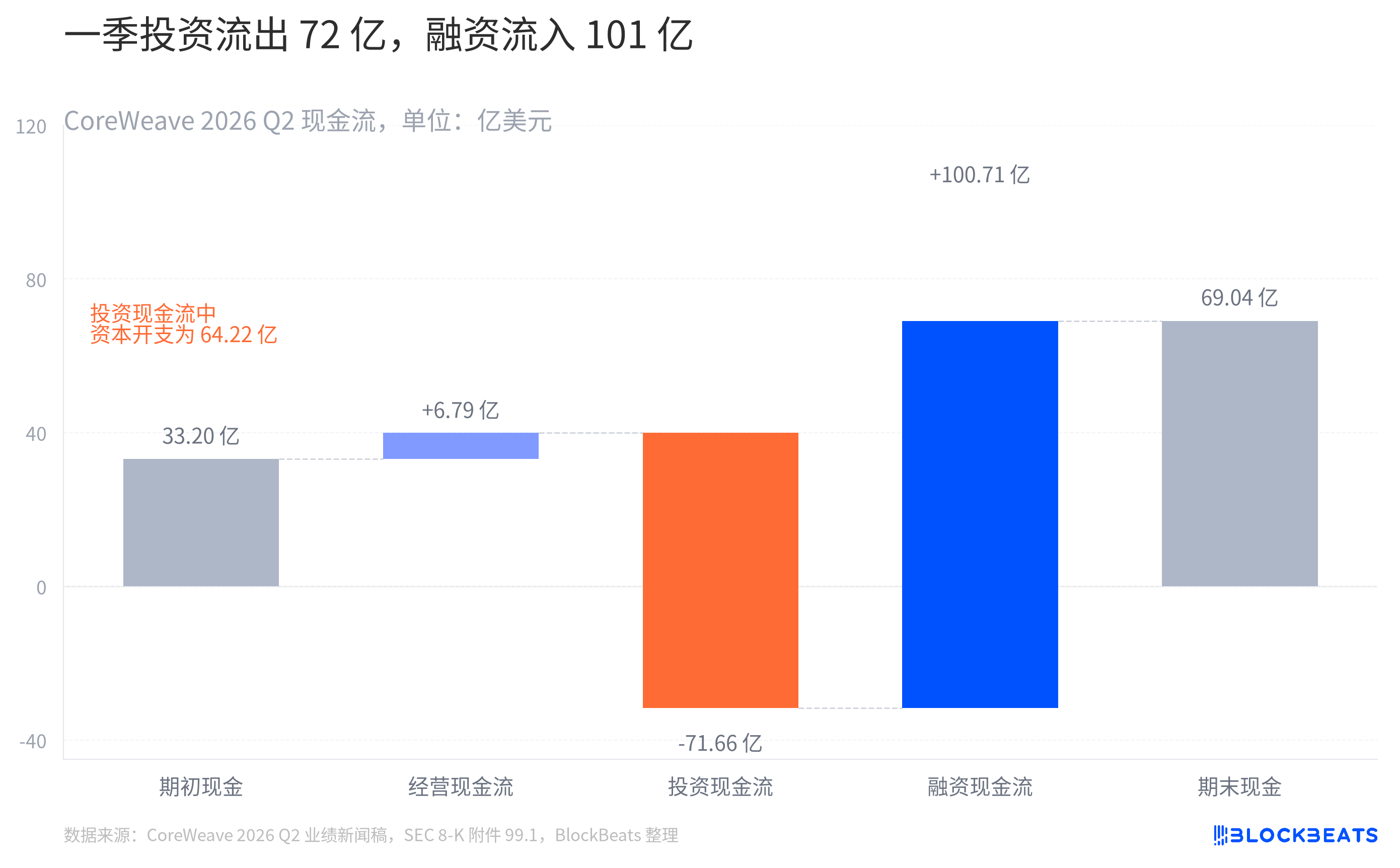
The second chart picks up where the first leaves off. CoreWeave generated net cash inflows of $679 million from operating activities in the second quarter. But cash expenditures for property, equipment, and capitalized internal-use software totaled $6.422 billion — roughly 9.5 times the quarter's operating cash flow.
If you think of an AI cloud as a shopping mall that sells computing power, revenue corresponds to services that have already been settled. Capital expenditures are more like building the mall first, then installing the power supply, cooling, and servers all at once. The former comes back according to customer usage patterns, while the latter tends to be paid out in a concentrated burst at an earlier point in time.
That's why the thickest blue bar in the chart isn't operating cash flow — it's net inflows from financing activities. That figure stood at $10.071 billion, exceeding the quarter's net outflow of $7.166 billion from investing activities. According to the same cash flow statement, financing activities include debt issuance, debt repayment, private common stock issuance, and purchases of capped call hedges tied to convertible notes. It can't simply be translated as "new borrowing," but it's enough to show that external capital continues to bear a larger weight in the quarter's cash flow structure.
CoreWeave's outlook materials also show that management expects third-quarter capital expenditures to range between $11.5 billion and $13.5 billion. That's forward-looking guidance, not cash flow that has already occurred. Its purpose is to signal to readers that the second-quarter chart is not an isolated expenditure — the company still plans substantial construction spending in the next quarter.
A $104 Billion Backlog — Why Should You Still Watch Power Capacity?

As of the end of the second quarter, CoreWeave's active power capacity stood at 1.5 GW, with contracted power at approximately 3.7 GW — roughly 2.5 times the former.
There are at least three different states at play here. Revenue is the amount of services already recognized. What CoreWeave calls revenue backlog includes remaining performance obligations and other amounts the company estimates it will recognize in the future. Contracted power represents committed resources, while active power is the state of resources currently in operation. Collapsing all of them into the single label "demand" would erase the hardest stretch of the journey in between.
The $104 billion figure remains subject to delivery and service availability constraints. According to the company's earnings release, this number excludes over $25 billion in net customer commitments added at the start of the third quarter. It cannot be treated as locked-in quarterly revenue, nor can it be simply converted into a fixed number of revenue years based on current-quarter revenue.
Power follows the same logic. A contracted scale of 3.7 GW doesn't mean all of those resources are ready to be delivered to customers, nor can you extrapolate specific go-live dates or GPU counts from it. The gap between contracted scale and active scale at least signals that resource commitments and current operating status are not the same thing.
In CoreWeave's second quarter, revenue has hit the books, construction spending has been paid out, and a gap remains between contracted and active power capacity.


