BTC’s biggest governance conflict escalates, BIP-110 moves from soft fork to hard fork


- Key takeaway: The BIP-110 proposal failed to activate due to miner support of only 2%. After the mandatory window period, its supporters launched a minority chain soft fork attempt that failed, and now plan to switch the PoW algorithm to pursue a hard fork. However, they face the dual dilemma of low node support and insufficient community consensus, effectively signaling failure.
- Key factors:
- After BIP-110 entered the mandatory window period on August 9, the minority chain mined only 2 blocks, falling more than 200 blocks behind the main chain, and failed because it did not reach the longest-chain consensus.
- Miner voting support across the network was roughly 2%, far below the 55% activation threshold; node support was only 15.07% (17,913 out of 118,850 nodes), and even lower when excluding zombie nodes.
- The only mining pool supporting BIP-110, Ocean, accounts for just 1.6% of total network hashrate. After inheriting the main chain's difficulty of 127.48 trillion, it can produce at most 2-3 blocks per day.
- Luke Dashjr plans to change the PoW algorithm (candidates include RandomX, Scrypt, etc.) and proposed selecting the algorithm through a deterministic random process to prevent miners from pre-mining, but this has not yet been implemented.
- BIP-110 supporters blame the failure on collusion among large mining pools, claiming they executed a "secret hard fork"; opponents Michael Saylor and Adam Back point out that forks without security and consensus backing are meaningless.
Original|Odaily Planet Daily (@OdailyChina)
Author|Golem (@web3_golem)
On August 9, Bitcoin block height reached 961,632, and the BIP-110 proposal officially entered its enforced lock-in window (961,632-963,647). During this phase, nodes running BIP-110 began rejecting blocks that do not comply with the new rules (including those containing non-monetary data transactions), and Bitcoin was effectively soft-forked into two competing chains (the main chain and a minority chain supporting BIP-110).
One day after the soft fork, the BIP-110 chain has only mined two blocks — 961,632 and 961,633 — and now lags more than 200 blocks behind the main chain. According to the longest chain rule of Bitcoin, the BIP-110 chain has not become the longest-chain consensus, and the network will not unify under the new BIP-110 rules. Therefore, it is safe to declare that the BIP-100 soft fork, led by core Bitcoin developer Luke Dashjr, has failed.

Length comparison between the main chain and the minority chain supporting BIP-110
The failure of BIP-110 was expected. Prior to entering the enforced lock-in window, miner support across the network stood at only about 2%, far below the 55% activation threshold. However, BIP-110 supporters led by Luke Dashjr still refuse to accept defeat and are already planning to change the PoW algorithm, which means the BIP-110 chain will no longer use the SHA-256d algorithm, evolving from a Bitcoin soft fork into a Bitcoin hard fork.
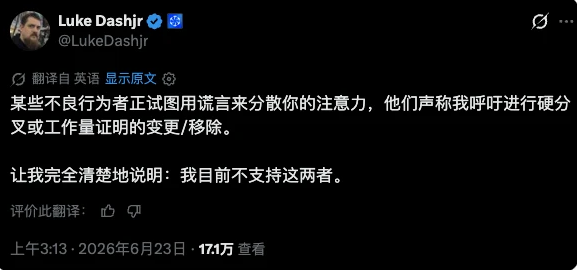
It is worth noting that in June, Luke Dashjr himself stated that he would not conduct a BIP-110 hard fork or make any changes or removals to the proof-of-work mechanism. Yet now, it has come to this. F2Pool co-founder Wang Chun directly criticized, stating: "Luke Dashjr is not only financially bankrupt but also personally bankrupt; attempting to change the PoW algorithm will not end well either."
BIP-110 heads toward a hard fork
In mid-July, Odaily Planet Daily had already published an analysis of the positions on both sides of BIP-110 and outlined three scenario assumptions for what might happen after its activation. (Recommended reading: "With less than 1% support, will BIP-110 still push Bitcoin into a soft fork?")
Reality has entered the third scenario — the worst one. That is, the BIP-110 chain cannot surpass the main chain, and Luke Dashjr is calling on BIP-110 supporters to permanently fork the BIP-110 chain into an independent chain, "manually" adjust the block difficulty, and launch a new network token.
The reason the BIP-110 chain cannot produce blocks is simple: it inherited Bitcoin's main chain mining difficulty of approximately 127.48万亿 (127.48 trillion), yet it only attracts a tiny fraction of Bitcoin's main chain SHA-256d hashrate. The only mining pool supporting BIP-110, Ocean, accounts for just 1.6% of the network's total hashrate, allowing it to produce at most only 2-3 blocks per day — each block mined can only be described as a stroke of incredible luck.
To change this situation, Luke Dashjr and BIP-110 supporters have chosen the solution of "firing the miners" — that is, changing the proof-of-work algorithm of the BIP-110 chain so that main chain miners can no longer work on the BIP-110 chain. The hashrate supporting BIP-110 then becomes the "entire network hashrate," dominating block production on BIP-110, but the block rewards mined are no longer bitcoins worth over $60,000.
In the Discord channel of Bitcoin Knots (a Bitcoin full-node software version created by Luke Dashjr), Luke Dashjr and BIP-110 supporters have been focusing on discussing what proof-of-work mechanisms could keep the BIP-110 chain running smoothly without relying on current Bitcoin miners. Participants have discussed specific cryptographic algorithms such as RandomX, KT256, BLAKE3, various variants of BLAKE2, Scrypt, Autolykos v2, and CPU and GPU mining.
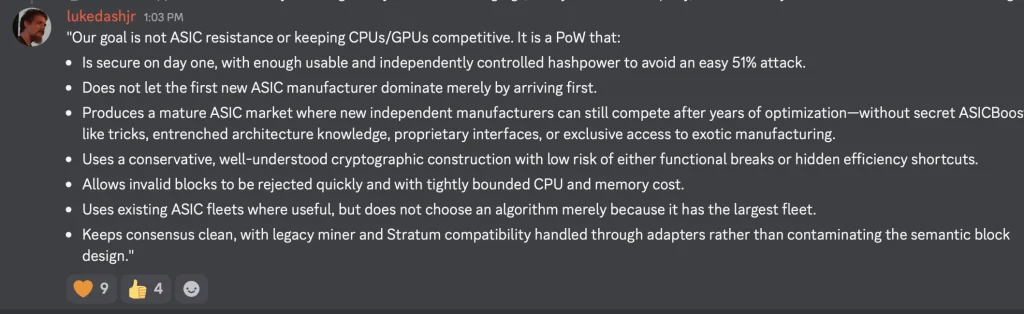
Luke Dashjr discussing the BIP-110 algorithm change on the Bitcoin Knots Discord server. Source: BitcoinNews
Ultimately, Luke Dashjr proposed selecting the final algorithm from these candidates through a deterministic random process, arguing that "this way, no one will know in advance before everyone knows," reducing the risk of some miners preparing BIP-110 chain-specific mining equipment ahead of others.
As of press time, the BIP-110 chain has not yet enabled or approved any PoW change, and Luke Dashjr has not yet announced the selected algorithm or the activation block height. Relevant experimental code has been ported to the recent Bitcoin Knots codebase. In short, the BIP-110 chain hard fork has not yet truly materialized, but the probability of it happening has never been higher.
Who actually caused the centralization problem?
Meanwhile, the conflict between BIP-110 supporters and opponents continues to escalate.
Dathon Ohm, author of the BIP-110 proposal, believes that BIP-110 was "forced" into a hard fork by a coalition of large mining pools. In a post on X, he stated: "Large mining pools have colluded and executed a secret hard fork on Bitcoin's node network, turning Bitcoin from a monetary network into a toxic data dumping ground." In other words, it is not BIP-110 that is truly conducting a hard fork, but rather the large mining pools that are going against the community's will. The community is developing a new proof-of-work mechanism to escape their centralized control.
Luke Dashjr, on the other hand, is even more intense in his rhetoric. He still believes that BIP-110 has community support and views the actions of large mining pools that do not support BIP-110 (such as Antpool and F2Pool) in seizing block production rights as an attack by a tiny group of malicious actors. Therefore, changing the PoW mechanism is precisely to eliminate their centralization threat.
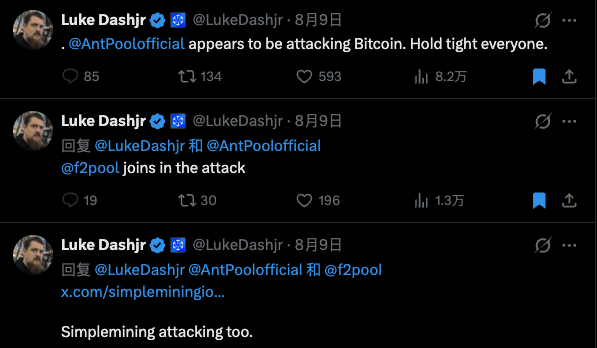
Antpool and F2Pool competing with BIP-110 miners for the right to produce block 961,632, viewed by Luke Dashjr as an attack on the Bitcoin network
Currently, the narrative of BIP-110 supporters is that nodes and the community — not miners and hashrate — determine Bitcoin network governance. They subjectively believe that the main chain operated by large mining pools through "hashrate superiority" is no longer the true Bitcoin chain, and that what they mine is merely "Core altcoin." The true Bitcoin chain is the new BIP-110 chain.
But the biggest flaw in the BIP-110 narrative is that, setting aside the mining community, the so-called nodes and community supporting BIP-110 are also a niche group within the broader Bitcoin community. The actual level of community support is hard to measure, but node support is unmistakable: of the 118,850 Bitcoin nodes across the network, only 17,913 are willing to run BIP-110, accounting for 15.07% of the network. If "zombie nodes" are excluded, that support rate would be even lower.
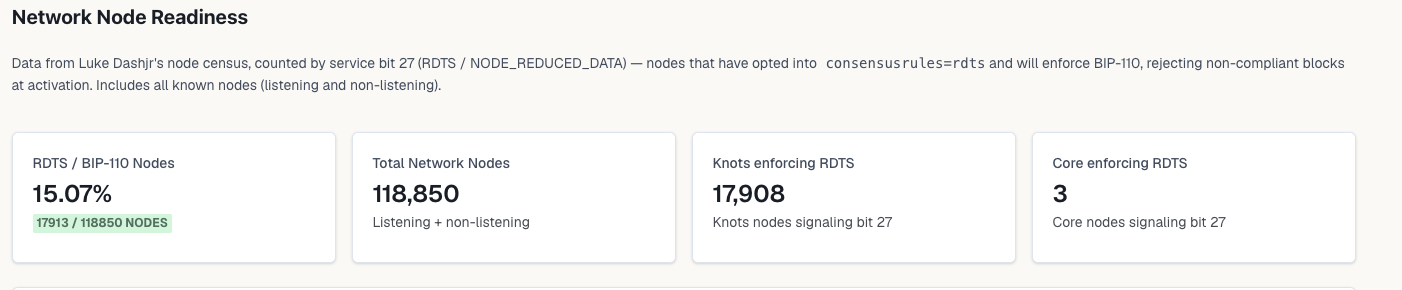
BIP-110 node support rate
Such data makes it difficult to argue that the majority of Bitcoin nodes and the community support BIP-110, with only large mining pools opposing it. At the end of the day, Luke Dashjr and BIP-110 supporters have simply been deceiving themselves. When protesting the so-called "centralized tyranny" of large mining pools, perhaps they should look in the mirror and ask whether they are imposing their own Bitcoin maximalist will on everyone else. Isn't that itself a form of governance centralization?
Michael Saylor, founder of Strategy and a BIP-110 opponent, believes the failure of BIP-110 was inevitable. He stated that BIP-110 can fork freely, but other network participants can also choose not to follow. With BIP-110's current hashrate at only 0.15% of Bitcoin's main chain, "anyone can fork Bitcoin, but without security, utility, capital, and users, a fork is meaningless. Consensus is achieved through effort, not through declarations."
Cypherpunk pioneer Adam Back also criticized BIP-110 supporters' "persecution complex" regarding large mining pools. He pointed out that the belief among BIP-110 supporters that "Bitcoin whales," governments, or miner groups are conspiring against Bitcoin and causing it harm is wrong, and that thinking nodes control Bitcoin protocol changes while miners will simply submit is even more off-base. "BIP-110 has not achieved consensus, so economic nodes and the market have ignored it, and therefore miners have not mined it."
No one can control Bitcoin. Consensus comes from the network, and the network has already made its choice.