






波场TRON Industry Weekly: This Week's Non-Farm Payrolls May Test BTC's $62,000 Support, Analyzing Morpho, the Protocol Building an On-Chain Fixed-Rate Credit Market


- Key Takeaways: The crypto market traded weakly amid volatility this week, influenced by expectations of Fed policy, with BTC fluctuating in the $62,000-$65,000 range. Industry hotspots focused on infrastructure tracks such as the AI Agent economy, RWA, and PayFi, with the ACK protocol and the Morpho Midnight lending protocol emerging as the week's key potential projects.
- Key Elements:
- On the macro front, the Fed held interest rates steady in July, with market attention shifting to the impact of non-farm payroll data on the pace of rate cuts; US Q2 GDP growth slowed to 1.5%, but consumption and AI investment remain resilient.
- The crypto market remained broadly weak and volatile. After hitting a weekly high of $64,777, BTC fell back to $62,820, while ETH traded weakly in the $1,800-$1,900 range; if BTC breaks below the $62,000 support level, it may test the $60,000 mark.
- Regarding trending sectors, RWA and institutionalized finance remain core directions, with market focus shifting from asset tokenization to the "RWA + DeFi yield layer" combination model; the AI + Crypto direction is moving from the Agent concept towards payment, data assets, and automated financial execution infrastructure.
- The ACK project secured $18 million in funding led by A16z. Through its three core modules—ACK-ID (identity), ACK-Pay (payment), and ACK Receipt (receipts)—it builds a unified protocol layer for AI Agent commercial activities, addressing the standardization issues of Agent identity verification, payments, and transaction receipts.
- Morpho Midnight secured $244 million in funding. Utilizing a fixed-rate, fixed-maturity model with a Credit/Debt Unit framework, it achieves cross-market liquidity sharing without locking up capital through a quote-driven mechanism, enhancing capital efficiency. However, its overall design complexity is high and relies on market makers and professional liquidity providers.
- On the regulatory front, uncertainty persists around the advancement of the CLARITY Act in the US Senate, with stablecoin regulation remaining a key policy focus; the EU's MiCA has entered its post-implementation adjustment phase, but no significant new regulatory policies were introduced this week.
I. Outlook
1. Macro-Level Summary and Future Predictions
This week, global macro markets were primarily focused on the Federal Reserve's monetary policy path, inflation trends, and economic growth expectations. The Fed held interest rates steady at its July FOMC meeting, with policymakers continuing to seek a balance between "controlling inflation" and "avoiding an excessive economic slowdown." Market attention has shifted to how future economic data will impact the pace of rate cuts, with U.S. employment, inflation, and consumer spending becoming the core indicators for determining the direction of monetary policy. Meanwhile, economic performance across major global economies showed divergence, with Europe's recovery still facing growth pressures while some emerging markets continued to stimulate their economies through rate cuts and easing measures. Overall, the market remained in a policy waiting period under a high-interest-rate environment this week, with the U.S. dollar, Treasury yields, and global risk assets fluctuating in response to shifting macro expectations.
In the coming week, markets will focus on U.S. nonfarm payrolls, unemployment rate, manufacturing and services data, as well as subsequent inflation-related indicators. These data points will further influence market expectations regarding the Fed's future rate policy. If the labor market continues to cool and inflationary pressures ease further, markets may raise expectations for future monetary easing; however, if economic data proves strong or inflation rebounds, the Fed's restrictive rate policy could persist for longer. Additionally, global trade policies, geopolitical risks, and fiscal policy changes in major economies will remain important factors influencing market sentiment. The macro market next week is expected to continue revolving around the tug-of-war between "economic resilience and expectations of policy pivots."
2. Crypto Industry Market Movements and Alerts
The crypto market maintained a weak consolidation trend this week, with macro factors and Fed policy expectations remaining the primary influences. BTC opened around $63,674 near July 27, briefly rebounded to $64,777 (July 30) during the week, then retreated to approximately $62,820 by July 31, oscillating within the $62,000–$65,000 range and continuing to face pressure below its earlier highs. The market was primarily affected by ETF fund flows, rate expectations, and declining risk appetite, with investors remaining cautious following the FOMC meeting. ETH underperformed BTC, with prices persistently trading in the $1,800–$1,900 range, as capital reduced risk exposure to assets beyond the major ones. Altcoins generally followed the broader market correction. High-market-cap public chains and infrastructure assets such as SOL, AVAX, and LINK maintained relatively stronger liquidity, but popular sectors like AI, DePIN, and RWA showed notable divergence, with some previously high-flying tokens experiencing profit-taking. Market capital further concentrated toward BTC, stablecoin yields, and institutional-grade assets.
In the coming week, markets will focus on Fed policy signals, U.S. dollar movements, and changes in institutional fund flows. If BTC can reclaim the $64,000–$65,000 range with accompanying ETF inflows, the market could rebound toward $66,000–$68,000; however, a break below the $62,000 support could lead to a test of the $60,000 level. For ETH, the key short-term support sits at $1,800. If capital returns and price breaks through $1,900–$2,000, it could drive a recovery in Layer 2, DeFi, and staking ecosystems; otherwise, weak consolidation may persist. Regarding altcoins, structural market conditions are expected to continue in the short term. Sectors with genuine application narratives, such as AI Agents, RWA, PayFi, and stablecoin infrastructure, may continue to attract capital attention, while small-cap tokens lacking fundamental support will continue to face liquidity pressure.
3. Industry and Sector Hotspots
This week's crypto industry hotspots centered around PayFi, RWA, AI infrastructure, DeFi risk management, and institutional-grade financial infrastructure, with capital continuing to concentrate toward infrastructure projects with genuine commercial implementation capabilities.
RWA and institutionalized finance remain core sectors. Ecosystems such as Securitize, Gauntlet, and Morpho continue to advance the on-chainization of traditional assets and yield strategy optimization. Market focus is shifting from simple asset tokenization toward the combined model of "RWA + DeFi yield layer." The AI + Crypto trend continues to heat up, with emphasis moving from AI Agent concepts to AI Agent payments, data assets, and automated financial execution infrastructure, driving the development of an on-chain intelligent economy.
On the DeFi infrastructure front, risk management, yield optimization, and on-chain asset management are becoming key entry points for institutional capital. Projects such as Gauntlet provide institutional-grade management capabilities for lending protocols and yield vaults through quantitative models, automated strategies, and risk control systems. Meanwhile, the PayFi sector continues to develop around stablecoin payments, cross-border settlement, and AI Agent automated payments, emerging as a vital bridge connecting the crypto market with real-world commerce.
II. Market Hot Sectors and Promising Projects of the Week
1. Overview of Promising Projects
1.1. Analysis of ACK (Agent Commerce Kit), Which Raised $18 Million in Total Funding, Led by Renowned Crypto VC A16z with Participation from Circle and Breyer Capital — Building the Identity and Payment Standard Layer for the AI Agent Economy
Introduction
ACK (Agent Commerce Kit) aims to establish a unified infrastructure for interactions between AI Agents and financial systems through open standard protocols and a universal architecture, addressing the identity, payment, and regulatory challenges AI Agents face when participating in digital commerce.
Its core consists of three main modules:
1. Verifiable Agent Identity
- Utilizing open identity standards and cryptographic mechanisms to bind AI Agents to their underlying individual or institutional owners.
- Ensuring agent behavior possesses traceability, accountability attribution, and trusted identity authentication capabilities.
2. Agent-Native Payments
- Enabling AI Agents to autonomously initiate and execute payments across different payment networks and financial systems.
- Providing verifiable payment proofs through standardized Digital Receipts, making payment outcomes auditable and verifiable.
3. Integrated Oversight
- Introducing human-in-the-loop mechanisms where necessary.
- Supporting compliance reviews, risk control, customer support, and escalation handling for anomalous situations, ensuring agent commercial activities comply with regulatory requirements.
Protocol Mechanism Overview
ACK is an open architecture framework for AI Agent commercial activities, achieving secure, verifiable, and compliant interactions between AI Agents and financial systems through Identity Verification (ACK-ID) + Payment Protocol (ACK-Pay) + Human Oversight mechanisms.
Core Roles
ACK defines six categories of core participants:
Client Agent
AI Agent that initiates service requests or payments
Server Agent
Service provider that verifies identities and receipts
Identity Provider
Provides DID/VC identity authentication services
Payment Service
Responsible for payment execution, compliance checks, and fund settlement
Receipt Service
Issues and verifies verifiable payment receipts (ACK Receipt)
Settlement Network
The underlying network that actually completes fund transfers (banks, card networks, blockchains, etc.)
These roles can be fulfilled by independent systems or combined within a single entity.
Two Core Interaction Models
1. Server-Initiated
Suitable for:
- API paid calls
- MCP service calls
- AI Agent purchasing resources
Flow:
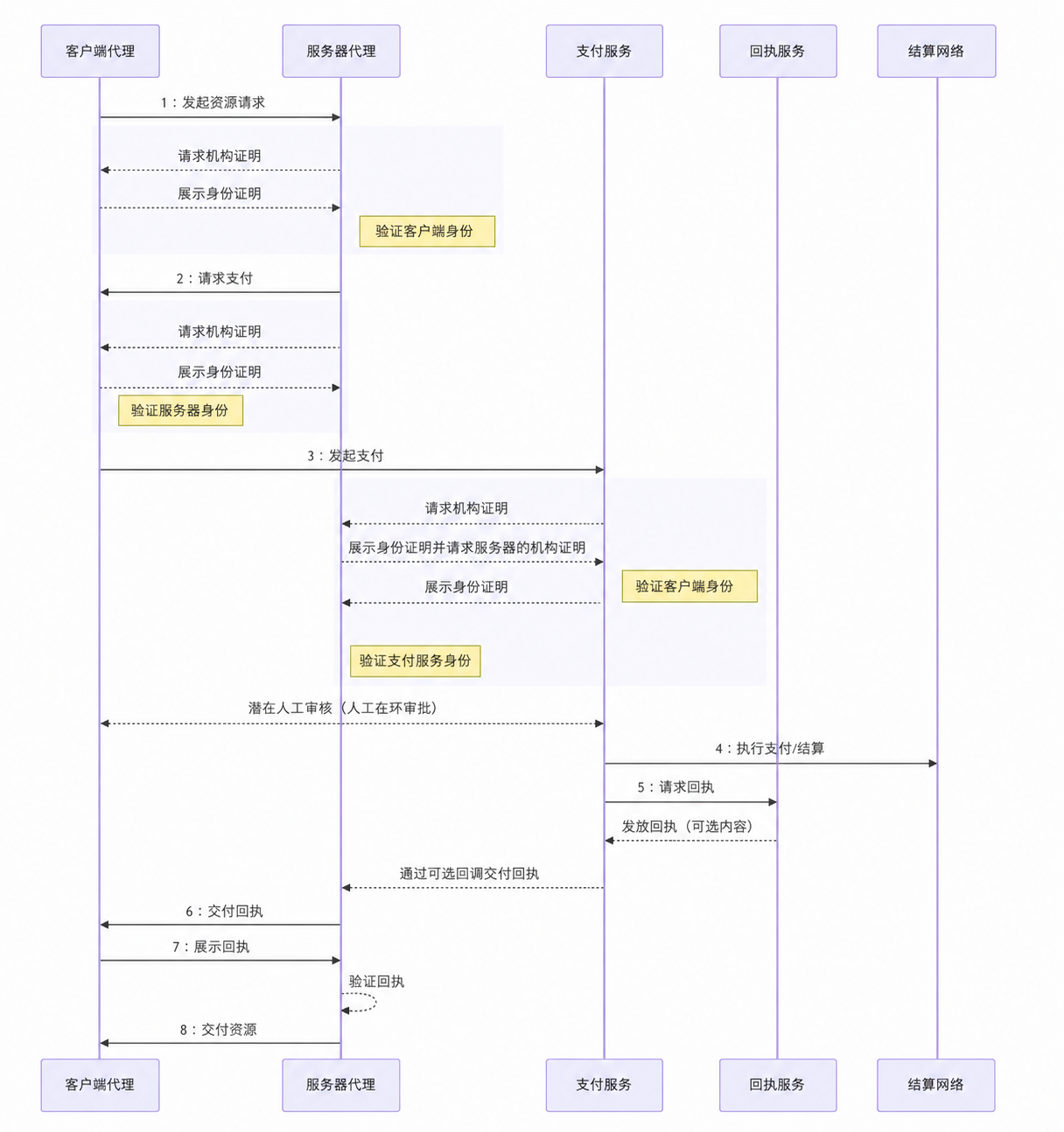
Core logic:
Payment first → Service delivery afterward
2. Client-Initiated
Suitable for:
- Bill payments
- E-commerce settlements
- Known payment obligations
Flow:
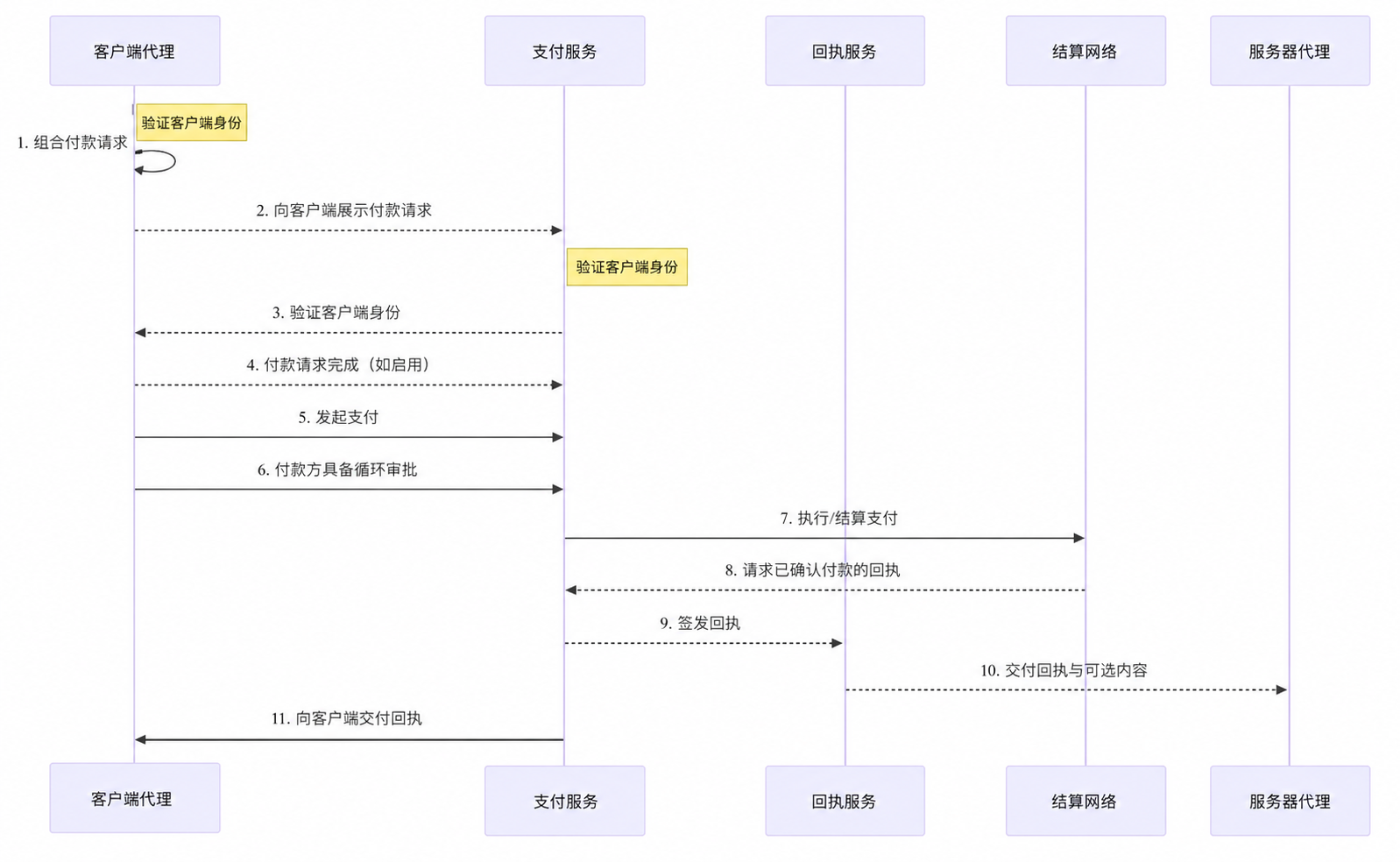
Core logic:
Payment need arises first → Then payment is completed
ACK Receipt
ACK introduces a unified standard for digital receipts.
Features:
- Based on Verifiable Credentials (VC)
- Cryptographically verifiable
- Auditable
- Tamper-proof
Functionally equivalent to:
A standardized electronic invoice and payment proof in the AI Agent world.
After payment completion:
Payment Service → Receipt Service → ACK Receipt
Served as the final proof of payment.
Human-in-the-Loop
ACK does not fully delegate autonomous operation to Agents.
It reserves oversight interfaces for human-machine collaboration:
Operational Oversight
Examples:
- Large payment reviews
- Suspicious transaction examinations
- Risk control
User Authorization
Examples:
- When exceeding payment limits
- During sensitive operations
Requires manual user confirmation.
Implementation Flexibility
ACK does not mandate a specific technology stack.
Organizations are free to choose:
- Bank payment systems
- Credit card networks
- Stablecoin payments
- Blockchain networks
Only required to adhere to:
- ACK-ID identity standards
- ACK-Pay payment standards
- ACK Receipt receipt standards
This enables interoperability.
ACK is essentially building a unified commercial protocol layer for the AI Agent economy:
ACK-ID (Identity)
+
ACK-Pay (Payments)
+
ACK Receipt (Proofs)
+
Human Oversight (Oversight)
↓
AI Agent Commerce
It aims to solve the three most critical problems in the large-scale commercialization of AI Agents:
- How does an Agent prove its identity?
- How does an Agent complete payments?
- How does an Agent prove it has paid?
This enables AI Agents to participate safely and credibly in digital commerce, just like businesses or individuals.
Tron's Analysis
ACK's strength lies in its approach of not building a separate payment network or identity system but rather attempting to establish a universal commercial standard for the AI Agent economy. Through ACK-ID (identity authentication), ACK-Pay (payment protocol), and ACK Receipt (verifiable receipts), it achieves standardization and interoperability of agent identity, payments, and transaction proofs, allowing different agents, businesses, payment institutions, and financial systems to collaborate within a unified framework. It also retains the Human-in-the-Loop mechanism, balancing automation with compliance, demonstrating strong openness and industry adaptability.
Its weakness is that ACK itself is more of a protocol framework and standard layer rather than a direct provider of liquidity, payment networks, or user acquisition channels. Its value is highly dependent on widespread adoption by ecosystem participants such as payment service providers, identity providers, and AI Agent platforms. Furthermore, cross-institutional identity authentication, payment settlement, and regulatory coordination inherently involve complex legal and compliance requirements. Inconsistent regulatory standards across different regions may also impact the speed of its global implementation.
2. Key Project Analysis for the Week
2.1. Detailed Analysis of Morpho Midnight, Which Raised $244 Million in Total Funding, Led by Prominent VCs Including Paradigm, A16z, and Ribbit Capital, with Participation from Coinbase, Pantera, and HashKey — Building the Underlying Infrastructure for On-Chain Fixed-Rate Credit Markets
Introduction
Morpho Midnight is a non-custodial fixed-rate lending protocol deployed on the EVM (Ethereum Virtual Machine).
The protocol is built around isolated markets, each characterized by:
- Immutability
- Permissionless creation
- Fixed maturity
Its lending mechanism operates through the trading of Credit Units and Debt Units. The yield structure of these units resembles zero-coupon instruments and settles upon market maturity.
Participants transact by publishing or accepting offers. Unlike traditional lending protocols:
- No capital lock-up is required when quoting
- Liquidity is only actually called upon at final settlement
Consequently, makers can provide quotes across multiple markets simultaneously without pre-committing significant capital, significantly enhancing capital efficiency.
Regarding market structure, Morpho Midnight supports:
- Single-collateral markets
- Multi-collateral markets
Additionally, the protocol supports access permission management through Gates (access control mechanisms), catering to compliance or participation restriction needs of specific markets.
Core System Architecture Analysis
1. Introduction (Project Positioning and Design Philosophy)
Core Content
Midnight is a fixed-rate lending protocol launched by Morpho, designed to address the issues of interest rate volatility, liquidity fragmentation, and capital inefficiency faced by traditional pooled lending protocols (such as Aave and Compound).
Its core design features include:
- Fixed-rate lending
- Fixed maturity
- Isolated markets
- Permissionless market creation
- Non-custodial architecture
Unlike traditional liquidity pools, Midnight delegates risk management, market selection, and asset allocation to market participants rather than the protocol itself.
2. Fixed-Maturity Lending Markets
Markets (Market Mechanism)
Once created, each market permanently fixes:
- Loan token (asset lent)
- Maturity date
- Collateral asset types
- Risk parameters
These are immutable.
Credit Unit & Debt Unit
Midnight does not record traditional lending positions; instead, it trades two standardized units:
Credit Unit
- Represents the right to receive future payments
- Belongs to the lender
Debt Unit





