






This cycle's "greatest myth" comes to an end: In just a few weeks, the "AI stock guru" was defeated, with Citadel stepping in to acquire all positions


- Core Thesis: Aschenbrenner, the 24-year-old founder, ran an 8-person fund, SA, which heavily weighted AI infrastructure with 4x leverage, delivering a 439% return in six months and reaching a peak AUM of $45 billion. The July pullback in the AI sector triggered losses on both long and short positions and margin calls from banks. The fund was forced to sell roughly $16 billion in public holdings to Citadel at a significant discount within 36 hours, exposing the core problem of being right on direction but fragile in position structure.
- Key Elements:
- SA Fund's Investment Logic: Heavily weighted AI compute and infrastructure stocks (e.g., SK Hynix, Nebius, CoreWeave), shorted traditional software stocks, and used Total Return Swaps (TRS) to amplify returns with roughly 4x leverage.
- Performance: Net return of 439% as of the end of June 2026, with cumulative returns exceeding 2,000% since inception. AUM ballooned from under $1 billion to a peak of approximately $45 billion.
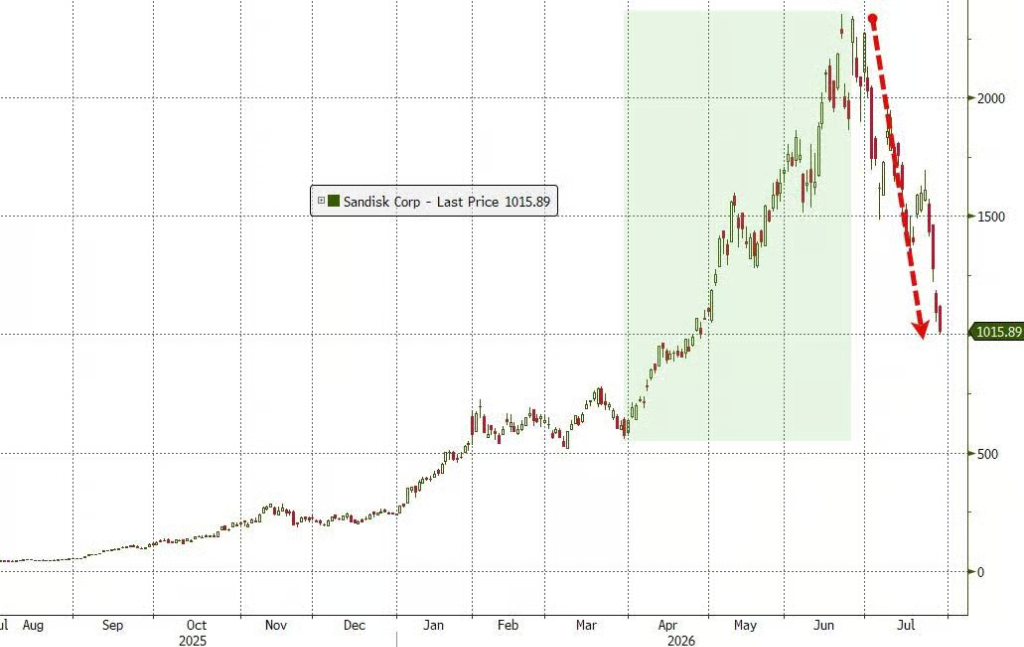
- Trigger for Collapse: The sharp decline in AI stocks in July, with Nebius down about 48% from highs and SanDisk down over 56%, coupled with losses on short positions due to rising software stocks. Losses on both sides of the book, amplified by leverage, triggered margin calls from banks.
- Emergency Resolution: Late on July 29, SA urgently sought to sell over $10 billion in stock. On the morning of July 30, Citadel acquired all roughly $16 billion in public holdings at a significant discount, marking one of the largest emergency trades in Wall Street history.
- Residual Assets: Post-trade AUM fell to around $10 billion. SA retained approximately $10 billion in private positions, including about $5 billion in Anthropic equity. The fund will transition into a private investment firm.
- Core Lesson: Aschenbrenner's long-term thesis on AI has not been disproven, but the highly concentrated positions, 4x leverage, and a dual long/short strategy left no buffer when the market turned, ultimately leading to the blow-up of the public book.
Original Author: Long Yue
Original Source: Wall Street CN
A 24-year-old young man raised $45 billion on Wall Street with a long essay predicting AI would change the world, and made a 439% profit in the first half of this year. However, during the recent month-long AI sector selloff, he lost all the myth he had built over two years in one fell swoop.
On July 30, a piece of news circulated on Wall Street:
A hedge fund with only 8 employees, within the past 36 hours, sold its entire public market portfolio—approximately $16 billion in stocks—in a single trade to a counterparty.
The buyer was Citadel, one of the world's largest hedge funds, founded by Ken Griffin, with $71 billion in assets under management.
The fund forced to sell at a loss is called Situational Awareness (SA for short), founded by Leopold Aschenbrenner.

It's worth noting that Aschenbrenner's fiancée, Avital Balwit, is the chief of staff to Anthropic CEO Dario Amodei. This AI crash and his forced liquidation happened to occur on the eve of their wedding.
And just a few weeks ago, he was the most sought-after name on Wall Street and in Silicon Valley.
Silicon Valley's "AI Prophet"
Leopold Aschenbrenner, a German national, is 24 years old.
He entered Columbia University at 15 and graduated first in his class at 19. After graduation, he joined OpenAI's "Superalignment" team, dedicated to ensuring superintelligence aligns with human values. In 2024, OpenAI fired him for "improperly leaking internal information." He denies this, claiming he merely sent a largely non-confidential planning document to external researchers for feedback, and that the real trigger was an internal memo he wrote criticizing OpenAI's safety measures.
After being fired, he did something many didn't expect—he wrote a 165-page essay titled "Situational Awareness."
The core thesis of the article is: AI is developing far faster than the outside world imagines. By 2027, AI will be able to conduct AI research autonomously, and humanity will face true superintelligence. And all of this requires an explosive expansion of chips, memory, data centers, and power infrastructure.
The article caused a sensation in Silicon Valley. Some called it "the most important article in a decade." Podcast host Tim Ferriss dubbed him "the Nostradamus of AI" (akin to a prophet or seer).
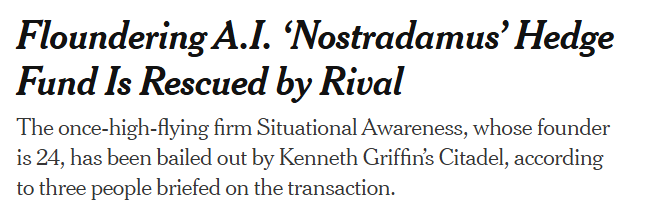

In 2024, he founded the eponymous fund SA with approximately $225 million in seed capital. Investors included Stripe co-founders Patrick and John Collison, former GitHub CEO Nat Friedman, and institutions like Jane Street.
With no prior experience in the industry, he directly managed billions of dollars. The fund's size rapidly expanded from there, peaking at nearly $45 billion in early July 2026.
The entire fund has only 8 employees, 4 of whom are investment professionals.
"AI Stock Guru" Goes All-In on AI with 4x Leverage, Making 439% in Six Months
SA's investment thesis is very straightforward: since AI requires massive computing power and infrastructure, go heavy on the companies providing that computing power and infrastructure.
Long positions: SK Hynix (Korean semiconductor/memory), Nebius (AI cloud platform), SanDisk (storage chips), Micron (memory chips), CoreWeave (AI cloud computing), Bloom Energy (energy).
Short positions: Shorting traditional software companies like Adobe—the logic being that AI will disrupt them.
Meanwhile, the fund amplified returns by borrowing money from banks (i.e., leverage), with a leverage ratio of approximately 4x.
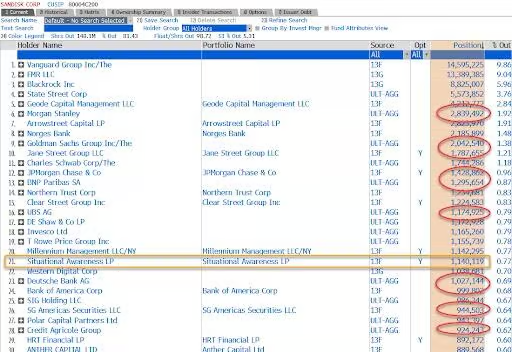
This structure has a specific characteristic: the banks hold the physical stocks, and SA synthetically obtains economic exposure and leverage through "Total Return Swaps" (TRS). The benefit is multiplied returns; the downside is that if stock prices fall, the banks will demand additional margin (margin calls).
From 2025 to the first half of 2026, this strategy produced stunning results.
As of the end of June 2026, SA's net return rate reached 439%. According to reports, the fund's cumulative return since inception exceeds 2000%. The fund started with less than $1 billion and swelled to approximately $45 billion at its peak in early July.
Some early investors saw returns as high as 200% this year.
Getting Hit on Both Sides Within a Month
However, the good times didn't last. In July, AI stocks began to fall.
The market began to question: Can the high valuations of AI infrastructure be sustained? Significant capital flowed out of AI hardware stocks.
SA's long positions bore the brunt of it:
- Nebius fell approximately 48% from its June high, erasing about $35 billion in market value
- SanDisk dropped over 56% in just over a month
- CoreWeave, Micron, and SK Hynix all fell over 35% this month
At the same time, the software stocks SA was shorting (like Adobe) rallied in the opposite direction, meaning the short positions were also losing money.
Both the long and short legs were losing money simultaneously, and the 4x leverage amplified the losses. Banks began issuing margin call notices.
This is what Wall Street calls a "margin call": you borrowed money to buy stocks, the stocks fell, and the bank demands you deposit more collateral or face forced liquidation. It's the same logic as margin financing blowups in the A-share market.
SA's prime brokers include Bank of America, Goldman Sachs, and JPMorgan. All three intervened simultaneously to assist the fund in meeting margin calls or reducing positions in an orderly manner.
Interestingly, on July 24, Aschenbrenner was still writing to investors: "Sometimes we'll specifically point out that now is a good time to add to positions—if you've been waiting." The letter ended with a postscript inviting investors to commit additional capital on August 1.
36 Hours, an Overnight Auction
The crisis escalated rapidly within 36 hours.
Late on July 29, SA sent urgent appeals to multiple potential buyers, seeking to sell over $10 billion in stocks to stabilize the situation. The news was widely reported by media outlets including the Financial Times and Bloomberg.
Bidders included: Millennium Management (a top global multi-strategy hedge fund) and Jane Street (one of SA's investors).
Millennium made a bid but considered the positions too risky and was unwilling to pay a high price.
Ultimately, Citadel emerged victorious.
On the morning of July 30, the deal was completed. Citadel acquired SA's entire public stock portfolio of approximately $16 billion—including both long and short positions—at a significant discount. It was one of the largest emergency stock transactions in Wall Street history.
After the news of the completed transaction broke, the Nasdaq 100 index surged over 3% that day—the market breathed a sigh of relief: SA no longer needed to dump stocks into the market.
This isn't the first time Citadel has done something like this. Historically, it has bought distressed assets at low prices during crises, including companies like Enron. In Ken Griffin's own words, one of the reasons for Citadel's sustained success is: "Experience. It's wisdom earned through losses and pain. My leadership team and I have been through many of the market's toughest moments together and learned many painful lessons. But it makes us more effective investors during periods of turbulence and crisis."
Citadel was founded in 1990. SA was founded in 2024.
What's Left
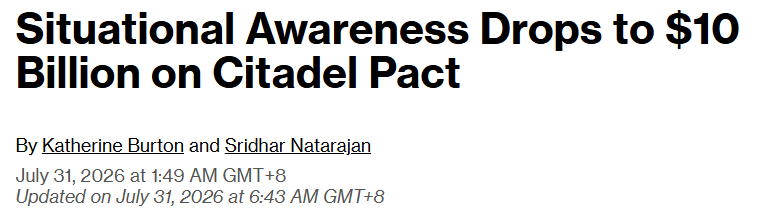
After the transaction, SA's assets under management plummeted from a peak of $45 billion to approximately $10 billion, a decline of more than half.
But Aschenbrenner hasn't been completely wiped out.
SA retains all of its private positions, approximately $10 billion, the most significant of which is its equity stake in Anthropic, valued at around $5 billion. SA will continue operating as a private investment firm.
Whether these private assets can be realized depends on the valuations of companies like Anthropic when they eventually go public.
That's an open question.
On a side note: Aschenbrenner's fiancée, Avital Balwit, is the chief of staff to Anthropic CEO Dario Amodei. There had been rumors that SA was looking to sell its Anthropic stake, but an SA spokesperson denied this.
Where He Went Wrong
The most thought-provoking question from this incident is: Was Aschenbrenner's judgment on AI wrong?
Not necessarily.
The long-term demand logic for AI infrastructure is still endorsed by many institutions.
The problem was in the position structure.
Someone on X quoted Ken Griffin's earlier description of why fund managers fail: "Your portfolio is highly concentrated, with massive positions, yet you cannot clearly articulate what competitive advantage you hold in those positions."
SA's problem was exactly that: heavily concentrated in a single theme (AI infrastructure), with 4x leverage, betting on both sides of the same narrative with long and short positions. Once the market turned, there was no buffer whatsoever.
This structure can generate 439% returns on the way up, but on the way down it can just as easily blow up the entire public portfolio in a matter of weeks.
As someone summarized: "His judgment on AI wasn't wrong. He was wrong in how he built his positions."
The Other Side of the Myth
Aschenbrenner's story is one of the most extreme examples of this AI bull run.
One essay, one narrative, eight people, $45 billion, a 439% return—and then, within a month, brought down by margin call phone calls.
This is not the end of AI, nor is it the end of Aschenbrenner.
But it clearly illustrates one thing: Being right about the direction doesn't mean you'll survive long enough to see it play out.


