






Platform token surges 15x in half a month, Pons claims dual crown on Robinhood Chain for token issuance and trading volume


- Core Takeaways: Pons has surpassed NOXA and Flap to become the leading token issuance platform on Robinhood Chain, dominating both issuance volume and trading volume through streamlined issuance processes and tokenomic incentives, with plans to expand into the RWA sector.
- Key Elements:
- On July 15, Pons issued over 15,000 tokens in a single day, ranking first on Robinhood Chain, and has maintained the top position since; on July 26, it contributed 77.1% of the platform's total trading volume, with cumulative trading volume exceeding $1.5 billion.
- Platform mechanics simplified: fixed token supply of 1 billion, creation cost of 0.0005 ETH, 1% trading fee, contract and Uniswap V3 pool deployed in the same transaction, liquidity locked immediately, with no bonding curve or migration phase.
- Platform token PONS market cap surged from under $5 million on July 16 to a peak of $67 million, a stage gain of over 15x; 80% of protocol fees are used for buyback and burn, with 22% of total supply already destroyed.
- Pons V2 plans to support paying trading fees in ETH, USDG, or RWA assets, positioning itself to expand from a Meme issuance platform into on-chain finance and broader asset categories.
Original: Odaily Planet Daily (@OdailyChina)
Author: Asher (@Asher_ 0210)

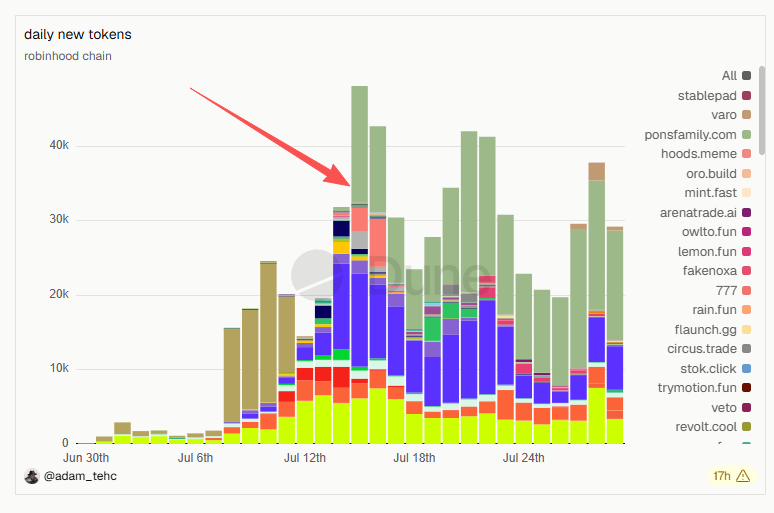
After NOXA ceased issuing new tokens, Flap was the first to capture the traffic from Robinhood Chain's token issuance platforms. On July 14, Flap created over 11,000 tokens in a single day, accounting for more than 35% of the entire chain's daily token issuance. Bankr, Klik, and trench.today also captured a portion of the traffic.
Two weeks later, the outcome of this competition has become clearer.
Dune data shows that on July 15, Pons issued over 15,000 tokens in a single day, ranking first among Robinhood Chain token issuance platforms for the first time. Since then, Pons has maintained the top spot in daily token issuance and has gradually widened the gap with platforms like Flap.
Beyond daily issuance volume, trading volume for tokens on Pons also began to grow rapidly from mid-July. On July 18, Pons' daily trading volume reached $40.7 million, surpassing NOXA's $37.4 million for the first time, and has remained in the lead since. To date, Pons' cumulative trading volume has exceeded $1.5 billion.
On July 26, Pons contributed 77.1% of the total trading volume across Robinhood Chain token issuance platforms, while second-place NOXA accounted for only 6.6%. Pons has not only become the platform with the highest number of token issuances but also commands the vast majority of trading volume on Robinhood Chain token issuance platforms.
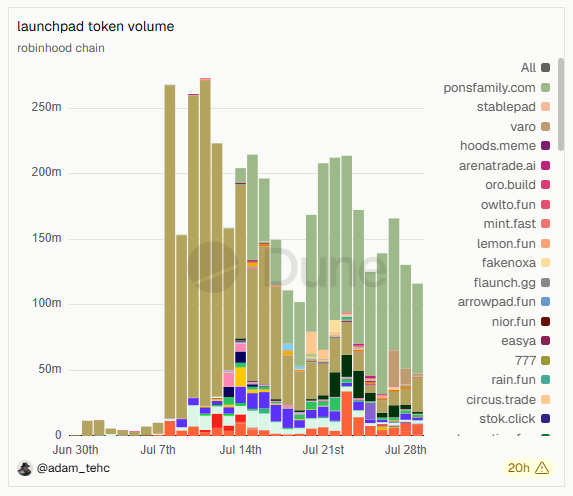
From Flap first absorbing the demand left by NOXA's exit to Pons overtaking rivals in both issuance volume and trading volume, a new leader has emerged among Robinhood Chain token issuance platforms.
No Bonding Curves, No Migrations — Pons Compresses the Token Launch Process to Its Shortest
Pons is a token issuance and trading platform built specifically around Robinhood Chain, operated by Pons Labs, and is not an official Robinhood product. Users can create and trade tokens on the platform, with all operations signed by individual wallets — Pons does not custody user assets.
Currently, each new token on Pons has a fixed total supply of 1 billion, with a creation cost of just 0.0005 ETH. The platform charges a 1% fee on trades. Creators only need to fill in the token name, ticker, image, and social links to complete the issuance.
Unlike the common bonding curve model seen on Pump.fun and Four.meme, Pons' current version deploys the token contract and an Uniswap V3 trading pool in the same transaction, with liquidity locked immediately. Once listed, tokens trade directly against WETH — no need to wait for a bonding curve to sell out, and no subsequent migration to an external DEX.
When the paired WETH in the pool reaches the default threshold of 4.2 ETH, the token is marked as "graduated," but the original pool remains unchanged, and users continue trading in the same pool. Pons also implements a protection period for the first two blocks after a new token goes live, limiting the buy amount and holding ratio of any single wallet to reduce the risk of a few addresses sweeping up supply during the opening phase.
Pons' mechanism isn't packed with complex innovations — its strength lies in its simplicity. Creators don't need to prepare initial liquidity or worry about post-bonding-curve migration issues, while traders can discover, buy, and sell tokens all on the same platform.
In the early stages of Robinhood Chain, what many projects and traders sought was low cost, fast issuance, and instant trading. Pons compresses the path from token creation to live trading into a single on-chain transaction, providing the foundation for quickly attracting token creators, bots, and short-term capital.
Surged Over 15x at Peak, PONS Drives Platform Momentum
Beyond product design and data growth, the surge of Pons' platform token PONS may be a key driver behind its ability to widen the gap with other platforms in such a short time.
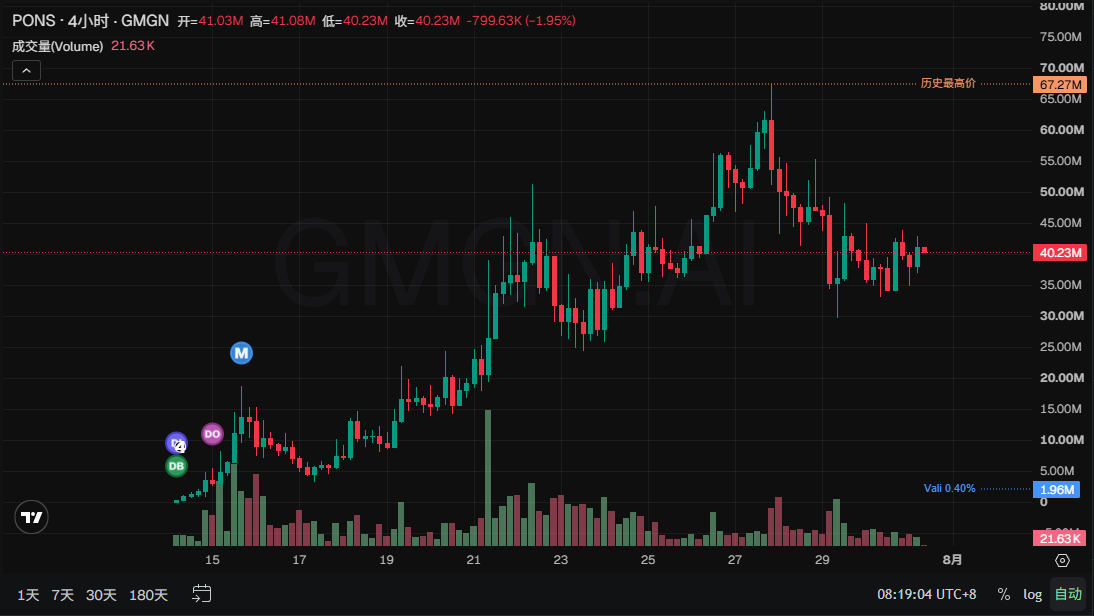
According to GMGN data, on July 16, PONS had a market cap of under $5 million before rapidly climbing, briefly surpassing $67 million — a peak gain of over 15x. The price has since pulled back, with the current market cap around $40 million.
Currently, for tokens issued via Pons' new contracts, trading fees are split between the creator and the protocol at a 70/30 ratio (the old contract splits them at 90/10). Of the fees received by the protocol, 80% is used to buy back and burn PONS from the market, while the remaining 20% covers infrastructure and team operations. On July 28, the team stated that 22% of the total PONS token supply has been burned.
Compared to the tens of thousands of new tokens issued daily, PONS serves as a unified vehicle for the market to identify and trade the Pons narrative. As the PONS price continued to rise, more capital began paying attention to the issuance platform behind it and flowed into Pons to hunt for new projects; the growth in platform trading volume, in turn, generated more fees and buyback funds, further reinforcing PONS' price performance.
For Pons, PONS is more than just a platform token — it has become a key gateway for attracting new capital and users.
From Meme to RWA: Pons V2's Positioning Upgrade
What truly differentiates Robinhood Chain from other public chains is stock tokens and on-chain finance. Pons' V2, currently in development, is extending in this direction as well. According to official disclosures, the platform will support paying trading fees to token creators and CTO operators in ETH, USDG, or RWA assets.
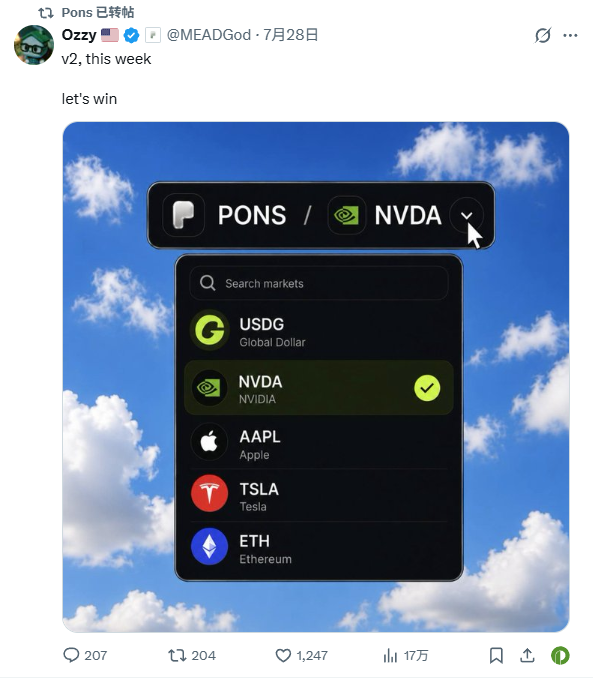
Pons initially gained a large user base and trading volume through Meme tokens issued on the platform. V2 aims to connect this issuance mechanism with Robinhood Chain's stablecoins and RWA assets. For Pons, this signals a positioning shift — from a pure token issuance platform to one gradually expanding into a broader range of asset types and revenue settlement scenarios.


