Deep Dive into the Bankruptcy of Poolin: From a $163 Million IOU Crisis to Understanding Why Platform Wallets Are Not Safe


- Core Thesis: Crypto mining pool Poolin, due to misappropriating user assets for high-leverage expansion, ultimately faced a $164 million funding gap and filed for bankruptcy. This event reveals the fundamental differences in legal protection and risk isolation between ordinary platform wallets and compliant asset custody.
- Key Factors:
- Poolin filed for Chapter 11 bankruptcy in the United States in July 2026, with total liabilities of $173 million, of which $164 million were IOUs issued to users due to suspended withdrawals.
- The root of the crisis lies in Poolin privately pledging and lending out user assets. The funds were used for the construction of mining farms in the US. Subsequently, project delays and a drop in cryptocurrency prices led to the forced liquidation of the pledged collateral, creating a massive shortfall.
- In ordinary platform wallets, user assets are often treated as the platform's "on-balance-sheet liabilities." Once the platform goes bankrupt, users are downgraded to unsecured creditors, ranking lower in the order of repayment.
- Compliant custodians, operating under a trust law framework, achieve bankruptcy remoteness at a legal level. Client assets are held independently of the custodian's balance sheet and are not affected by the platform's bankruptcy liquidation.
- Compliant custody adheres to a zero rehypothecation principle, strictly prohibiting any lending, pledging, or other operations on user assets without explicit authorization, fundamentally eliminating the risk of third-party forced liquidation.
On July 22, 2026, Poolin, a Singapore-based crypto mining pool giant, and its affiliated companies officially filed for Chapter 11 bankruptcy protection in the U.S. Bankruptcy Court for the District of New Jersey.[1] According to the latest court filings, Poolin currently has a staggering $173 million in liabilities, with the most alarming item being $164 million in unsecured claims—stemming from "IOUs" issued to tens of thousands of users after its wallet suspended withdrawals in 2022.
From issuing IOUs after a funding freeze in 2022 to finally heading for court-ordered restructuring in 2026, this four-year saga of delays and decline ultimately culminated in user assets being relegated to "unsecured claims" in bankruptcy court.
This protracted crisis serves as yet another stark warning for the entire crypto market: do not mistake an ordinary platform wallet or financial account for professional asset custody. A deep dive into the underlying logic behind Poolin's IOU crisis can help investors and high-net-worth individuals recognize the vast chasm between "platform credit" and "trust custody."
Revisiting the Poolin IOU Crisis: From Liquidity Crunch to a $160 Million "Fictional IOU"
Looking back at this multi-year crisis, Poolin's collapse was not a sudden event but an inevitable outcome driven by a combination of asset misappropriation, high-leverage expansion, and failed risk controls:
Withdrawal Halt and the Birth of "IOU" (September 2022)
As institutions like 3AC (Three Arrows Capital) and Celsius collapsed, the crypto market entered a deep downturn in 2022. Starting September 2, numerous miners reported severe delays in withdrawals from Poolin Wallet. On September 5, Poolin officially announced a complete suspension of all withdrawals, flash swaps, and internal transfers.[2]

To quell user backlash, Poolin introduced a so-called "IOU solution" in mid-September: it forcibly converted frozen real assets (like BTC, ETH, USDT) in user wallets 1:1 into platform-issued IOU certificates (e.g., IOUBTC, IOUUSDT). At that time, Poolin made grand promises, claiming it would gradually redeem these IOUs through quarterly 1:1 buybacks, deductions from mining pool fees, or open on-chain trading.
However, lacking liquidity and real buyers in the secondary market, these certificates quickly became worthless "digital air," constituting a material default.
Collateral Liquidation and Broken Redemption Pledges (Q4 2022)
By the end of 2022, as crypto prices continued to fall, Poolin's cash flow completely dried up, and its promised quarterly redemption unsurprisingly fell through entirely. Affected users organized collective actions on channels like Telegram, and some large investors even initiated emergency arbitration at the Singapore International Arbitration Centre (SIAC) demanding the return of frozen assets. However, Poolin was beyond saving by that point.
Root Causes Revealed by Bankruptcy Filing
With the disclosure of Chapter 11 bankruptcy documents in 2026, the true reasons behind Poolin's asset shortfall were laid bare:
- Misappropriation and Leveraged Lending: Without proper risk segregation, Poolin used user assets from its wallet as collateral to borrow substantial funds from third-party lending institutions like Antalpha.[3]
- Misguided Heavy Asset Expansion: Poolin heavily invested the borrowed funds into building large-scale mining facilities in Texas, USA, and purchasing mining rigs. This was met with severe construction delays and insufficient local power quotas, trapping the capital.
- Cascading Liquidations Drained Liquidity: The 2022 bear market caused crypto prices to plummet, triggering margin calls from lenders. Unable to meet these calls, the assets Poolin had staked as collateral were forcibly liquidated by lenders like Antalpha, creating a massive, unbridgeable hole in the user wallet reserves.
The Fatal Misconception: How Platform Wallets Turn Your Assets into "Corporate Liabilities"
The Poolin incident exposes a major misconception among investors regarding asset security: believing that storing funds in a "wallet app" is equivalent to safe custody.
In traditional finance or crypto platforms lacking trust safeguards, the underlying operational logic of ordinary wallets is often "on-balance sheet" business:
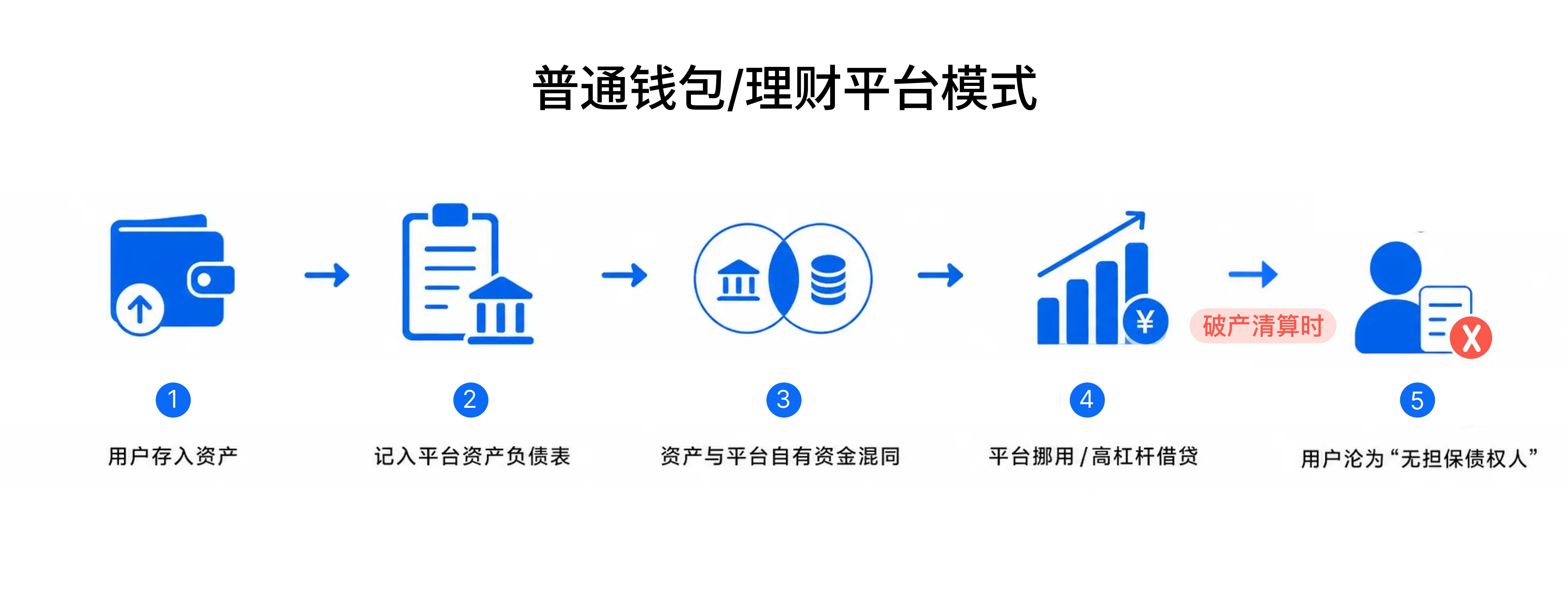
When a user deposits assets into an ordinary wallet, the legal and financial ownership of those assets often becomes ambiguous. Platforms commingle user funds with their own operational capital, even leveraging them through re-hypothecation (re-staking) to external lenders.
Once a platform makes poor investments or encounters a market black swan event, the user's absolute property ownership instantly downgrades to an "unsecured claim" against the platform. In Chapter 11 bankruptcy court, wallet holders stuck with IOUs must line up alongside suppliers, lenders, and other creditors to share a limited pool of residual liquidation assets.
The Solution for Compliant Custody: Building a "Bankruptcy Remote" Fortress with a Compliant Trust Structure
"Not your keys, not your coins" is the creed of crypto enthusiasts; in the world of institutional finance, "Not your qualified trust, not your assets" is the ultimate iron law for ensuring fund security.
As a licensed, professional compliant digital asset custodian, Cactus Custody fundamentally severs the potential transmission of platform credit risk to user assets from both a legal and technical architecture perspective:
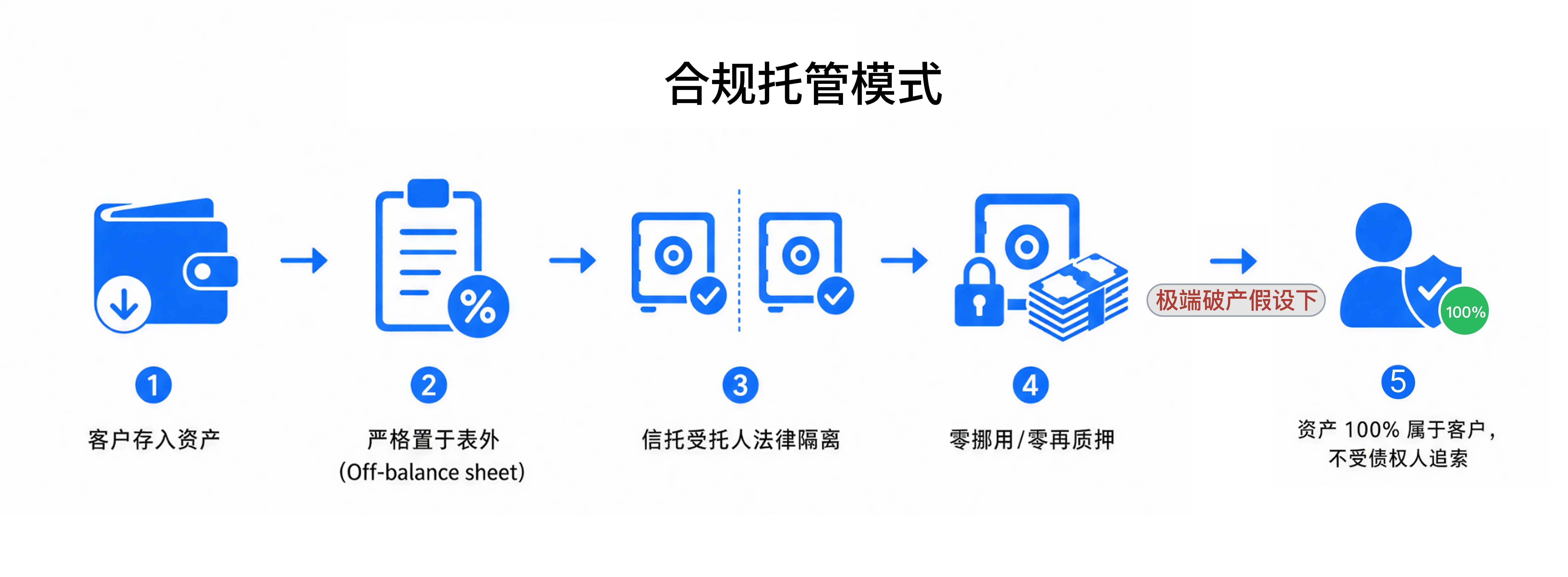
True Legal-Grade Bankruptcy Remoteness
This is the most fundamental legal distinction between compliant custody and ordinary wallets. Operating under a strict trust law framework, assets deposited by clients with a custodian remain the absolute private property of the client and are strictly held off-balance sheet.
This means that even in an extreme scenario where the custodian itself faces financial distress or bankruptcy liquidation, client assets will absolutely not be included in the bankruptcy estate. No creditor of the platform can claim client assets, and clients can withdraw their full assets at any time.
Absolute Asset Segregation and Zero Re-hypothecation
The root cause of the Poolin tragedy was its unauthorized re-pledging of user assets to third parties for loans, mirroring FTX's misuse of client funds for high-leverage investments. In contrast, trust-licensed institutions must adhere to the highest level of fiduciary duty, establishing a technically and operationally independent system for asset segregation. Without explicit authorization from the client, the custodian cannot engage in any form of re-hypothecation, lending, staking, or off-balance-sheet activity with client assets, completely eliminating the risk of fund freeze due to third-party liquidation.
Conclusion: Returning Asset Custody to Its Essence
Poolin's painful journey over four years, culminating in bankruptcy restructuring with $163 million in liabilities, serves as a stark reminder to the industry: managing user assets through corporate debt mechanisms is, at its core, a gamble destined to fail.
For institutional investors, Web3 projects, and high-net-worth individuals, the bottom line for asset security should not be built on blind trust in any single platform or founder, but must be anchored in a robust fortress constructed from legal constraints, trust isolation, and technical defenses.
Stop mistaking platform wallets for safe havens for your assets. Choosing compliant custody isn't just selecting an institutional-grade system of hot/cold wallet segregation and multi-tiered risk control for on-chain finance; it's choosing a contract powerfully protected by modern trust law.
Let custody return to its purest essence — your assets, forever and exclusively yours.
References:
[1] https://backend.theenergymag.com/wp-content/uploads/2026/07/Poolin-Chap-11.pdf
[3] https://theenergymag.com/news/2026-07-23/poolin-chapter-11-bitcoin-pool