






868美元击穿5亿市场:Hyperliquid海力士合约「插针」事件始末


- 核心观点:2026年7月28日,韩国盘前市场一笔仅868美元的SK海力士单股成交,通过TradeXYZ的预言机机制传导至Hyperliquid永续合约,引发约8000万美元的连锁清算,暴露了低流动性市场下价格发现与清算机制之间的深层矛盾。
- 关键要素:
- 事件起因:韩国NXT盘前市场,一笔SK海力士以合法价格下限(1,272,000韩元)成交仅1股,折合868美元,盘口深度极薄。
- 传导机制:TradeXYZ在韩国盘前时段切换至外部报价,该笔异常低价成交直接成为SKHX永续合约的预言机价格,触发价格大幅下跌。
- 清算规模:短时间内SKHX清算名义额约7939.8万美元,未平仓合约从4.81亿美元降至3.31亿美元,406个账户被系统接管。
- 系统角色:特殊地址0x400...0001作为系统后备承接账户,被动接管并后续清算大量多头仓位,承担了约2473.74万美元的名义成交额。
- 对比差异:Binance因在同期放弃外部报价、采用内部平滑机制,其SK海力士永续合约指数价格仅小幅波动,避免了系统性冲击。
- 深层问题:依赖多个数据源无法解决底层市场流动性不足问题,单一低流动性市场的异常成交可同步影响所有报价商的中位数。
Under thin liquidity, real trades do not equate to reliable prices.
On the morning of July 28, 2026, in the South Korean pre-market, only a single share of SK Hynix traded at 1,272,000 KRW, equivalent to approximately $868. This trade, worth less than $900, was subsequently fed into TradeXYZ's pricing system, causing the SKHX perpetual contract to plummet from $1,128.2 to a low of $927 within one minute.
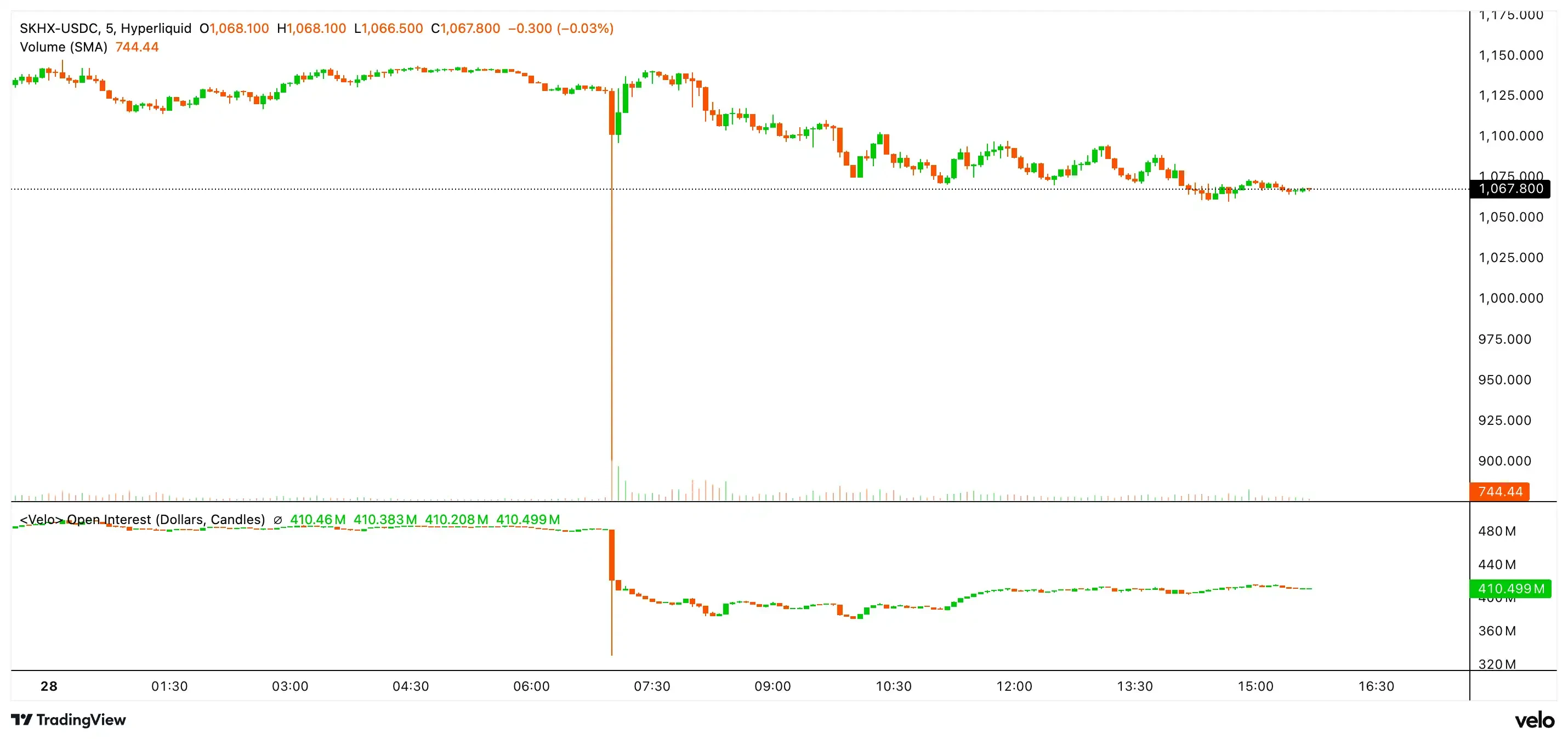
Within less than three minutes, hundreds of accounts were taken over by the system. Over the next four hours, liquidation volumes surged to approximately $80 million.
A mere $868 trade had leveraged a market with $500 million in open interest for the Hyperliquid SK Hynix perpetual contract.
Korean Stock Pre-market Pricing
The incident originated on Nextrade, an Alternative Trading System (NXT) operating in South Korea alongside the KRX.
NXT uses continuous auction trading during the pre-market. If a buy order exceeds a sell order in price, the trade executes immediately. It is not exempt from South Korea's price limit rules for stocks, with the upper and lower bounds set at approximately 30% based on the previous day's KRX closing price.
SK Hynix's previous day closing price was approximately 1,816,000 KRW. Applying a 30% downward limit and adjusting for the minimum tick size for Korean stocks, 1,272,000 KRW falls precisely near the legitimate lower price bound.
This trade did not breach market rules. The problem lay in the order book depth: the buy-side liquidity in the NXT pre-market was extremely thin. A single sell order, priced low enough, executed against just one share, pushing the last traded price down to the limit.
 Source: @yourquantguy
Whether the seller's intent was a mistake, an attempt to manipulate the price downwards, or simply a willingness to sell at that price remains unconfirmed and is currently not evidenced. For the subsequent liquidations, subjective intent is less critical. It was a real trade, executed within the permissible price range, providing an external market data system with a valid reason to ingest it.
The danger began here.
The Chain of Mis-pricing Transmission
According to TradeXYZ's official documentation, SKHX tracks the USD value of a single common share of SK Hynix. The calculation is straightforward: the KRW price of 000660.KS is divided by the USDKRW exchange rate to derive SKHX's oracle price.
TradeXYZ divides its pricing for Korean stocks into two phases: external oracle feed and internal pricing period. The Korean pre-market external pricing period runs from 8:00 AM to 8:50 AM Korean Standard Time, corresponding to 7:00 AM to 7:50 AM Beijing time. This means that as soon as NXT begins pre-market trading, TradeXYZ receives executable quotes from institutional data providers and inputs them as external prices.

Before 7:00 AM Beijing time, SKHX is still in the internal pricing phase. The oracle primarily adjusts slowly based on the impact price from TradeXYZ's own order book. At 7:00 AM, external data resumes, and the oracle updates to reflect the external price in the next cycle.
This transition coincided precisely with the $868 single-share trade.
According to on-chain records, at 07:00:21.678 UTC+8, TradeXYZ's "oracle update component" submitted an update to HyperCore: the external price for SKHX was $868.17, the oracle price was $908.21, and the two "mark price components" were $921.96 and $954.98 respectively.

The "Mark Price" is the price displayed to users and used operationally by TradeXYZ. TradeXYZ calculates the median of three values: the oracle price; the oracle price plus the 150-second EMA of the perpetual contract's mid-price deviation from the oracle; and the median of the best bid, best ask, and last traded price on the order book.
This design incorporates TradeXYZ's order book data and a time-smoothing mechanism intended to slow the transmission of anomalous prices. However, it failed to account for a deeper, hidden vulnerability: the external pricing itself could rely on an illiquid market.
During the minute starting at 07:00 AM, SKHX opened at $1,128.2, hit a low of $927, with contract volume reaching 40,978 units, generating 7,501 trade records. The ±10% boundary intended to constrain price discovery during the internal pricing period also failed to prevent this decline because external pricing had resumed, shifting the system's reference anchor to the new external price.
Liquidations Flowed from Traders to System Accounts
The liquidation figures need to be viewed from two perspectives.
According to HyperInsight's transaction-by-transaction analysis of on-chain addresses, the notional value of liquidations for SKHX within a short period was approximately $79.398 million. Open interest dropped from $481 million to $331 million, a decrease of about $150 million. The top three liquidated addresses collectively faced liquidations of $14.7754 million, with the largest loss (address starting with 0x320) liquidated by approximately $3.957 million, realizing a loss of around $2.045 million.
In these liquidations, approximately $26.26 million flowed to a special address: 0x4000000000000000000000000000000000000001.
Between 07:00:21 and 07:00:48, this address took over 406 long positions, totaling 27,098.687 SKHX contracts, at a weighted average price of approximately $969.05.
The standard liquidation process first sends a liquidation order to the order book. If market buyers can absorb the sell orders, the position closes in the open market. If the order book cannot fill them quickly enough, and the account's margin continues to deteriorate, the system must transfer the remaining positions elsewhere. In this event, 0x400...0001 served as the backup absorption and liquidation relay role.
It was passively forced into a long position.

Taking over did not end the risk. As the price continued to drop, on-chain records began listing 0x400...0001 itself as a liquidated account. This address had 26,560.549 long positions entering the subsequent wave of liquidation, corresponding to a notional trade value of approximately $24.7374 million and realizing a loss of $1.001 million.
A documentation discrepancy also exists here. TradeXYZ's public page still states that XYZ assets are not protected by the HLP Liquidator Vault and that there is currently no backstop liquidator. However, actual on-chain data marks these position transfers as 'backstop'. Therefore, 0x400...0001 cannot be directly equated with the HLP Vault. A more accurate definition is that it is the system's backup absorption account invoked by HyperCore during this SKHX incident. The public documentation has yet to explain the relationship between this current operational process and the older version's description.
Binance Skipped One Hour of External Quotes, But was Spared This Time
The same Korean spot trade also affected Binance's SK Hynix perpetual contract, but the impact was significantly milder.
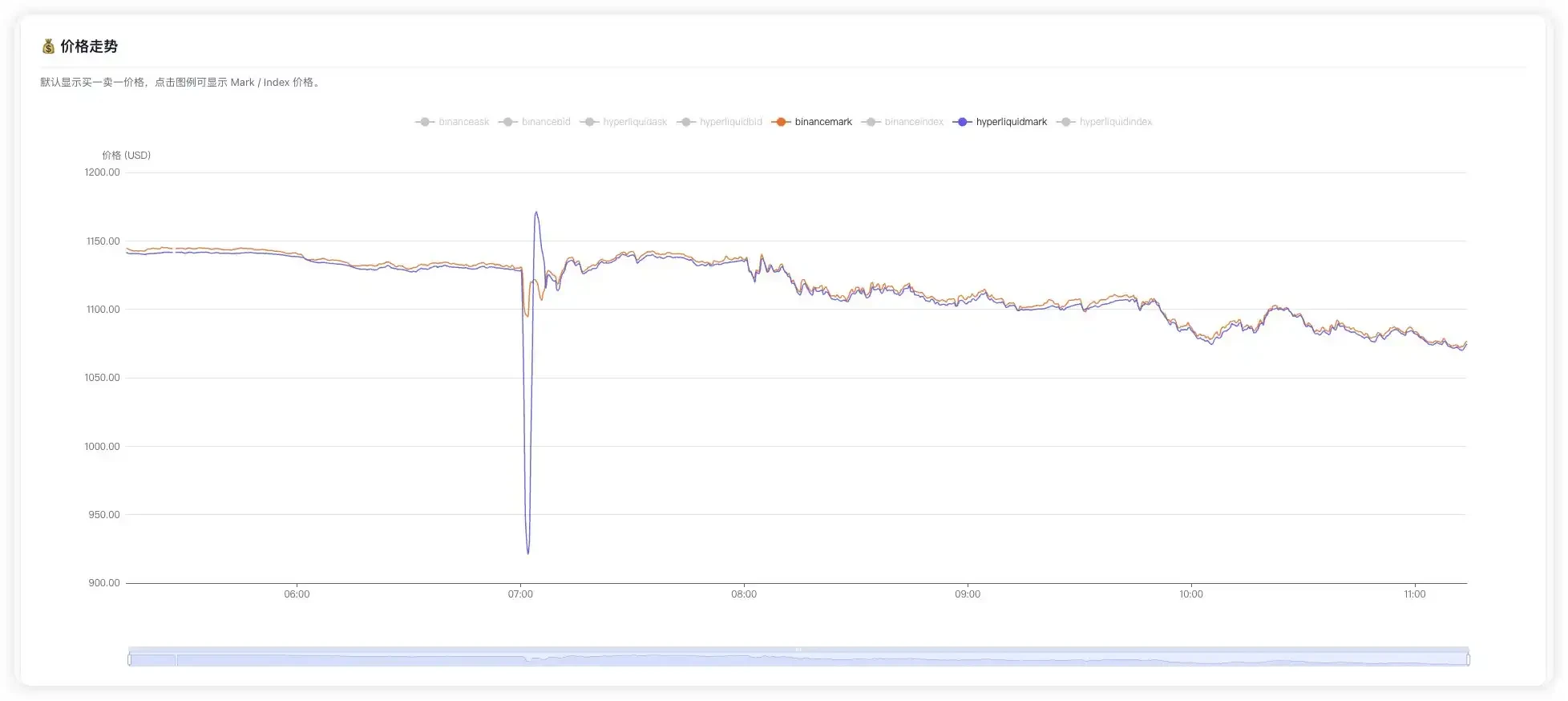
High-frequency trader Boywus provided a direct comparison of the two mechanisms: At 7:00 AM Beijing time, TradeXYZ on Hyperliquid had already connected to the Korean pre-market's external quotes. Binance, at this point, remained in its internal pricing phase and only switched to external quotes around 8:00 AM, near the opening of the main Korean market.
Binance's official documentation states that for stock perpetual contracts, when external markets are closed, it uses the order book's impact mid-price with an EWMA smoothing index. The stated goals include reducing the risk of liquidation during opening price gaps and low-liquidity periods. During the first minute at 7:00 AM, the SKHYNIXUSDT index only decreased from $1,132.49 to $1,130.66.
TradeXYZ adopted earlier price discovery at 7:00 AM. By forsaking this one hour of external quotes, Binance sacrificed some timeliness but successfully avoided the direct impact of the $868 trade entering the liquidation system.
This distinction is unrelated to centralization versus decentralization. The difference stems solely from when external prices are adopted, how smoothly the transition occurs, and whether the liquidation price incorporates independent outlier protection.
Source: @Boywus
What Now?
Some might argue that TradeXYZ merely faithfully reflected the real market situation. The 1,272,000 KRW trade did indeed occur, the data provider did not err, and each module of the trading platform followed its established rules to transmit the price on-chain. From this perspective, a clear basis for compensation claims might be difficult to establish.
However, a correct price discovery mechanism does not equate to sound liquidation design.
Traditional markets have long distinguished between the last traded price, the index price, and the fair price used for risk control. The very purpose of a "Mark Price" is to prevent a single local trade from directly determining the fate of high-leverage accounts. In this event, although the external quote passed through median calculations, EMA smoothing, and update range limits, it still triggered approximately $80 million in liquidations within one minute. This indicates a mismatch between the existing protective mechanisms and the depth of the reference market.
Simply adding more price oracles cannot solve this problem alone. Multiple data sources would all observe the same NXT pre-market order book; the low-price, single-share trade would enter all their quotes simultaneously, and the median across them would still converge toward the same anomalous price. The service providers were diversified, but the underlying liquidity was not.
Hyperliquid has delegated the oracle definition and operational responsibility for HIP-3 markets to the deployer. However, liquidation is executed by HyperCore, meaning the risk and reputation extend beyond just the HIP-3 deployer.
Earlier and broader price discovery offers value but comes with costs. Hopefully, Hyperliquid and TradeXYZ can learn from this experience.


