






Unlocking $100 Million in Liquidity? Pump.fun’s New Policy Tests a 5-Minute Price Pump Strategy


- Core Insight: Pump.fun introduces the BOOST mode, which takes the approximately 20% of “dead liquidity” funds originally locked in the liquidity pool (LP). Within the first 5 minutes after a token migration, it uses these funds to buy and burn the token via TWAP, creating short-term buying pressure and reducing the circulating supply. This aims to improve the short-term performance of tokens after launch and enhance user retention.
- Key Elements:
- BOOST Mechanism: When a token graduates from the bonding curve and migrates to the PumpSwap liquidity pool, the platform intercepts approximately 20% of the funds (for SOL trading pairs, this is 17.6 SOL). Over the next 5 minutes, it continuously buys and burns the token using a TWAP strategy.
- Addressing the “Dead Liquidity” Issue: Under the original mechanism, about 20% of liquidity was permanently locked in the LP, representing a sunk cost. The platform estimates this leads to over $100 million in liquidity being lost annually. The BOOST mode converts this capital into actual buying pressure.
- Automatic Activation & Scope: The BOOST mode is automatically enabled for Pump.fun tokens migrating after 22:23 UTC on July 21, 2025. It does not apply to tokens that have already migrated or those launched via the Mayhem mode.
- Platform Revenue & Token Price: Pump.fun’s current annualized revenue is approximately $342.54 million, with a total buyback value of about $411.27 million. However, the token price remains significantly below its all-time high of $0.008, suggesting the massive buyback program has had a limited effect.
- Potential Risks: The additional buying pressure could lower the barrier to entry for low-quality tokens, encouraging more aggressive launches. The 5-minute TWAP window is short; if a large sell order hits the market after the buying stops, the token price could collapse with higher slippage.
Original Author: Mahe, Foresight News
On July 21, Pump.fun officially announced the launch of BOOST mode, setting it as the standard default launch mechanism for new tokens. Following the announcement, the PUMP token price continued to fluctuate around $0.002.
According to the official explanation, historical data shows that when a token graduates from the bonding curve and migrates to a liquidity pool, approximately 20% of the liquidity becomes "dead liquidity." Even if all holders sell off their tokens, this portion of funds remains permanently locked in the LP and can no longer be utilized effectively. The platform estimates this mechanism results in over $100 million in permanent liquidity loss annually.
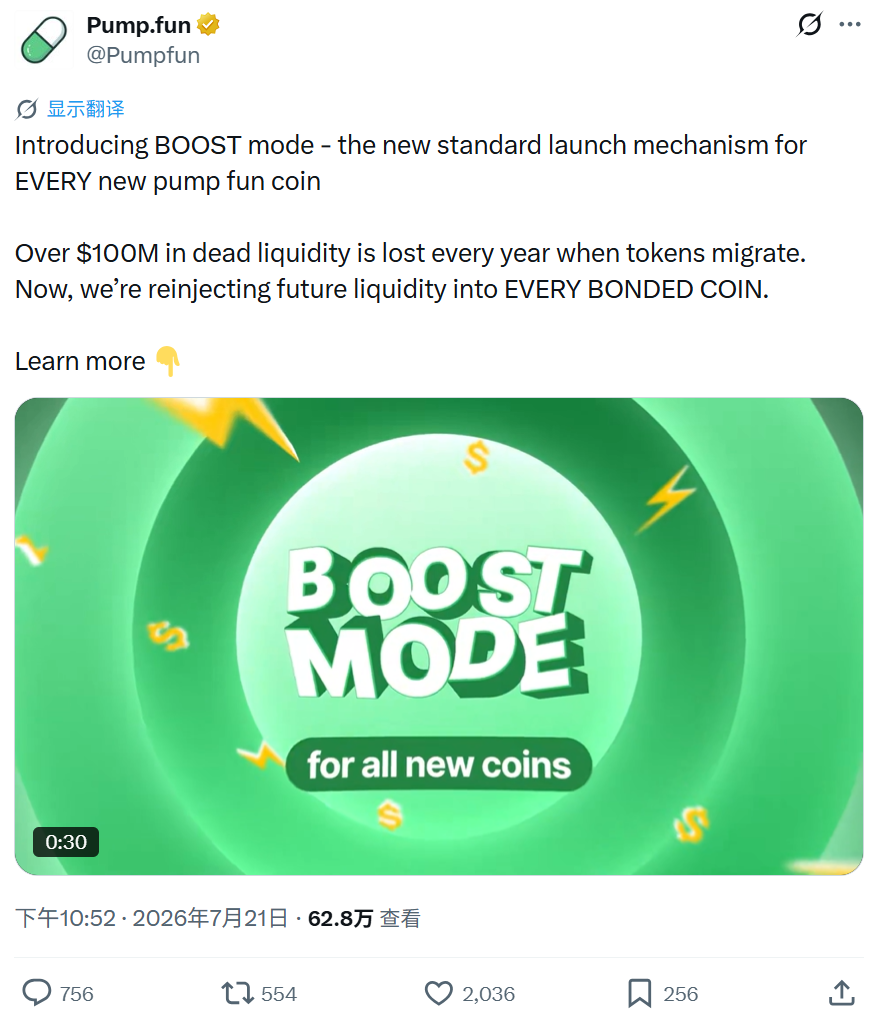
The core action of BOOST mode is straightforward: it takes this otherwise wasted capital and, within the first 5 minutes after token migration, continuously buys the token using a TWAP (Time-Weighted Average Price) mechanism, immediately burning all purchased tokens. Upon token graduation, Pump.fun forcibly intercepts approximately 20% of this capital. Based on fixed migration rules, it intercepts 17.6 SOL for SOL trading pairs and approximately $2,516 for USDC trading pairs.
All these funds come from the liquidity that was previously "sacrificed" during migration—not from new platform subsidies. After the purchase is complete, the corresponding tokens are directly burned, creating short-term buying pressure while permanently reducing the circulating supply.
Using Reserve Funds to Provide a 5-Minute Buying Spree for Tokens
The classic Pump.fun process is: a user creates a token with a single click, trades it on the bonding curve, and once the token reaches a certain market cap threshold, it automatically migrates to the PumpSwap liquidity pool. During migration, the platform locks a portion of liquidity into the LP according to a predetermined ratio to ensure subsequent trading depth.
The problem is that this locked capital proportion is relatively high. Even if the token's price later goes to zero and everyone sells out, a "dead fund" remains in the LP. This money can neither be withdrawn nor reallocated to other active assets, representing a systemic waste of capital. The official estimate for this is "over $100 million annually."
BOOST mode does not alter the trading experience on the bonding curve, nor does it adjust the graduation threshold itself. BOOST mode does not arbitrarily add or release any external liquidity. Its essence is to divert the 20% settlement capital originally intended for the LP, using it to buy tokens on the secondary market via TWAP within 5 minutes and then directly burning them.
The official statement clarifies that Pump.fun tokens migrating after 22:23 Beijing time on July 21 will automatically have the BOOST configuration enabled. Tokens that have already migrated, as well as those launched through the Mayhem (AI Agent Lab) mode, will not benefit from this mechanism.
Fireworks in the First 5 Minutes
As of July 22, Pump.fun's annualized revenue stands at approximately $342.54 million, with a total buyback token value of about $411.27 million. However, its token price remains far from its high of $0.008. Relying solely on large-scale buybacks can no longer effectively boost price expectations.
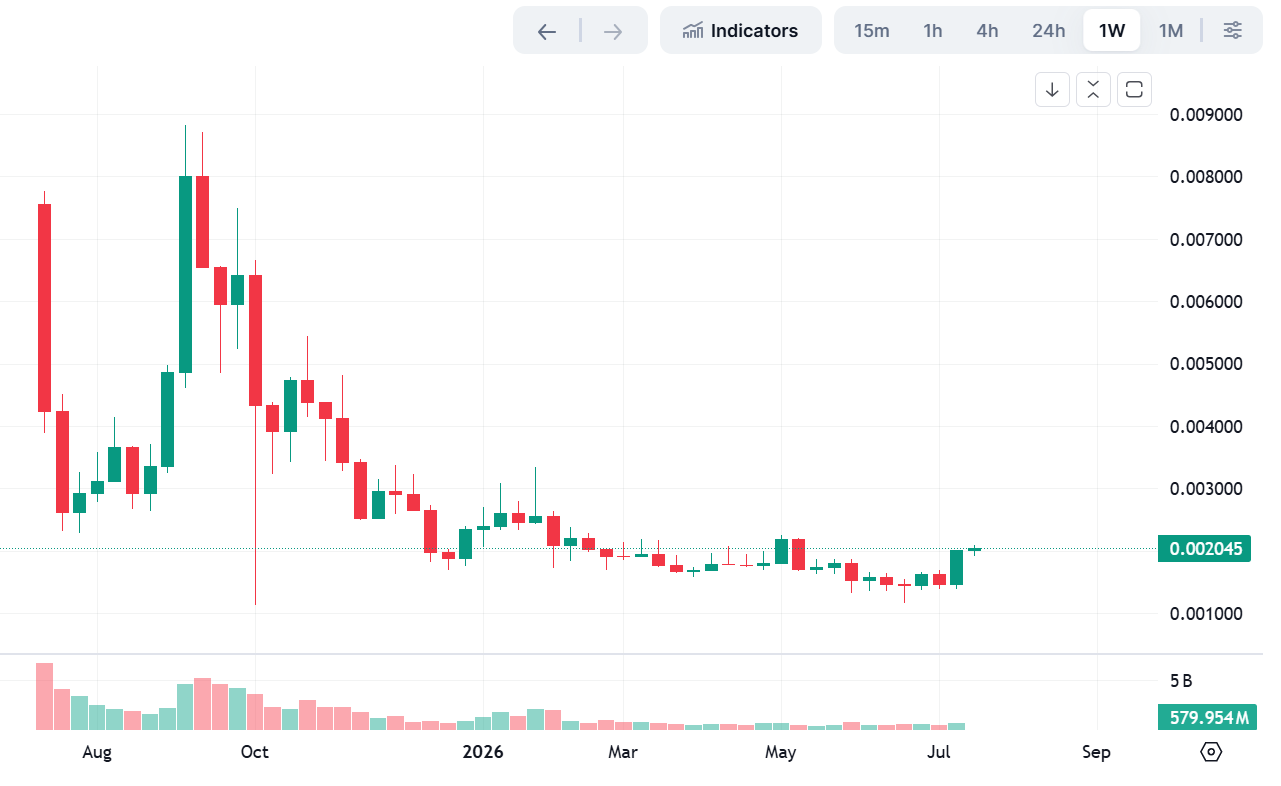
The essence of BOOST is not to add another round of buybacks for PUMP, but to address the underlying product issues of the launchpad itself.
The logic behind this might be: if post-graduation meme coins have slightly thicker order books and slightly better short-term performance, trader retention and repeat purchase willingness will be higher. In the PvP environment, most players simply don't care about a meme coin's fate three days later—they care about whether it will "pump hard" at the moment of graduation. Pump.fun may have realized this: rather than deadlocking 20% of funds defensively in the LP pool, it's better to turn this capital into the "fireworks" of the first 5 minutes.
The platform's true moat is not "high token issuance volume," but rather "a certain proportion of issued tokens can consistently generate trading volume." Only by stabilizing the latter can protocol revenue be truly sustainable. If revenue stabilizes or even grows, buybacks will have continuous ammunition, rather than increasingly resembling "using existing revenue to artificially prop up the price."
Of course, many traders also worry that additional buying pressure could lower the actual difficulty of project launches, potentially making it easier for more low-quality coins to "appear successful," thereby encouraging more aggressive launch behavior. Some also point out that the 5-minute TWAP buying window is still relatively short—once buying stops after 5 minutes and a large sell order hits, the token price could crash with more severe slippage than before. This essentially trades a high risk of subsequent dump for the illusion of a pump in the first 5 minutes.





