






This year has already triggered seven circuit breakers, and Goldman Sachs' trading desk is asking in frustration: when will the sell-off in Korean stocks stop?


- Core Viewpoint: The South Korean stock market is experiencing one of its worst declines this century, triggering its seventh circuit breaker of the year, primarily driven by a plunge in semiconductor giants and forced liquidations of leveraged ETFs. Goldman Sachs defines this as a "liquidity-driven position washout," suggesting the bottom has not yet arrived after retail funds are exhausted.
- Key Elements:
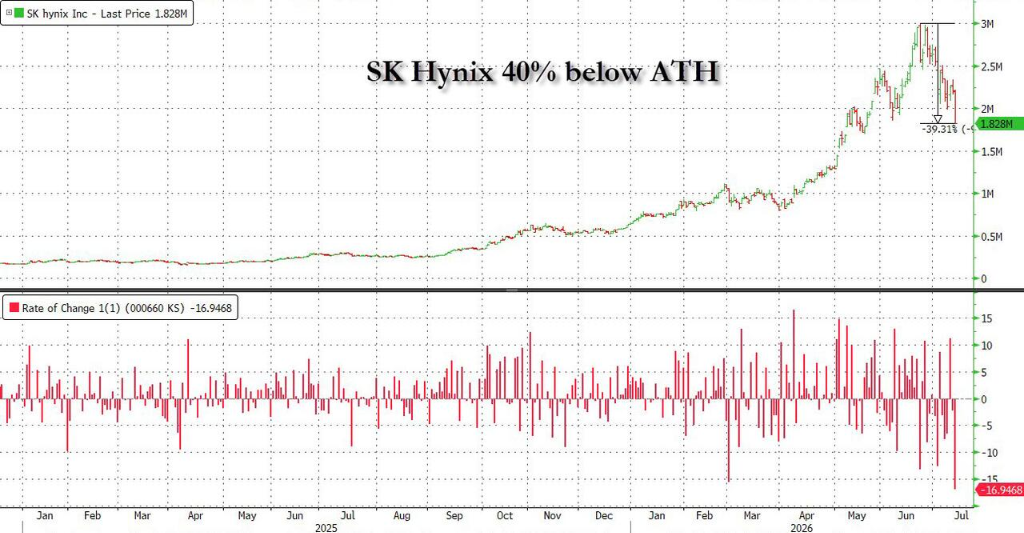
- The KOSPI index closed nearly 9% lower on the day, a 27% decline from its June highs, triggering its seventh circuit breaker of the year. Samsung Electronics and SK Hynix plummeted by 10.7% and 15.4%, respectively.
- Forced liquidations of leveraged ETFs were a key factor exacerbating the decline. Goldman Sachs estimates they accounted for 62% of the day's net selling by local institutions. Regulators have already called in asset management companies, demanding enhanced investor protection.
- Foreign and local institutions combined for a net selling total of $2.63 billion in a single day, with quantitative trading dominating foreign sell orders. The margin call rate for retail investors' financing has risen to 5%, with over 1.2 million leveraged accounts receiving margin calls.
- Signs of retail capital depletion are evident: the balance of margin deposits fell to 107.1 trillion Korean Won, the lowest since February 2020, dropping approximately 30 trillion Korean Won from two weeks prior.
- Fundamental views among institutions are divided: bulls cite the shortage of equipment capacity as a positive catalyst, while bears worry about the cycle for HBM peaking in 2026. Forward earnings expectations for memory stocks continue to be revised downwards.
- On the technical front, if the Fibonacci support level at 6800 points is lost, the next support lies at 6500 points (an additional 4.5% decline). Goldman Sachs advises buying high-conviction memory chip and tech stocks at a discount.
Original Author: Bao Yilong
Original Source: Wall Street CN
South Korean stocks suffered one of the worst single-day drops this century, triggering the seventh circuit breaker of the year, as a Goldman Sachs trader publicly asked: When will the selling finally stop?
On Monday, the Korea Composite Stock Price Index (KOSPI) closed down nearly 9%, marking the third-largest single-day decline since the Lehman crisis. The index closed below the key support level of 6800 points, with a cumulative retreat of 27% from its all-time high set in early June.
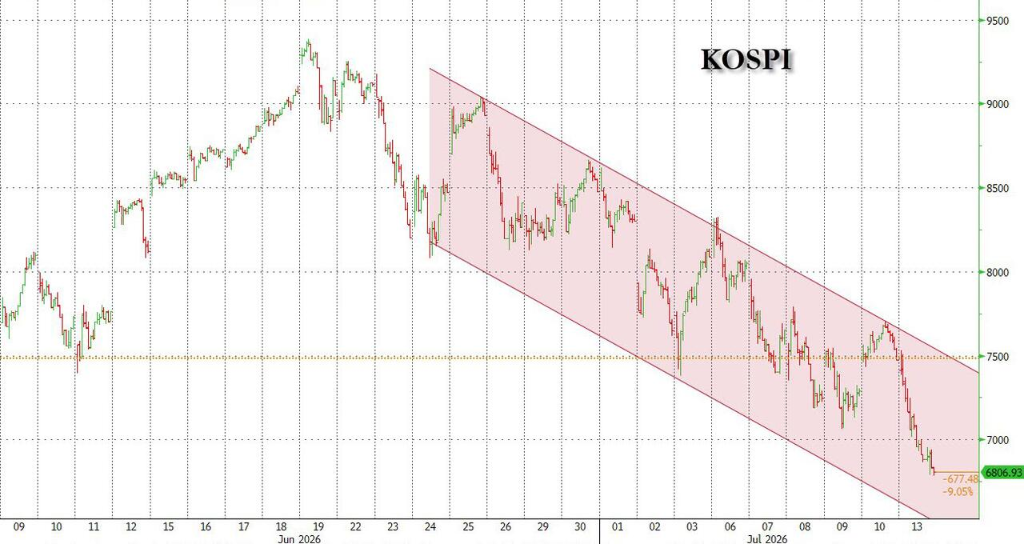
The day triggered the seventh circuit breaker of the year. Of the 13 market-wide trading halts since the circuit breaker mechanism was established in 2000, this year alone accounts for more than half.
The decline was primarily led by two companies critical to the South Korean market. Samsung Electronics plummeted 10.7%, while SK Hynix plunged 15.4%, marking its largest drop ever and a 40% decline from its record high set just weeks ago.
Goldman Sachs trader Heejae Lee stated in that day's report:
So far, we have not heard a truly compelling fundamental catalyst that can convincingly explain this round of selling.
Leveraged ETF Forced Liquidation Amplifies the Downtrend
One of the key drivers of the extreme intraday volatility was the rapid deleveraging of newly listed single-stock leveraged ETFs.
Semiconductor-related 2x leveraged products fell over 30% that day, forcing large-scale re-hedging, which further accelerated the downward spiral. The 3x leveraged Korea ETF has now fallen 65% from its all-time high on June 1.
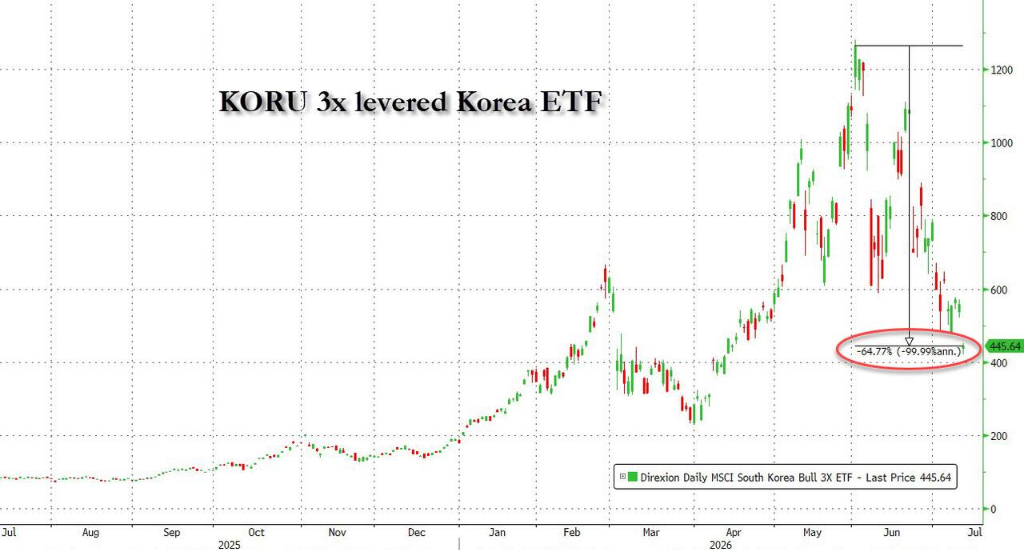
According to Goldman Sachs estimates, the forced liquidation of these products accounted for 62% of the total net selling by local institutions that day.
Regulators responded swiftly. Lee Chan-jin, head of the Financial Supervisory Service (FSS) of South Korea, summoned CEOs of 20 major asset management companies that day, expressing strong concern over the systemic risks and "overheated" marketing of these products, and calling for enhanced investor protection.
Reports indicate that regulatory focus is expected to center on raising product entry barriers rather than an outright ban.
Foreign and Institutional Exodus, Retail Investors Exhausted
Goldman Sachs' prime brokerage desk observed that institutional block trading activity was relatively subdued that day. Momentum hedge funds selectively reduced positions, while long-only institutions remained largely on the sidelines.
On the capital flow front, foreign investors and local institutions recorded net selling of $1.13 billion and $1.5 billion, respectively, on the day. Local institutional selling was heavily concentrated in ETF liquidation, while foreign selling came almost entirely from quantitative trading, with quantitative net outflows reaching $1.18 billion.
More alarmingly, retail investors, who had previously been the last line of support for South Korean stocks, are rapidly approaching their limits. Goldman Sachs data shows that the retail margin call ratio had risen to 5% as of last Friday. Given Monday's decline, Monday's figure will be significantly higher.
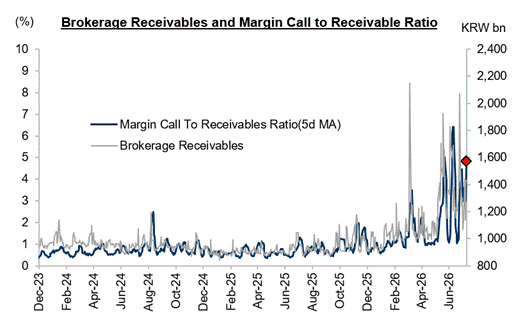
According to the Financial Supervisory Service (FSS) of South Korea, as of July 13, over 1.2 million leveraged retail accounts in the Korean market had received margin calls. Of these, approximately 320,000 to 360,000 accounts were forcibly liquidated by brokerages, resulting in zero principal and some accounts even falling into negative balance.
Furthermore, as of July 9, the balance of margin deposits at retail brokerages had fallen to 107.1 trillion won, a sharp drop of about 30 trillion won from the 132.47 trillion won recorded on June 29, marking the lowest level since February 2020.
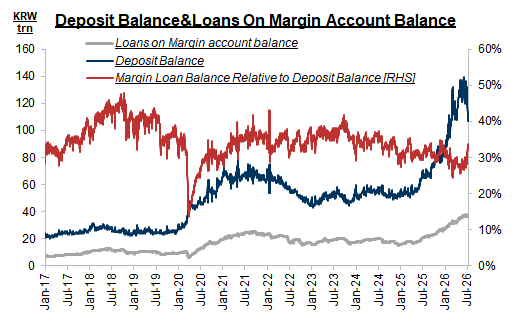
Goldman Sachs points out that once retail investors' willingness to "buy high and sell low" is completely exhausted, the true bottom for the KOSPI may not have arrived yet.
Fundamental Divergence: Institutions Bullish, Capital Votes with Its Feet
The sharp decline on Monday stands in stark contrast to the institutional feedback Goldman Sachs gathered during its roadshow in Singapore last week.
At that time, the prevailing view among institutional investors was that the recent correction had significantly improved the risk-reward profile, and they leaned towards re-establishing exposure to memory chips. However, the market responded with a starkly different outcome, plunging 9% in a single day.
The logic supporting the bull camp stems from structural factors, namely equipment capacity shortages, with industry capacity expansion expected to be delayed until the second half of 2028.
A minority of bears expressed concerns about a decline in average selling prices (ASP) in the fourth quarter of 2026 and a peak in the HBM4 cycle.
Korea Investment & Securities previously released a report forecasting SK Hynix's operating profit to reach 60.4 trillion won, a 556% year-on-year increase, but approximately 8% below the market consensus of 65 trillion won. The reason cited was that a higher proportion of HBM revenue led to a smaller-than-average market ASP increase.
It is noteworthy that despite the significant pullback in the KOSPI, forward earnings per share (EPS) expectations continue to be revised downward, largely due to overly optimistic earnings forecasts for memory stocks previously.
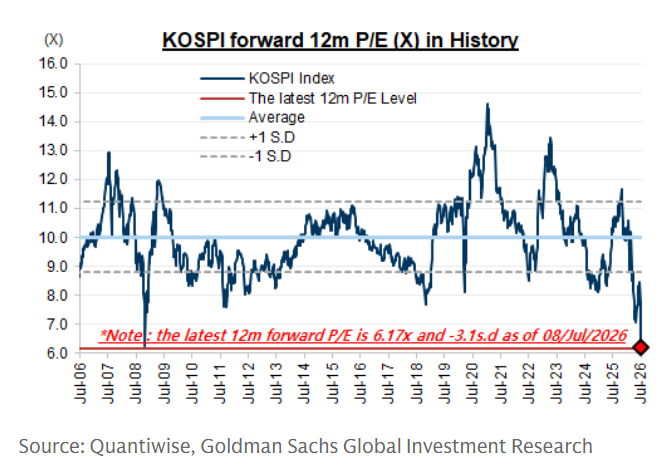
Technical Levels at a Critical Juncture, Goldman Sachs Maintains Cautious Optimism
Based on the above analysis, Goldman Sachs characterizes the current KOSPI decline as a "liquidity-driven position washout."
From a technical perspective, the KOSPI closed precisely at the 6800-point support level that day, which corresponds to the 52-week Fibonacci retracement level. If this support is breached, the next support level is at 6500 points, implying a further downside of 4.5%.
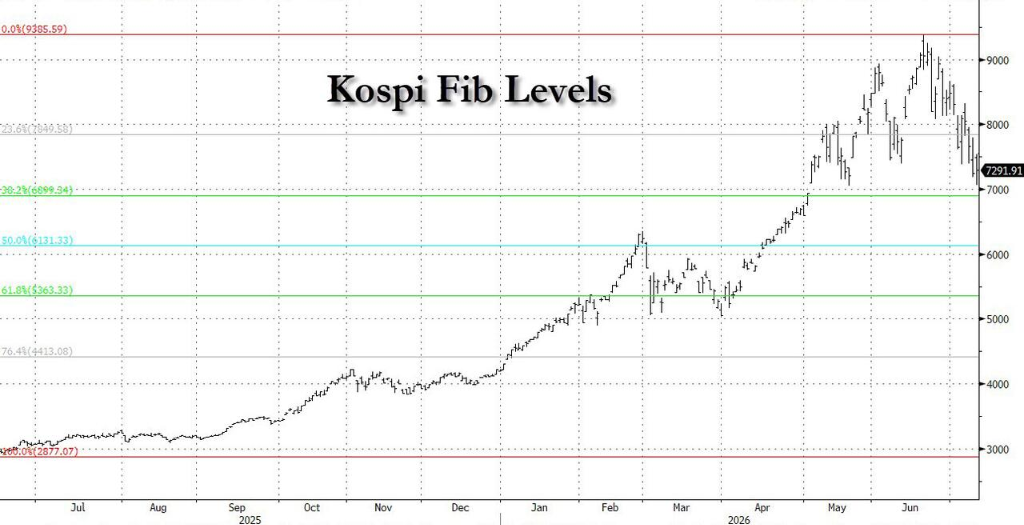
Citing historical data showing the KOSPI's maximum drawdown over the past 5 years at around 30%, Lee noted that the current -25% decline is "quite close."
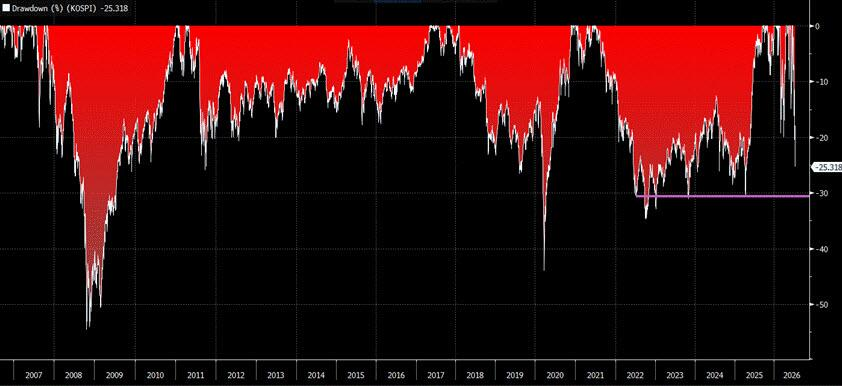
Goldman Sachs advises investors to utilize the current extreme volatility to selectively buy high-conviction memory chip and technology stocks at significant discounts.
However, Goldman Sachs also acknowledges that the market still faces multiple headwinds in the short term.
First, is the seasonal pattern. The KOSPI has historically shown weak performance in the third quarter. If the first half of the year sees substantial gains, the third quarter naturally becomes a window for institutions to lock in profits, rebalance portfolios, and rotate into defensive sectors.
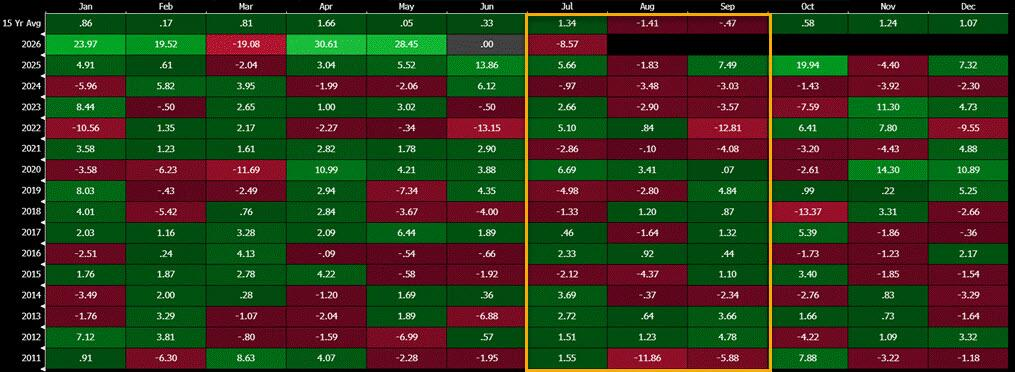
Second, is the issue of financing costs. The margin loans available from Korean banks for retail investors are approaching their limits. While swap financing costs have eased slightly from their peaks, they remain elevated, and prime brokers are actively reducing their inventory and risk exposure.


