Strategy's Accounting Tricks: The Bitcoin Selling Cap Is Far More Than $1.25 Billion


- Core Thesis: Strategy recently sold $216 million worth of Bitcoin to pay dividends and replenish reserves, but this move was not counted against its previously announced $1.25 billion reserve building capacity. This reveals that the company uses accounting classifications ("building" vs. "replenishing") to differentiate the purposes of its sales, effectively transforming from a Bitcoin hoarding institution into an actively managed hedge fund that utilizes Bitcoin as a balance sheet tool.
- Key Elements:
- Between June 29 and July 5, Strategy sold 3,588 BTC (approximately $216 million) to pay preferred stock dividends and replenish USD reserves, while claiming the $1.25 billion reserve building capacity remained intact.
- According to the "Monetization Plan," proceeds from BTC sales are allocated to three main pools: building reserves (capped at $1.25 billion), covering preferred stock and debt costs (no explicit cap), and funding share buyback programs (a new $2 billion facility).
- "Building Reserves" refers to adding cash to reserves after selling BTC, whereas "Replenishing Reserves" means using reserves to pay dividends and then selling BTC to recapitalize them. The accounting classifications differ, but the essence remains the same.
- As of June 28, Strategy held $2.55 billion in USD reserves, sufficient to cover the company’s annual debt and preferred stock payment obligations of approximately $1.76 billion, equating to about 17 months of coverage.
- Strategy’s CEO stated the company is shifting from a unidirectional capital issuance model to an active capital management model, now resembling an actively managed hedge fund that trades different components of its own capital structure.
Source: Bankless
Translation: Odaily (@OdailyChina); Translator: Azuma (@azuma_eth)

On July 7, Strategy disclosed that it sold 3,588 BTC between June 29 and July 5, valued at approximately $216 million.
The proceeds were used to pay dividends on STRC and replenish the USD Reserve previously drawn down for dividend payments. Despite this sale, Strategy stated that its full $1.25 billion reserve-building capacity remains intact.
- Odaily Note: In its "self-rescue plan" announced last week, Strategy had disclosed authorization to sell BTC to establish a USD reserve of up to $1.25 billion.
In other words, the $216 million worth of BTC sold by Strategy to replenish reserves was not counted against the previously disclosed reserve-building capacity.
Strictly speaking, there is a technical distinction between the two: one is "replenishing" the reserve, and the other is "building" the reserve. In practice, however, both types of sales ultimately flow into the same reserve pool for the same purpose, categorized only as different "uses" within the plan.
From another perspective, the previously disclosed "BTC Monetization Program" never capped Strategy's total BTC sales at $1.25 billion. What it actually limited was only one specific pool — the sale of BTC specifically for "building" the USD reserve.
The program also permits Strategy to sell BTC for other purposes, which is precisely what we are observing now.
Three Pools of Capital
On June 29, after weeks of pressure on MSTR and STRC, Strategy launched the aforementioned BTC Monetization Program as part of its broader "Digital Credit Capital Framework."
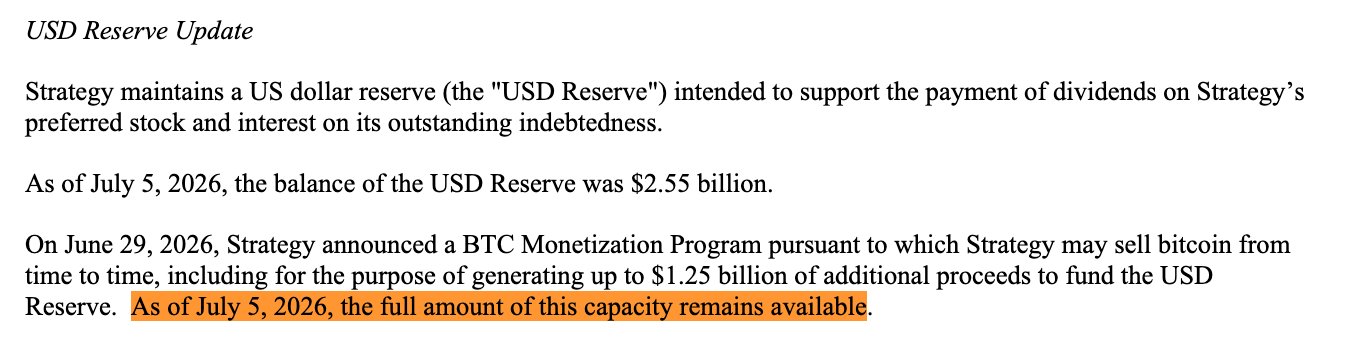
The program authorizes Strategy to sell Bitcoin and outlines three primary uses:
- First is building the reserve: selling up to $1.25 billion in BTC to establish the USD Reserve.
- Second is covering the preferreds and debt costs: selling BTC to meet Strategy's fixed dividend and interest obligations on its preferred shares and debt. If management deems "selling BTC more advantageous than issuing common stock," proceeds can also be used to replenish reserve funds previously deployed for these obligations.
- Third is funding buybacks: selling BTC to repurchase up to $1 billion in preferred shares and up to $1 billion in MSTR common stock. Additionally, BTC sale proceeds may cover related taxes, fees, and other expenses.
At the time, the entire market's discussion focused on the $1.25 billion cap of the first pool, but the reality is far more extensive.
Looking only at the third pool, it effectively adds a further $2 billion in sales capacity. Thus, even just counting the components with explicit caps, the total BTC sales currently designed within Strategy's framework already exceed $3 billion — and this excludes the pool for paying dividends, interest, and replenishing reserves, which has no disclosed ceiling.
Building vs. Replenishing
This is where the nuance truly lies.
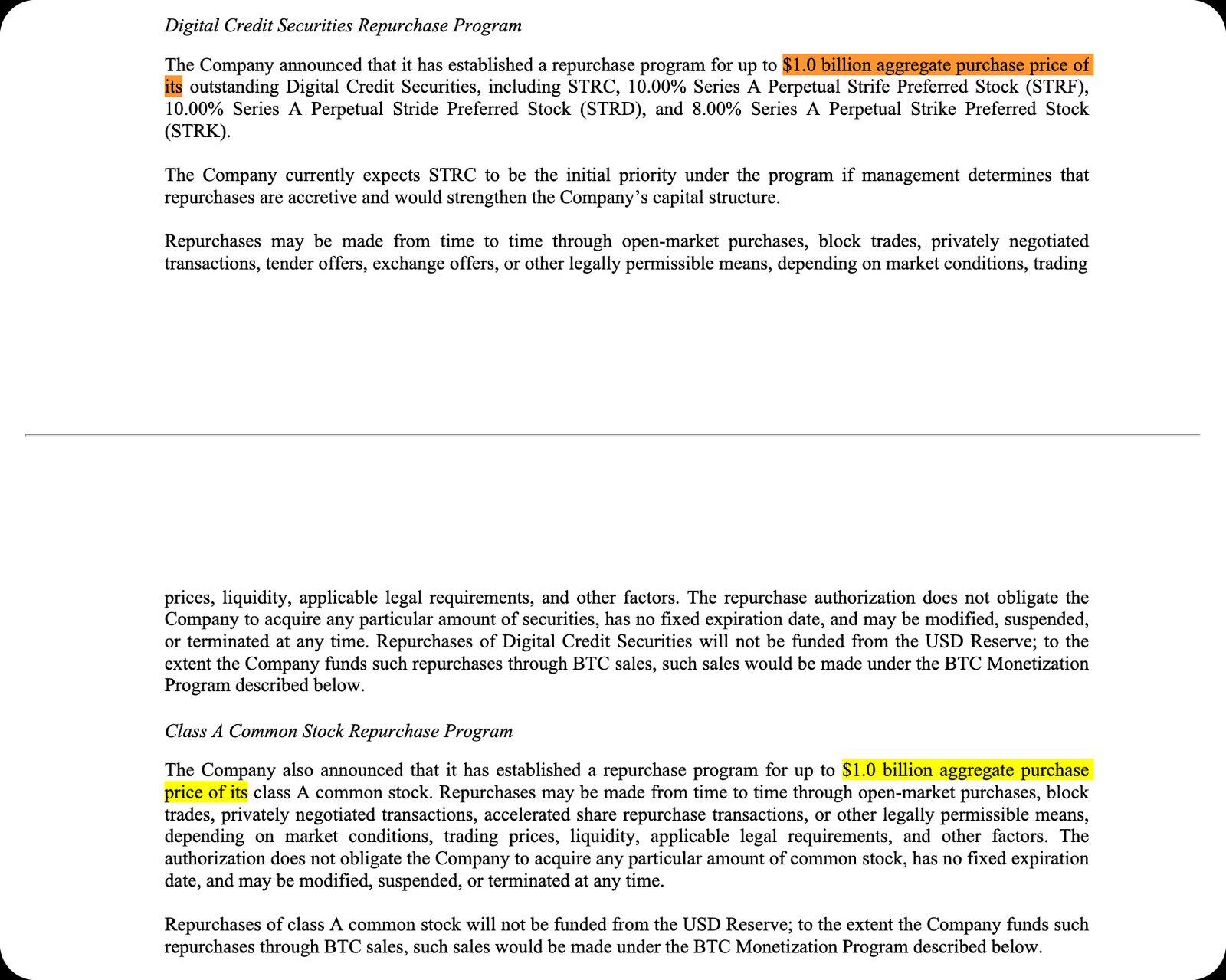
The USD Reserve exists specifically to cover preferred stock dividends and debt interest payments. Under the current policy framework, it cannot be used for stock repurchases.
As of June 28, Strategy's USD Reserve stood at $2.55 billion, sufficient to cover approximately 17 months' worth of the company's roughly $1.76 billion in annual debt and preferred stock obligations. The Strategy board's minimum requirement is to maintain a 12-month coverage level, unless the board approves a lower threshold.
This is precisely why the distinction between "building" and "replenishing" the reserve warrants attention.
- Selling BTC before paying dividends and adding the cash to the reserve: This is defined as "building."
- Using the reserve to pay dividends, then selling BTC to replenish the reserve: This is defined as "replenishing."
The plan treats these as separate categories, but they achieve the same outcome — converting BTC into cash to cover preferred stock dividends and interest expenses.
These details were already disclosed in the documents, but the recent sale made the distinction far more tangible. Strategy sold $216 million worth of BTC, used the funds for dividends and reserve replenishment, yet simultaneously announced that its $1.25 billion reserve-building capacity remained fully intact.
Now, the market must begin to understand Strategy's "specialized language": "building" and "replenishing" are essentially accounting classifications, but they determine whether Strategy's BTC sales consume the "public cap" visible to the market.
From HODLing to Active Capital Management
In the June 29 announcement, Michael Saylor stated that the framework reflects Strategy's need for "liquidity, discipline, and active capital management."
Strategy CEO Phong Le was even more direct, stating: "Strategy is transitioning from a one-way capital issuance model to an active capital management model."
As Castle Island's Matt Walsh and Jeff Dorman explained on a podcast last week, Strategy has effectively evolved into an actively managed hedge fund.
In the past, the Strategy narrative was straightforward: sell MSTR stock → buy Bitcoin → offer investors leveraged BTC exposure. That logic has now changed.
Today, Strategy is actively trading different components of its own capital structure to manage the tensions between MSTR common stock, preferred shares, the USD reserve, and Bitcoin holdings.
This dynamic also introduces new conflicts of interest, as Walsh and Dorman pointed out:
- Selling common stock can support preferred dividends but depresses MSTR's premium relative to its BTC holdings.
- Selling Bitcoin can extend cash runway but further erodes the core "never sell" narrative.
- Supporting the preferred stock system maintains market confidence but consumes cash reserves.
- Cutting preferred dividends preserves liquidity but could trigger a collapse in preferred share prices.
The so-called "reserve loophole" is a manifestation of this shift. Bitcoin is no longer just an asset for Strategy to accumulate continuously; it is becoming a balance-sheet lever to sustain the preferred stock system.
What We Might Ultimately See
Investors must now assess whether Saylor can operate such a machine — every adjustment of a lever within the capital structure aids one component while potentially threatening another.
This is the most critical takeaway from the disclosure on July 6. Strategy is not without options. It may possess far more operational flexibility than the market superficially perceives.
Please stop mistakenly believing that the $1.25 billion cap represents the upper limit of Strategy's Bitcoin sales.
Today, Strategy has become an institution that requires the market to re-evaluate. Every specialized term now carries greater weight:
- Build;
- Replenish;
- Issue;
- Repurchase;
- Defend;
Just as Fed watchers meticulously parse every punctuation in policy statements, the market must deconstruct every term Strategy uses to assess what it means for future BTC sales.
By introducing this framework, Strategy has granted itself greater flexibility, yet the underlying tensions persist. This is no longer a simple "leveraged Bitcoin trade." It has become a bet on the firm's active capital management capabilities.
Can Strategy consistently succeed in "selling BTC," "replenishing reserves," "issuing securities," "repurchasing stock," and "maintaining its capital structure" without any one part breaking the others?
Personally, I would not choose to take this bet.