The Battle the Bank of Japan Cannot Win


- Core Thesis: The Bank of Japan’s unprecedented intervention and rate hike efforts to support the yen are doomed to fail in this exchange rate defense war, due to the massive US-Japan interest rate differential and fiscal constraints caused by Japan’s government debt reaching 250% of GDP.
- Key Factors:
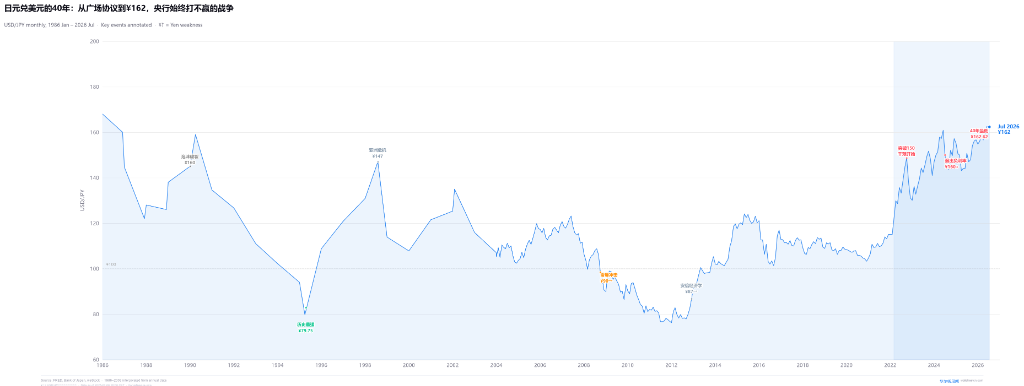
- Japan’s Ministry of Finance spent 11.7 trillion yen on exchange rate intervention in April-May 2026, a single-month record, yet the yen depreciated to 162.62 within six weeks, hitting a nearly 40-year low.
- A 275-basis-point interest rate differential between the US dollar and the yen has fueled a persistent carry trade mechanism, with hedge fund net short yen positions at extreme levels.
- In Japan’s FY2026 budget, debt servicing costs (national bond expenses) amount to 31.3 trillion yen, accounting for 25% of fiscal revenue. Raising interest rates would cause a sharp surge in interest payments, creating a self-defeating dilemma of “central bank hikes versus fiscal stimulus.”
- Yen depreciation led to 5,346 SME bankruptcies in the first half of 2026, a 7.1% year-on-year increase, with bankruptcies directly caused by exchange rate fluctuations hitting a record high.
- Goldman Sachs has raised its 12-month USD/JPY target to 165, with the market pricing a 72% probability of reaching this level before June 2027.
Original Source: Wall Street CN
From April 28 to May 27, Japan's Ministry of Finance spent 11.7 trillion yen buying yen. This was the single largest monthly intervention in Japan's foreign exchange history.
On June 30, the yen fell to 162.62 against the dollar – its lowest level since December 1986. It touched that level again during trading on July 8. Today, it continues to trade above 162.
11.7 trillion yen held for less than six weeks.
It's not for lack of effort by the Bank of Japan. In June, the policy rate was raised to 1%, the highest in 31 years. Cumulative rate hikes since the end of negative interest rates in March 2024 total over 100 basis points. Combined with the 9.8 trillion yen spent on intervention in 2024, the Ministry of Finance has burned through over 21 trillion yen in dollar reserves over the past two years.
Goldman Sachs is not buying it. On July 6, strategist Karen Reichgott Fishman raised her one-year dollar/yen target from 155 directly to 165 – one of the most bearish forecasts on Wall Street. Market pricing implies traders see a 72% probability of reaching 165 before June 2027.
This isn't a question of "another 25 basis points." The Bank of Japan is facing a war it was destined to lose from the start.
The Gravity of 275 Basis Points
The forex market doesn't trade absolute values; it trades differentials.
The Fed's benchmark rate is 3.50-3.75%, the BOJ's is 1%. The gap is 275 basis points. Latest CFTC data shows that hedge fund net short positions on the yen are at multi-year extremes.
275 basis points means a trade repeated countless times daily: borrow yen – with inflation above 3%, a 1% interest rate equals a negative real rate – swap for dollars, and buy US Treasuries yielding over 4.5%. Excluding exchange rate fluctuations, the annualized carry return exceeds 3%. Every tick lower in the yen adds to the profit.
This isn't some "market sentiment." It's a mechanism. The carry trade doesn't care if the BOJ hiked by 25 or 50 basis points; it only cares about the yield differential between the US and Japan. As long as the Fed doesn't cut rates – and with oil prices surging, tensions escalating in Iran, and the shadow of US inflation far from dissipated – the yen isn't facing the BOJ; it's facing the entire gravitational field of the dollar system.
The reason 11.7 trillion yen of intervention was absorbed by the market in under six weeks isn't that the amount wasn't large enough. It's that the direction was wrong.
For Every 4 Yen Earned, 1 Yen Goes to Interest
More lethal than the US-Japan rate differential is Japan's fiscal situation – a chain wrapped around the BOJ's ankles that tightens the more it struggles.
The budget for fiscal 2026 totals 122.3 trillion yen, a record high. Of this, "national bond service costs" – spending to repay principal and interest on government bonds – amount to 31.3 trillion yen, up a full 3 trillion yen from 28.2 trillion the previous year, consuming a quarter of the budget.
For every 4 yen the Japanese government collects in taxes, 1 yen goes to its creditors.
More troubling is that this figure is accelerating.
The 10-year JGB yield has risen from 0.25% in 2022 to 2.88% today. The Japanese government isn't paying off old debt; it's issuing new debt to pay off old debt – government debt exceeds 250% of GDP, and maturing bonds must be redeemed with new issuance, which carries interest rates over a dozen times higher than the old debt. Of the 31.3 trillion yen in bond service costs, the interest portion is growing far faster than the principal repayment. Interest on interest; the snowball grows on its own.
If the 10-year JGB yield rises another 100 basis points – not an aggressive move, just the BOJ continuing to hike or even merely tapering its bond purchases – bond service costs would easily exceed 35 trillion yen, heading towards 40 trillion. At that point, for every 3 yen in tax revenue, 1 yen goes to interest payments.
This is the BOJ's ceiling for rate hikes. It's not that inflation doesn't permit it, or that politics forbid it. It's that the Ministry of Finance has done the math: hike another 50 basis points, and the yen might not even appreciate 100 pips, but the interest bill will jump by trillions first. The market knows this arithmetic too – which is why rate hikes don't boost the yen but instead reinforce the market's conviction that the BOJ will ultimately be tied down by the Ministry of Finance.
Brakes and Accelerator
The Takaichi administration's attitude toward fiscal policy is the polar opposite of the BOJ's.
In the fiscal 2026 budget, defense spending exceeds 9 trillion yen, growing for the 14th consecutive year, and its share of GDP reached 2% in fiscal 2025. The ruling coalition is discussing suspending the consumption tax on food, which would reduce annual revenue by 4 to 5 trillion yen if implemented. Various economic stimulus measures and household subsidies continue to expand. Nomura Securities warned earlier this year that this "Takaichi trade" pattern – Japanese stocks up, yen down, long-end JGBs under pressure – mirrors the logic that priced the market during UK PM Truss's "mini-budget" crisis in 2022: the government spends without limits, and the market does the pricing.
There's just one difference. Truss was gone in 45 days. Japan's fiscal expansion has lasted thirty years.
Hiking rates tightens monetary policy; issuing bonds loosens it. The central bank steps on the brakes, the finance ministry floors the accelerator. More ironic still, the BOJ itself is the largest holder of Japanese government bonds – its monthly bond purchase program, though tapering, still releases 1 yen into the market for every 1 yen of JGBs it buys. One hand tightening via rate hikes, the other loosening via bond purchases, each action neutralizing the other.
You don't need to be an economist to see it: every card the BOJ holds is canceled out by another card.
5,346
Behind the numbers are real costs.
On July 8, Tokyo Shoko Research reported that in the first half of 2026, 5,346 companies in Japan with liabilities of 10 million yen or more went bankrupt, a 7.1% year-on-year increase, marking the fifth consecutive year of increase and the first time in 12 years that the number surpassed 5,000 in the first half.
Forty-five companies went bankrupt directly due to yen depreciation, a 32.3% increase year-on-year, the highest since records began. The wholesale industry bore half of these – 23 of the 45, compared to just 14 at this time last year. Separately, bankruptcies due to labor shortages rose 37.7%, and those due to rising prices rose 27.6%.
These figures reveal a fact obscured by "record high profits for big companies": yen depreciation is not universally beneficial.
Labor shortages are the other side of the same coin. Large corporations lure away young workers with high wages. SMEs aren't short of orders; they're short of people to do the work. Concomitant data from Teikoku Databank shows "bankruptcies due to labor shortages" hitting an all-time high.
No Winning Hand
Three paths, three different costs.
Don't hike. The yen continues to fall, import costs keep rising, SMEs keep collapsing. Social discontent continues to accumulate.
Hike. National bond interest costs explode, fiscal sustainability is jeopardized, the market bets the central bank will eventually be reined in by the government – the yen continues to fall because the market sees an "exit illusion," not tightening resolve.
Hike and shrink the balance sheet. JGB yields spike, global carry trades reverse, Japanese investors sell foreign assets to repatriate funds – the yen might appreciate in the short term, but the August 2024 playbook is on the table: that BOJ surprise hike didn't trigger a steady yen recovery; it triggered a global stock market crash.
None of the three paths work because the problem isn't something monetary policy can fix. Japan's 250% government debt, its shrinking workforce, its year-after-year expanding fiscal deficit – these aren't things a 25-basis-point rate change can alter.
On July 6, the day Goldman Sachs adjusted its target to 165, the market wasn't waiting for the BOJ's next meeting. It was pricing in a deeper question: Does the Bank of Japan even have a chance of winning?
The answer is becoming increasingly clear: It was destined to lose from the start.
162.62 is not the end, and 165 likely isn't either. Unless fiscal discipline miraculously returns, or the Fed cuts rates significantly, this "impossible trinity" will only lock tighter. The direction of the yen doesn't depend on Tokyo. It depends on Washington, Riyadh, and the deeper currents of global capital flows.
What the BOJ can choose is only how to lose this unwinnable war: slowly, or disastrously.