Hong Kong: A Key Hub in Asia’s $2 Trillion AI Trade Network


- Core Thesis: Leveraging its status as a free port and air cargo hub, Hong Kong has become a critical node in Asia’s $2 trillion trade network driven by the global AI wave. Its market share of mainland China’s chip imports has surpassed 50%, reaching a record high.
- Key Elements:
- In the first five months of 2026, Hong Kong accounted for 52% of mainland China’s $239 billion in chip imports, up from just one-third a decade ago.
- Intra-Asia AI trade volumes in 2025 have nearly doubled from pre-pandemic levels, approaching $2 trillion; Hong Kong ranks fifth in Asia for AI-related goods exports, surpassing Japan.
- Nearly all of Hong Kong’s semiconductor shipments are re-exports. By value, over 80% are destined for mainland China, approximately 40% are sourced from mainland China, and 20% from Taiwan.
- From January to May 2026, AI-related electronic products constituted 57% of Hong Kong’s total exports, up from 44% in 2024; Hong Kong’s trade promotion council has revised its 2026 export growth forecast upward to over 20%.
- Hong Kong has surpassed mainland China to become Taiwan’s largest chip export market and is receiving triple-digit percentage growth in shipments from South Korea.
- As an intermediary, Hong Kong offers greater convenience in handling payments and currency exchange compared to dealing directly with foreign suppliers, attracting mainland Chinese companies to trade through it.
- Hong Kong’s intermediary role has declined in maritime shipping, but it retains an irreplaceable advantage in the airfreight of high-value, high-intellectual-property goods such as chips.
Original article from Bloomberg, by Nectar Gan, James Mayger
Translated by Odaily’s Qin Xiaofeng (@QinXiaofeng888)
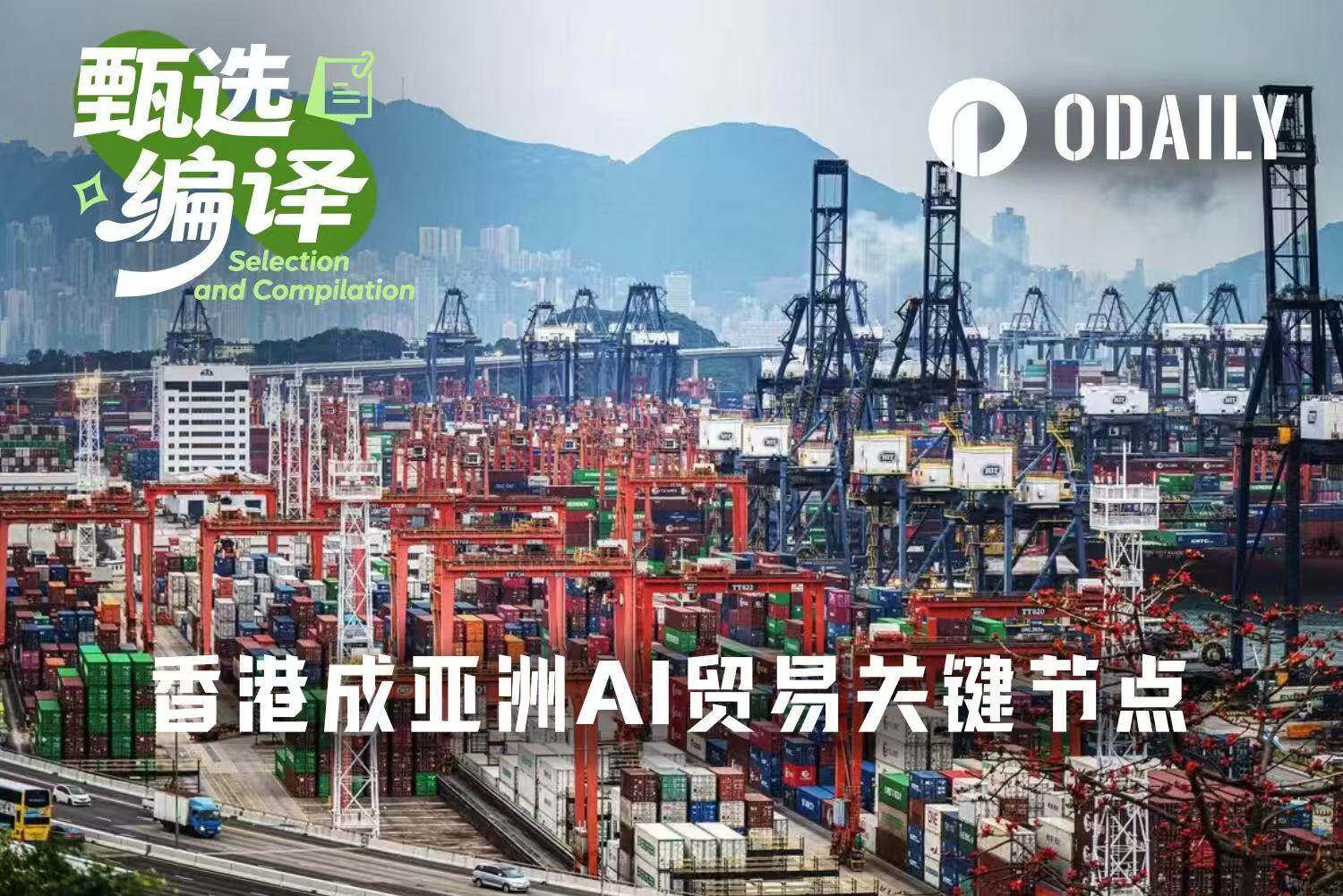
Hong Kong has emerged as a vital gateway for high-tech goods flowing into and out of China, becoming a key node in a $2 trillion Asian trade network fueled by the global artificial intelligence boom.
An analysis of official data by Bloomberg shows that in the first five months of 2026, Hong Kong accounted for over half of China's $239 billion in chip imports, the highest share on record. A decade ago, Hong Kong's share of mainland China's semiconductor procurement was only one-third.
After experiencing massive capital inflows, Hong Kong recently surpassed Switzerland to become the world's largest offshore wealth center. Now, it is carving out a new economic niche for the AI era. Official data released last week showed that Hong Kong's trade with China surged nearly 50% year-on-year in May, the largest increase (excluding the pandemic period) since 1992.
"Hong Kong's strong air freight network and free port status make it an ideal trade hub for semiconductors—goods that are high-value, lightweight, and time-sensitive," said Gary Ng, senior economist at Natixis. "Chip manufacturers can use Hong Kong for frequent, stable shipments, or flexible storage for future sales."
As a long-standing gateway connecting China to the world, Hong Kong operates a free port system with no capital controls, positioning it as a crucial link in the emerging commercial system taking shape in Asia, largely driven by AI infrastructure development.
Economists at HSBC believe this technology is "hard-wiring Asia into a tighter production group." They estimate that intra-Asian AI trade in 2025 has nearly doubled from pre-pandemic levels to close to $2 trillion.
But the middleman role comes with both advantages and risks. Hong Kong lacks the chip manufacturing capabilities of Taiwan and South Korea, and it does not have mainland China's market scale, making it vulnerable to geopolitical shifts.
Hong Kong has long been caught in the crossfire of the US-China trade war. During President Trump's first term, Washington revoked Hong Kong's special customs treatment, no longer treating it as a separate entity from China. Since Trump's return to the White House and the tightening of restrictions on China's access to the most advanced US chips, Hong Kong has ramped up its procurement of American-made semiconductors—likely those not subject to restrictions—and significantly increased purchases from third countries.
The chart below shows that Hong Kong's imports of US-origin chips have surged since Trump's second trade war with China:
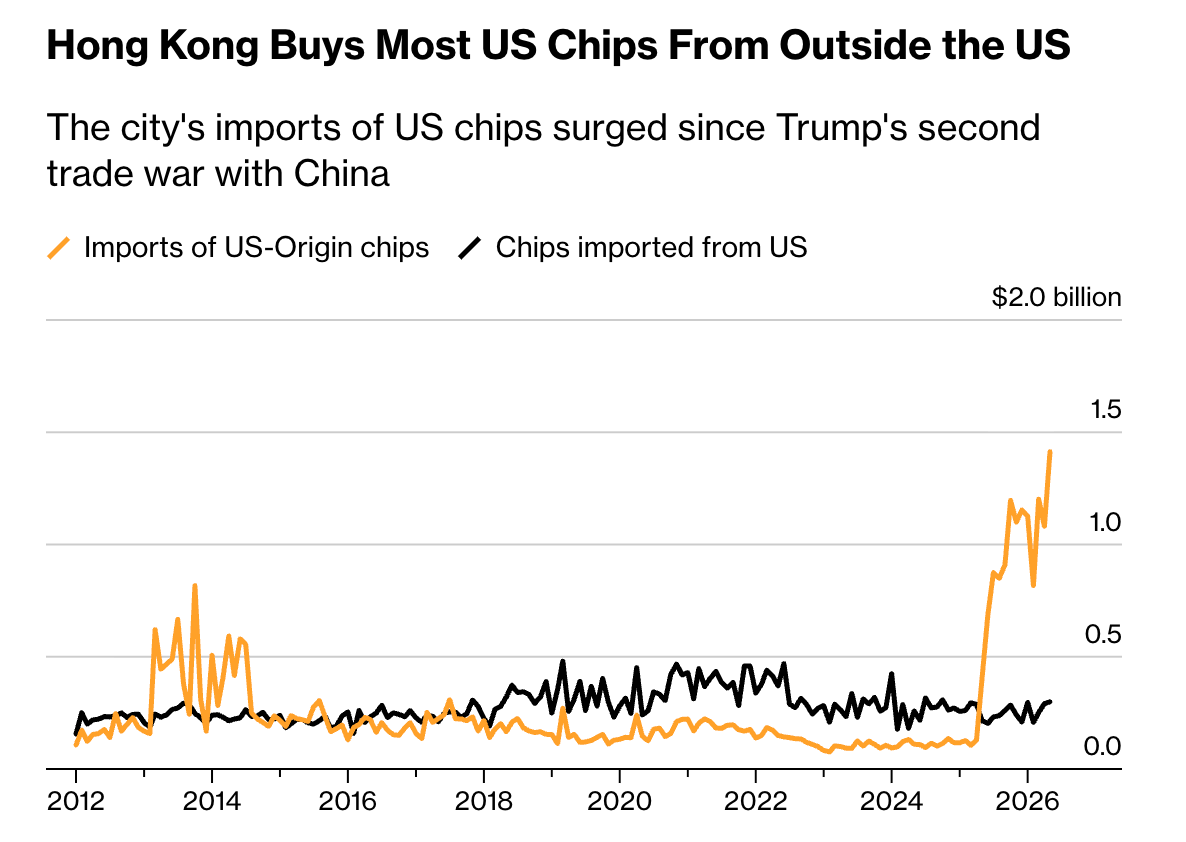
Yellow line: Imports of US-origin chips; Black line: Chip imports from the US; Data from 2012-2026; Peak ~$2 billion; Source: Hong Kong Census and Statistics Department
This risk is pushing Hong Kong to explore new markets. Chief Executive John Lee has personally led delegations to the Middle East, Central Asia, and Southeast Asia to diversify the economy.
For now, however, AI is the primary growth driver.
Despite its limited industrial base, according to Oxford Economics, Hong Kong exported nearly $159 billion in AI-related goods last year, ranking fifth in Asia and surpassing Japan.
"Hong Kong's strength lies in facilitating the flow of AI-related goods, not their production," said Yongshi Mai, an economist at the consulting firm.
Based on Bloomberg's calculations using data from Hong Kong's Census and Statistics Department, virtually all of Hong Kong's semiconductor shipments are re-exports, with over 80% by value going to mainland China. Of these chips, about 40% are supplied by mainland China, one-fifth by Taiwan, followed by Singapore and South Korea.
In S&P's latest Asia GDP growth outlook report, Taiwan and Hong Kong saw the largest rating upgrades, as shown below:
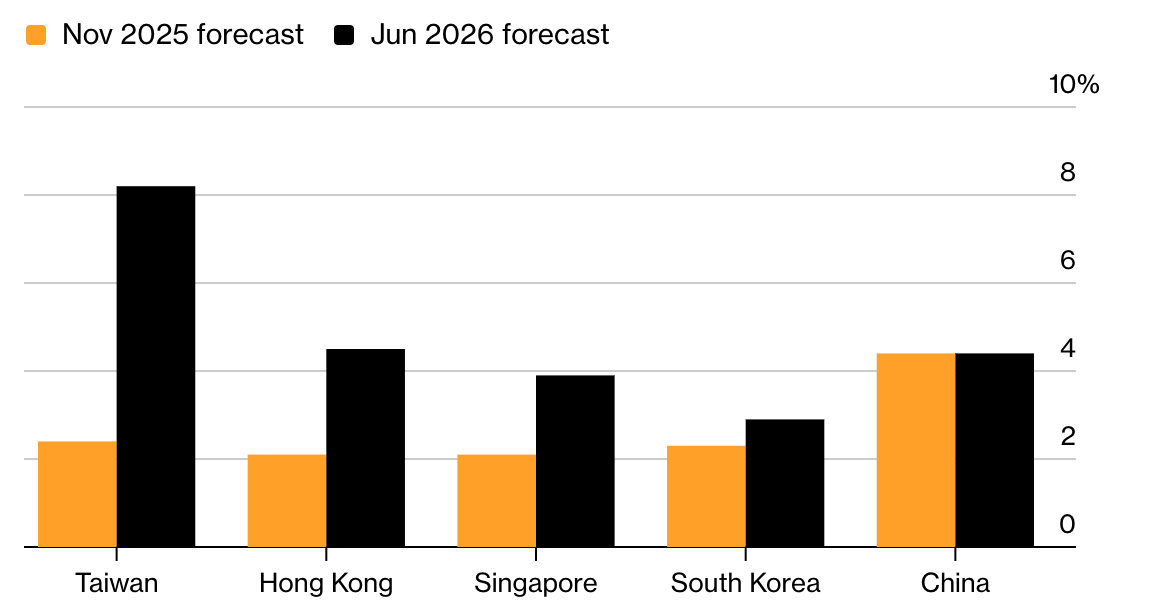
Source: S&P Global Ratings
Customs data shows that from January to May this year, Hong Kong re-exported $124 billion worth of semiconductors to mainland China, accounting for 52% of China's total chip imports. Despite a global energy shock triggered by the war in Iran, this economic boom helped Hong Kong's economy achieve its fastest growth rate in nearly five years in the first quarter.
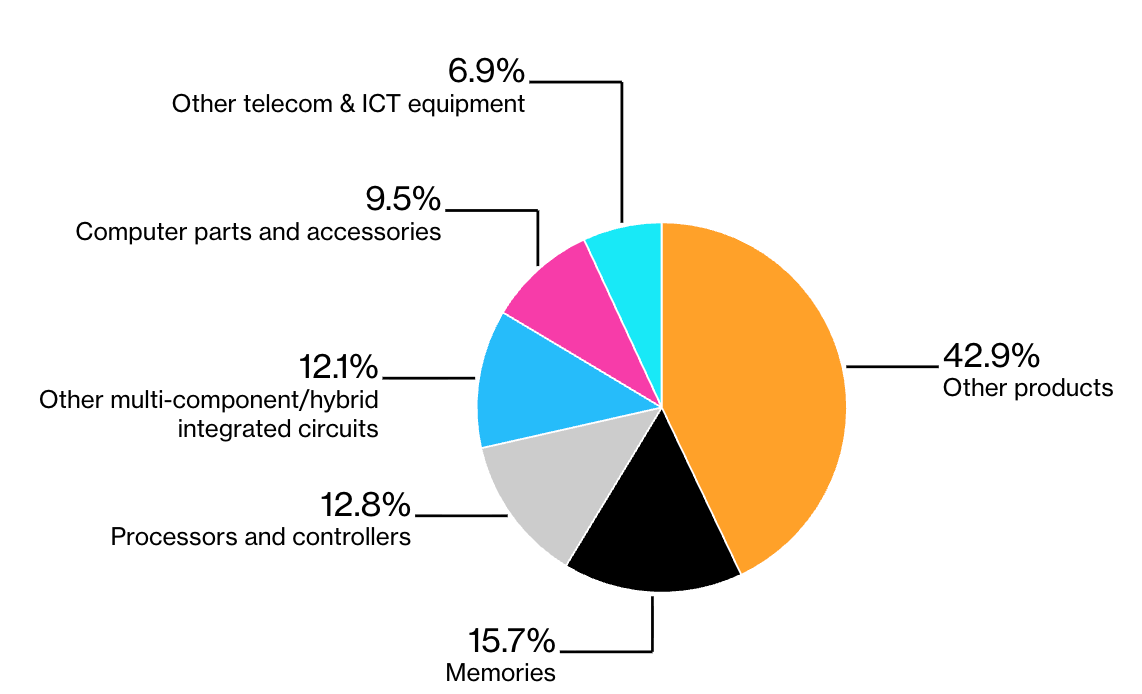
Furthermore, data show that the majority of Hong Kong's exports are AI-related; AI-related electronics accounted for 57% of total exports this year, up from 44% in 2024, as illustrated below:
Note: Data from January to May 2026; Source: Hong Kong Census and Statistics Department, HKTDC Research
Recently, the Hong Kong Trade Development Council more than doubled its 2026 export growth forecast for the region to over 20%, citing an AI-driven "technology upcycle." Its research shows AI-related electronics now account for 57% of Hong Kong's exports, up from 44% in 2024. Barclays estimates the figure as high as 70%.
Hong Kong levies no import tariffs—an advantage amid the tit-for-tat trade war and export controls between the US and China—although goods transshipped to mainland China are still subject to Chinese taxes.
Even so, mainland Chinese companies may prefer to trade through Hong Kong-based entities, as payments and currency exchange are often easier than dealing directly with foreign suppliers.
"As a middleman, Hong Kong has found ways to handle payments," said Charles Mok, a researcher at Stanford University and a former Hong Kong lawmaker representing the information technology sector. "This makes it easier for mainland buyers to operate."
Hong Kong has surpassed mainland China to become Taiwan's largest chip export market, and it is receiving triple-digit growth in shipments from South Korea.
This shift is occurring at a time when China is rising as the world's largest supplier of AI-related goods, even though mainland China remains a net importer of advanced chips. China's overseas semiconductor sales surged 111% in May, the fastest pace since 2013.
This boom has propelled Hong Kong's trade with China to record highs. In May alone, Hong Kong absorbed over $40 billion in Chinese exports—the largest monthly total since 2015, roughly three to four times the amount China shipped to Japan or Germany.
According to Chinese customs data, semiconductors drove most of this growth, accounting for over a third of total export value.
In maritime shipping, Hong Kong's middleman role has been declining for years as China built world-class ports in Shanghai, Ningbo, and Shenzhen, allowing mainland goods to directly access global markets. However, in the highest-value trade, Hong Kong still retains an advantage.
"For products with very high intellectual property content, Hong Kong still plays a role in quality assurance, standard verification, and intellectual property protection," said Heiwai Tang, an economics professor at the University of Hong Kong.
Hong Kong's status as an international aviation hub is another advantage. "Hong Kong is close to the mainland and can serve as a distribution center, seamlessly integrating air and land transport," said Michael Li Chi Fung, vice-chairman of the Nam Pak Hong Association trade group. "This is something other transit hubs like Singapore simply cannot do."