






White B.AI user base surpasses 2 million, marking the multi-model aggregation platform's entry into a phase of refined services


- Core Insight: The AI model aggregation platform White B.AI has surpassed 2 million users, with a daily token throughput of 18.69 billion and API calls accounting for up to 99.7% of total usage. The core driver of its growth is shifting from conversational AI to developer calls and agent operations. By implementing service tiering, diversified payments, and a unified API, it is building an AI service infrastructure geared towards high-frequency, production-grade scenarios.
- Key Elements:
- User and Data Growth: The platform has surpassed 2 million users, with a daily token throughput of 18.69 billion and API calls accounting for up to 99.7%, indicating deep integration into developer and enterprise system scenarios.
- Service Tiering Model: It offers official access and a self-service provider selection model. The latter groups models like Claude and GPT into discount tiers (e.g., 40% off, 60% off), catering to different task requirements for stability and cost.
- Diversified Payment System: Supports WeChat Pay, Alipay, bank cards, Visa/Mastercard, and multi-chain crypto asset payments to lower the conversion barrier for developers and high-frequency users across different regions.
- Deepening Developer Usage: The high API usage share indicates a shift from front-end conversations to backend calls, AI agent workflows, and automated processes, with the usage structure becoming more professional and high-frequency.
- Ecosystem Positioning and Trends: The platform is evolving from a "unified entry point" into the infrastructure for the AI agent era, aiming to connect model capabilities, service consumption, payment methods, and the developer ecosystem, adapting to continuous, high-frequency model call consumption.
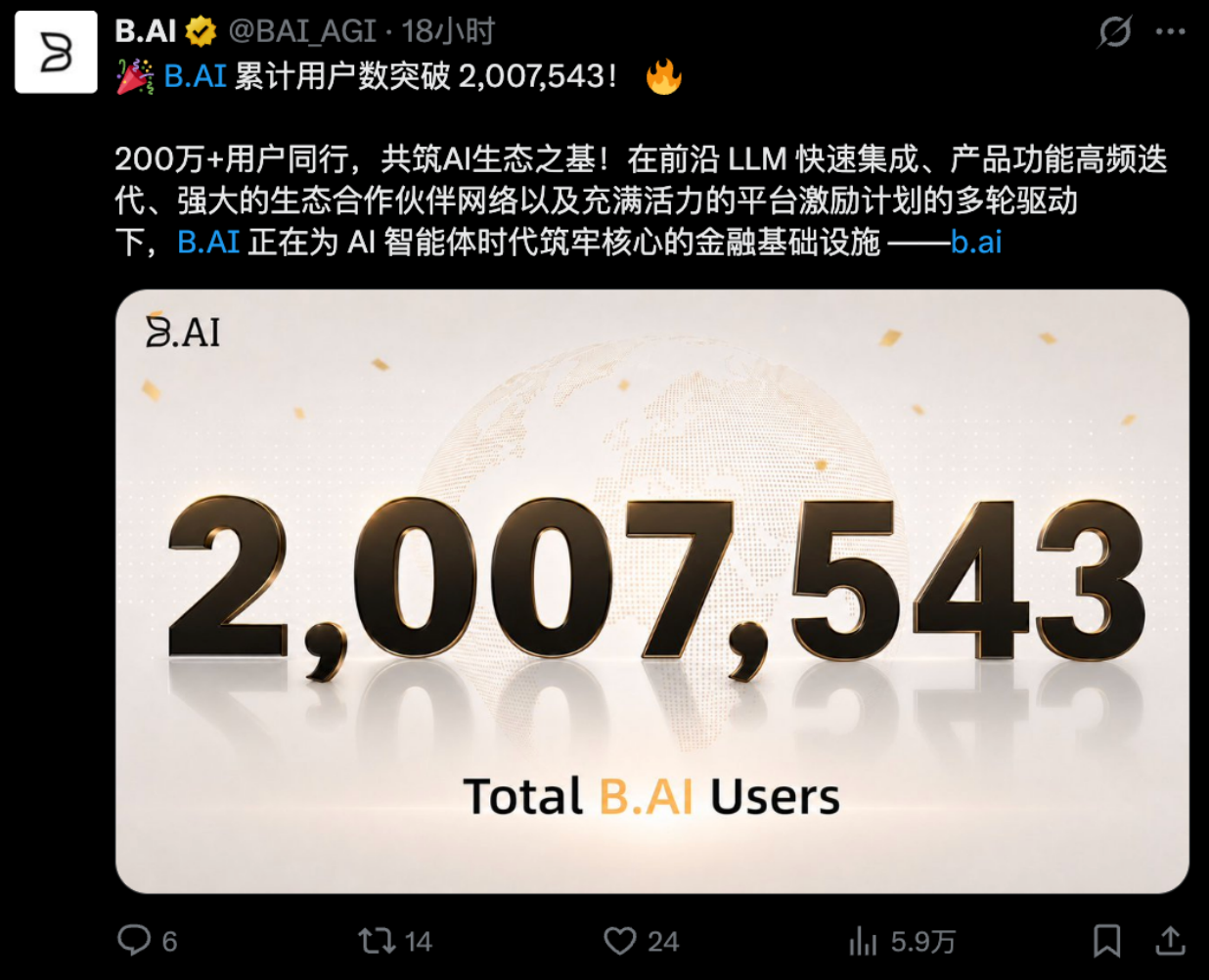
Recently, the AI model aggregation platform Bai B.AI has reached a new growth milestone. According to the latest disclosure on its official X account, the platform's user base has surpassed 2 million. Concurrently, the platform's actual call data is also increasing: Bai B.AI's recent single-day token throughput peaked at 18.69 billion, with API calls accounting for up to 99.7%, primarily supporting large-scale AI Agents, automated workflows, and enterprise-level core system applications. This indicates that BaiB.AI's growth is no longer confined to front-end conversational scenarios but is penetrating high-frequency use cases such as developer calls, Agent operations, and production-level system integration, generating more sustainable real-world consumption.
Over the past year, the competitive focus of the global AI industry has been shifting. As large language model capabilities rapidly iterate, users and developers are no longer solely concerned with whether a single model is powerful enough. Instead, they care more about how to efficiently select between different models, how to control token costs, and how to stably integrate AI capabilities into real business processes. The sustained attention on model aggregation and routing platforms like OpenRouter demonstrates that multi-model coexistence has become a key direction for AI application development. Bai B.AI's growth further points to another trend: AI model aggregation platforms are evolving from a "unified entry point" to more refined service layering. Platforms must not only provide model calling capabilities but also offer users greater flexibility in choosing based on stability, pricing, payment habits, and use scenarios.
Refined Multi-Model Calling, Bai B.AI Strengthens Service Layering Capabilities
Against the backdrop of the rapidly expanding large model ecosystem, complex reasoning, code generation, long-text processing, multimodal tasks, and low-cost high-frequency calls often correspond to different model capabilities. For ordinary users, switching accounts, subscriptions, and payments across multiple platforms is inefficient; for developers and enterprises, integrating separate model interfaces introduces additional engineering costs, billing challenges, and stability issues.
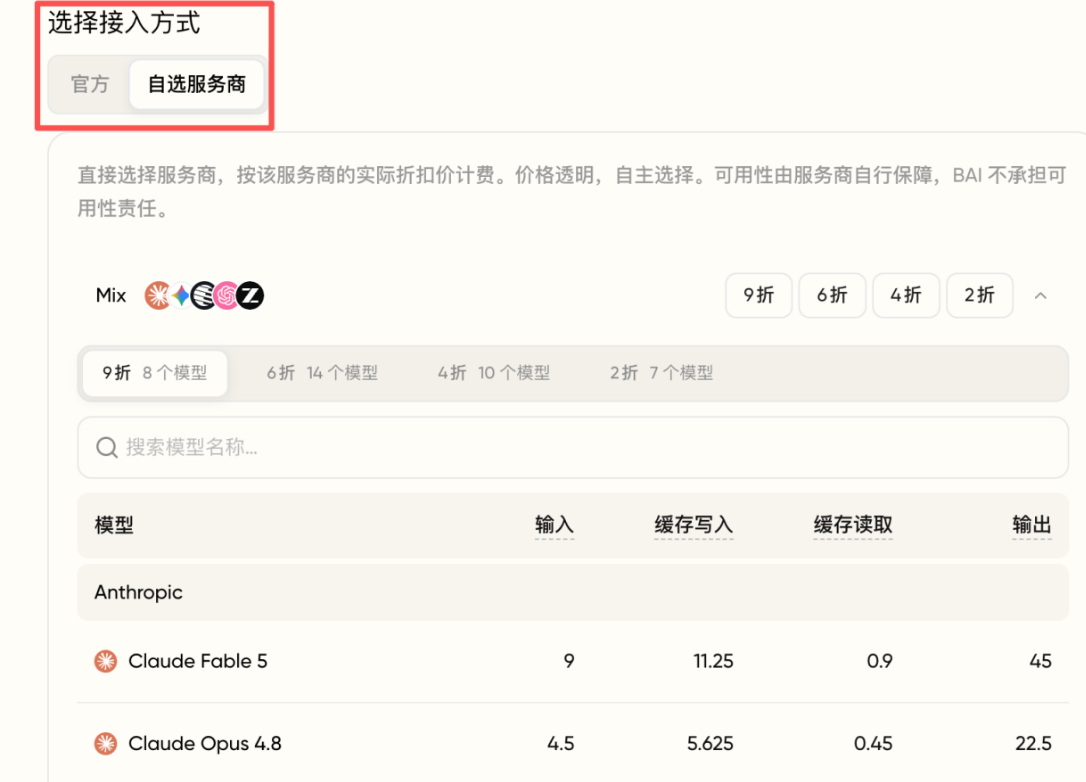
Bai B.AI addresses precisely this pain point. As an AI model aggregation platform, Bai B.AI provides a unified entry point to access multiple mainstream large models and offers API services compatible with common calling methods. This allows users and developers to manage model selection, calls, and cost control on a single platform. Compared to a single-model entry point, Bai B.AI emphasizes using AI services tailored to specific scenarios: production-grade applications with higher stability requirements can opt for more standardized, stable official access; cost-sensitive scenarios like testing, exploration, AI Agents, and batch calls can leverage self-selected service providers for more flexible pricing plans.
This design also makes Bai B.AI's differentiation clearer. According to Bai B.AI's official X platform information, the self-selected service provider model currently offers discount groups such as 10%, 40%, 60%, and 80% off, covering mainstream model series including Claude, Gemini, GPT, Kimi, and GLM, and can be stacked with top-up bonus promotions. In other words, Bai B.AI does not merely provide a fixed-price model entry point; it breaks down AI services into different consumption tiers: core production tasks prioritize availability, while testing environments and high-frequency call scenarios emphasize cost efficiency. For developers, the value of this model lies not in "having more models," but in being able to choose the most suitable service path based on task importance, call frequency, and budget constraints.
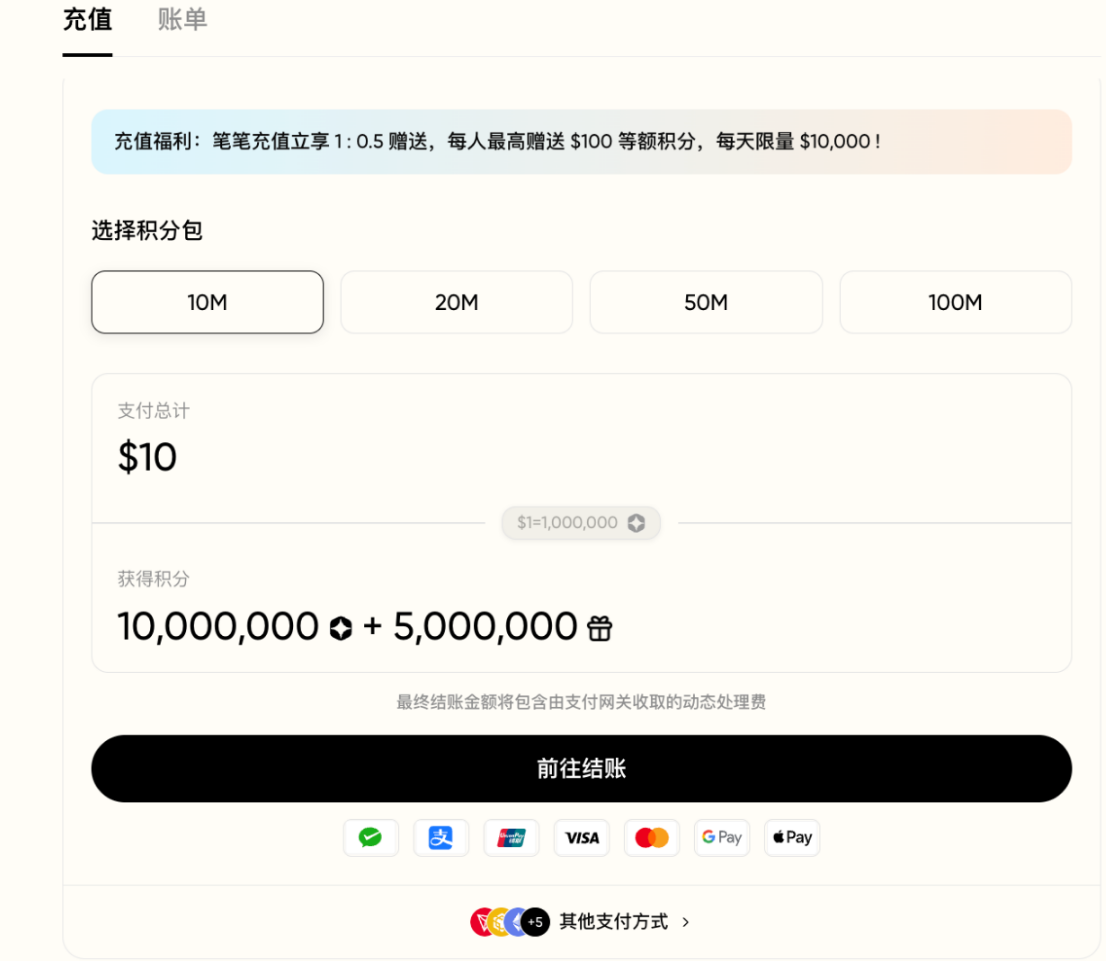
The diversification of payment methods also serves this logic. Bai B.AI currently supports common fiat payment methods such as WeChat Pay, Alipay, bank cards, as well as UnionPay, Visa, Mastercard, Google Pay, and Apple Pay, along with multi-chain, multi-currency cryptocurrency payments. Compared to a single payment method, this arrangement is better suited to covering users from different regions and with different habits, and helps lower the barrier for developers and high-frequency callers to transition from testing to sustained use. Previously released data showed that Stripe payments accounted for 69.0% of the platform's core paying user base. Combined with the increase in API call share, this indirectly reflects the growing user stickiness among traditional developers and production-level users.
Behind the High API Proportion, Bai B.AI is Entering Deeper Developer Scenarios
From a usage structure perspective, Bai B.AI's recent API call share has reached up to 99.7%, with platform consumption driven more by developer interfaces, automated tasks, AI Agent workflows, and enterprise-level system calls. Previously released data also showed that the DeepSeek-V4 series once contributed nearly 60% of token consumption. Combined with the recent rise in calls for models like MiniMax M3, BaiB.AI's user usage structure reveals two characteristics.
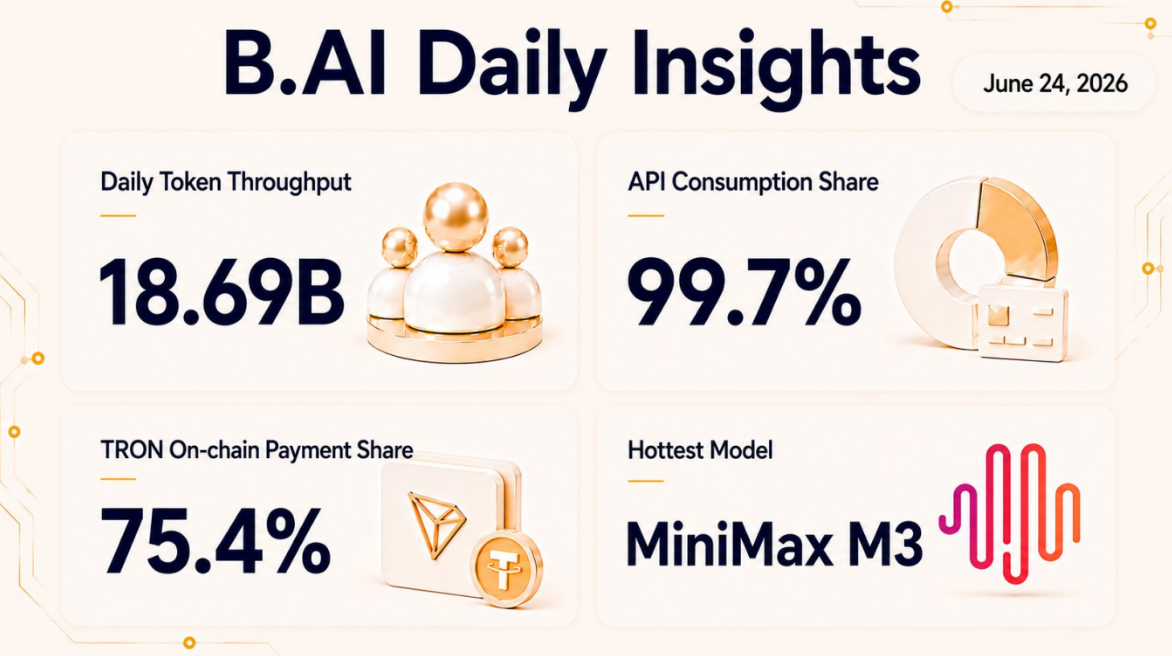
On one hand, the platform is attracting more traditional developers and production-level users, extending use cases from front-end conversations to back-end calls and automated workflows. On the other hand, users are beginning to make practical choices between different models based on cost, performance, and task type: complex tasks can opt for stronger models, high-frequency tasks can choose more cost-effective models, and testing scenarios can leverage service providers with more flexible discounts. This further highlights the practical value of model aggregation, intelligent routing, and multi-service provider integration.
As AI Agents move from demonstrations to real-world workflows, model calls will no longer be one-off conversations but continuous, high-frequency, billable service consumption. For an Agent to truly integrate into a business system, it not only requires model capabilities but also stable interfaces, clear billing, flexible payments, and a sustainable operating service environment. BaiB.AI's current focus on building a unified API, multi-model access, service layering, and diverse payment experiences is precisely to adapt to this new way of using AI.
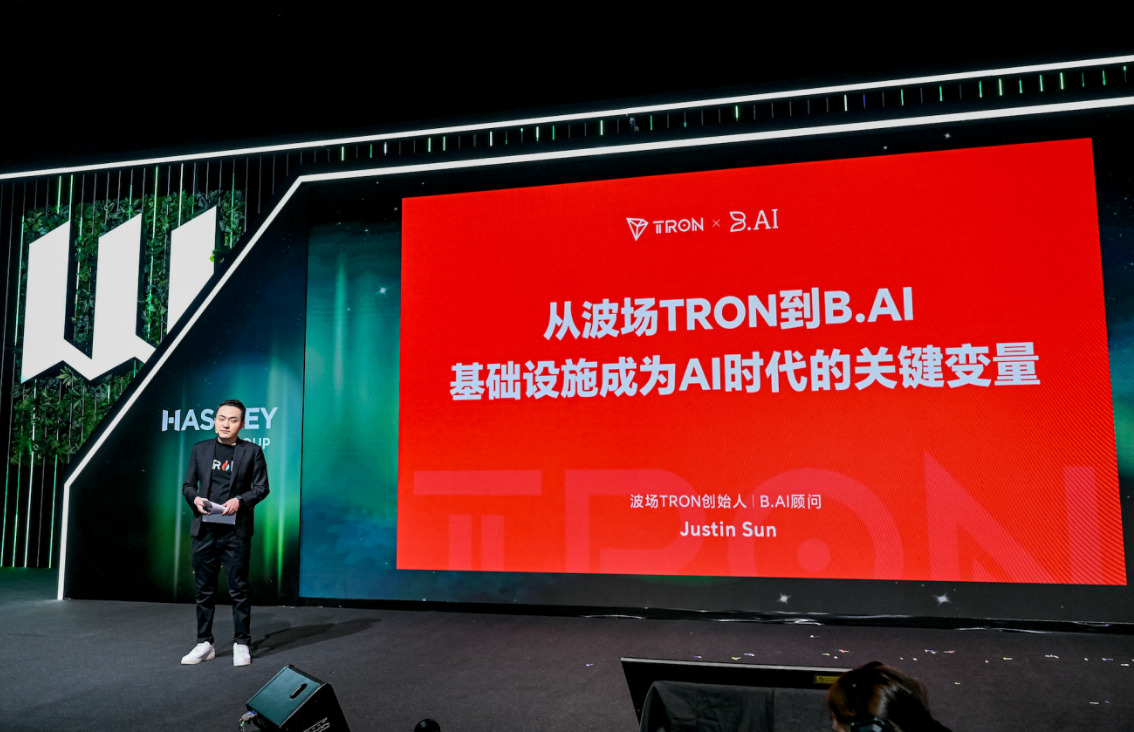
The involvement of Tron founder Justin Sun as an advisor to Bai B.AI also makes it easier for outsiders to understand its long-term strategic layout from the perspective of AI service infrastructure. Sun has repeatedly emphasized that the era of AI Agents requires new underlying capabilities. As AI transitions from an auxiliary tool to autonomous execution, model calls, resource purchases, and automated settlements will become higher-frequency demands. The value of Bai B.AI lies in its attempt to provide lighter, more flexible, and more scalable underlying support for these new forms of AI service consumption and Agent operation scenarios.
From surpassing 2 million users to achieving a single-day token throughput of 18.69 billion and an API call share of up to 99.7%, Bai B.AI is forging a clearer development path. In the short term, it serves as an aggregated entry point for users and developers to access multi-model capabilities; in the medium term, it is a service platform for AI applications and Agents to reduce call costs and improve integration efficiency; in the long term, as AI Agents become more widely involved in task execution and machine-to-machine collaboration, Bai B.AI aspires to become an AI infrastructure platform connecting model capabilities, service consumption, payment methods, and the developer ecosystem.


