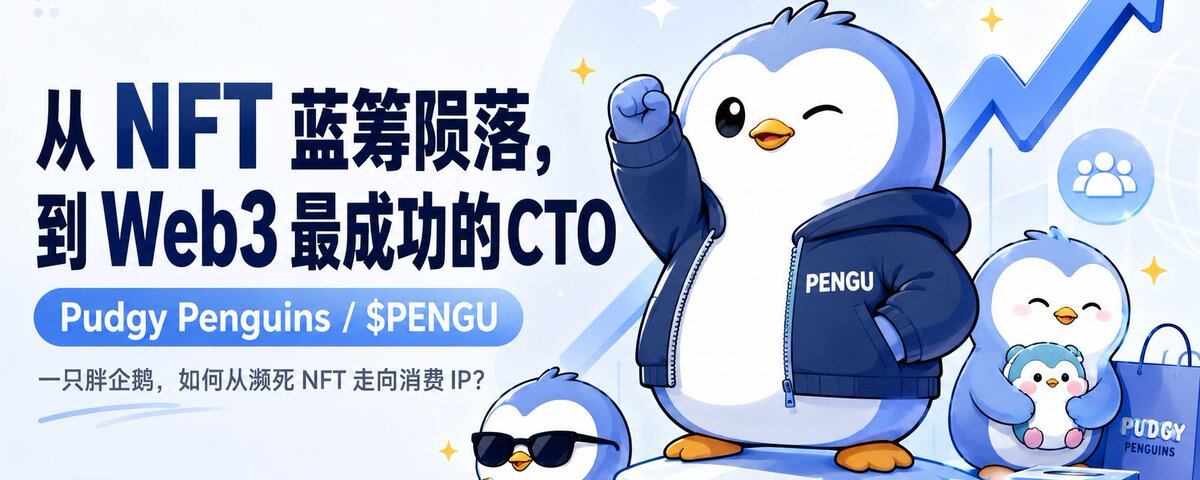
The most successful CTO in Web3: Pudgy's community rescue


- Core Thesis: The Pudgy Penguins NFT project staged a remarkable comeback from near-death in 2022 by implementing a Community Takeover (CTO) and strategically transforming its NFT characters into a physical consumer IP. It now plans to drive the company toward an IPO by 2027.
- Key Factors:
- In January 2022, due to slow project progress and a crisis of trust, the community voted to oust the founder, causing the NFT floor price to plummet to approximately 0.5 ETH.
- In April 2022, Luca Netz acquired the project's IP and operational rights for 750 ETH (around $2.5 million), marking one of the most successful CTOs in Web3.
- Post-acquisition, the team faced a collapsing NFT market and went 11 consecutive months without pay (80% of members), pivoting to develop the NFT characters into a consumer goods IP.
- In 2023, Pudgy Toys launched in 3,100 Walmart stores across the U.S. Physical toys feature QR codes that direct consumers to Pudgy World and allow NFT holders to earn IP licensing royalties.
- Targeting $120 million in revenue by 2026, the brand has partnered with the NHL and Manchester City, launched a Visa payment card (100,000 registrations), and sold over 4 million units of the Vibes TCG card game.
- The $PENGU airdrop (2024) was notably generous, covering early Solana users. Each Pudgy Penguin NFT could claim over $100,000 worth of tokens at peak value.
A few days ago, I tweeted about preparing to buy a Pudgy Penguins NFT, and many friends asked why. Isn't NFT already outdated? Why spend so much money on one now?
Most Chinese-speaking users probably first encountered Pudgy Penguins because of the $PENGU airdrop in 2024. That airdrop was remarkably generous, you could even call it a "universal blessing." Even if you didn't hold a Pudgy Penguins NFT, just being an early trader on Solana might have earned you hundreds of dollars worth of $PENGU.
What was truly astonishing was the situation for Pudgy Penguins NFT holders. On the eve of the airdrop, the NFT floor price skyrocketed to over 30 ETH. Each Pudgy Penguins NFT could claim approximately 1.7 million tokens, and each Lil Pudgy about 188,000. Based on the token price at the time, one large penguin corresponded to tens of thousands of dollars, at its peak exceeding $100,000. A single Lil Pudgy also surpassed $10,000 at its peak. For on-chain enthusiasts like @wenxue600, who held multiple NFTs, it wouldn't be an exaggeration to say they received a million-dollar airdrop based on their holdings.
But many brothers who claimed the airdrop didn't understand the story behind it.
$PENGU is not just a memecoin that appeared out of nowhere. The Pudgy Penguins behind it once nearly died during the craziest era of NFTs.
In 2022, the Pudgy Penguins floor price once plummeted to around 0.5 ETH, and the community even voted to oust the founder. Four years later, it entered 3,100 Walmart stores across the US, collaborated with Manchester City and the NHL, launched a payment card connected to the Visa network, and set a 2026 revenue target of $120 million.
This might be the most incredible turnaround in Web3.
So, how did Pudgy Penguins survive? The story starts in 2021 when 8,888 Pudgy Penguins were minted at 0.03 ETH, selling out in less than 20 minutes. Within a month of launch, The New York Times even published a feature article. Back then, few doubted it would become the next blue-chip NFT.
But what truly makes Pudgy special isn't how it took off, but how it later fell and then climbed back up.
By the end of 2021, the promised games, tokens, and ecosystem had yet to materialize. The mystery egg eventually hatched into a fishing rod, and the community immediately turned "Rods" into "Rogs," subtly mocking the project as a rug pull.
More severe was the crisis of trust. The original team was suspected of draining the treasury and planning to sell the project and exit. By January 2022, holders initiated a vote on Discord demanding the removal of founder Cole. For the first time, an NFT community acted like shareholders and voted out its own founder.
But removing the founder didn't guarantee the project's survival. At that time, the Pudgy floor price had dropped to around 0.5 ETH. The community was fractured, the project treasury was nearly empty, and some holders even used Wrapped Penguins to bypass the original team's royalties. That penguin wasn't just "facing difficulties"; it was genuinely on the verge of extinction.
The turning point came in April 2022 when @LucaNetz acquired the IP and operational rights of Pudgy Penguins for 750 ETH, equivalent to about $2.5 million at the time. This deal was later hailed by many as the most successful CTO (Community Takeover) in Web3.
But the reality after the takeover wasn't a fairy tale; it was arguably quite harsh. Luca later recalled: when the team took over, the treasury was nearly empty. Then came the NFT bubble burst: trading volume collapsed by 95%, ETH dropped around 80%, and the royalty model crumbled. At the most difficult time, 80% of the team members went without salary for 11 consecutive months.
Pudgy's turnaround wasn't simply about changing management and pumping the NFT floor price again. What they did right was to stop treating the NFT price as the product and instead start treating the character behind the NFT as a genuine consumer IP.
In 2023, Pudgy Toys began appearing on Amazon and Walmart's marketplace. Within less than a year, products were stocked in 3,100 Walmart stores across the US. Each toy includes a QR code that can bring ordinary consumers – who have no knowledge of wallets or NFTs – into Pudgy World. Interestingly, these physical toys use the penguin designs owned by community holders, and eligible NFT holders can also receive IP licensing revenue.
This means NFT holders aren't just buying a picture; they can participate in the creation and distribution of brand value. This was the most crucial step in Pudgy's journey from OpenSea to Walmart.
Looking at 2026, Pudgy's roadmap increasingly resembles something other than a traditional NFT project:
- Collaborating with the NHL to host offline events at the 2026 Winter Classic;
- Launching co-branded collectibles and merchandise with Manchester City, expanding the partnership after initial cooperation;
- Launching the Pengu Card, connected to the Visa payment network, supporting Apple Pay and Google Pay, covering approximately 150 million merchants globally, with the virtual card quickly reaching 100,000 sign-ups;
- Officially launching the free web game Pudgy World, giving real use cases to the digital content obtained by scanning QR codes on physical toys;
- Vibes TCG trading cards cumulative sales exceeding 4 million units
The CEO set a 2026 revenue target of $120 million and has publicly expressed a desire to push for the company's IPO before 2027. Looking at all these initiatives together, the picture becomes very clear. NFTs brought the first group of owners and evangelists, toys brought it into ordinary households, social media and memes drove continuous exposure for the penguin image, while games, cards, and payment products kept expanding its use cases. $PENGU lowered the barrier to participation from an expensive NFT to a much larger internet community.
The reason the NFT bubble burst is that most NFT projects ultimately died trying to answer the question, "What do we do after selling pictures?" Pudgy was almost there too, but it survived. It survived because it stopped relying on the next wave of buyers at higher prices and instead started answering a more important question: Can this penguin become a brand that people genuinely like, buy, and use?
So, my desire to buy a Pudgy Penguins NFT isn't just because the NFT has been rising in price recently. Back then, although I didn't hold a Pudgy Penguins NFT, just by being an active user on the Solana chain, I also received thousands of dollars worth of $PENGU airdrop. Now, picking up an NFT as an afterthought and treating it as an identity credential for this IP and community seems like a good choice to me.
Recently, I also noticed that the Pudgy Penguins Chinese community @PudgyChina is restarting. In a bull market, everyone talks about price; it's actually the bear market that is better for seriously building a community. If interested, you can also follow: @PudgyChina @pudgypenguins @LucaNetz