






SPCX drops below its IPO price of $150 in pre-market trading, but don't rush to buy the dip just yet


- Key Takeaway: The SpaceX Starship test explosion and the launch of a $20 billion bond financing round, combined with a global correction in AI-related stocks, led to a three-day stock price plunge. The market cap evaporated by approximately $400 billion, falling below the closing price on its IPO debut, dealing a blow to market confidence.
- Key Factors:
- The explosion during the Starship static fire test on June 18, considered the most serious ground accident to date, triggered market panic.
- On June 22, SpaceX announced the initiation of at least $20 billion in bond financing to repay bridge loans used for the acquisition of xAI, raising investor concerns about cash flow and capital expenditures.
- SPCX plummeted over 16.43% in a single day, with its market cap evaporating by approximately $400 billion, marking the second-largest single-day market value loss in global corporate history.
- A broad correction in global AI-concept stocks saw South Korea's KOSPI index fall over 9% and Hong Kong-listed MINIMAX drop 15%, exacerbating the downward pressure on SpaceX's stock.
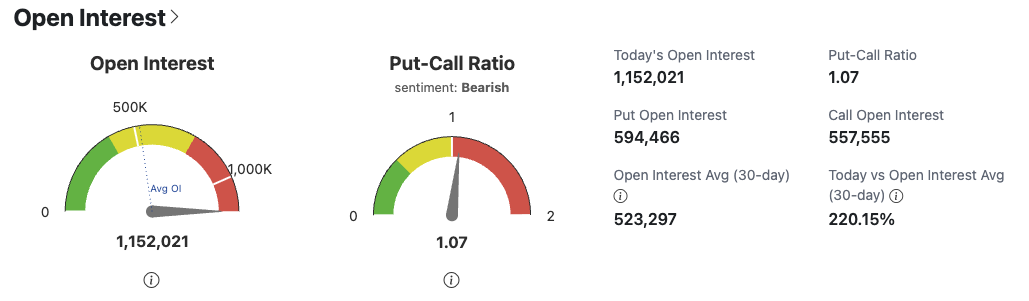
- Retail buying momentum dried up, with the put/call ratio rising to 1.07, shifting market sentiment to a neutral-bearish stance. Furthermore, with only 5% of the total shares trading since the IPO, expectations of equity unlocking are creating additional downward pressure.
- ARK Invest bucked the trend during the crash, buying approximately 210,000 shares, betting on SpaceX's long-term disruptive innovation. However, most institutions like Morningstar and KeyBanc believe the current valuation already fully reflects future growth.
Original by Odaily Planet Daily (@OdailyChina)
Author: Golem (@web3_golem)
On the evening of June 18, SpaceX's Starship, designated SN36, exploded during its 10th static fire test, creating a massive fireball on site. Fortunately, no injuries were reported. This was SpaceX's most severe ground accident in recent times, causing extensive damage to all test facilities. Western media outlets have described it as a "catastrophic failure."
The "ripple effects" of this explosion quickly spread to the capital markets. Since June 18, SPCX has declined for three consecutive trading days, with a drop of over 16.43% on June 22 alone. The single-day market value loss amounted to approximately $400 billion, marking the second-largest single-day market value loss in global corporate history.
Worse still, SPCX has fallen below its IPO first-day closing price ($160.95). According to Hyperliquid data, it briefly dipped below its listing opening price ($150) in after-hours trading. If it indeed breaks below $150 when the US stock market opens on June 23, it would mean that all investors who bought and held SPCX in the secondary market are now underwater.
Is this consecutive decline a loss of investor confidence in SpaceX or a short-term market sentiment correction? How will SpaceX's stock price perform going forward? Odaily Planet Daily provides a brief analysis in this article.
The $20 Billion Bond Offering Might Just Be the Trigger
The direct trigger for SPCX's over 16% plunge on June 22 was SpaceX's announcement to launch its first senior unsecured notes offering. Although SpaceX's 8-K filing with the SEC didn't disclose the specific offering size, Bloomberg reported last week that SpaceX was planning a bond offering of at least $20 billion. SpaceX confirmed the proceeds will be used to repay bridge loans, pay related fees, and for general corporate purposes. The bridge loan was incurred from SpaceX's acquisition of Musk's own company, xAI, in February of this year.
However, raising debt via bonds less than two weeks after going public is not good news for investors. While the additional interest expense from the bond issuance is a minor concern, the major negative implication is that SpaceX still needs additional financing, signaling potential underlying issues.
SpaceX had already raised $85.7 billion in its IPO, and according to disclosures, holds approximately $100.8 billion in cash and cash equivalents. This has become the latest point of attack for bears. A recently listed company with over $100 billion in cash on its books yet again borrowing from the market suggests that SpaceX has not yet achieved positive free cash flow, and that the cash burn rate for Starship and AI infrastructure capital expenditure has far exceeded market expectations.
CFRA Research, an agency that had previously maintained a sell rating on SpaceX, also questioned the necessity of this massive fundraising, commenting, "With Elon Musk, you never know what's going on in his head."
Renowned tech hedge fund manager Dan Niles also posted on X that the SpaceX bond issuance and its computing power agreement with Reflection AI might serve as a reminder to investors that the market has another hyperscale AI competitor requiring massive funding. He has previously expressed concerns about its high valuation.
Dragged Down by the Global AI Stock Sell-off
The bond offering announcement might just be the trigger for SpaceX's decline, but its stock price pressure is also due to the broader pullback in global AI concept stocks.
On June 23, AI concept stocks fell broadly not only in the US market close but also experienced corrections in markets worldwide. South Korea's KOSPI index became the worst-performing major index in Asia, falling over 9%. The South Korean stock market triggered a circuit breaker in the morning and continued to decline in the afternoon, with SK Hynix and Samsung Electronics both dropping over 12%. Meanwhile, Hong Kong's AI duos also plummeted, with MINIMAX down 15% and Zhipu down over 9%. The four major A-share indices also collectively declined in early trading.
The global correction in AI stocks is primarily due to growing investor concerns that the massive investment in AI infrastructure may not yield corresponding returns due to excessively long commercial return cycles. SpaceX is also considered one of the representative companies in this narrative, with investment scales far exceeding the pace of commercial returns, naturally leading to significant stock price declines.
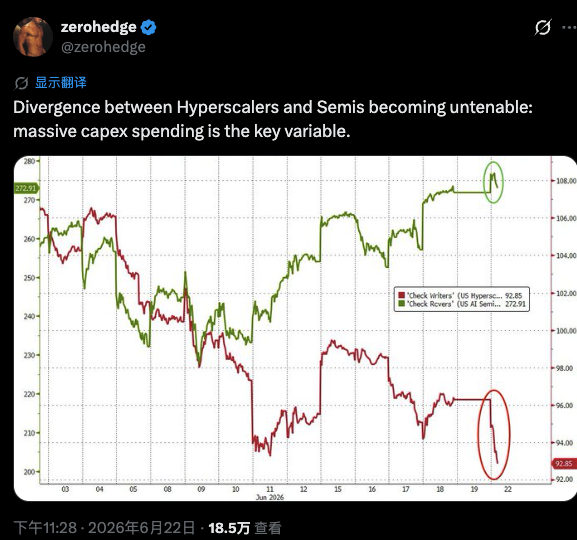
US financial media outlet zerohedge stated on X on June 22 that the divergence between hyperscale cloud providers and semiconductors is intensifying, with massive capital expenditures becoming the key issue.
Retail Buying Power Dries Up, Equity Unlocking Overhang Materializes Early
Since its listing, SpaceX has been one of the most sought-after stocks by retail investors in the US market. Because initially only less than 5% of the float was tradable, SPCX's price was effectively driven up by retail investors. According to Vanda Track statistics, retail investors net bought $405 million worth of SPCX in its first five trading days. The retail buying volume for SPCX surpassed their total purchases of the other six of the "Magnificent Seven" tech stocks combined, which only saw $278 million in purchases during the same period for NVDA, MSFT, AMZN, META, GOOGL, and GOOG.
However, retail buying power cannot provide long-term price support for SPCX. On the contrary, the more aggressive the initial retail buying, the faster this momentum will dissipate once the truly interested buyers are done and market sentiment cools down.
SpaceX options trading began on June 16, initially dominated by bullish sentiment. But according to OptionCharts data, SPCX's current Put-Call Ratio is 1.07. From a sentiment perspective, investors have turned slightly bearish-neutral. While not yet a consensus bearish view, it at least indicates that retail investors are beginning to show hesitation.
This sharp decline in SPCX has occurred with only 5% of the float being tradable. How can SPCX hold up when the equity unlock date arrives? To some extent, the current stock price decline is a pre-emptive pricing-in of the negative impact from the equity unlock, with investors possibly waiting to re-enter their positions after the first round of unlock by SpaceX insiders.
According to regulations, after SpaceX releases its Q2 earnings report in mid-August, 20% of the stock will be unlocked. If, at that time, the stock price is 30% above the IPO price and meets that standard for 5 out of 10 trading days, an additional 10% could be unlocked.
Jeff Jacobson, a strategist at 22V Research, suggested that insiders could sell up to 44% of SpaceX's shares before early September, which would increase the current public float by approximately 900%.
The next potential positive catalyst for SpaceX is its possible inclusion in the Nasdaq 100 index in July. However, due to the three consecutive days of price decline, investor fear regarding SpaceX currently outweighs the anticipation of this potential positive catalyst.
Bull and Bear Arguments
In contrast to the first week of listing, bearish sentiment now dominates the market for SpaceX. The main arguments for bulls and bears are as follows.
Short-selling Tools Filled In, Correction Materializes; Valuation Already Priced In Future Growth
On June 18, after SpaceX announced the $60 billion equity acquisition of Cursor, independent investment research firm Morningstar not only refrained from raising its expectations for SpaceX's AI business but actually lowered its fair value estimate from $63 to $62. They believe that without solid quarterly earnings to support it, the current stock price is entirely narrative-driven.
Gary Black, co-founder of Future Fund, previously pointed out that before SPCX options trading began, SpaceX's trading logic was completely detached from fundamentals. "It was trading more like a meme stock than a fundamentally driven company. Therefore, the current crash is an inevitable correction after the short-selling tools were filled in."
On June 22, US investment bank KeyBanc Capital Markets (KBCM) initiated coverage on SPCX with a Neutral rating. While not providing a price target, its analysts stated that SpaceX's current valuation already fully reflects future growth, and the stock price could potentially be halved. Although there are long-term growth drivers, many of the positive catalysts have already been "priced in."
Cathie Wood Becomes a Staunch SPCX Bull
Twilight reveals the faithful. Cathie Wood's ARK Invest, already a major Bitcoin bull, is now one of the most steadfast bulls for SpaceX. On the day of SpaceX's IPO, ARK Invest aggressively bought about 3.3 million shares, valued at over $500 million on that day. On June 22, the day of SPCX's sharp decline, ARK purchased approximately 210,000 shares of SPCX (worth about $38.9 million) through several of its ETFs, including ARKK and ARKQ.
Previously, in 2024, ARK's models estimated SpaceX's enterprise value to reach $2.5 trillion by 2030, with an optimistic scenario approaching $3.1 trillion. At that time, ARK's estimate was for a then-unlisted company valued around $180-350 billion. Now that SpaceX is successfully listed and its market cap once approached ARK's model estimates from back then, ARK's decision to increase its stake likely reflects a long-term bullish view on disruptive innovations like reusable rockets, Starlink, and the space economy.


