






想买的人已经买完了:SpaceX散户狂欢退潮,真正的抛压还在8月


- 核心观点:SpaceX(SPCX)上市后经历散户狂热推动的短暂暴涨,但动量迅速消退,在抛压担忧和内部股份解禁预期下,股价连跌三天,回吐全部涨幅至开盘价附近,市场认为“想买的人已买完”。
- 关键要素:
- SpaceX上市首日开盘价150美元,随后六天内涨至225美元历史高点,市值一度超过微软,但散户日度资金流在6月16日见顶后崩溃。
- 上市首周散户净买入4.05亿美元SPCX,超过同期所有Mag 7个股(合计2.78亿美元)及SPY和QQQ ETF的散户买盘总和。
- 当前仅5%流通盘可交易,但内部人股份将在8-9月逐步解禁,首次20%于财报后释放,截至9月初最多可出售44%股权,扩大流通盘约900%。
- 散户资金迅速涌向杠杆产品,如2倍做多SPCX ETF在头数日吸引6580万美元,但后续需求远低于典型狂热水平。
- 6月16日见顶后,股价连跌三日,周一单日暴跌16.4%,抹去6000亿美元市值,盘后触及150美元上市开盘价,威胁所有二级市场买入者。
- 分析师警告,美股市场(尤其是科技股)当前上涨依赖散户狂热和动量,一旦散户退缩,抛盘压力可能扩散至存储和半导体板块。
Original Author: Tyler Durden (ZeroHedge pseudonym)
Original Translation Edited by: Source: ZeroHedge
Overview: SpaceX has fallen for three consecutive days, with a single-day plunge of 16.4% on Monday, wiping out $600 billion in market value and falling back to the IPO opening price of $150. This analysis is blunt: everyone who wanted to buy has already bought, and more critically, the selling pressure hasn't truly arrived yet. This pump-and-dump operation used only 5% of the float, and insiders could sell up to 44% of their shares by early September.
It started with a bang. SpaceX went public on June 12, with an opening price of $150, well above its $135 IPO price. Within two days, aggressive traders began frantically buying $380 call options expiring two days later, aiming to send the stock price to the moon and create a gamma squeeze (where market makers are forced to buy the underlying stock to hedge options, pushing the price higher).
@zerohedge tweeted: They're really going for it this time.
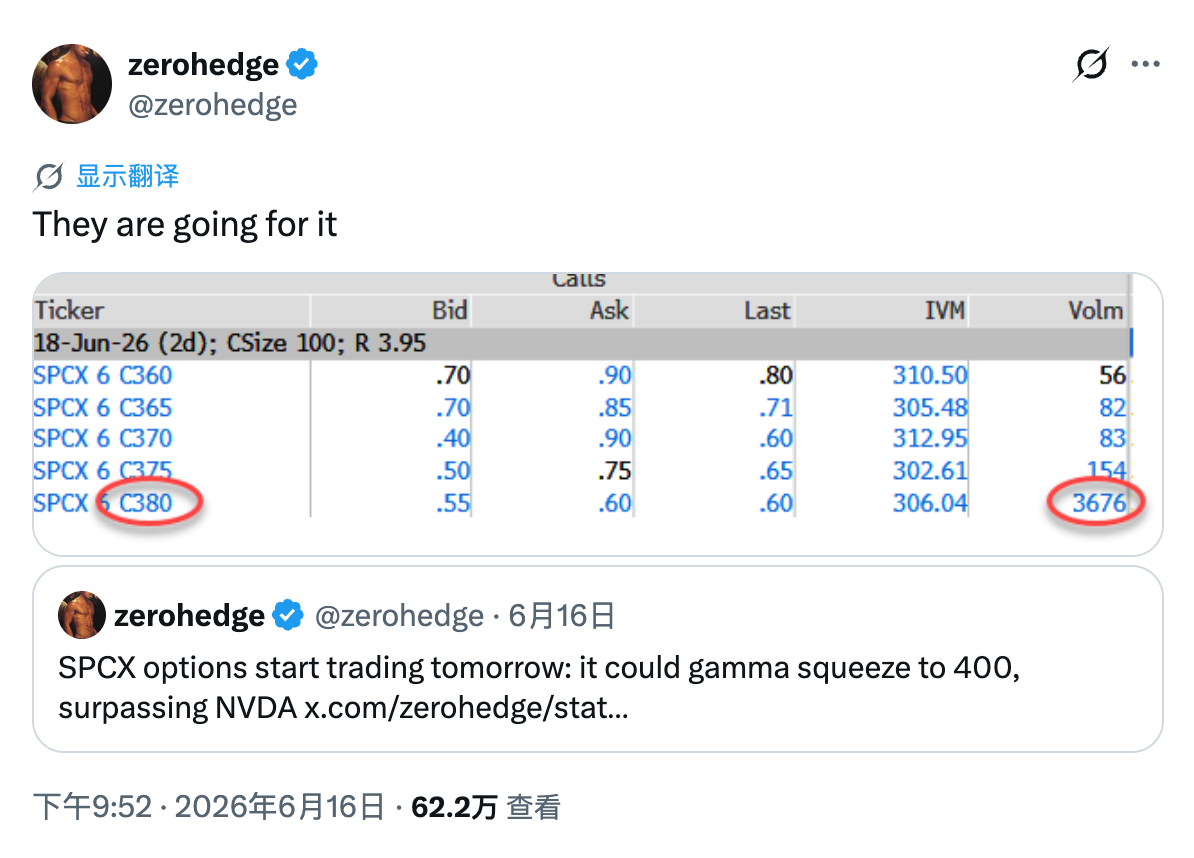
In a report this morning, Canaccord described the "wave of renewed optimism" accompanying SpaceX's listing as follows:
"SPCX's order book shows the market has entered a new level of frenzy. Before this historic IPO, we thought AI optimism was already full, sometimes even excessive, but buying was primarily from rational (if exuberant) institutions – large, well-capitalized public companies and PE investors. In our view, SPCX has opened a new chapter, with retail participation dramatically increasing, pushing the stock into the top six globally by market cap and adding the equivalent of half a META in its first week. Its market cap has already far surpassed its sister company TSLA, while its revenue is only about 20% of TSLA's. Despite the name SpaceX, revenue is actually skewed towards the connectivity business – Starlink contributed $11.39 billion, launch services only $4.1 billion, and AI computing was $3.2 billion in 2025."
Vanda Track was even more emphatic. In a review earlier Monday, it wrote: "SpaceX's first week of trading was record-breaking. Retail investors net bought $405 million of SPCX in the first five trading days, the strongest retail participation in an IPO in recent years. Buying was extremely aggressive in the first few days, only cooling off later in the week. The flow increasingly looks like position-building for the long term, rather than chasing a short-term meme stock."
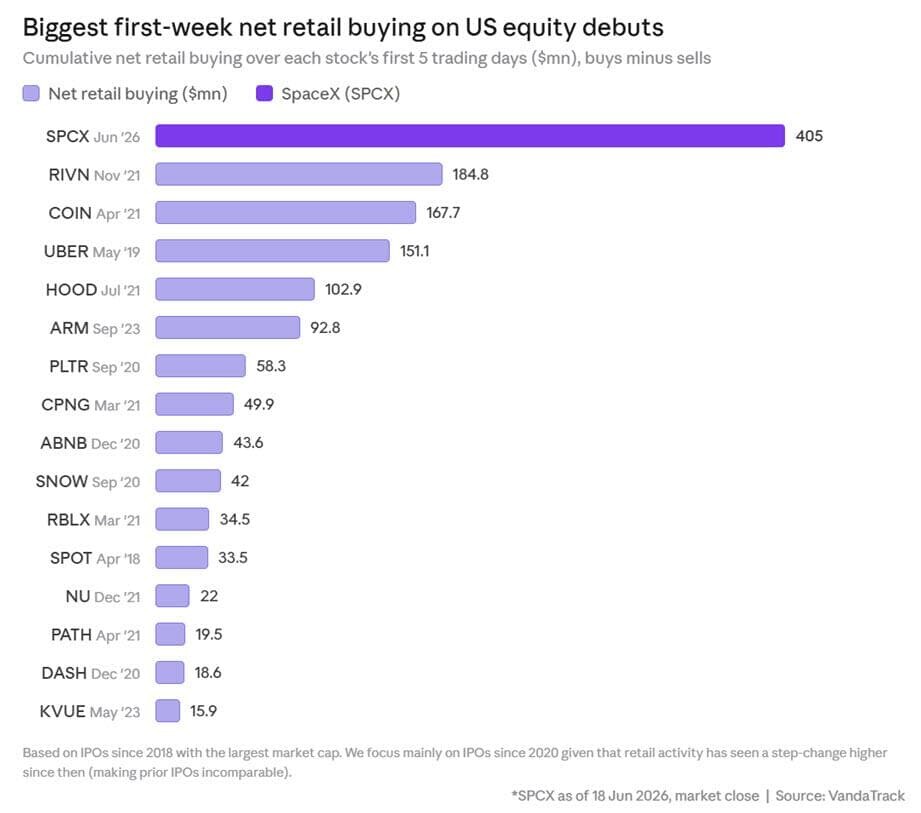
Chart: Retail capital flows for SPCX during its first five trading days
Source: Vanda Track
The scale of retail buying of SPCX becomes even more striking in comparison. Last week, retail purchases of SPCX surpassed their total purchases of all other Mag 7 stocks combined – NVDA, MSFT, AMZN, META, GOOGL, and GOOG together only attracted $278 million over those five days. Retail buying of SPCX also exceeded the combined retail buying of the SPY and QQQ ETFs during the same period ($352 million). A stock that only began trading last week is already competing with the market's biggest individual stocks and ETFs for retail money.
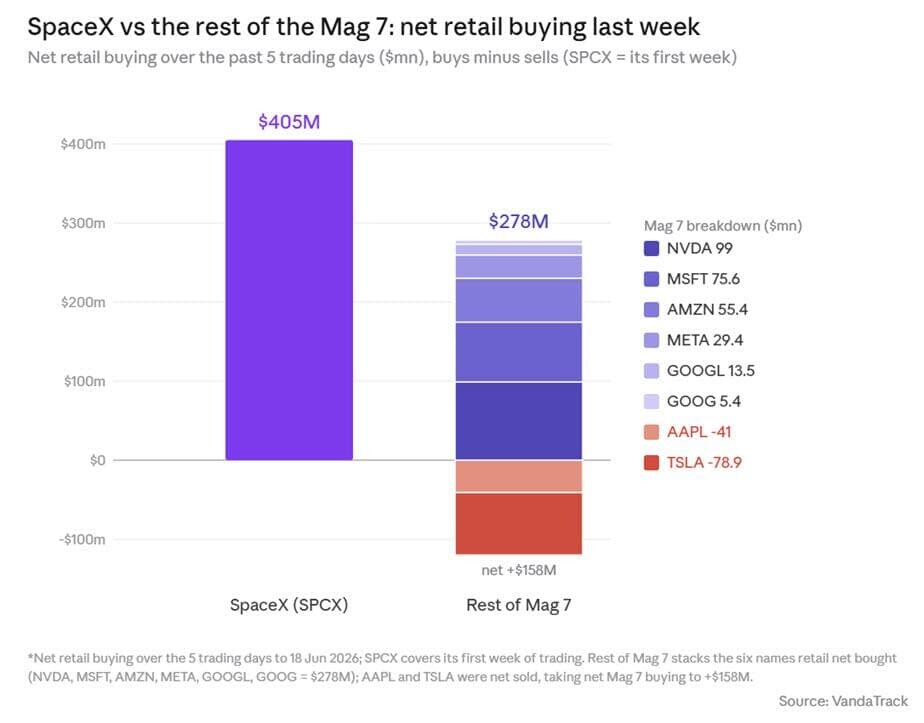
Chart: SPCX retail buying vs. Mag 7 individual stock retail buying comparison
Source: Vanda Track
The old pattern repeated itself. As retail investors piled into the stock, they also quickly rushed towards various SpaceX leveraged products, with similarly strong demand. In the first few trading days, retail investors bought $65.8 million of the Leverage Shares 2x Long SPCX Daily ETF – a significant number, but still well below typical levels seen during periods of intense retail speculative frenzy. Nonetheless, it dwarfed recent thematic new issues: Roundhill's storage ETF (ticker DRAM) only attracted $5.6 million in its first four trading days, and it took DRAM 22 trading days for cumulative retail buying to surpass the amount the SpaceX leveraged ETF absorbed.
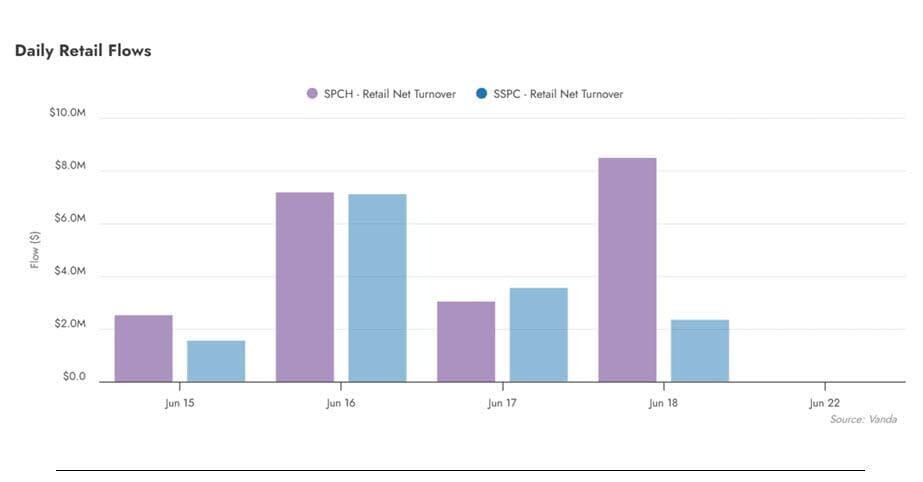
Chart: Retail capital flows comparison between SPCX leveraged ETF and thematic ETFs over the same period
Source: Vanda Track
After bursting out of the gates, the momentum quickly fizzled, and the fantasy of a "gamma squeeze ride into orbit on a reusable rocket" dissipated. June 16 was the peak, with SPCX hitting an all-time high of $225, briefly valuing the company above Microsoft. After that, daily retail flows collapsed, and retail turnover nearly ground to a halt.
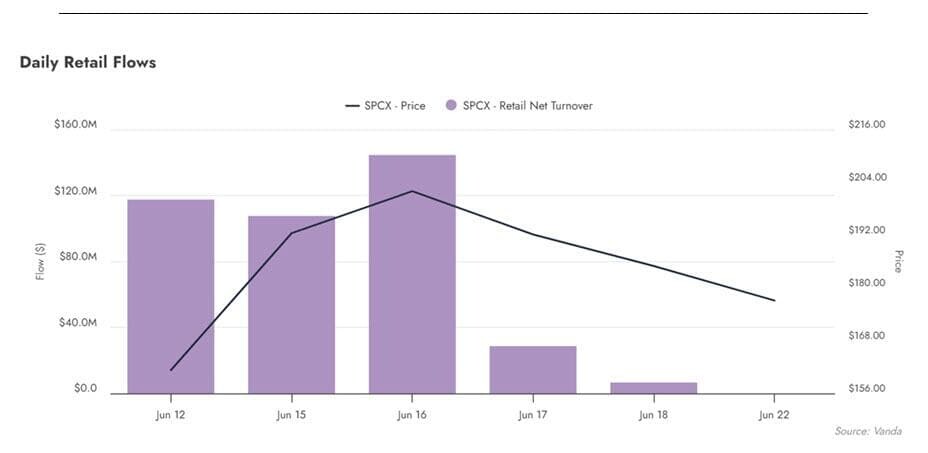
Chart: SPCX daily retail capital flows – cliff-like decline after peaking on June 16
Source: Vanda Track
This brings us back to Canaccord's point. Based on SpaceX's early trajectory, the investment bank judged that "tech stocks can probably maintain momentum in the short term," but it also warned: "There's now a more dangerous vacuum beneath these stocks."
Sure enough, once momentum faded, coupled with the market's realization that trillions of shares were about to unlock, the stock fell for three consecutive days, culminating in a crash on Monday. That day, while the bond market was still exuberant, SpaceX attempted to issue over $20 billion in investment-grade bonds for the first time before the issuance window closed, to refinance a much higher-interest bridge loan. SPCX promptly plummeted 16.4%, wiping out a record $600 billion in market value in a single day. Factoring in the 5% drop on Wednesday and 3.5% drop on Thursday, the stock is now only slightly above its $150 opening price from two weeks ago.
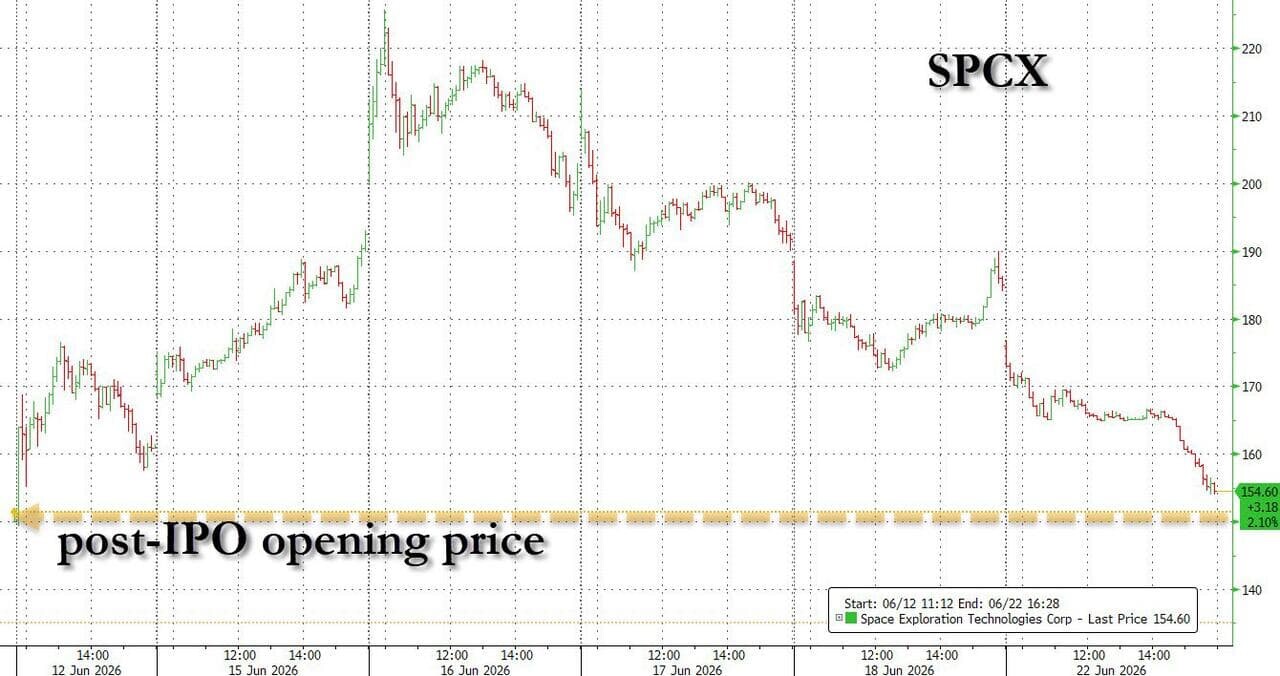
Chart: SPCX stock price trend since listing – falling from the $225 high back towards $150
Source: ZeroHedge
Worse still, SPCX briefly hit the $150 IPO opening price in after-hours trading. If it closes below that level tomorrow, everyone who bought and held the stock on the secondary market will be underwater.
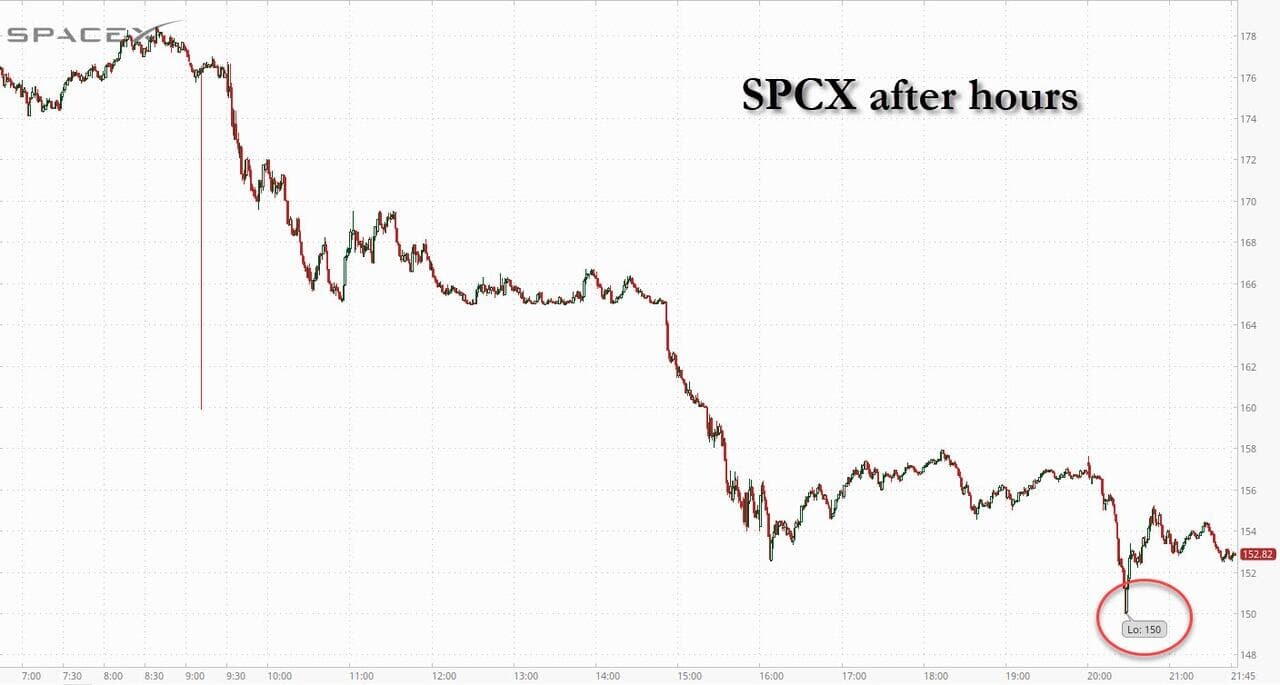
Chart: SPCX falls to near $150 IPO opening price in after-hours trading
Source: ZeroHedge
What's particularly worth highlighting is that this pump-and-dump occurred with only 5% of the total float available for trading – 95% of the shares were still locked up. But that is about to change.
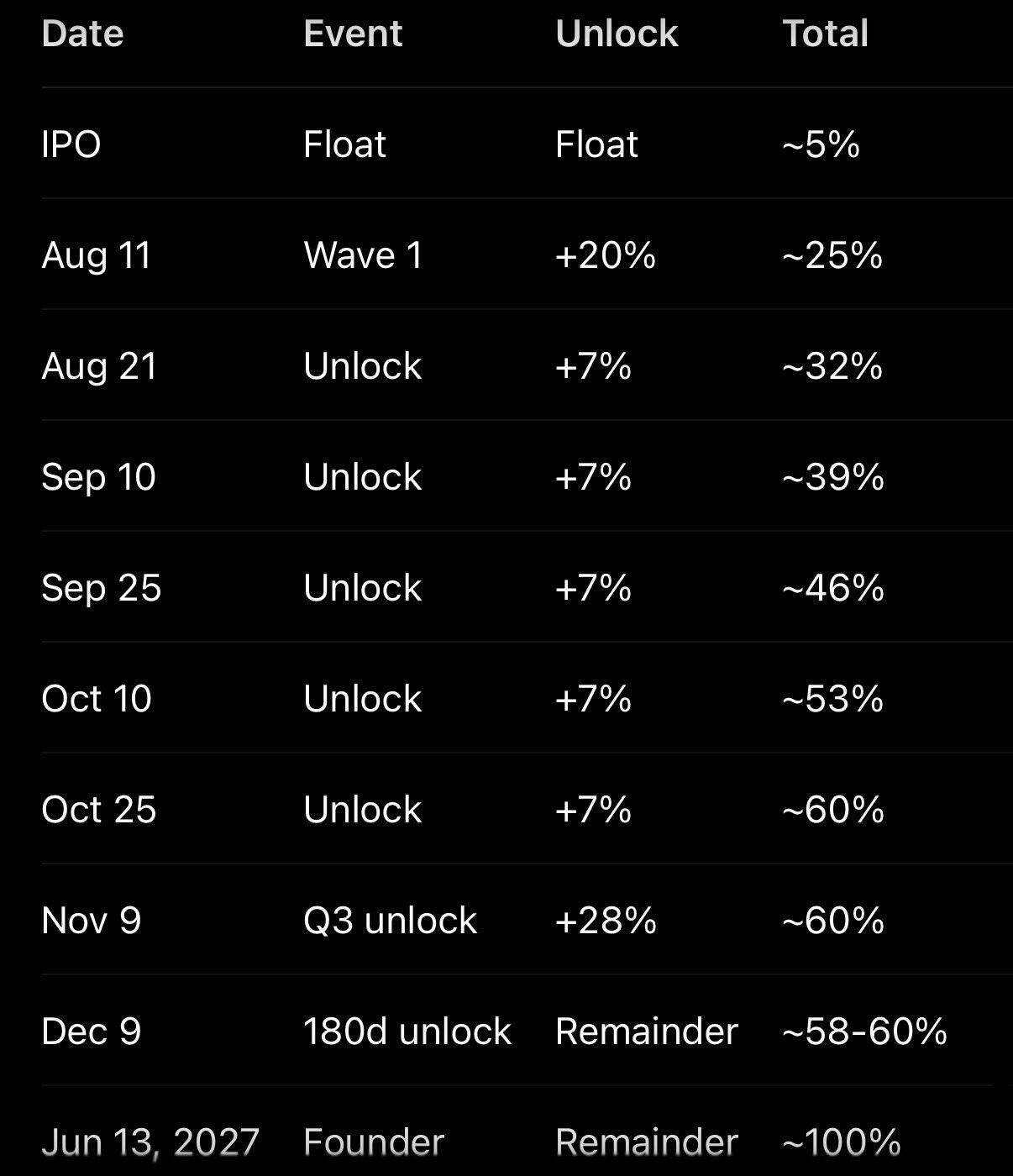
Chart: SPCX lock-up structure – currently only 5% in float, 95% locked
Source: ZeroHedge
Jeff Jacobson, strategist at 22V Research, said that after SpaceX reports earnings in early to mid-August, 20% of insider shares will unlock. Additionally, if the stock price is 30% above the IPO price, a further 10% unlock is triggered; there are also 7% unlocks around August 21 and September 10.
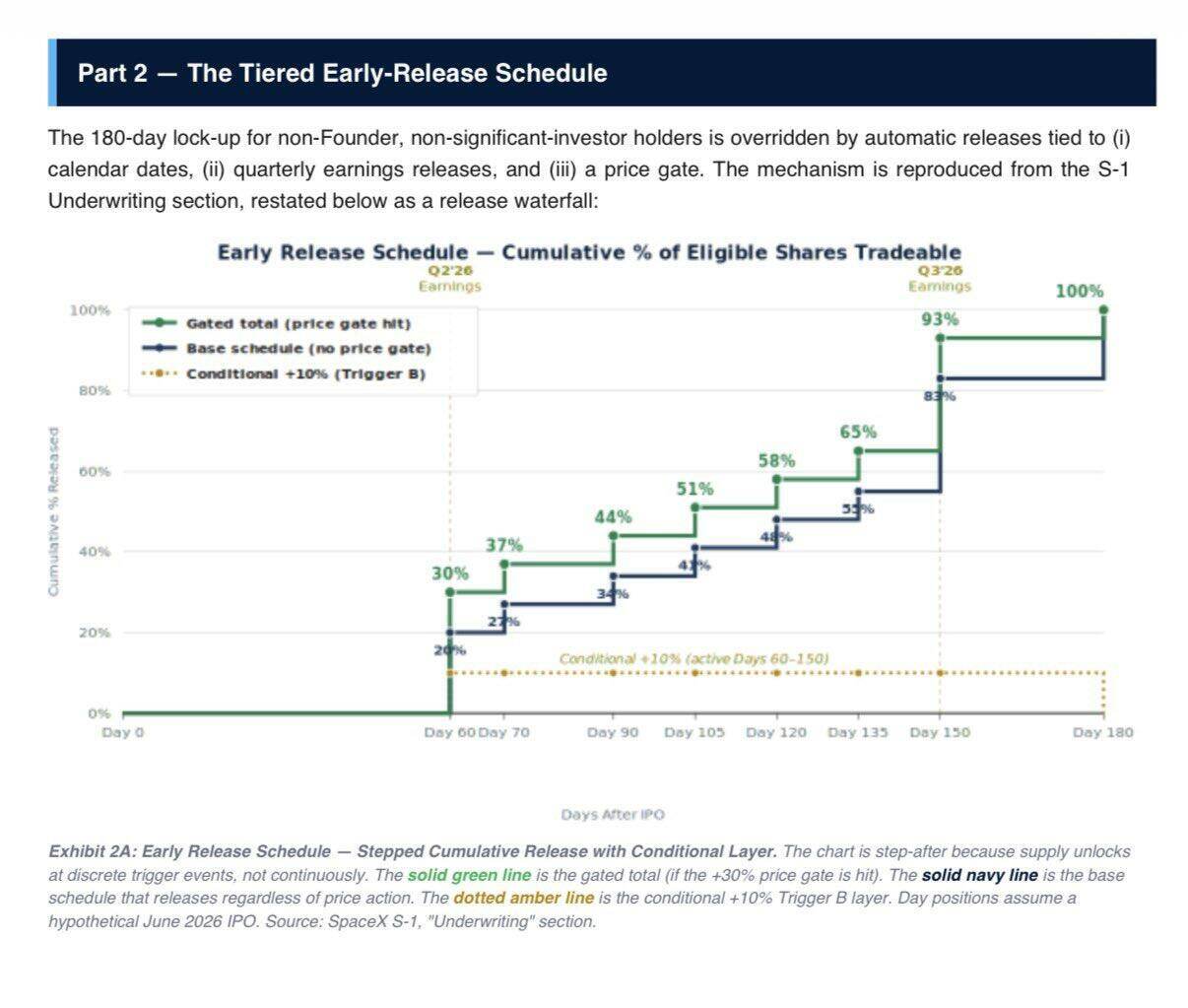
Chart: SPCX lock-up expiration schedule
Source: 22V Research
Jacobson stated that insiders could sell up to 44% of their SpaceX shares by early September, expanding the current float by approximately 900%.
In other words, it will only get harder to push the stock price higher from here. Meanwhile, Michael O'Rourke, Chief Market Strategist at JonesTrading, said "the sellers have taken control of the situation again," and added: "Everyone in the world who wanted to buy has already bought."
In a commentary on today's decline, Bloomberg wrote that SpaceX's fall "dragged the majority of the market down with it."
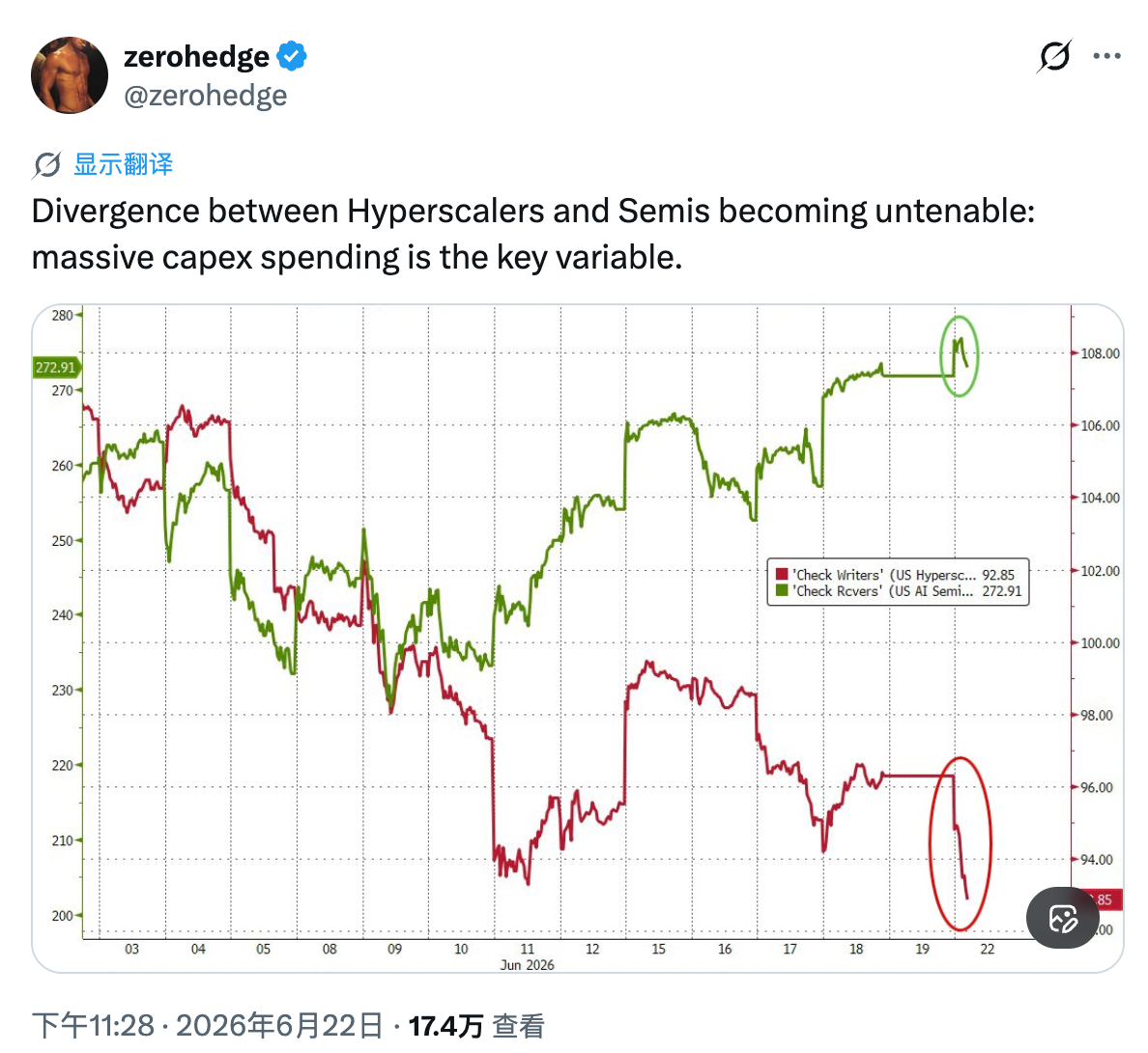
Whether that's truly the case remains to be seen. But in this market – which has rallied from the March lows almost entirely propped up by retail frenzy and momentum chasing – if retail investors truly lose their nerve, first it's SpaceX, then the storage bubble, and finally the semiconductor stocks that have feasted on the AI trade...
@zerohedge tweeted: The divergence between hyperscalers and semiconductors is no longer sustainable: massive capex is the key variable.
...That's when Eliot's line should be inverted: the whimper of the sell-off will become a bang.


