波场TRON Industry Weekly Report: Fed's Hawkish Signals Cause BTC to Rise Then Fall, Analyzing the Construction of an AI Agent Native Economic Collaboration and Value Network ARC


- Core View: This week, global markets were influenced by geopolitical easing and the Fed's hawkish stance, resulting in a rebound for risk assets but constrained upside due to high interest rates. The crypto market experienced synchronized volatility, with BTC fluctuating in the $64,000-$67,000 range. Industry hotspots focused on the AI-driven DAO governance infrastructure platform DAO Kraft and the modular intelligent agent infrastructure for AI Agent collaboration, ARC, which secured $3.4 million and $222 million in funding respectively.
- Key Elements:
- On the macro level, the Fed kept interest rates unchanged at 3.50%-3.75%, but the dot plot turned hawkish, hinting at possible rate hikes within the year, with inflation expectations revised up to around 3.6%.
- In the crypto market, BTC was briefly pushed to $67,000 by the US-Iran temporary peace agreement, but subsequently fell back to around $64,000 due to ETF outflows and weakening institutional demand.
- DAO Kraft positions itself as an AI-driven governance intelligence layer, enhancing DAO decision-making quality through intelligent proposal analysis, outcome simulation, and reputation systems. Its token, $KRAFT, coordinates governance permissions and incentives.
- ARC is a public Layer-1 blockchain, positioned as the "economic operating system" for the internet, integrating global financial infrastructure through stablecoins, institutional-grade validator nodes, and cross-chain payments.
- ARC's native token acts as a "productive asset," capturing value through staking, governance, and fee redistribution. Its economic model converts protocol fees into ARC and partially burns them to balance inflation with long-term incentives.
- On the regulatory front, the U.S. CFTC clarified rules for perpetual contracts, and bipartisan senators demanded clarity on state-level regulatory authority for stablecoins; Singapore's MAS added Bybit to its investor alert list; the Philippine central bank banned privacy coins from being listed on licensed platforms.
- Key economic data to watch next week includes the U.S. Core PCE Price Index and preliminary PMI figures for May, which will directly impact subsequent Fed policy expectations and market direction.
I. Outlook
1. Macro-Level Summary and Future Predictions
During the week of June 15 to June 21, 2026, the global macro market was primarily focused on geopolitical de-escalation and monetary policy repricing. The situation in the Middle East cooled significantly compared to the previous period, reducing the risk of energy supply disruptions and causing international oil prices to fall from highs. This alleviated market concerns about imported inflation, boosted global risk appetite, and resulted in relatively strong performance in both US and European stock markets. Meanwhile, the Federal Reserve maintained interest rates unchanged at its June FOMC meeting but signaled a hawkish stance, emphasizing that inflation has not yet been fully controlled. This further dampened market expectations for rate cuts within the year, keeping US Treasury yields in a high-level range. Against this backdrop, the global market showed characteristics of "risk assets supported by geopolitical positives, but valuation expansion constrained by the high-interest-rate environment." Capital began to reassess the possibility of "Higher for Longer."
Looking ahead to the week of June 22 to June 28, 2026, market focus will shift from central bank meetings to fundamental economic verification. Major economies such as the US and Europe will successively release PMI, consumer confidence, and manufacturing data, providing a critical window for assessing the resilience of the global economy. If US economic data continues to be strong, the market may further delay expectations for the timing of rate cuts, potentially supporting US Treasury yields and the US dollar. Conversely, weaker data could alleviate concerns about sustained tightening. Meanwhile, oil price trends will depend on the subsequent implementation of the Middle East situation, and energy prices will continue to influence inflation expectations for the second half of the year. Overall, the global market in the coming week is likely to maintain a pattern of "stable economic growth expectations, hawkish interest rate expectations, and cautiously improving risk appetite," characterized by mildly volatile stock markets and potentially increased fluctuations in bond and foreign exchange markets.
2. Crypto Industry Market Changes and Warnings
Market Changes from June 15 to June 21, 2026: The crypto market rose initially then fell back this week. On June 15, driven by the temporary US-Iran peace agreement, risk assets rebounded, with BTC briefly rising to around $67,000 and ETH seeing significantly expanded single-day gains. However, impacted by ETF outflows, hawkish central bank statements, and weakening institutional demand, BTC fell back to around $64,000 by June 21. Overall, it presented a range-bound pattern where "geopolitical risk easing led to a rebound, but macro and liquidity conditions limited upside."
Forecast for the Coming Week: If the US-Iran situation continues to ease and oil prices remain on a downward trend, risk appetite may continue to support BTC trading in a range of $63,000 to $67,000. However, if ETF redemptions persist and the US dollar or US Treasury yields rebound, the upside pressure on BTC remains significant. In the short term, high-volatility consolidation is more likely than a unilateral upward trend. Key focuses include ETF fund flows, macro interest rate expectations, whether the geopolitical situation remains stable, and whether ETH can hold support near the $1,700 level.
3. Industry and Sector Hotspots
DAO Kraft has completed a $3.4 million funding round, positioning itself as a modular DAO infrastructure platform for decentralized governance and on-chain collaboration, aiming to improve the quality of DAO proposals and decision-making efficiency through intelligent governance tools. Meanwhile, ARC has accumulated total funding of up to $222 million, led by a16z, with participation from top institutions like BlackRock, SBI Holdings, and IDG Capital. It is positioned as a modular intelligent agent infrastructure for AI Agent collaboration and on-chain autonomous ecosystems, dedicated to building an AI Agent-native economic collaboration and value network.
II. Market Hot Sectors and Potential Projects for the Week
1. Overview of Potential Projects
1.1. Detailed Analysis of DAO Kraft: Raised $3.4 Million with Participation from Animoca and Castrum Capital; A Modular DAO Infrastructure Platform for Decentralized Governance and On-Chain Collaboration
Introduction
DAOKraft is an AI-powered Governance Intelligence Layer designed to help DAO contributors turn ideas into high-quality, strategically optimized governance proposals and systematically analyze why proposals succeed or fail.
It combines:
- Proposal Intelligence
- Governance Analytics
- Outcome Simulation
- Execution Tracking
- Reputation Systems
to improve governance decision quality, proposal clarity, and long-term governance efficiency within DAO ecosystems.
Overview of the Protocol Framework
The Governance Intelligence Stack
DAOKraft believes that the core of governance is not just "voting," but "Decision Intelligence."
Most DAO governance failures actually occur *before* the vote, for example:
- Poorly articulated proposals
- Lack of contextual information
- Missing impact analysis
- Insufficient risk assessment during execution
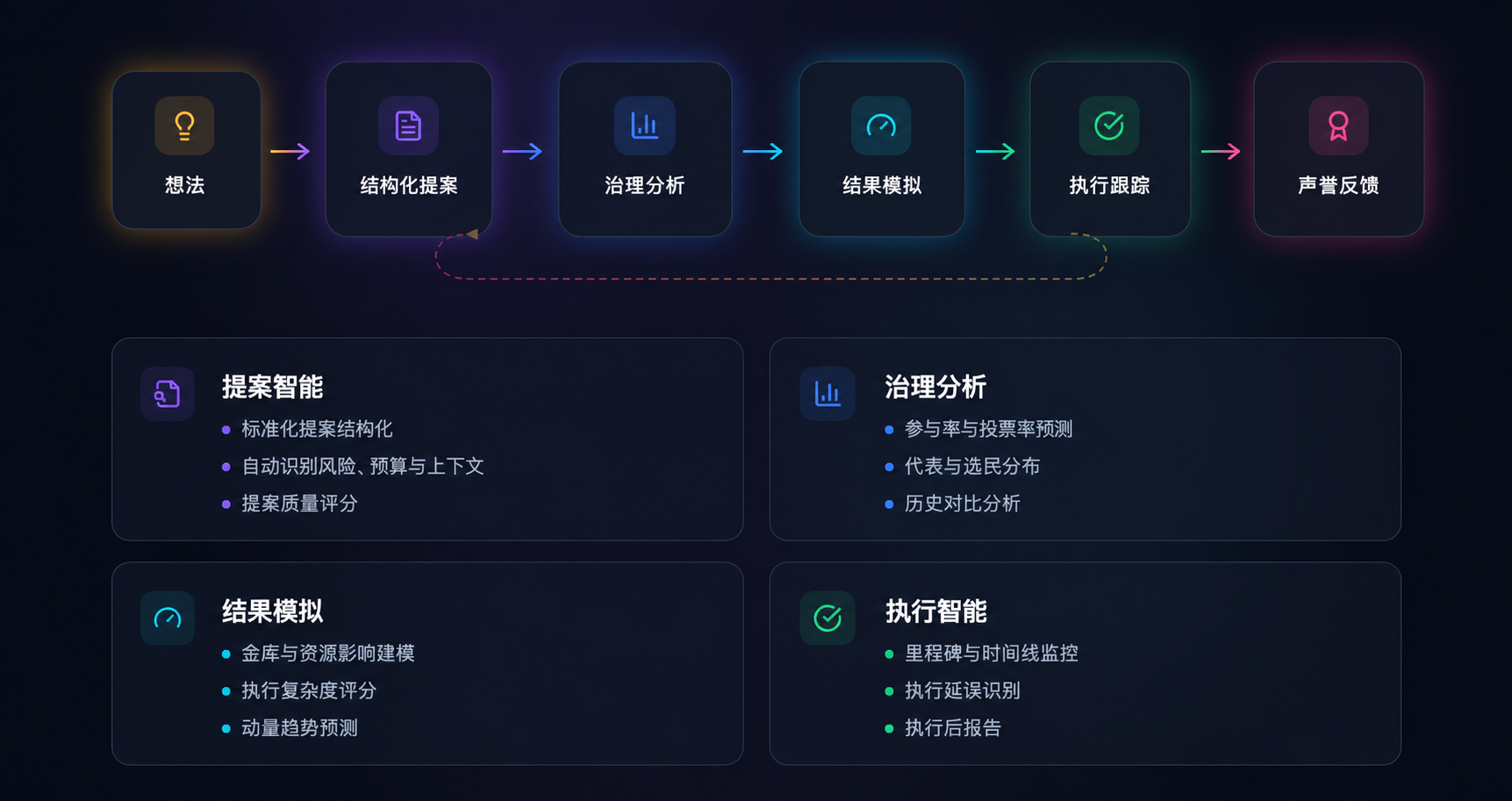
Therefore, DAOKraft redefines DAO governance as a continuously iterative, intelligent governance cycle:
Idea
→ Structured Proposal
→ Governance Analytics
→ Outcome Simulation
→ Execution Tracking
→ Reputation Feedback
Each layer reinforces the next, creating a continuously optimizing DAO governance system.
1.1 Proposal Intelligence
DAOKraft analyzes the structure and quality of governance proposals, including:
- Standardizing proposal structure
- Automatically identifying risks, budget, and background information
- Scoring proposals for clarity, completeness, and executability
Its goal is to enhance the quality of governance proposals and reduce low-quality governance noise.
1.2 Governance Analytics
The system further analyzes DAO governance behavior, including:
- Participation rate and voter turnout prediction
- Delegate and voter distribution analysis
- Community sentiment identification
- Comparative analysis with historical similar proposals
This helps DAOs better understand governance trends and community feedback.
1.3 Outcome Simulation
Before a proposal is formally executed, DAOKraft simulates the governance outcome, including:
- Treasury and resource impact analysis
- Execution complexity and risk scoring
- Community engagement and governance momentum prediction
Helping DAOs identify potential risks and execution costs in advance.
1.4 Execution & Accountability Intelligence
After a proposal passes, the system continuously tracks the execution process, including:
- Milestone & timeline monitoring
- Execution delay detection
- Post-execution outcome reporting
It is important to emphasize that DAOKraft does not control DAO assets or execute on-chain transactions.
All its analyses are based on raw DAO data and publicly verifiable information.
1.5 Reputation & Feedback Loop
DAOKraft builds an outcome-based reputation system for governance participants, including:
- Proposers
- Contributors and reviewers
- Advisors and governance bodies
The core logic is that reputation is based not on "intent," but on "actual results."
This reputation data then feeds back into future governance recommendations and decision analysis, creating a long-term optimization loop for governance.
How DAOKraft Works
- Users log in via email or wallet
- Select the target DAO and Proposal Intent
- AI automatically generates a structured governance proposal draft
- The system simultaneously analyzes historical governance data and similar proposal records
- Based on governance data, it generates:
- Proposal success probability
- Strategic optimization suggestions
- Governance risk analysis
- Users finally submit the proposal formally through the DAO's native governance system
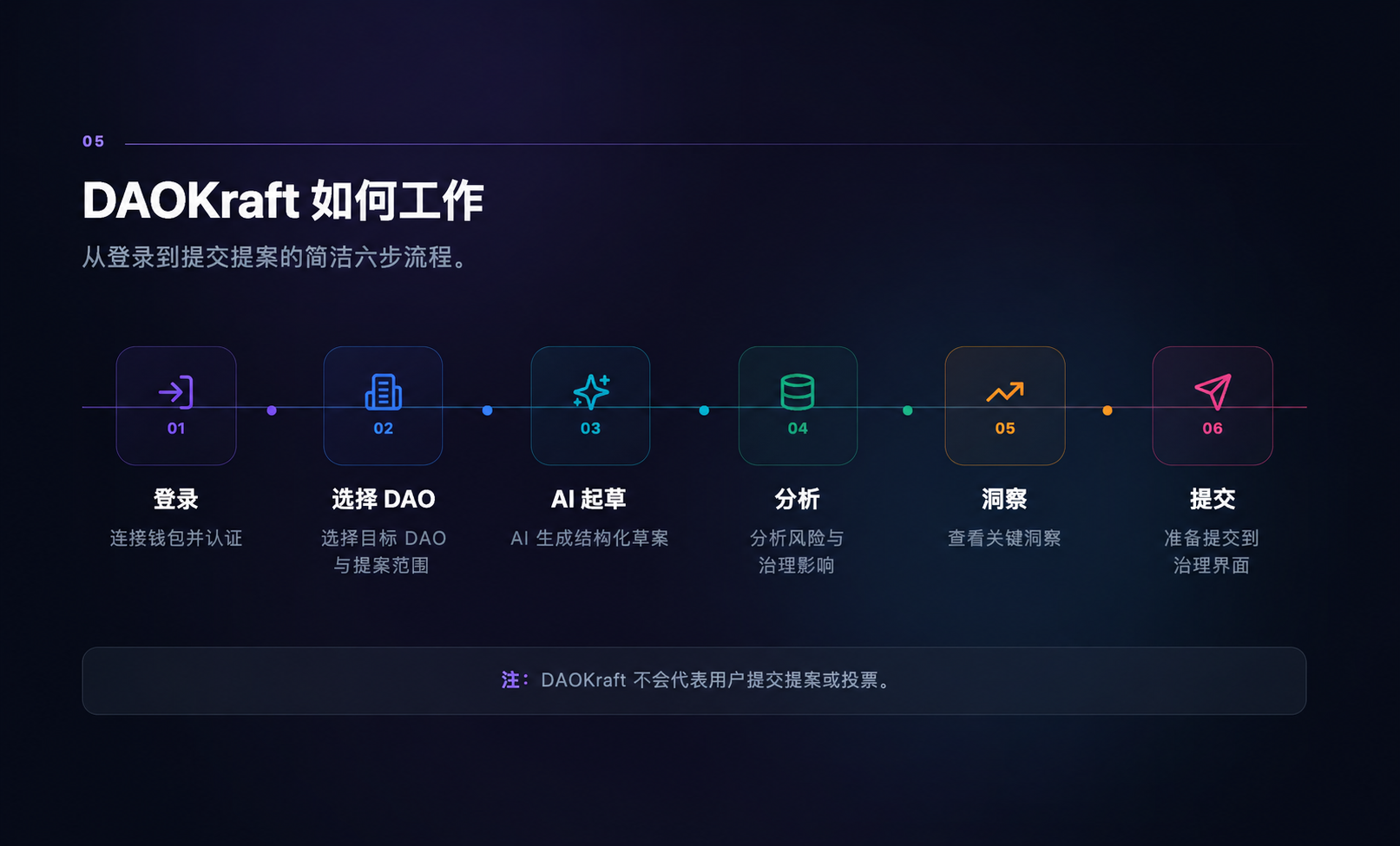
It is important to emphasize that DAOKraft does not submit proposals for users, nor does it vote on their behalf.
Its positioning is more like an AI decision-making and governance analysis assistance layer within DAO governance.
Governance Intelligence & Token Model
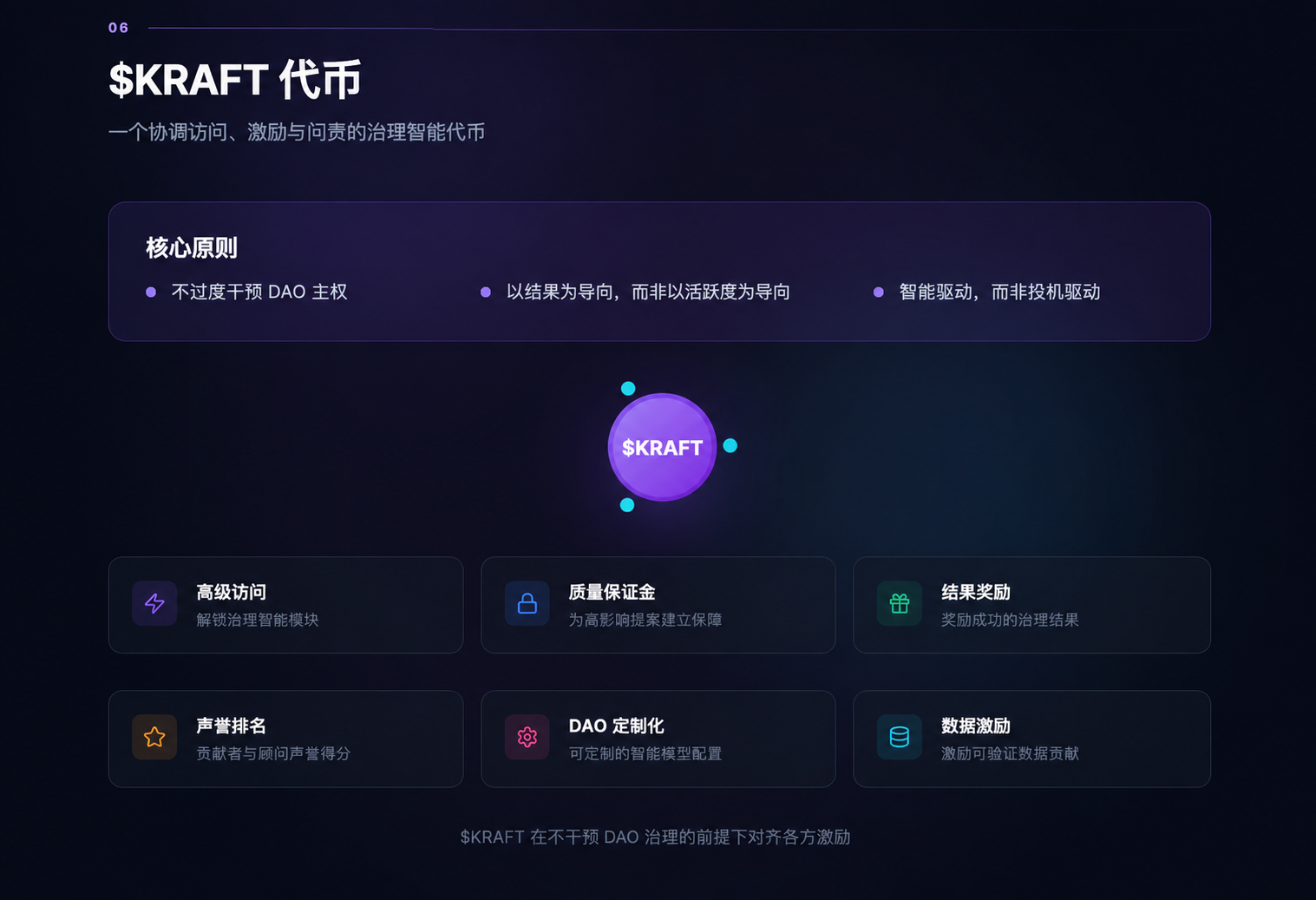
DAOKraft has launched its governance intelligence token — $KRAFT.
It is important to emphasize that $KRAFT does **not** restrict users from submitting proposals or participating in DAO voting.
Its core function is not to control governance permissions, but to coordinate the following within the entire Governance Intelligence Layer:
- Access permissions
- Incentive mechanisms
- Reputation and accountability systems
Thus driving the long-term optimization of the DAO governance system.
Core Principles
Non-intrusive to DAO Sovereignty
DAOKraft does not take over DAO governance power nor replace native governance mechanisms.
Its positioning is to provide governance analysis and intelligent assistance, not to control the DAO.
Outcome-oriented, not Activity-based
DAOKraft focuses more on the final results of governance, rather than just whether users "participate."
For example:
- Whether the proposal is genuinely effective
- Whether it is successfully executed
- Whether it creates long-term value
Rather than simply counting votes or activity metrics.
Intelligence-driven, not Speculative
The core goal of $KRAFT is to support governance analysis, decision optimization, and governance collaboration, rather than pure token speculation.
Its overall logic leans more towards AI + DAO Governance Infrastructure.
Governance Data Sources & Integrity

DAOKraft's governance intelligence analysis relies solely on publicly accessible and user-authorized data sources, including:
- DAO public governance forums and proposal archives
- Snapshot, Tally, and on-chain voting records
- DAO public governance documents and frameworks
- Governance metadata explicitly provided by users
- Execution data verifiable through on-chain transactions or public reports
DAOKraft will not use:
- Private communication content
- Proprietary databases
- Unauthorized data scraping
All its governance analysis results emphasize:
- Transparency
- Reproducibility
- Public Verifiability
Essentially, DAOKraft aims to build: an AI DAO Governance Intelligence System based on public governance data.
Tron's Commentary
DAOKraft's strength lies in the fact that it is not just a traditional DAO governance tool; it attempts to build an AI-driven "Governance Intelligence Layer." By utilizing proposal analysis, governance data modeling, outcome simulation, execution tracking, and reputation feedback systems, it upgrades DAO governance from a simple "voting mechanism" to a continuously optimizable "decision intelligence system." Furthermore, its design of not taking over DAO sovereignty, not controlling assets, and only analyzing based on public governance data reduces its intrusiveness into the native governance structure.
However, its weakness is that DAO governance itself is still highly dependent on community culture, governance participation, and human dynamics. While AI can improve proposal quality and governance efficiency, it has difficulty truly resolving internal conflicts of interest and governance fragmentation within a DAO. Additionally, governance outcomes are inherently subjective, and the long-term accuracy and real-world adoption of "governance intelligence" and "success rate predictions" still need time to be validated.
2. Detailed Analysis of Key Projects for the Week
2.1. Detailed Analysis of ARC: Raised $222 Million, Led by A16z, with Participation from Top Institutions like BlackRock, SBI Holdings, and IDG; A Modular Intelligent Agent Infrastructure for AI Agent Collaboration and On-Chain Autonomous Ecosystems
Introduction
Arc is a public Layer-1 blockchain positioned as the "Economic OS" for the internet.
It aims to build a full-stack economic infrastructure platform enabling:
Economic Contracts
Stablecoins
Tokenized Assets
Global Markets
to operate on a unified, composable shared infrastructure.
ARC is the native coordination asset of this network. It is a utility-driven token designed to align the interests of network participants with the long-term development of Arc through:
Staking
Governance
Fee Capture
Full platform functional usage
The utility of ARC extends beyond the chain itself, covering multiple protocols and products built on the network by Circle and ecosystem partners.
Core System Architecture Analysis
1. Connection to Global Finance and Crypto Ecosystem
Arc connects with traditional finance and the crypto ecosystem through various infrastructure components, including:
- CCTP cross-chain transfers
- Programmable Wallets
- Foreign Exchange (FX) infrastructure
- Circle Mint
- Circle Payments Network
This positions Arc not just as a public chain, but more like a unified economic network for global payments, stablecoins, and on-chain finance.
2. Developer Kits & Frameworks
Arc provides developer tools like Skills and CLI to help developers quickly deploy:
- Lending protocols
- Trading services
- Payment systems
- AI Agent services
Developers do not need to build the underlying infrastructure from scratch.
Its core logic is to standardize and modularize complex financial infrastructure.
3. ARC Token
ARC is the native coordination asset of the Arc network and the core coordination layer of the entire Arc Economic OS.
Arc itself is positioned as a blockchain network for the global internet economy, and the role of ARC is not merely a typical Gas or payment token; it is more importantly responsible for coordinating governance, security, economic incentives, and long-term value distribution throughout the network.
ARC holders possess governance rights and participate in maintaining:
- Network regulatory compliance
- Network security
- Infrastructure integrity
This enables institutions to build critical financial applications and settlement systems on Arc.
Arc's Three-Layer Structure
Arc's overall system primarily consists of three layers:
1. Arc Network (Execution Layer)
The Arc network itself provides:
- Deterministic settlement
- Stablecoin-denominated Gas
- Configurable privacy
- Institutional-grade validator node system
This is the underlying execution environment for the entire Economic OS.
2. Stablecoins (Medium of Exchange Layer)
Stablecoins serve as the primary medium of value within the network, providing:
- Predictable unit of value
- Global liquidity
- More stable payment and settlement capabilities
Essentially serving as the "monetary layer" in the on-chain economy.
3. ARC (Coordination Layer)
ARC is the coordination mechanism within the entire system, responsible for:
- Network security maintenance
- Economic governance
- Incentive distribution
- Network value sharing
It is essentially the core asset connecting network participants with the long-term development of Arc.
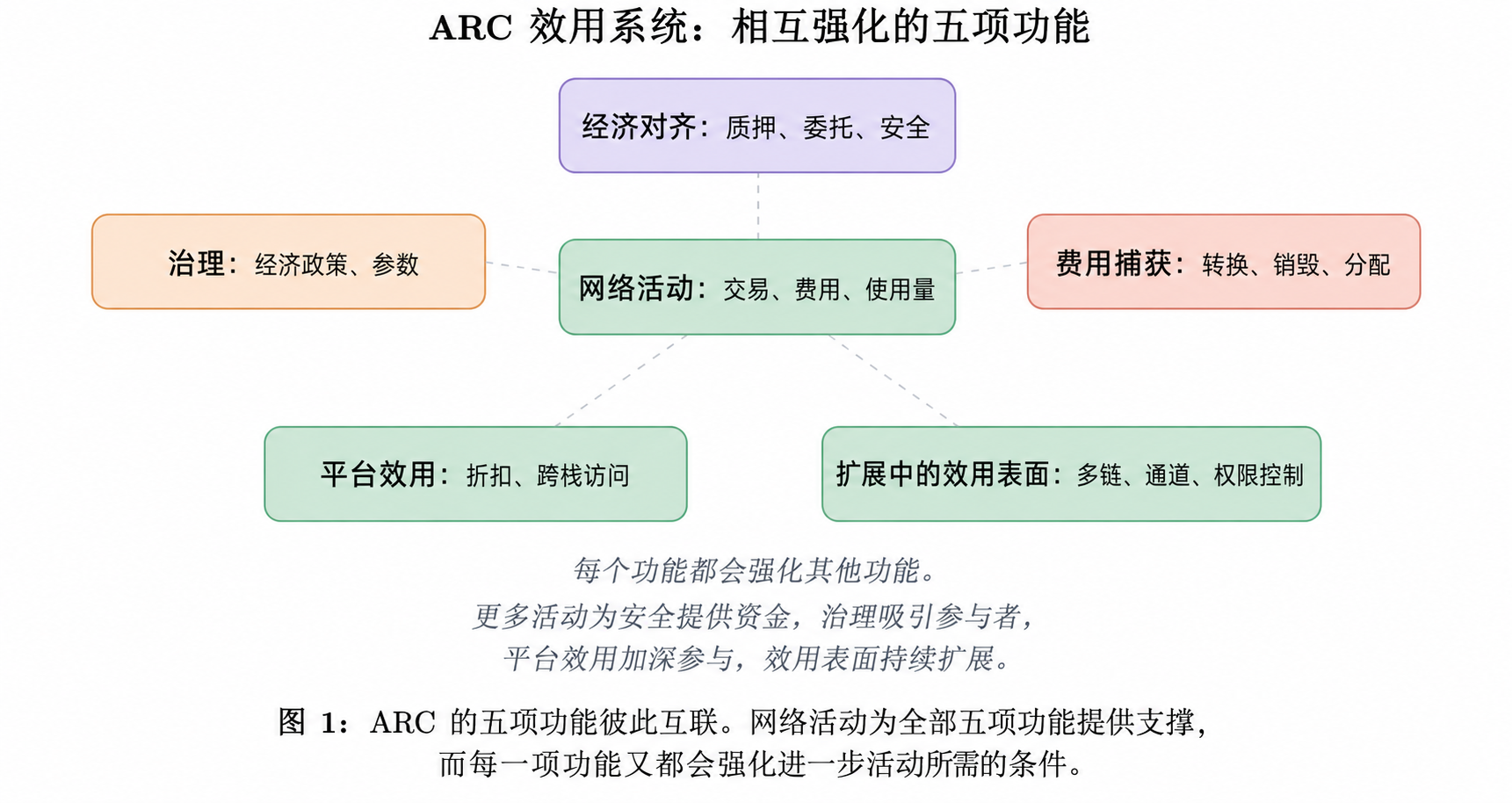
4. ARC Utility in Depth
ARC is designed as a "Productive Asset."
The core logic is: the deeper a user's participation in the Arc Economic OS, the stronger ARC's actual utility becomes.
It's not just about holding the token; if users continuously:
- Trade
- Build applications
- Run services
- Participate in network governance
they can gain more platform benefits, including:
- Lower Gas costs
- Lower platform service fees
- Higher governance weight
- More ecosystem access rights
Essentially, ARC's value is directly tied to the depth of a user's participation in the Arc ecosystem.
Staking Mechanism
The Arc network will transition from:
- PoA (Proof-of-Authority)
gradually to:
- Po