Apple AI: Is It Actually Good? The Most Important US Stock Mapping Chain to Watch at WWDC26


- Core Thesis: The key to Apple's WWDC 2026 isn't about whether it launches AI, but whether it can transform Apple Intelligence from a software update into a system-level AI gateway. This could drive a new hardware replacement cycle and a developer ecosystem overhaul, potentially forming the core source of short-term earnings expectation trades.
- Key Elements:
- WWDC is an Expectation Gap Event: Historical data shows WWDC is not a consistently positive catalyst for stock prices (down 5.7% in 2022, up 7.9% in 2024). Stock reactions hinge on whether AI, Siri, and the developer ecosystem exceed expectations.
- Siri Upgrade as a Core Focus: If Siri evolves from a "voice assistant" to a system-level AI agent that can read context and execute tasks across applications, it will be crucial for re-evaluating Apple's AI standing.
- On-Device AI Drives the Replacement Logic: If Apple Intelligence requires more powerful chips and local inference capabilities, it will be tied to new hardware, encouraging migration from old devices to new ones, creating a wealth effect from the replacement cycle.
- Ecosystem Openness as a Larger Spillover Opportunity: If Apple opens its AI capabilities to third-party developers, Apple Intelligence can expand from being Apple's own story to the story of the entire App Store ecosystem.
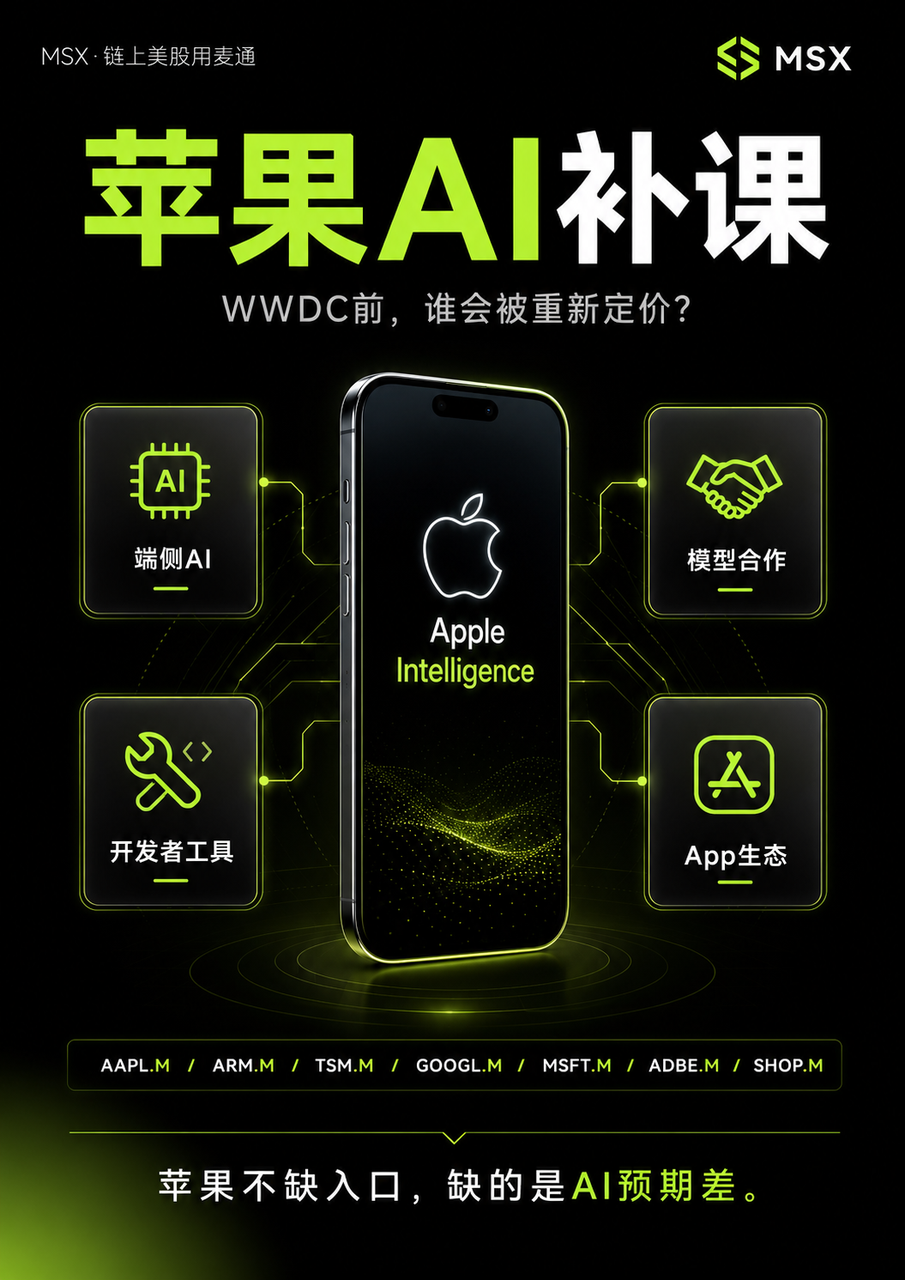
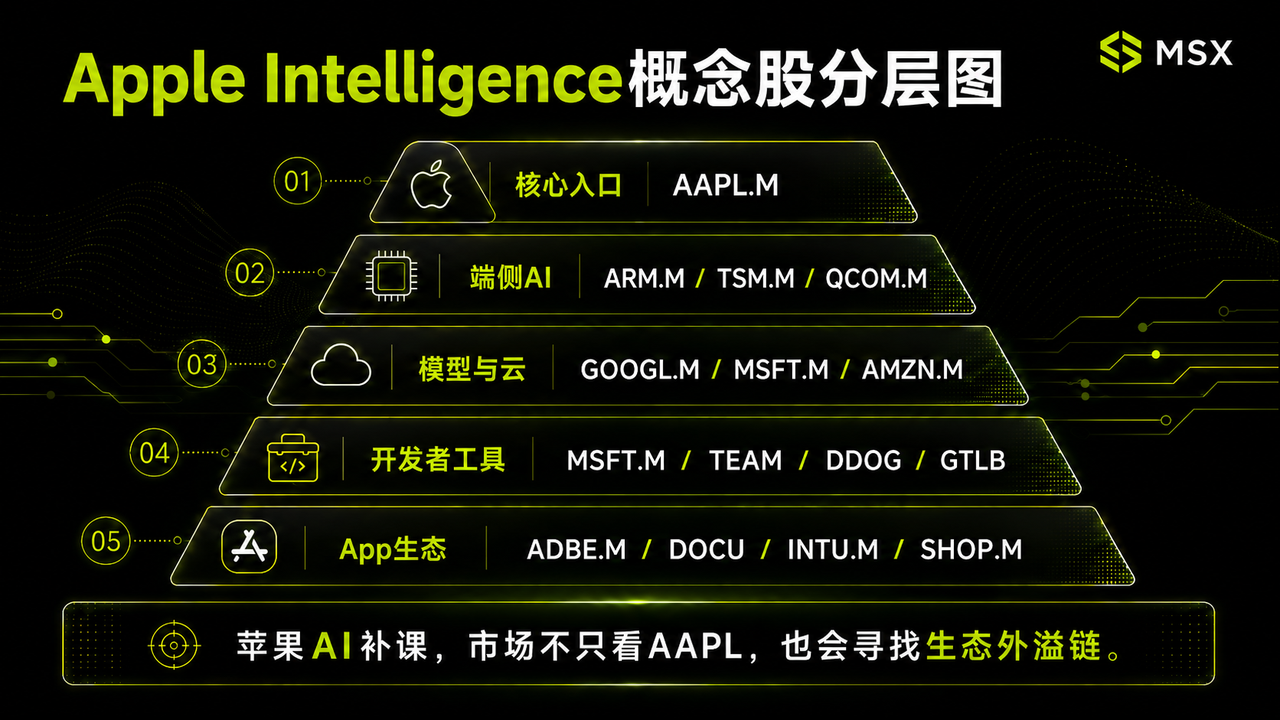
- Tiered Concept Stock Mapping: The impact spans five layers: from core gateways (AAPL.M) to on-device AI chains (ARM/TSM/QCOM), model and cloud partnerships (GOOGL/MSFT/AMZN), developer tools (MSFT/TEAM), and the app ecosystem (ADBE/INTU).
In the early hours of June 9, Beijing time, Apple WWDC 2026 brought the long-awaited answer to the market:
Can Apple AI finally catch up?
As we all know, over the past two years, the strongest players on the AI front have been tech giants like Nvidia, Google, Microsoft, and Meta, along with major model companies such as OpenAI and Anthropic. In contrast, although Apple possesses the world's strongest hardware entry points—including iPhone, iPad, Mac, Apple Watch, and Vision Pro—along with a complete App Store ecosystem, the rollout of Apple Intelligence and Siri has consistently fallen short of expectations.
Therefore, this year's WWDC is no longer just about whether Apple will talk about AI. The core question is whether it can convince the market that Apple Intelligence will truly become an AI gateway capable of reigniting the upgrade cycle, developer ecosystem, and application ecosystem.
1. WWDC Doesn't Always Lift Apple, But It's the Best Catalyst for Expectation Gaps
Let's first look at historical performance.
Over the past few years, WWDC has not been a guaranteed catalyst for rising Apple stock. Based on a rough calculation from the Friday close before WWDC to the Friday close of WWDC week:
- During WWDC week in 2022, AAPL fell by approximately 5.7%;
- During the week of the Vision Pro launch in 2023, AAPL was roughly flat;
- On the day of the Apple Intelligence launch in 2024, AAPL first fell by about 1.9%, but the market subsequently reassessed the logic of "on-device AI + replacement cycle," ultimately rising by about 7.9% for the week;
- After WWDC 2025, the market was dissatisfied with Siri delays and AI progress, resulting in a weekly decline of about 2.4%;
Thus, WWDC itself is not a consistently bullish event, but it frequently creates "expectation gap trades." From this perspective, if this year's event is merely a routine system update, the stock price reaction may be muted. However, if AI, Siri, on-device capabilities, and the developer ecosystem exceed expectations, it could generate short-term wealth effects.
This is precisely why this year's WWDC is worth watching in advance.
2. The Key Differentiator for Apple AI: It's Not the Model, But the Gateway and the Upgrade Cycle
It's worth highlighting that many companies approach AI by first building a model and then seeking a user gateway. Apple is the opposite—it already possesses the gateway; it simply needs to upgrade its AI capabilities.
Apple's true advantage isn't parameter count, but its system-level gateway. It can embed AI into iOS, macOS, iPadOS, watchOS, and visionOS, allowing AI direct access to Mail, Photos, Calendar, Messages, Notes, the App Store, and third-party applications.
This is why Siri is so crucial.
If Siri remains merely a tool for "checking the weather" or "setting alarms," it will be difficult for it to support a revaluation of Apple AI. However, if Siri can read user context, invoke different apps, and complete cross-application tasks, it will cease to be just a voice assistant. Instead, it would become the AI Agent gateway within the Apple ecosystem.
Therefore, the biggest highlight of WWDC is whether Siri will be upgraded from a "voice assistant" to a "system-level AI gateway."
The most direct counterparty on this front is, of course, AAPL.M. If Apple continues to rely on external models or cloud inference, GOOGL.M, MSFT.M, and AMZN.M might also be mapped by the market.
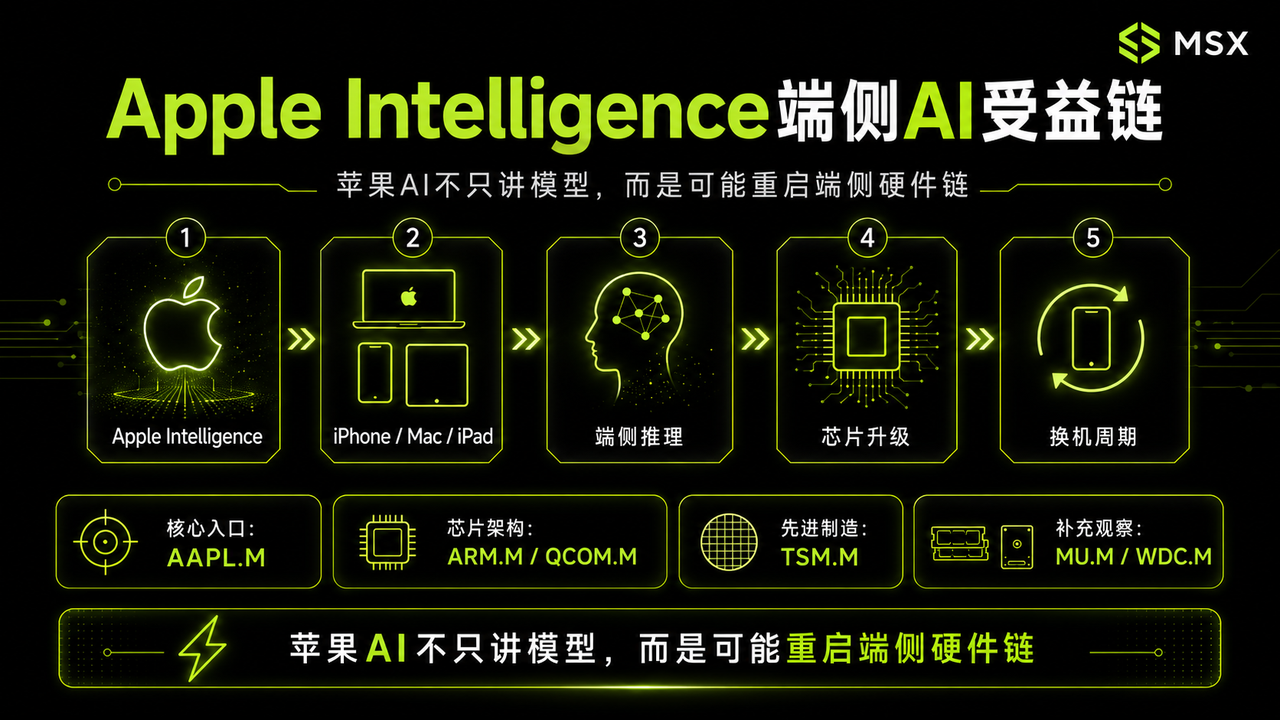
However, the real wealth effect of Apple AI may not lie solely at the software level, but rather at the hardware level. If new Apple Intelligence features require stronger chips, more memory, and better on-device inference capabilities, it will transform a software update into a hardware upgrade cycle story.
The advantages of on-device AI are clear: it enables many tasks without relying entirely on the cloud, resulting in faster response times. It also aligns well with Apple's long-standing emphasis on privacy and security. More importantly, it naturally binds with new hardware, encouraging users to migrate from older iPhones and Macs to newer devices.
One key reason the market repriced Apple after a brief period of disagreement following the 2024 release of Apple Intelligence was the emerging thought: if AI features are tied to new devices, could it trigger a new replacement cycle?
This is also one of the most critical sources of wealth effect potential at this year's WWDC.
Key stocks in the on-device AI chain include AAPL.M, ARM.M, TSM.M, and QCOM.M. AAPL.M represents the terminal gateway; ARM.M, the low-power architecture; TSM.M, the key foundry for Apple chips; and QCOM.M, while both competing and cooperating with Apple, will also be compared by the market within the on-device AI and mobile chip ecosystem.
3. The Real Spillover Opportunity: From the Chip Chain to the App Ecosystem
It's important to note that WWDC isn't just a single day or solely Apple's own keynote. It is fundamentally a developer conference.
If Apple merely adds a few AI features to the system, it remains largely a story for AAPL. However, if Apple opens its AI capabilities to developers, allowing third-party apps to leverage on-device models, system-level Agent capabilities, privacy computing frameworks, and new developer tools, Apple Intelligence will evolve from an Apple story into an ecosystem story.
This line of thought is very important.
Because Apple's true moat is not individual AI features, but the App Store ecosystem. If developers can integrate Apple Intelligence into creative, productivity, document, e-commerce, fintech, and business applications, it could spawn a new wave of AI application scenarios.
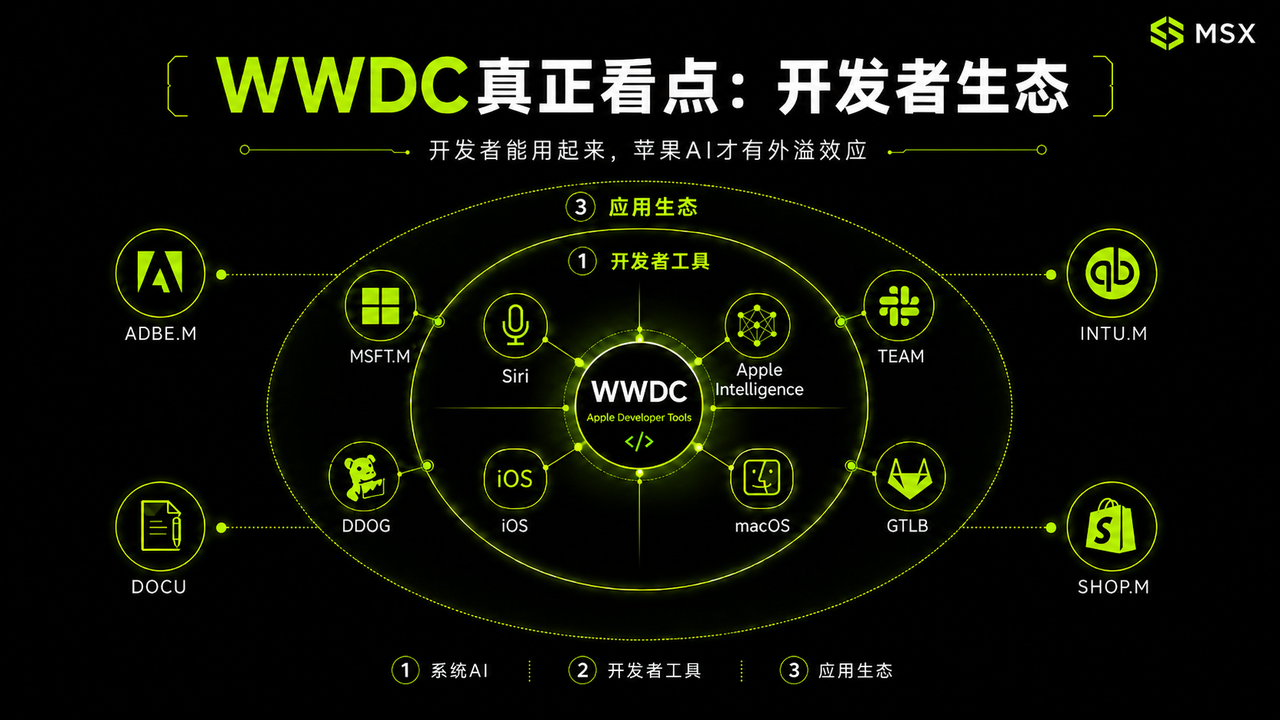
From an investment mapping perspective, Apple Intelligence concept stocks can be divided into five layers.
The first layer is the core gateway: AAPL.M. If Siri and Apple Intelligence exceed expectations, Apple itself will benefit most directly. Apple controls the hardware gateway, system permissions, and application distribution. Once AI capabilities are truly embedded in the system, AAPL.M will be the first to be revalued.
The second layer is the on-device AI chain, such as ARM.M, TSM.M, and QCOM.M. If Apple runs more AI capabilities locally on devices, low-power chip architecture, advanced manufacturing processes, and mobile AI capabilities will all come back into focus.
The third layer involves model and cloud partnerships, such as GOOGL.M, MSFT.M, and AMZN.M. If Apple continues to enhance Apple Intelligence through external models or cloud capabilities, these giants will also be mapped by the market. Especially against the backdrop of Apple's continued emphasis on privacy, security, and on-device plus cloud synergy, whoever becomes the underlying model provider or cloud inference partner could impact the market's short-term perception of these related companies.
The fourth layer is developer tools, such as MSFT.M, TEAM.M, DDOG.M, and GTLB.M. If WWDC emphasizes AI programming, Xcode upgrades, developer APIs, and application building efficiency, the AI development ecosystem could be catalyzed. For the market, this line of trade isn't about the direct revenue Apple brings to these companies, but rather the overarching theme that "the barrier to entry for AI application development continues to lower."
The fifth layer is the app ecosystem, like ADBE.M, DOCU.M, INTU.M, and SHOP.M. These companies are not direct beneficiaries of Apple AI. However, if system-level AI capabilities are opened up, creative, document, fintech, and e-commerce applications will be the easiest to integrate with new features. They are more like potential mapping targets emerging from the spillover of Apple Intelligence into the application layer.
Of course, while this possibility exists, it also carries risks.
First, Apple AI might turn out to be "much ado about nothing." If it's just a routine system update with no substantial Siri upgrade or opening of developer capabilities, the market is likely to be disappointed.
Second, spillover targets may not immediately realize revenue. For example, even if ADBE.M, SHOP.M, DOCU.M, and INTU.M can eventually integrate Apple AI capabilities, it may not quickly show up in their financial reports.
Third, Apple's AI upgrades may primarily benefit AAPL.M itself. If the new capabilities are largely confined within Apple's closed system, the benefits for external concept stocks will be relatively weak.
Fourth, the valuation repair of AAPL.M ultimately depends on iPhone demand. AI can tell a good story, but hardware sales, services revenue, and profit margins remain the core drivers for long-term pricing.
Therefore, while Apple Intelligence concept stocks can be traded based on expectations, it cannot be simply concluded that "WWDC guarantees a rise."
Final Thoughts
Before WWDC, the market trades on expectations; after WWDC, the market will begin to verify whether Apple AI has truly delivered substantive changes.
If Apple merely adds a few AI features, it might just be an ordinary software update.
But if Siri evolves into a system-level AI gateway, on-device AI is tied to new hardware, and developer tools unlock new capabilities, then Apple Intelligence will be more than just Apple's own story—it could catalyze a new mapping chain in the US stock market.
We'll see if it can embed AI into the world's largest consumer electronics ecosystem.