






South Korean stocks plummeted, global capital liquidation: Has the semiconductor fundamentals really changed?


- Core Viewpoint: Last week, the South Korean stock market plummeted and triggered a circuit breaker due to a heavy sell-off in the global semiconductor sector. However, NVIDIA CEO Jensen Huang subsequently visited South Korea to deepen cooperation with supply chain partners like SK Hynix. Market interpretations are divided: Is this a signal of the AI cycle peaking, or simply a congestion trade unwinding in high-valuation sectors.
- Key Elements:
- Global AI Trade Sensitivity: The South Korean stock market (KOSPI) plunged sharply due to high-weight AI memory stocks like Samsung Electronics and SK Hynix, with losses far exceeding those of the U.S. market, making it a direct bearer of global AI position adjustments.
- Contrast between Industry Chain and Capital Markets: Huang's visit to South Korea announced a multi-year partnership agreement with SK Hynix aimed at developing next-generation AI memory products, emphasizing that AI infrastructure construction is still in its early stages and refuting the theory of peaking demand.
- Profit Pool Reassessment: The market has entered a second phase, shifting from "AI growth" to "profit distribution." Capital is beginning to scrutinize the pricing power and profit realization capabilities of various links in the industry chain (such as HBM, DRAM), leading to increased sector volatility.
- Core Driving Factors: The key determinants of the short-term direction for South Korean stocks are NVIDIA orders, HBM supply-demand dynamics, and cloud capital expenditure data. If these data remain strong, this crash could be seen as a trend-based deleveraging adjustment.
TL;DR
- Last Friday, the global semiconductor sector suffered a heavy blow, triggering a circuit breaker on Monday during Korean stock market trading, with Samsung Electronics and SK Hynix leading the market decline.
- However, over the weekend following the crash, Jensen Huang made a high-profile visit to South Korea and strengthened cooperation with the country's AI supply chain, prompting the market to reassess whether this marks the peak of the AI cycle or a clearance of overcrowded trades.
- Related tickers: 000660.KS, 005930.KS, NVDA, MU, AVGO, EWY (Korea ETF), SOXX (US ETF).
The South Korean stock market has just experienced its most severe crash this year.
After Monday's market open, the KOSPI index once fell nearly 9% intraday, triggering a circuit breaker. Both Samsung Electronics and SK Hynix suffered significant losses, sparking market discussions on whether the AI bull run has reached an inflection point.
But amidst the market panic selling, something else was unfolding in Seoul.
Jensen Huang kicked off his South Korea visit over the weekend. Not only did he meet with SK Group Chairman Chey Tae-won, but he also announced a new multi-year cooperation agreement between NVIDIA and SK Hynix to jointly develop next-generation memory products for AI data centers. Simultaneously, he engaged in intensive meetings with Korean tech giants such as Samsung Electronics, LG, and NAVER, reiterating that AI infrastructure construction is still in its early stages.
This created a somewhat contrasting picture in the market.
On one side, South Korea's AI leaders faced concentrated selling; on the other side, the most crucial customer in the AI supply chain was actively strengthening its ties with the Korean supply chain.
If AI demand were truly starting to collapse, Jensen Huang would have no reason to fly specifically to Seoul to solidify partnerships.
This is why new debates are emerging in the market today.
Is the South Korean market preemptively reflecting the peak of the AI cycle, or is it merely undergoing a typical deleveraging from high levels?
South Korea Has Become One of the World's Most Sensitive Markets for AI Trades
Although this decline originated in South Korea, the trigger did not come from within the country.
Last Friday, the US semiconductor sector experienced a significant sell-off. The Philadelphia Semiconductor Index recorded one of its largest single-day drops in recent years, with AI infrastructure-related companies like Broadcom and Micron pulling back concurrently. Subsequently, the market began reassessing risk exposure in high-valuation tech stocks.
South Korea became the most directly affected market.
Over the past year, the core driving force behind the rise of the South Korean stock market was not its domestic economy, but the construction of AI data centers, growing demand for HBM, and the expansion of the NVIDIA supply chain.
Samsung Electronics and SK Hynix collectively hold an extremely high weighting in the South Korean market. When global capital wants to bet on AI infrastructure, South Korea is one of the most convenient entry points; conversely, when capital starts reducing AI positions, South Korea naturally becomes the easiest market to sell.
Consequently, the decline in the South Korean market far exceeded that of the US market itself.
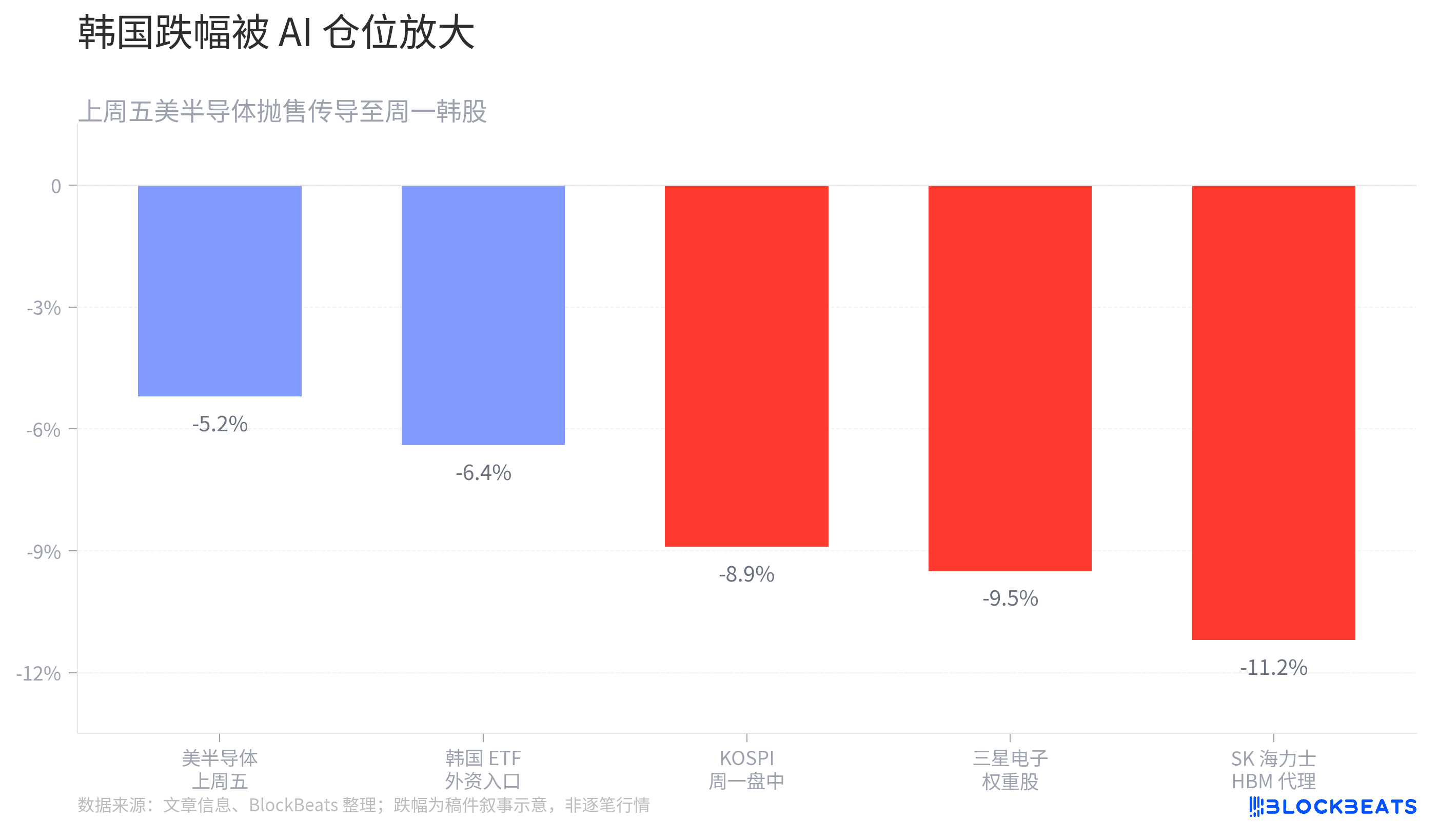
In a sense, South Korea is no longer just a national index but functions more like a large-scale AI memory ETF.
Jensen Huang's South Korea Visit Contrasts Sharply with Market Panic
If the market panic stems from valuations, then the biggest positive catalyst from the weekend came from the supply chain itself.
The core objective of Jensen Huang's visit to South Korea is clear: to further strengthen NVIDIA's cooperative relationship with the Korean AI supply chain. The most closely watched development was the announcement of a new multi-year agreement between NVIDIA and SK Hynix. Over the past two years, HBM has become one of the most critical components for AI servers, and SK Hynix is currently one of the biggest beneficiaries.
This is why the market is paying close attention to this collaboration.
In recent months, as the scale of AI infrastructure construction has expanded, market concerns have grown about whether the growth rate of HBM demand might be peaking. However, Jensen Huang's visit to South Korea at this time actually sends an opposite signal. If NVIDIA believed that AI data center construction was nearing its end, it would have no reason to continue strengthening long-term partnerships with suppliers at this juncture.
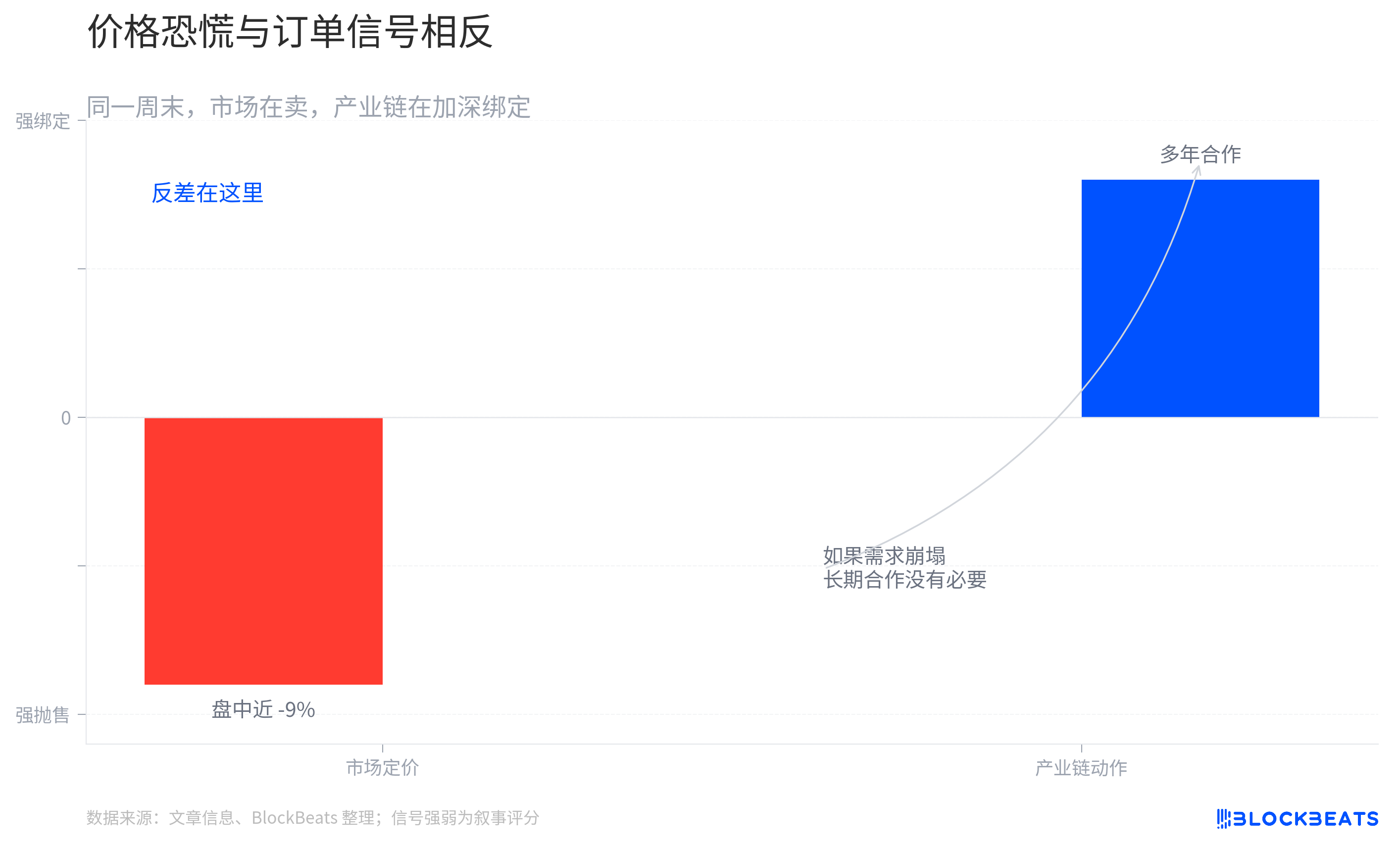
From a supply chain perspective, the market has yet to see evidence of a sudden disappearance of AI demand.
This is precisely what makes the past two days most intriguing. The capital market is using stock prices to express concerns about AI sector valuations, while the core companies within the supply chain are still discussing expansion plans and cooperation plans for the coming years. A clear disconnect persists between the prices set by the market and the signals emanating from the supply chain.
The AI Bull Market Is Entering a Phase of Profit Pool Reassessment
This also represents the biggest divergence currently.
Over the past year, the market traded on a very simple narrative: AI demand is growing. Consequently, NVIDIA rose, Micron rose, SK Hynix rose, Samsung Electronics rose – almost any company associated with AI received a valuation boost.
However, as sector gains have broadened, the market is moving into a second phase.
Investors are no longer satisfied with the story that "AI will grow," and have begun asking another question: Who will ultimately capture the profits generated by AI growth? In recent months, from adjustments to the Rubin rack system memory, to market reactions following Broadcom's earnings report, and now the South Korean market crash, all essentially reflect the same thing – the market has started to decompose the AI profit pool.
SK Hynix benefits from HBM, Samsung Electronics is involved in HBM, DRAM, and advanced packaging, while Micron benefits more from the overall memory upgrade in AI servers. Although all belong to the AI supply chain, their corresponding profit sources and pricing power differ.
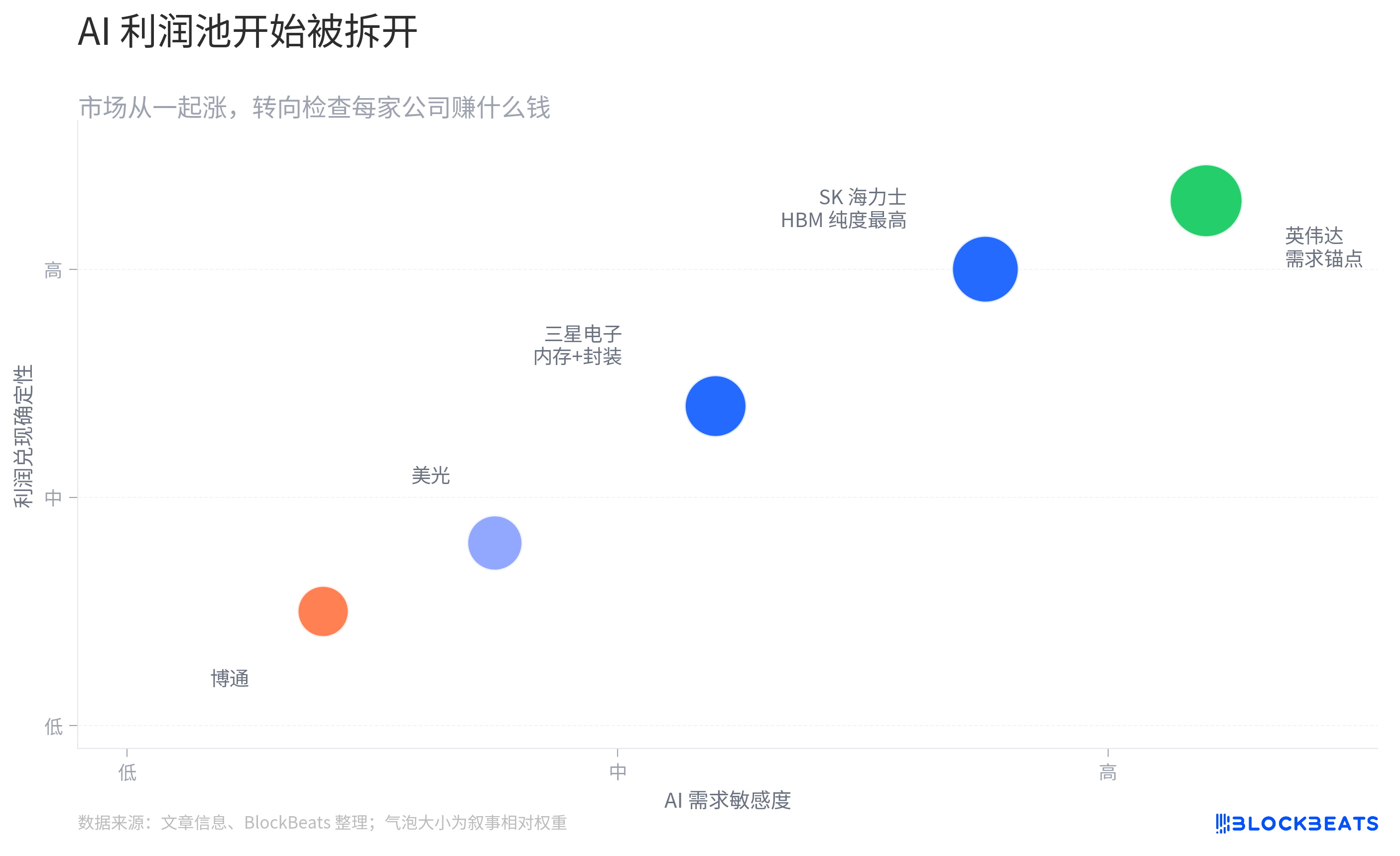
Previously, the market was willing to expand valuations broadly across the entire sector. Now, capital is scrutinizing each company to see if these profits can actually be realized.
This explains why a piece of supply chain news, an earnings guidance update, or even an adjustment in capital expenditure can trigger significant volatility across the entire sector. The market's trading focus has shifted: rather than whether AI will continue to grow, investors are more concerned about whose financial statements will ultimately reflect that growth.
What Determines the Direction of Korean Stocks Is Not South Korea Itself
In the coming weeks, the true determinants of the South Korean market's direction will still be NVIDIA's orders, HBM supply-demand dynamics, and cloud vendors' capital expenditures.
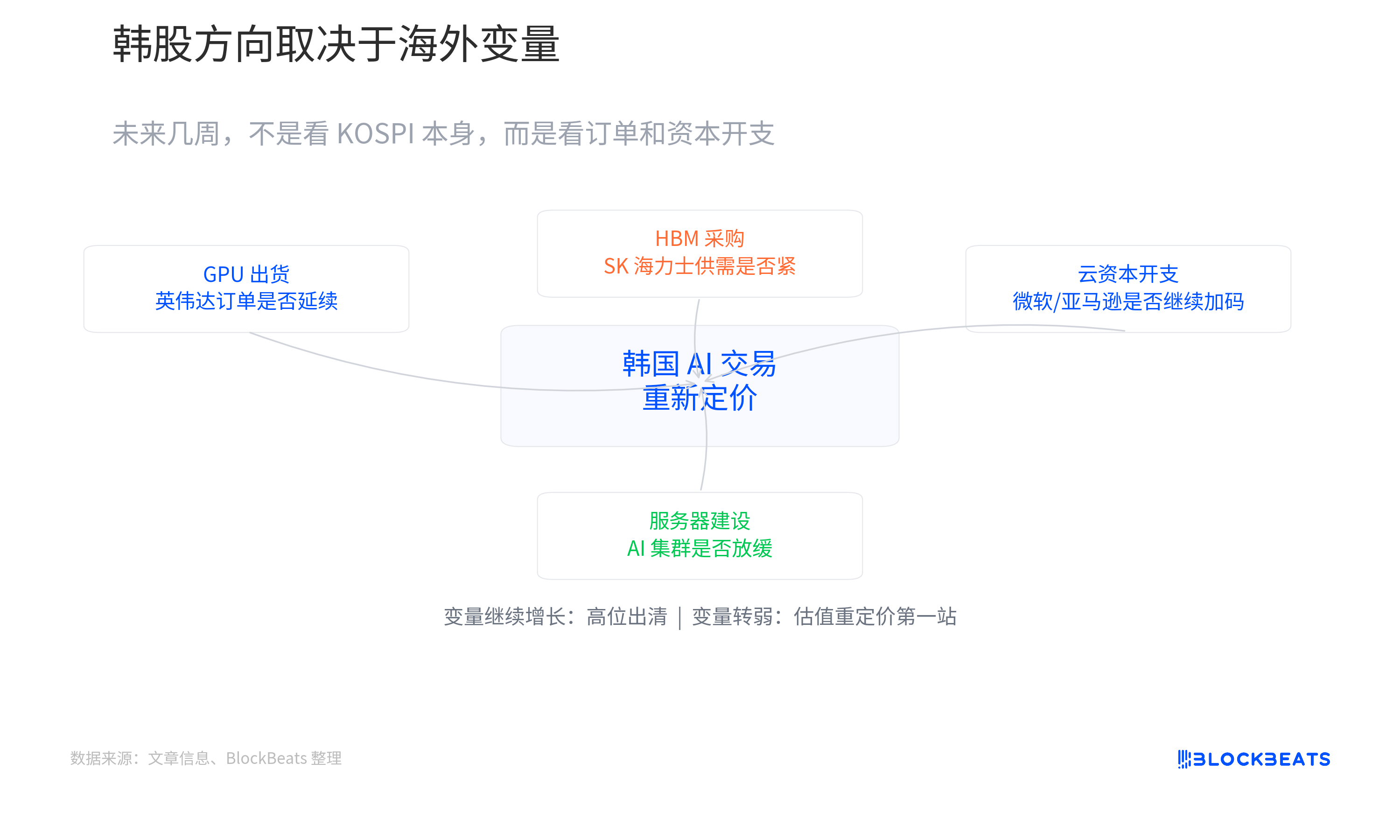
If these data points begin to weaken, then this crash might just be the beginning of a larger-scale valuation adjustment.
Conversely, if data center construction, GPU shipments, and HBM procurement continue to maintain high growth, then Monday's circuit breaker looks more like a concentrated clearance of an overcrowded trade.
At least for now, the prices set by the market and the signals from the supply chain are not entirely aligned.
On one side, South Korea's AI leaders face their most intense sell-off in recent years; on the other side, Jensen Huang is in Seoul discussing next-generation AI infrastructure with supply chain partners.
Whose assessment is closer to reality? We might find out soon.


