






BIT invited to speak at Beyond Expo 2026, Broker-Direct U.S. Stocks Pave a New Paradigm


- Core Thesis: The key for Web3’s market cap to grow from $4 trillion to $10 trillion lies in building compliant channels to drive institutional capital inflow; stablecoins serve as a bridge connecting traditional and digital finance, and tokenized RWA (Real World Assets) like high-quality U.S. stocks will together fuel market cap growth.
- Key Elements:
- BIT has launched a broker-direct U.S. stock service, supporting instant stablecoin deposits to purchase real U.S. stocks (not tokenized representations). Its compliance framework includes holding a Bhutan financial services license and connecting with a U.S. clearing broker.
- Institutional entry faces structural barriers, as the custody and settlement systems for traditional and digital assets operate independently, leading to inefficient cross-asset allocation. Bridging these two infrastructures is a core competitive moat.
- Currently, individual investors prefer using stablecoins to buy U.S. stock assets rather than using fiat to purchase Crypto Altcoins. Wealth hotspots are shifting from crypto assets to traditional markets.
- Key asset categories for achieving a $10T market cap include: stablecoins as a bridge (with increased issuance and liquidity), and tokenized RWAs of U.S. stocks (especially the AI sector) with wealth effects, allowing more investors to hold scarce assets.
- RWA U.S. stocks primarily offer price exposure to meet trading demand, whereas the direct-connection model allows users to enjoy shareholder rights. The underlying logic differs between the two.
- Emphasize that value creation is the driver for healthy upward momentum; innovation enhancing productivity creates quality assets. Long-term holding of high-quality assets can withstand short-term bubbles and outpace inflation.
On May 29, Elio Cui, Head of BIT Brokerage, was invited to participate in a roundtable discussion at the Web2+3 Wealth Forum, part of the BEYOND Expo 2026 held in Macau. He joined fellow panelists to explore the path to genuine growth for Web3 in its next phase, under the theme: "How Can Web3 Reach a $10T Market Cap?"
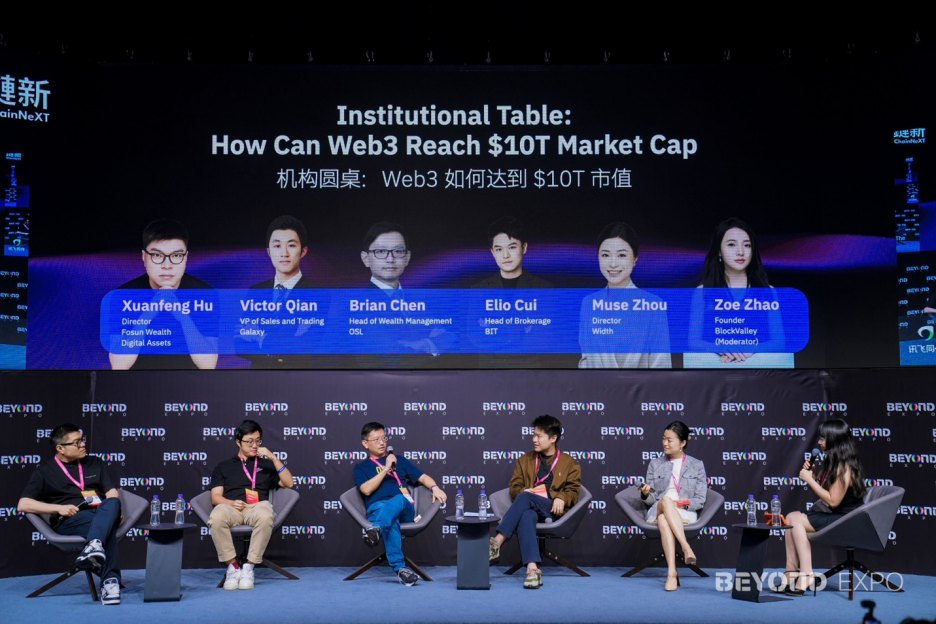
This roundtable brought together top executives from the Web3 and traditional finance sectors to discuss the institutionalization of crypto markets, new asset classes, and regulatory milestones. Joining Elio Cui on the panel were Xuanfeng Hu, Director of Digital Assets at Fosun Wealth; Victor Qian, Vice President of Sales & Trading at Galaxy; Brian Chen, Head of Wealth Management at Hong Kong-licensed digital asset platform OSL; and Muse Zhou from infrastructure provider Width. The panelists engaged in an in-depth and lively discussion on topics such as the real barriers for institutional capital entry, whether RWA or derivatives will drive the next trillion, and the path from $4T to $10T.
Key takeaways from Elio Cui's remarks at the event include:
First, BIT (formerly Matrixport) is an industry-leading one-stop digital asset service platform founded in 2019. In February of this year, BIT pioneered an innovative US equities service model that directly connects to brokerage partners. This service allows users to transfer stablecoins directly into a BIT securities account in seconds to purchase real US stocks—rather than using tokenized stock price proxies common in the industry. We made this decisive choice back when we were still developing the product late last year. This choice stems from the company's seven-year heritage serving institutions and high-net-worth clients, rooted in a long-term value-oriented philosophy.
BIT's direct-brokerage US equities model operates through a compliant framework and partnerships with upstream and downstream collaborators:
- Facilitating stablecoin-to-fiat conversion in accordance with applicable regulations.
- Holding a financial services license in Bhutan, enabling users to compliantly and securely purchase and hold securities.
- Connecting with licensed financial partners, including clearing broker-dealers in the US.
Second, on how the Web3 sector can reach a $10 trillion market cap, Elio believes the primary focus is "creating compliant channels for institutions to buy these assets."
"This question was actually first explored back in 2017, when Bitcoin was still widely questioned. At the time, the idea was that if all global sovereign wealth funds and pension funds allocated just 0.1% or even 1% to Bitcoin, its price would surge dramatically. It seemed like a fantasy, even for industry practitioners—far too ahead of its time. But in just under a decade, roughly seven to eight years, we have truly seen it happen: products like IBIT's ETF have grown to manage tens of billions, and allocations from sovereign wealth funds, pension funds, and compliant capital channels have entered Web3.
So, how do we reach $10 trillion? My view remains the same as a decade ago—if there are compliant channels enabling more people to buy and hold these assets, market capitalization will naturally rise."
Third, current challenges for Web3 assets in attracting significant capital include:
1) Client Trading Preferences
Analyzing from a retail investor perspective, recent business data shows significantly more capital and users are using stablecoins to buy USD-denominated US stocks compared to using fiat to purchase crypto altcoins. The wealth effect in the US stock market is currently drawing retail investors in, shifting the epicenter of wealth and wealth paradigms.
2) Institutional Entry Barriers
From an institutional point of view, portfolio management bridging traditional assets and digital assets remains a persistent industry pain point. The custody systems, management entities, and settlement rules for these two asset classes are entirely different. This leads to low capital efficiency in cross-category allocation and makes leveraging and position management difficult to coordinate. In reality, many institutions operate two entirely separate infrastructures to manage the same client's assets. This structural barrier, paradoxically, defines the true moat: companies capable of bridging traditional finance and digital assets by connecting these two distinct infrastructures derive their advantage not from an accumulation of product features, but from years of building compliant frameworks and institutional service capabilities.
Fourth, two key asset types are crucial for Web3 assets to transition from $4T to $10T.
1) Stablecoins serve as the bridge, transmitting capital between the traditional finance and digital asset markets. Significant volumes of stablecoins will be used in connecting traditional finance and Web3, leading to increased issuance scale and liquidity, thereby boosting Web3's overall size and market cap.
2) RWA: The tokenization of high-wealth-effect stocks, particularly from the AI sector, allows ordinary retail investors who previously lacked access to purchase and hold specific stocks that offer scarcity, liquidity, and wealth effects. Investors can execute their AI investment strategy by holding tokenized stocks.
Investors can use the first method—stablecoins—to allocate capital to both digital assets and traditional financial assets, or use the second method—holding tokenized stocks—for asset allocation. The expansion of these two major asset categories will provide the growth needed to move from $4 trillion to $10 trillion. It's important to note that while both methods use stablecoins to trade US stocks, their underlying mechanisms differ. The first method uses stablecoins as a bridge to buy and hold actual US stocks within the traditional financial system, granting access to substantially all shareholder rights. In contrast, current RWA US stocks primarily facilitate price trading. While price exposure satisfies trading needs, holding the actual underlying asset requires a framework involving broker-dealers, custody, shareholder rights, and compliance.
Fifth, value creation is the driver of healthy asset appreciation.
Disruptive innovation enhances human productivity. Creation leads to good assets, and using stablecoins to trade these assets ensures that price increases are healthy. As we all know, to outpace inflation, one must hold assets, not cash.
Sixth, Long-term Perspective and Risk.
Make long-term value and investment judgments. Short-term bubbles and volatility are just minor bumps on a long-term upward trajectory. Holding quality assets for the long term allows one to outpace inflation. As the saying goes, "You can't drink beer without foam."
About BIT
BIT (formerly Matrixport), founded in 2019, is a leading global digital asset financial services group. Headquartered in Singapore with offices across seven countries and regions, BIT connects traditional finance with digital asset markets through its robust governance, technological capabilities, and compliant operations.
BIT offers a comprehensive suite of digital asset services to global institutions and professional investors, including trading, custody, asset management, liquidity, and financing services. It also supports the on-chain introduction and application of Real World Assets (RWA). Its entities hold relevant licenses and are regulated locally in Singapore, Hong Kong, Switzerland, the United Kingdom, the United States, and Bhutan. These include a Major Payment Institution (MPI) license in Singapore and a Swiss FINMA license for collective asset management.
Currently, the group manages over $6 billion in assets, with a monthly trading volume exceeding $7 billion. It has paid over $2 billion in cumulative interest to clients and is valued at over $1 billion. BIT was listed on the 2024 Hurun Global Unicorn Index and the 2025 Singapore Fintech Unicorn List.
Disclaimer:
This content is for informational purposes only and does not constitute investment advice, an offer to invest, or a solicitation to purchase any financial product. The information herein should not be construed as a recommendation for any specific investment strategy or product.


