How to Enable AI Agents to Call APIs, Purchase Permissions, and Complete Payments? Exploring ERC-8257.


- Core Thesis: OpenSea has proposed the ERC-8257 standard draft, aiming to establish a decentralized and permissionless on-chain tool registry for AI Agents. This enables them to autonomously discover tools, understand access rules, and automatically complete tool calls and payments upon meeting conditions, filling the current gap in unified standards and payment processes for autonomous AI Agent tool invocation.
- Key Elements:
- Problem-Driven: AI Agents face obstacles such as decentralized access points, a lack of unified discovery channels, and standard payment processes when calling tools, making it difficult for them to autonomously complete registration, credential acquisition, and permission verification like human users.
- Core Architecture – Tool Registry: The core of ERC-8257 is an on-chain smart contract used to record tool information. To reduce costs, detailed tool descriptions (Manifest) are stored off-chain in JSON format, with only its hash recorded on-chain for tamper-proof verification.
- Flexible Access Control: Access permissions are defined through independent smart contracts, allowing developers to customize rules (e.g., holding a specific NFT, Token, or completing a subscription), requiring AI Agents to obtain corresponding credentials before invoking the tool.
- Openness and Compatibility: The standard does not restrict the permission model (supports Soulbound NFTs or reputation scores) nor define payment logic. Instead, it declares supported payment protocols (e.g., x402), addressing value volatility and speculation risks.
- Automated Workflow: AI Agents can discover tools by scanning the on-chain registry, read rules, acquire permissions, and ultimately autonomously complete payment and invocation without human intervention.
- Potential Challenges: Differences in permission definitions among developers may require AI Agents to accommodate complex logic when calling tools. Additionally, the standard cannot guarantee the operational logic, trustworthiness, or long-term availability of off-chain tools, necessitating reliance on external reputation mechanisms.
Original Author: Shirley Li, Researcher at Web3Caff Research
How to easily grasp the market hotspots, technological trends, ecosystem developments, and governance dynamics currently unfolding in the new generation of FinTech industry? The "Market Pulse Analysis" column launched by Web3Caff Research will delve into the frontlines to explore and select current hot events, providing value interpretation, commentary, and principle analysis. See the essence through the phenomena and quickly capture front-line market trends with us now.
Compared to human users, the biggest advantage of an AI Agent is that, ideally, it possesses stronger autonomous execution capabilities: it can complete tasks by itself, execute operations automatically, and proactively call external tools without continuous human intervention. However, in the actual process of AI Agents calling tools (e.g., trading platform APIs, data analysis tools, oracles), they still face some issues.
Firstly, the access points for these tools are scattered across GitHub, official websites, centralized API platforms, etc., lacking a unified discovery channel. It is difficult for an AI Agent to independently locate and integrate the required tools without human intervention. Moreover, the specific payment methods on different platforms vary, lacking standardized processes. This creates certain difficulties for AI Agents in the tool-calling process.
Secondly, in the traditional internet environment, using an API typically requires developers to register an account, obtain an API Key, and perform permission verification according to specific rules. This process was originally designed for human participants. However, for an AI Agent to automatically complete registration, obtain credentials, and call tools, there is currently a lack of public and standardized implementation schemes.
Although the x402 protocol currently supports AI Agents in automatically completing payments, it is mainly suitable for "pay-per-use" open interfaces and struggles with more complex permission scenarios, such as users needing a subscription to access the service, or holding specific credentials to enjoy discounts.
To fill this gap, OpenSea recently attempted to introduce the ERC-8257 standard draft, aiming to establish an open, permissionless on-chain tool directory for AI Agents. This would allow AI Agents to autonomously discover tools, understand access rules, and automatically complete calling and payment once conditions are met.
In simple terms, the core of ERC-8257 is an on-chain tool registry. This registry is essentially a smart contract where tool developers can register information about their tools and access permissions on-chain, making them publicly available across the entire network.
However, since directly storing all data on-chain can be costly, ERC-8257 allows developers to store more detailed tool information on their own maintained servers or domains, presented in JSON format files (Manifest). The on-chain registry only records the link to these files. These off-chain files typically include: tool name, function description, API interface, calling method, pricing information, payment protocol, access rules, etc. The on-chain registry needs to record key data such as the address of the off-chain file, the file hash, and the developer's information. This design aims to prevent developers from privately tampering with the tool content later. When an AI Agent calls a tool, it can verify whether the off-chain content matches the information registered on-chain by checking the file hash.
Another crucial design in ERC-8257 is that access permissions are not fixed in format but are defined through independent smart contracts. Tool developers can freely define these contracts to specify who is eligible to call their tools. For example, developers can check if an AI Agent holds a specific NFT, holds a specific Token, has a subscription, or is on a specific whitelist, etc.
Consider an example: an on-chain analysis tool stipulates that the fee for a regular user to call the regular API is $0.05 per call, while a user holding a specific NFT only needs to pay $0.01 per call. Furthermore, if a user subscribes to the service (paying continuously via a designated Token or payment protocol), they can also gain access to premium analysis interfaces.
In this scenario, "holding a specific NFT" and "subscribing to the service" are two special types of access credentials. If the AI Agent currently lacks the corresponding permissions, it can obtain these prerequisites on-chain or in the marketplace (e.g., buying the NFT or completing the subscription) and then reapply for access.
However, it's important to note that when access permissions exist in the form of assets like NFTs or Tokens, they can enter the market circulation system. Consequently, they become subject to supply and demand dynamics, potentially leading to high value volatility or speculative behavior.
Therefore, ERC-8257 does not restrict the permission system to a single asset model. Instead, it chooses to remain open. Tool or service developers can select different access mechanisms based on specific needs, such as introducing non-transferable Soulbound NFTs to avoid value fluctuations caused by trading activities, or introducing non-asset-based mechanisms like reputation scores to reduce the impact of speculation.
On the payment side, ERC-8257 is also not responsible for defining specific payment logic. It only requires developers to declare in the JSON file which payment protocol they support, such as x402, on-chain ERC-20 payments, or other machine payment protocols. The actual payment execution will be handled by the corresponding protocol.
Looking at the overall workflow, ERC-8257 operates roughly as follows:
- A tool developer deploys the tool service, writes the corresponding access permissions, and submits the relevant information to the on-chain registry.
- When an AI Agent needs to call a specific tool or service, it can scan the on-chain registry. If it finds a suitable tool or service, it can further read the detailed description file to understand the calling rules.
- If the AI Agent does not meet the access conditions, it can attempt to acquire the necessary permissions and then initiate the call again.
- Finally, the AI Agent can autonomously complete the entire process of tool discovery, permission verification, payment, and calling without human intervention.
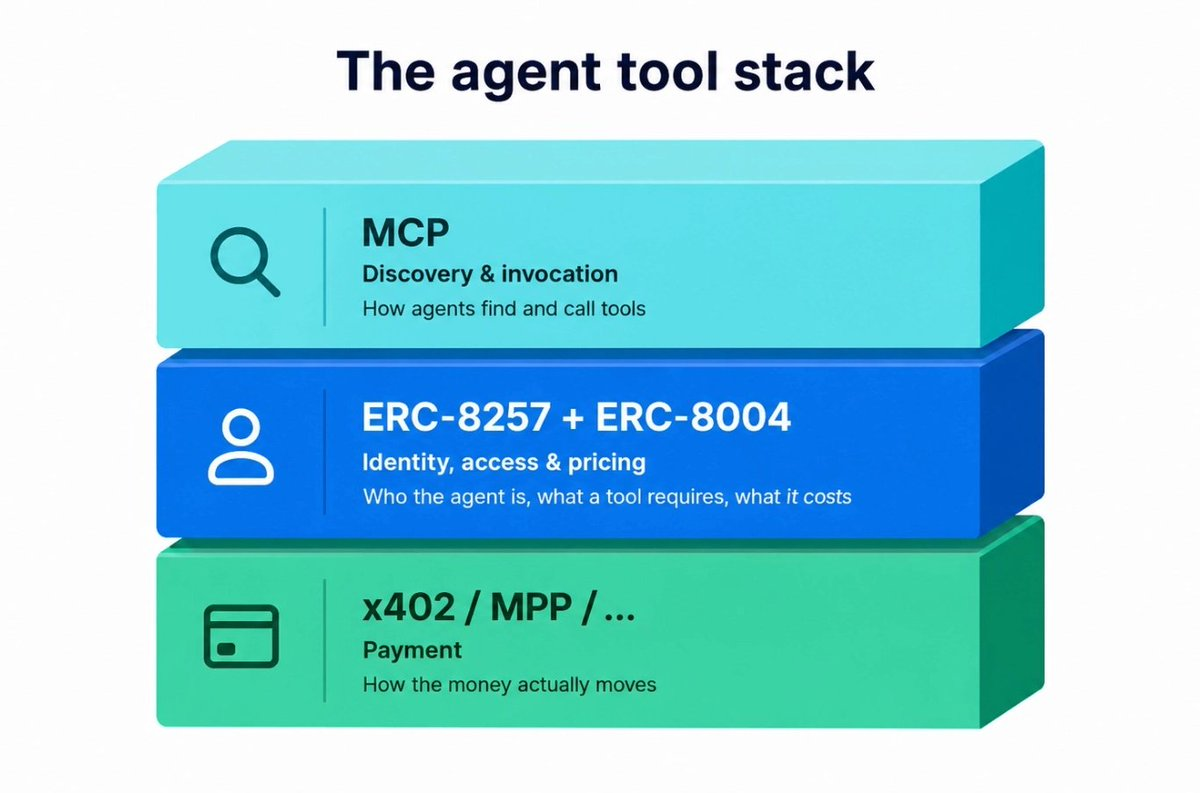
Source: The App Store for Agent Tools: ERC-8257
Overall, what ERC-8257 attempts to solve is not just the issue of how to put APIs on-chain, but how AI Agents can, like human users, automatically discover tools, understand access rules, obtain access permissions, and call these tools in a standardized way. From a design perspective, ERC-8257 will form a complementary relationship with the x402 protocol:
- ERC-8257 is expected to enable AI Agents to discover tools globally and determine whether they have access based on the rules.
- The x402 protocol handles payment and settlement during the tool-calling process. After a tool is permitted for use, it supports AI Agents paying on a per-call or per-frequency basis.
However, besides the aforementioned risk of value volatility and speculation if access permissions exist as assets like NFTs or Tokens, the actual implementation of the ERC-8257 standard will also face other potential risks and challenges.
For instance, although ERC-8257 provides a standardized framework for tool registration and access, different developers may still have variations in setting access conditions. While AI Agents can rely on a unified on-chain index path for tool discovery, they still need to adapt to different permission judgment logics during the actual calling process, introducing certain technical complexities.
Furthermore, regarding the trust mechanism, AI Agents currently compare the hash recorded on-chain with the off-chain tool description file to verify if the file has been tampered with during transmission. However, this mechanism only addresses the issue of data consistency. It cannot further guarantee whether the tool's operational logic is correct, whether its interface is trustworthy, or whether there are potential risks like information leakage during data processing. Additionally, since tool services are typically deployed on off-chain infrastructure, their long-term availability and stability still depend on the developer's operational capabilities. This means AI Agents also need to rely on external reputation mechanisms for selection.
It is evident that before the ERC-8257 standard is practically applied, aspects such as tool credibility and consistency of permission rules still require further verification and improvement.
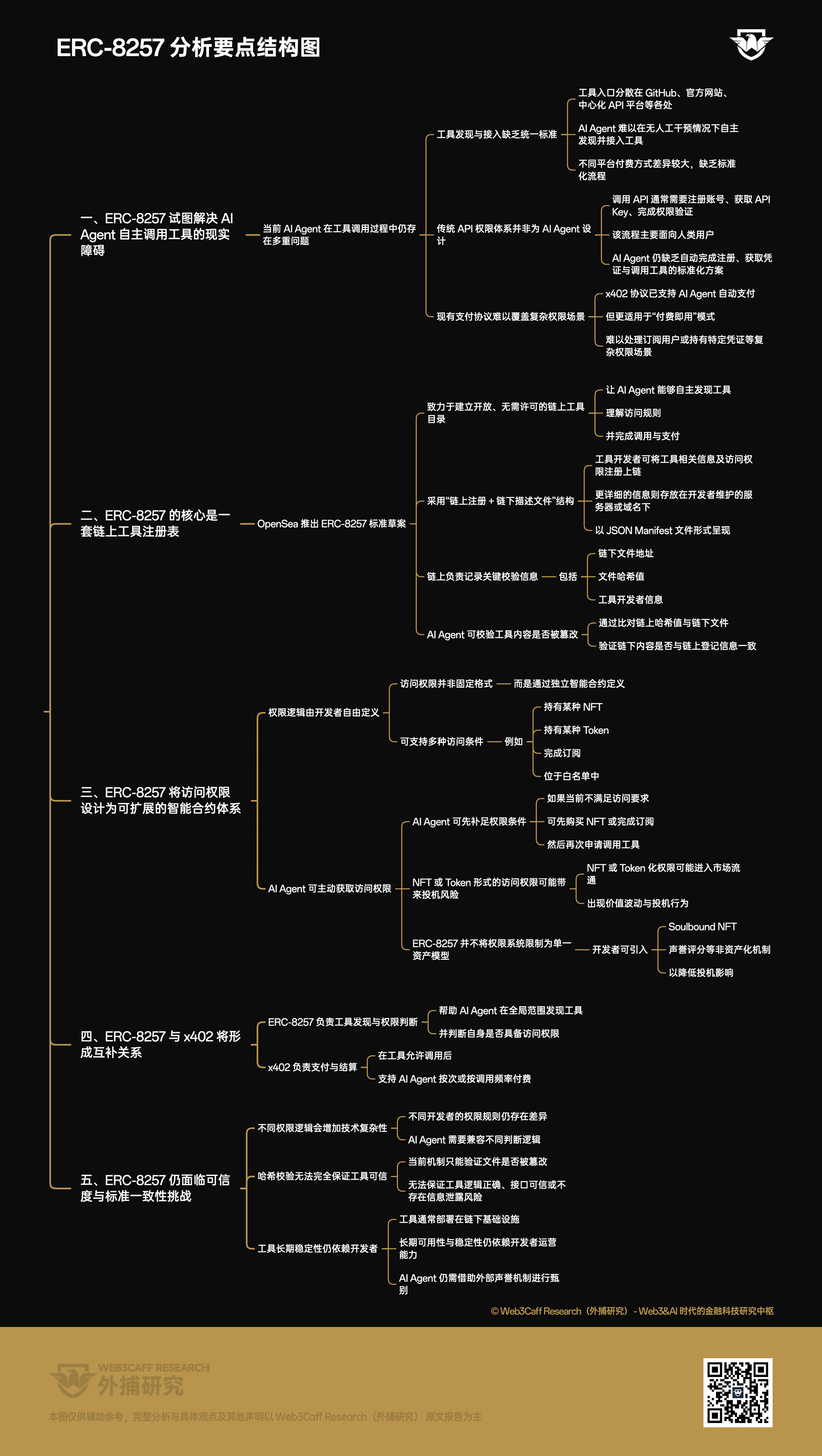
Key Structure Diagram:
References:
[1] The App Store for Agent Tools: ERC-8257
[2] ERC-8257: Agent Tool Registry
Disclaimer
This report is prepared by Web3Caff Research and is for informational purposes only. It does not constitute any forecast or investment advice, recommendation, or solicitation, and investors should not rely on such information to buy or sell any securities, cryptocurrencies, or adopt any investment strategy. The terminology used and views expressed in this report are intended to help understand industry trends and promote responsible development in the FinTech sector, including Web3, blockchain, AI, and payments. They should not be interpreted as definitive legal opinions or the views of Web3Caff Research. The views in this report reflect only the personal opinions of the author(s) as of the stated date, are independent of the stance of Web3Caff Research, and may change subsequently. The information and opinions contained in this report are derived from proprietary and non-proprietary sources deemed reliable by Web3Caff Research but do not purport to be comprehensive and are not guaranteed for accuracy. Therefore, Web3Caff Research makes no representation or warranty of any kind regarding their accuracy or reliability and assumes no liability for errors or omissions arising in any other way (including liability to any person by reason of negligence). This report may contain "forward-looking" information, which may include forecasts and projections, and nothing herein constitutes a guarantee of any projections. Whether to rely on the information contained in this report is entirely at the reader's own discretion. This report is for informational purposes only and does not constitute investment advice, recommendation, or solicitation to buy or sell any securities, cryptocurrencies, or adopt any investment strategy. Please strictly comply with the relevant laws and regulations of your country or region.