June marks a major test for centralized exchanges


- Key Thesis: In June 2026, the focus of user acquisition for crypto exchanges shifts towards US stock tokenization (SpaceX IPO) and prediction markets (World Cup), facing multiple pressures from capital spillover due to fines on traditional brokerages and competition from the decentralized perpetual contract protocol Hyperliquid.
- Key Elements:
- Market Consensus on Incremental Growth: The primary incremental user flows that crypto exchanges vie for in 2026 come from US stock tokenization (e.g., SpaceX Pre-IPO) and prediction markets (e.g., World Cup betting). The former creates FOMO sentiment, while the latter offers a short-term, fast-paced trading experience.
- SpaceX Liquidity Pressure: The SpaceX IPO (June 12) is expected to trigger users to sell BTC/ETH/SOL for stablecoins and withdraw funds to participate, constituting a liquidity stress test for the crypto market.
- Brokerage Regulatory Dividend: Fines imposed on Futu, Tiger Brokers, and Chailuo narrow the channels for onshore investors to buy US stocks. This capital may spill over to Hong Kong-funded brokerages or centralized exchanges, bringing incremental users to the latter.
- Exchange Competitive Dimensions: The core competition lies in listing speed (capturing the first wave of traffic surges), system stability (handling instantaneous high concurrency), product optimization (simplifying trading paths), and marketing campaigns (creating FOMO sentiment).
- Hyperliquid Threat: As a representative Perp DEX, Hyperliquid, with its small team and high decision-making efficiency, has already preemptively listed SpaceX perpetual contracts and World Cup prediction contracts, posing a speed challenge to centralized exchanges.
- World Cup and Exchange Strategy: Exchanges guide users to use Web3 wallets by integrating external prediction market protocols, aiming to boost on-chain activity. The World Cup is viewed as a long-term operational battle rather than a single-day traffic surge.
In the first half of 2026, the crypto market can only be described in two words: tough to bear.
BTC, ETH, and SOL, once considered "blue-chip assets," have been steadily declining. Activity on public chain ecosystems has dropped, and the community has lost its ability to create new hotspots. Meme coins tirelessly repeat the "news-pump-dump" market manipulation cycle; retail investors rush in, only for project teams to already be popping champagne.
A poor market doesn't just hurt users; exchange bosses are equally troubled. If users lose money on spot trading, their trading frequency drops. Lower trading frequency naturally leads to shrinking fee revenue. Shrinking fees cause OKRs to flash warning signs. The feedback from derivatives is even more direct: in a bear market, one liquidation event likely makes a user quit, and the cost to win back a high-volume trader is extremely high.
Acquisition, retention, reactivation – the operational playbook from the internet industry over the past few years is now spinning slower and slower in crypto. Essentially, investor attention is finite. Without a wealth effect in crypto, investors naturally shift their focus to other profitable sectors.
This brings a critical question to the forefront for every exchange: Where will the next wave of growth come from?
Tokenized US Stocks and Prediction Markets
The market has generally reached a consensus that the growth in 2026 stems from two main directions: tokenized US stocks and prediction markets. The former generates FOMO, while the latter triggers dopamine hits. Memory chip stocks like SanDisk, SK Hynix, and Western Digital have surged strongly, creating a powerful wealth effect. For the first time, many crypto users realize that "US stocks are easier to profit from than altcoins." Prediction markets offer faster, simpler trades. Users don't need to analyze on-chain data; they just place bets: Will the Strait of Hormuz be reopened? Will the Fed cut rates? Compared to the torment of holding onto BTC and ETH through endless volatility, prediction markets are far more addictive.
Consequently, tokenized US stocks and prediction markets have quickly become the new battleground for major exchanges, with competition intensifying. June isn't just the crucial college entrance exam month for students; it's also become the "major exam" period for crypto exchanges.
SpaceX IPO
First up is the biggest IPO in human history, the masterpiece of the Silicon Valley Iron Man, the creator of the Starlink era, the igniter of the space AI narrative, the behemoth valued towards $2 trillion—**SpaceX**.
The SpaceX IPO is not only a major event on Wall Street but also a liquidity stress test for the entire crypto industry. It's foreseeable that many users will start selling BTC, ETH, and SOL, converting them into USDT or USDC; then withdraw from exchanges, convert to USD, and rush into the secondary market to participate in SpaceX.
In other words, for the past few years, exchanges have been trying to turn dollars into stablecoins. Now, SpaceX might turn stablecoins back into dollars.
But within immense crisis often lies immense opportunity. Bitget, for instance, has provided its answer: listing SpaceX's Pre-IPO shares early. (This isn't an ad, just stating facts; other exchanges will be mentioned later.)
This move has given Bitget a head start in attracting traffic. For many average users, the real barrier isn't knowledge but the complexities of USD accounts, cross-border brokerages, and compliance procedures. What the exchange does is: "You don't have to leave crypto to participate in SpaceX." However, a new problem emerges. The SPV shares released by SpaceX are very limited, with a total quota of only $61 million. Consequently, there are many buyers in the market, but the available sell-side tokens are scarce.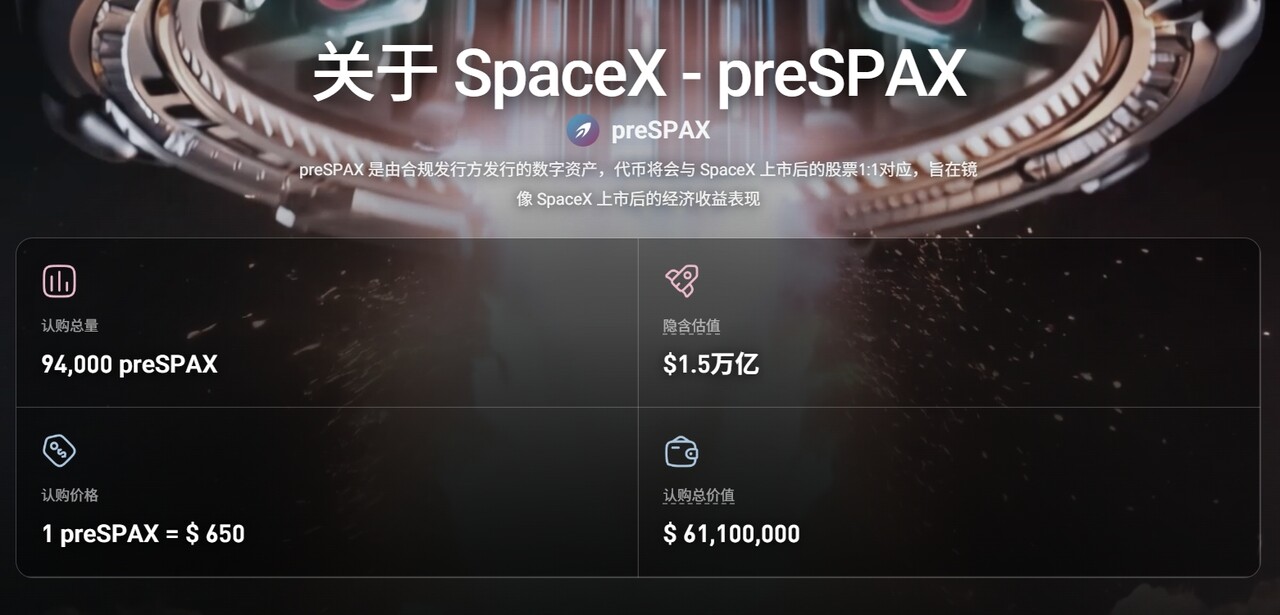
How Can Exchanges Capture the SpaceX Traffic?
Personally, I think Bitget's move was smart, but what truly determines which exchange captures the biggest traffic dividend isn't the Pre-IPO, but the day of SpaceX's official IPO on June 12th.
First, it's a race for listing speed. The exchange that lists SpaceX-related spots first will capture the most intense initial wave of traffic. The logic is similar to the MEME wars of yesteryear. Why did TRUMP bring huge user growth to exchanges? Because user FOMO is strongest in the first few hours. First to list gets the meat; those even slightly behind will see users open accounts elsewhere. Of course, how quickly SpaceX shares can be tokenized also depends on Ondo and xStocks. For these two, the SpaceX IPO might determine who becomes the king of on-chain US stocks.
Second, on the research and development front, the pressure from the SpaceX launch is a tough battle for exchanges. No user wants to miss out on IPO day due to app lag, K-line delays, or inability to place orders. But such events haven't been uncommon for exchanges in recent years. When a big market event hits, a massive number of users simultaneously refresh quotes, place and cancel orders, and use leverage. The backend systems for quote pushing, order matching, database reading/writing, and WebSocket real-time communication all come under instant pressure. Any slight issue, and the user experience blows up.
Third, on the product side, how smoothly users can execute trades directly determines conversion rates. Every extra click cuts conversion in half. Product managers need to think about how to design the trading interface to make it easier for users to buy SpaceX, reduce slippage, and provide a better trading experience. Details like how to arrange homepage resources, whether the quote page allows one-click trading, if the order process is short enough, and whether users can "blindly buy" after viewing the K-line all affect final execution.
Finally, the key on the operations side is turning "SpaceX" into a nationwide FOMO event. Trading competitions, airdrop rewards, deposit bonuses, referral programs, and KOL collaborations are sure to appear simultaneously. Large exchanges have natural advantages in operations, with higher visibility and broader channel reach. However, smaller exchanges still have a chance. By creating activities that truly resonate with users, they can also achieve massive growth. Users may not remember who listed SpaceX first, but they will certainly remember which platform gave them their first big win.
Futu, Tiger Brokers, and Longbridge Fined: Where Will Onshore US Stock Investors Go?
At the end of May, three internet brokerages – Futu, Tiger Brokers, and Longbridge – received regulatory fines. For many onshore users, the impact is bigger than expected. Simply put, existing users can only sell, not buy, for the next two years, and the platforms cannot onboard new onshore users. Many people's first reaction is: "Isn't this just a brokerage rectification?" But put this together with the SpaceX IPO, and things get interesting.
Over the past few years, many onshore investors have gone through the hassle of getting Hong Kong bank cards and opening overseas accounts, essentially for one reason: to buy US stocks. This year, SpaceX has become one of the strongest wealth narratives globally, and many were waiting to jump in on IPO day. Now, the traditional internet brokerage route is suddenly tightening. This means that a large amount of funds originally destined for the US stock market hasn't disappeared, but is looking for new exits. However, much of this capital won't return to trading A-shares. So, a very practical question arises: Who can absorb this capital overflow?
The answer is becoming relatively clear: Hong Kong-funded brokers and centralized exchanges.
Both have their advantages. The biggest advantage of Hong Kong-funded brokers is that they offer the "complete US stock market." While platforms like xStocks and Ondo have tokenized many US stocks, they mainly cover the most liquid core assets like Tesla, NVIDIA, and Google. Compared to the tens of thousands of stocks in the entire US market, the currently tradable tokens cover less than 5%. This means that if users want to buy relatively niche Chinese ADRs like KE Holdings, Full Truck Alliance, Atour, or even some small-cap growth stocks, they ultimately have to return to the traditional brokerage system.
But exchanges also have their killer app: user experience. As mentioned earlier, every extra step in a trade halves user conversion. Most Hong Kong-funded brokerage apps require about 6-7 clicks to reach the US stock trading page, and US stock trading permissions need to be activated separately. In contrast, exchange-based US stock trading is often placed prominently. It takes at most 3 clicks to trade tokenized US stocks. Most users' choice criteria lean towards: which is simpler, faster, and more like an internet product.
Of course, whether opening a Hong Kong brokerage account or registering on an exchange, both operate in a gray area. Users need to figure it out themselves; we won't elaborate here, DDDD (懂得都懂/You know what I mean).
When the World Cup Collides with SpaceX
As coincidence would have it, the 2026 World Cup kicks off on June 12th, the same day as the SpaceX IPO. Whether this timing is intentional by the US, well, you be the judge. One is the most anticipated IPO in human history; the other is the world's largest sporting event. When the "rocket" and the "football" collide on the same day, the global spotlight will be on the US.
The commercial value of the World Cup needs no introduction; it's already the world's largest gambling traffic funnel. According to Forbes, global betting during the 2022 World Cup reached a staggering $160 billion. By 2026, the World Cup will be even crazier. On one hand, the tournament has expanded from 32 to 48 teams, significantly boosting the number of matches, discussion volume, and betting demand. On the other hand, the on-chain prediction market is no longer dominated solely by Polymarket; platforms like Kalshi, Myriad, and Predict.fun have also entered the fray. In other words, the 2026 World Cup could be the first real instance of "large-scale user education" for on-chain prediction markets.
Exchanges certainly won't miss out on this pie. However, the regulatory risks for this type of business always exist, as gambling is a highly sensitive area in many regions. So, most exchanges won't run prediction markets themselves but will opt for a "circuitous route." Multiple exchanges, including Binance, OKX, and Bybit, currently prefer to connect to prediction market protocols like Polymarket, Kalshi, and Predict.fun, allowing users to participate in World Cup betting via Web3 wallets. What exchanges truly want isn't just the betting itself, but to cultivate the habit of users using Web3 wallets.
Because in most exchanges, the proportion of users who frequently open their Web3 wallets is actually quite low. If users start getting used to connecting wallets, signing transactions, and performing on-chain interactions for the World Cup, then the exchanges' own on-chain Dapps will naturally become more active. Especially after the hype around on-chain products like Binance Alpha and OKX Boost has faded, the World Cup might become the catalyst for many users to reopen their Web3 wallets.
Of course, from the perspective of the challenges exchanges face, the World Cup and SpaceX are not on the same scale. Even for exchanges aggressively promoting prediction markets like Gate, they are essentially funneling users to Polymarket, putting pressure on the prediction market protocol itself, not the exchange's backend. Secondly, most World Cup bets can be placed in advance. It's not like the SpaceX IPO, which requires users to frantically grab orders in a single moment. Therefore, for exchanges, the World Cup is more of a "sustained" operational battle than a sudden traffic surge on one specific day. Instead of a single-day stress test, exchanges need to think about how to continuously convert the World Cup's popularity into user activity and on-chain trading volume over the next 40 days.

The Looming Threat of Hyperliquid
Today, centralized exchanges don't just compete among themselves. What might truly keep them up at night is Perp DEX unicorns like Hyperliquid.
If you compare centralized exchange giants like Binance, OKX, and Bybit to elephants, then Hyperliquid is more like a cheetah hiding in the shadows. It's not large, but it's incredibly fast. It's more sensitive to hotspots and quicker to react to market movements. Often, while centralized exchanges are still in meetings assessing risks, Hyperliquid has already launched the product.
For the two most important hotspots in June – the SpaceX IPO and World Cup betting – Hyperliquid has already set its position. For SpaceX, Hyperliquid listed pre-launch perpetual contracts for SpaceX (SPCX-USDC) via Trade.xyz, allowing users to trade with leverage even without holding actual SpaceX shares. For the World Cup, on May 26th, the Hyperliquid HIP-4 testnet went live with a "2026 World Cup Winner" prediction contract, signaling Hyperliquid's formal entry into the on-chain prediction market and gambling arena.
Hyperliquid has always been known for its "small team, high efficiency" approach. In the crypto industry, smaller organizations often mean fewer processes, shorter decision-making chains, and faster product iteration. While many centralized exchanges might be waiting for rounds of approvals from legal, risk, operations, and marketing teams, Hyperliquid has already built the market.
But elephants have their own advantages too. The massive operations, customer support, content, and channel teams of centralized exchanges can still cover a broader range of regular users. For many newcomers, they don't necessarily care if something is native to a chain or truly care about "decentralization." They care more about: how to open an account, how to buy, why they can't buy, and who to contact when liquidated. Often, a customer support agent who can respond promptly might be more important than the narrative of "full decentralization."
Even if the HYPE token has performed exceptionally well in 2026, while exchange tokens like OKB, BGB, and KCS have generally been weak, this author still doesn't believe Hyperliquid will one day completely replace all centralized exchanges. Because in both the stock market and the crypto market, truly professional high-frequency traders and quant funds are always the minority. The vast majority of users remain ordinary retail investors.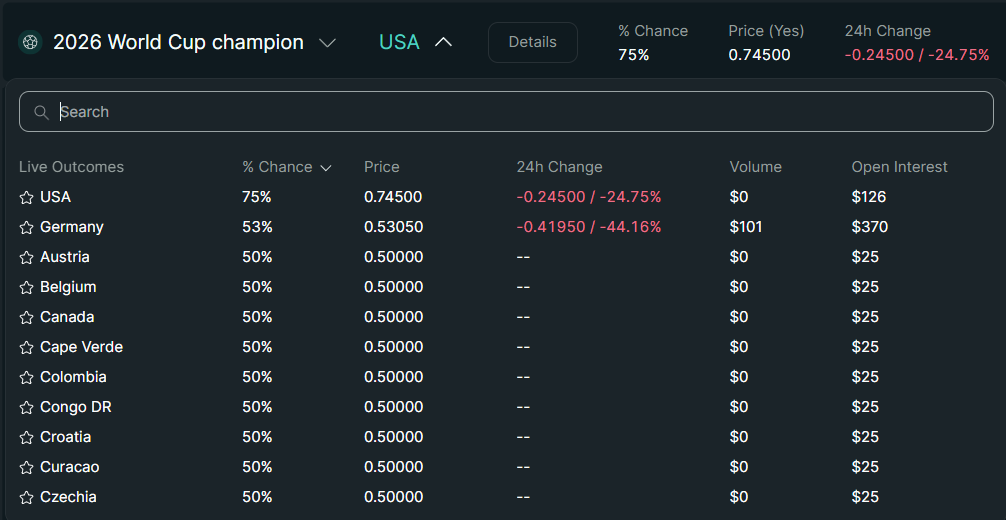
Epilogue
Tokenized US stocks are undoubtedly a major branch of RWA. They are naturally suited for the crypto world due to their high standardization, high liquidity, and relatively high volatility. Prediction markets, in a sense, are on-chain mirrors of real-world events. From the US presidential election to World Cup betting, they essentially bring real-world emotions, opinions, and odds onto the blockchain for trading.
The concept of RWA took different forms over the years: in 2023, the talk of the town was 5% yields on on-chain US Treasuries. In 2024, BlackRock issued its on-chain US Treasury fund, BUIDL. By 2025, stablecoins, on-chain US stocks, and on-chain gold entered the mainstream financial spotlight.
Soon, the real-world "rocket" and "football" are arriving in Web3.
The battle for exchange traffic kicks off in June.