OKX Exchange OS returns the trading market from "centralization" to "a bazaar"


- Core Thesis: OKX’s Exchange OS is an open protocol infrastructure designed to decentralize the right to "create markets" from centralized platforms to everyone. It allows anyone to freely deploy spot, perpetual futures, and prediction markets based on on-chain protocols without approval, thereby reshaping the access and power structure of financial markets.
- Key Elements:
- Exchange OS is built on OKX's X Layer, exposing core exchange capabilities such as order matching, margin management, and settlement as callable protocol-layer services, analogous to the "HTTP protocol" for finance.
- The barrier to market creation is significantly lowered: users only need to stake core assets on X Layer to deploy spot, perpetual contract, or prediction markets, without relying on platform approval or building a complete system from scratch.
- Unified account and capital reuse: A single account and one margin deposit allow users to participate simultaneously in spot, derivatives, and prediction markets, with funds managed uniformly at the protocol layer, greatly improving capital efficiency.
- Expanded market boundaries: Any verifiable event (e.g., whether a certain L1 can surpass Ethereum) can theoretically become a tradable asset. The types of markets are determined by real demand, not platform discretion.
- Capital security is guaranteed by code: User funds are locked in protocol smart contracts, and deployers (including OKX itself) cannot unilaterally access them. Deployers must post an economic bond to deter malicious behavior.
Thousands of years ago, markets were inherently peer-to-peer. Two individuals would meet in a marketplace; one had grain, the other had cloth. Once they agreed on terms, they traded without needing anyone's permission. Markets formed spontaneously, and the pricing power rested with the transacting parties.
Later, intermediaries entered the market, and power shifted from every individual stallholder to a few large trading venues. Stock exchanges, commodity exchanges, regulatory bodies, and clearing houses began to dictate what could be traded and what couldn't, who was qualified to open a market and who wasn't.
With the advent of blockchain, users can trade peer-to-peer, and assets can move freely on-chain without needing a centralized institution as an intermediary. However, the reality is that even on-chain, the question of "who can create a market" is still determined by a handful of platforms and protocols. Want to launch a perpetual contract market? You either build a matching engine, margin system, and clearing logic from scratch, or you submit your market to a platform for approval, ceding pricing power and user access.
With the release of Exchange OS today, OKX aims to fundamentally change this: returning the power to create markets back to everyone.
How Exchange OS Restores the Market
Exchange OS is an open protocol infrastructure built by OKX on X Layer. Core exchange capabilities like matching, margin, clearing, settlement, and unified accounts have been transformed from closed platform products into protocol-layer services accessible to anyone. In other words, it's not an exchange itself, but an infrastructure for building any kind of exchange.
Let's use a more intuitive analogy to understand: Exchange OS plays a role in the financial market similar to what HTTP did for the internet. HTTP opened up communication protocols, allowing anyone to build websites and services without having to create their own protocols, servers, or routers. Exchange OS provides the same open foundation, enabling anyone to launch a market on top of it.
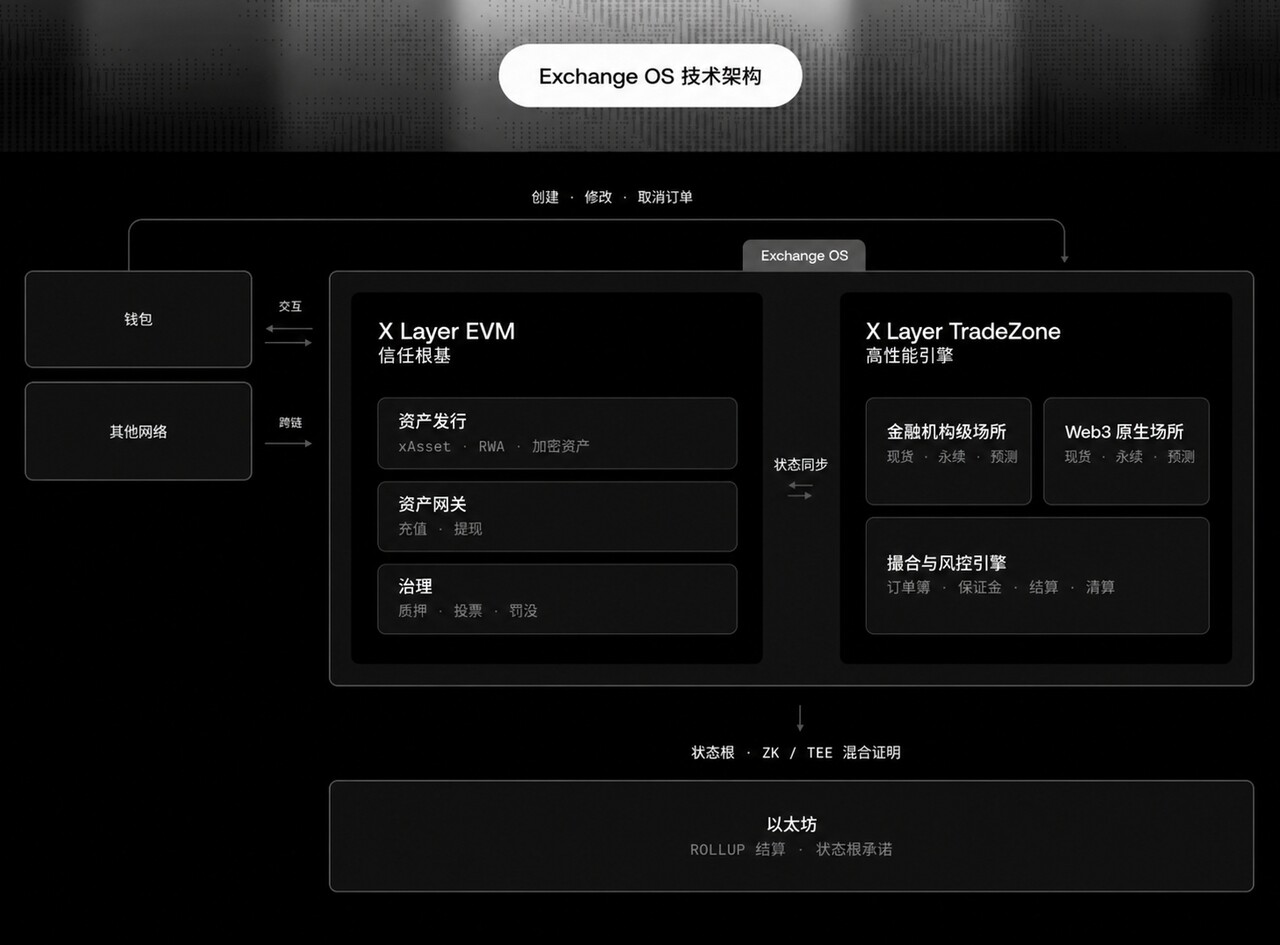
If you want to create a market, simply stake the core X Layer asset to deploy your own market on Exchange OS, including spot, perpetual contracts, and prediction markets. No need to apply to anyone or wait for any platform's approval. All core exchange functions like the matching engine, margin system, and clearing mechanism are built at the protocol layer and ready for you to use directly. The time and energy saved can be focused on the market itself.
Those who open markets can be quantitative teams, RWA institutions, new public chain projects, or any individual user who identifies a trading need and wants to turn it into a real market.
Different deployers can launch various types of markets based on Exchange OS. Some may choose to embed their market within a CEX app, offering users a one-click experience identical to traditional exchanges. Others might opt for users to connect directly via self-custodial wallets, preserving full on-chain sovereignty. Both forms share the same underlying protocol, consistent rules, and identical infrastructure. Deployers can choose their deployment method based on their understanding of users and compliance requirements. OKX only provides the infrastructure; it does not presuppose or endorse any specific compliance model.
One Account for All Markets
For everyday users, the most direct benefit of Exchange OS is a significantly improved account experience.
Today, an active on-chain trader often needs to operate across multiple platforms simultaneously: participating in prediction markets on Polymarket, trading perps on a DEX, and buying spot on an exchange. Accounts are separate, funds are separate, margin cannot be used across platforms, and whenever a new market appears, funds must be re-allocated to a new account on the new platform.
This experience is similar to non-interoperable social platforms: you have one set of followers on Weibo, another on X, and you start over again on Xiaohongshu—registering, setting up profiles, and building a network from scratch each time. You're doing the same thing but expending multiple times the effort. Web3 social aimed to solve precisely this: using an on-chain Social Graph to solidify identity and relationships, making one identity and one set of connections usable across all platforms, maintained once and effective everywhere.
Similar to Web3 social, Exchange OS aims to create a "unified identity and capital" layer in the trading world. One account, one pool of capital, can operate across spot, perpetual contract, and prediction markets, with funds managed uniformly at the protocol level. You can participate in multiple markets simultaneously without transferring funds back and forth, managing multiple accounts, or re-depositing capital every time a new market launches. The effort of maintaining a single account covers all markets.
For professional traders, this means a fundamental improvement in capital efficiency. The same capital is no longer fragmented and locked in accounts across different platforms, but can serve multiple markets and strategies simultaneously. Participating in a prediction market while using the same margin to hedge with contracts on the same underlying asset—this level of capital reuse was nearly impossible before but is natively supported on Exchange OS.
Any Verifiable Event Can Become a Market
For those wanting to create markets, Exchange OS offers another possibility.
Imagine these scenarios: A user focused on crypto tech believes "whether a certain L1 can surpass Ethereum this year" is a question worth pricing. An RWA institution wants to tokenize shares of a private equity fund into a tradable on-chain asset. A quantitative team spots an arbitrage opportunity in a perpetual contract for a small-cap coin and wants to open their own market.
How could they achieve this? Either build a complete system from scratch, which is an enormous engineering task only affordable for top-tier institutions, or partner with a platform, which comes with its own vetting process, launch schedules, revenue sharing requirements, and often disinterest in niche markets. The demand exists, but the market fails to materialize.
Exchange OS directly removes this barrier: users can turn trending events into prediction markets, communities can turn topics into tradable judgments, and institutions can turn assets into on-chain markets. Everyone focuses on what they do best, while Exchange OS handles the infrastructure.
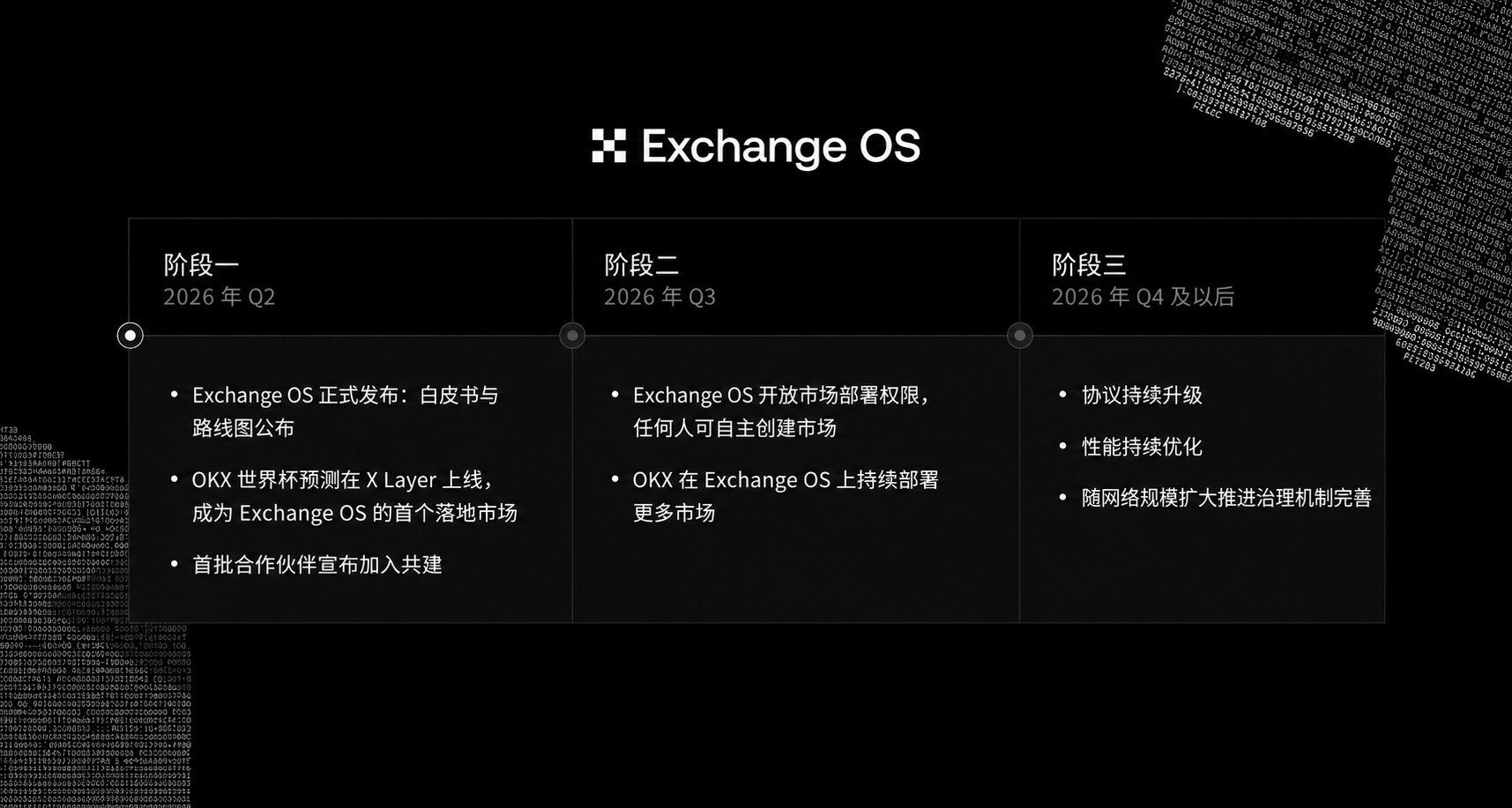 In the past, what you could trade was decided by the platform. Typically, it was a few hundred coins, occasionally some derivatives, while niche demands often never got a chance for listing. Now, as long as an event is verifiable, it can theoretically become a market on Exchange OS. For the first time, the boundaries of the market are not drawn by a platform, but by the boundaries of verifiable events in the real world.
The significance for the entire ecosystem is this: the number and variety of markets will no longer be constrained by any single platform's operational capacity or willingness, but driven by genuine market demand. Wherever there is a desire to trade, a market can exist.
Putting Fund Security in the Hands of Code
Any discussion about open markets inevitably confronts the question: Is it safe? This question is especially weighty in the crypto market. Over the past few years, countless platforms have attracted users to deposit assets under the guise of "decentralization," only to abscond with the funds in various ways. Users have realized that a platform claiming to be secure and actually being secure are two entirely different things.
Exchange OS's answer to this problem is: User funds are locked in the protocol contract, and no one can unilaterally move them—this includes the market deployer and even OKX itself. This assurance doesn't rely on trusting any institution, but on code and protocol rules. The protocol is open and transparent; anyone can audit every line of logic.
The worst-case scenario is a deployer creating a poor-quality market, not the platform running off with your money. These two risks are fundamentally different: the former is market risk, the latter is trust risk. Exchange OS eliminates the latter.
Furthermore, the markets opened by OKX itself on Exchange OS follow the exact same protocol rules as those opened by any external deployer. OKX has no backdoors at the protocol level, no platform privileges, and cannot bypass the rules to give its own markets an advantage.
Of course, "anyone can open a market" also necessitates a mechanism to deter malicious behavior. Exchange OS's approach requires staking the core X Layer asset to open a market. This stake acts as the deployer's economic bond. If a deployer's actions harm user interests, the governance committee can penalize this staked asset, with the penalty proportional to the severity of the malicious act. Opening a market requires a cost, and misbehavior comes with a cost—this is the economic foundation that makes the entire system work.
Exchange OS in Historical Context
To understand the significance of Exchange OS, we need to view it within a longer timeline.
Over the past decade-plus in blockchain, a pivotal moment arrives every so often that fundamentally shifts the power structure. Bitcoin enabled peer-to-peer value transfer, allowing people to transact without banks for the first time. Ethereum allowed anyone to issue assets, opening up "token creation"—previously only for institutions—to everyone. The advent of AMMs allowed anyone to create liquidity pools, eliminating the need for professional market makers. Prediction markets made "events" tradable for the first time, expanding market boundaries from asset prices to any verifiable judgment in human society. Each step was about redistributing power that was once concentrated in the hands of a few.
Exchange OS aims to be the next step on this path: allowing anyone to create a complete financial market. What was once only within the capability of top-tier exchanges to build and operate is now a protocol-layer service accessible to anyone. This is the liberation of the right to create markets. By analogy with the evolution of the internet: In the Web1 era, content was produced by a few websites and institutions, with ordinary people just browsing. In Web2, anyone could write articles or start channels; content creation rights spread to everyone with technological advancement. Web3 extended this openness to the asset layer—anyone could issue tokens and create liquidity pools, drastically lowering the barrier to financial participation.
Exchange OS aims to be the next step on this evolutionary path: making "market creation" something anyone can do. If Web3 solved the problem of "who can issue assets," Exchange OS aims to solve "who can create markets"—this is the form the next-generation financial infrastructure should take.
Thousands of years ago, anyone could set up a stall in the marketplace. What Exchange OS does is recreate that reality on-chain.
Read the Exchange OS Whitepaper and help us build the future of trading markets.