Annualized yield exceeding 13%, Apyx is bringing Bitcoin's "killer app" on-chain


- Core Thesis: Leveraging the Bitcoin credit instrument STRC issued by Strategy, new project Apyx utilizes on-chain financial architecture to channel STRC's high yield into DeFi, creating the interest-bearing stablecoins apxUSD/apyUSD with yields exceeding 11%, stability, and composability. This has made it one of the fastest-growing stablecoin protocols in the current market.
- Key Elements:
- STRC is a preferred share issued by Strategy, generating returns from the long-term appreciation expectation of Bitcoin, with yields exceeding 12.3% and an issuance scale surpassing $10.4 billion.
- Apyx introduces a dual-token model: apxUSD (pegged to $1, used for transactions) and apyUSD (yield-bearing vehicle, current APY ~11%), with core earnings derived from STRC dividends.
- Apyx has integrated major protocols such as Morpho, Curve, and Pendle. Through yield splitting and composition, users can execute complex operations like leverage and liquidity mining to enhance capital efficiency.
- Apyx's points program is divided into Season 1 (concluded, allocating 5% of tokens) and Season 2 (running until October 11, allocating 6%). The TGE and airdrop are scheduled for October 13, providing users with clear expectations.
- Compared to its competitor Saturn, Apyx holds advantages in TVL scale (reaching $500 million), yield (approximately 2% higher), absence of yield pause risk, and a definitive TGE timeline.
- Risks lie in the underlying asset credit risk (dependent on Strategy and the Bitcoin market) as well as DeFi composition risks (smart contract vulnerabilities, liquidity crises, etc.).
Original | Odaily (@OdailyChina)
Author | Liao Liao

The cryptocurrency market, particularly the decentralized finance (DeFi) sector, is constantly seeking underlying assets that offer stability, high liquidity, and high yields. As yields on traditional Real World Assets (RWA, such as US Treasuries) gradually plateau, the DeFi market's desire for high-yield, yield-bearing assets has triggered a new paradigm shift. Against this backdrop, stablecoin projects based on STRC are rising at an astonishing pace.
Stablecoins, the cornerstone of the crypto world, have evolved through several stages: from early fiat-backed models (like USDT, USDC), to crypto-asset overcollateralized types (like USDS), algorithmic stablecoins (like the collapsed UST), and the recently emerged basis-trading models (like USDe).
However, the current market pain point is that stablecoin yields below 10% or even 5% can no longer meet the risk premium demands of on-chain capital, while excessively high algorithmic yields often come with systemic risks like the "death spiral."
STRC-driven stablecoin projects have filled this gap precisely when needed. Judging by TVL growth rate, on-chain capital flows, and community discussion heat, building stablecoins based on STRC has become one of the most closely watched sub-sectors in the current DeFi market.
Especially with the support of yield protocols like Pendle and Morpho, these products are no longer just simple "stablecoins" but are evolving into a new asset class that combines stability, yield generation, and financial composability.
What is STRC?
STRC refers to a "Bitcoin credit instrument" launched by the Bitcoin treasury company, Strategy.
Odaily Note: For a detailed analysis of STRC, please refer to "Comprehensive Interpretation of STRC: Strategy's New Magic for Raising Funds to Buy Bitcoin".
Simply put, Strategy raises funds from the market by issuing STRC, then uses the proceeds to continuously purchase Bitcoin. STRC holders, in turn, receive a floating interest payment exceeding 12.3% annually, paid monthly. Unlike traditional bonds, STRC is preferred stock rather than debt, thus having no fixed maturity date; concurrently, its dividend rights are senior to common stock (MSTR), giving it strong "fixed-income-like" characteristics.
What makes STRC most unique is that it essentially converts the long-term appreciation expectation of Bitcoin into a "Digital Credit" product acceptable to traditional capital markets.
To keep the STRC price stable near its $100 par value, Strategy dynamically adjusts its dividend rate – increasing yields to attract capital when STRC falls below par, and suppressing premiums through additional issuance when STRC rises above par.
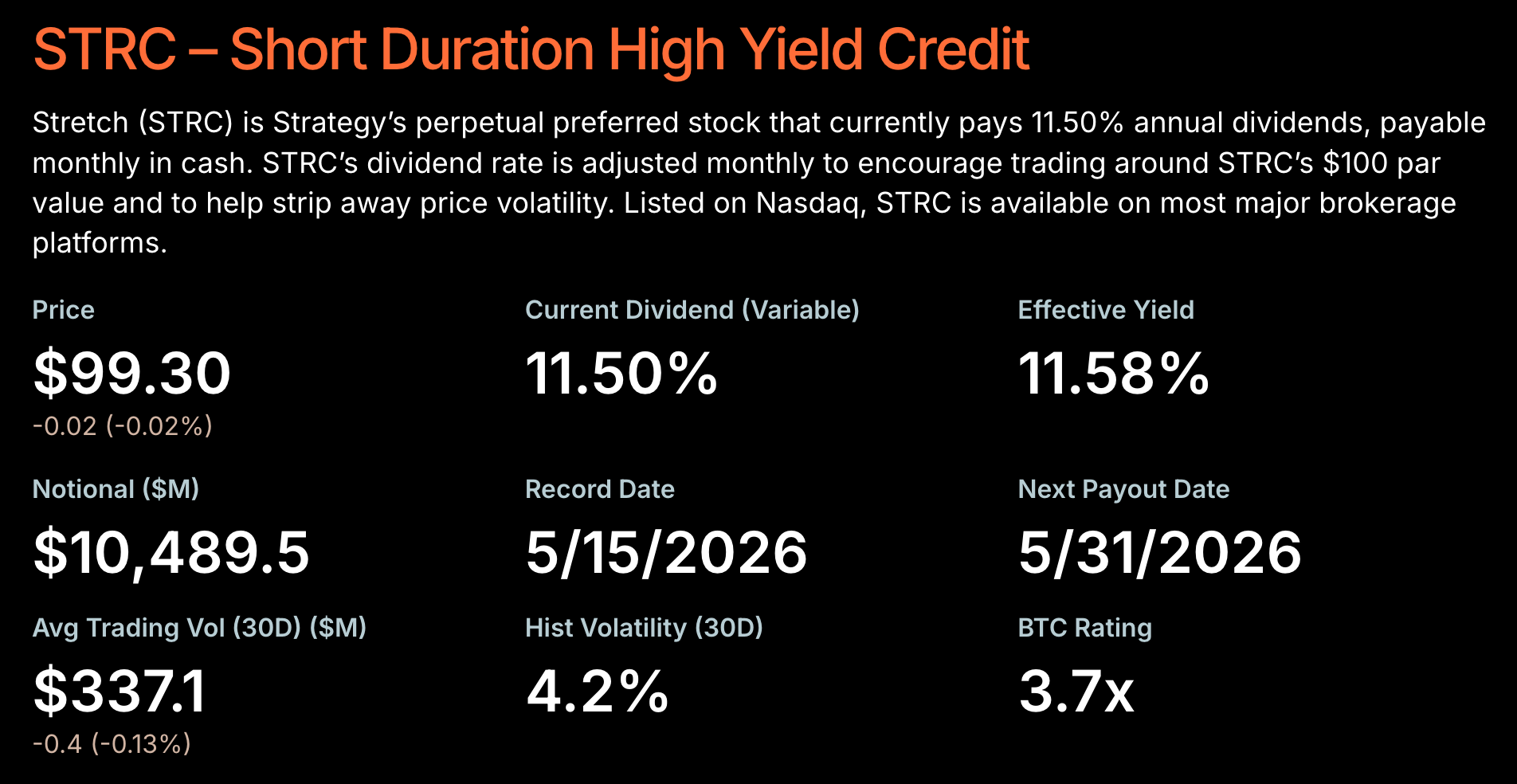
Since Strategy launched STRC, the market response has been quite positive, thanks to its relatively stable "peg" performance (with brief deviations successfully corrected) and its considerable yield.
As of writing, the total issuance of STRC has surpassed $10.4 billion, accounting for over 60% of the total preferred stock issuance market in 2026.
Earlier this month, Strategy founder Michael Saylor explicitly stated in an interview with David Lin that digital credit products like STRC are the killer application for Bitcoin (see "Exclusive Interview with Michael Saylor: I Said I Would Sell Bitcoin, But It Won't Be Net Selling").
However, traditional STRC shares typically circulate only among Wall Street hedge funds, regulated institutions, and high-net-worth accredited investors. On-chain DeFi users, due to门槛s, compliance, and capital channel limitations, find it difficult to directly access this high-yield product that is sweeping through traditional financial markets.
This is precisely where Apyx, the subject of this article, comes into play.
Apyx's mission is to act as a bridge between Wall Street's digital credit instruments and on-chain DeFi Legos. It achieves this through an innovative on-chain financial architecture, introducing STRC's excess yield opportunities on-chain to build the next generation of yield-bearing stablecoins that combine high liquidity, composability, and higher yields.
Deconstructing Apyx: Potentially the Highest-Yielding Stablecoin on the Market
Unlike many stablecoin projects that rely on airdrop narratives and lack genuine underlying yield sources, Apyx's core competitiveness lies not just in its "higher APY," but in its backing from traditional financial capital capabilities coupled with on-chain protocol composability.
In terms of background, the core supporting entity behind Apyx is the US-listed treasury company DeFi Development Corp. This company not only participated in Apyx's incubation and strategic investment but also provided a crucial bridge connecting traditional capital markets with the on-chain world.
In terms of product design, Apyx employs a dual-token model: apxUSD + apyUSD.
Here, apxUSD is closer to a traditional stablecoin, pegged to $1, primarily serving as a medium of exchange and providing on-chain liquidity. apxUSD itself does not automatically accrue yield; it is more like a highly liquid "base dollar asset" suitable for trading, payments, lending, and other scenarios.
The core value of Apyx is truly embodied in apyUSD – users can lock apxUSD to exchange for apyUSD (with a 20-day unlocking period). apyUSD is similar to Lido's wstETH; its price appreciates as the underlying yields accumulate. In other words, apyUSD itself is the vehicle for yield.
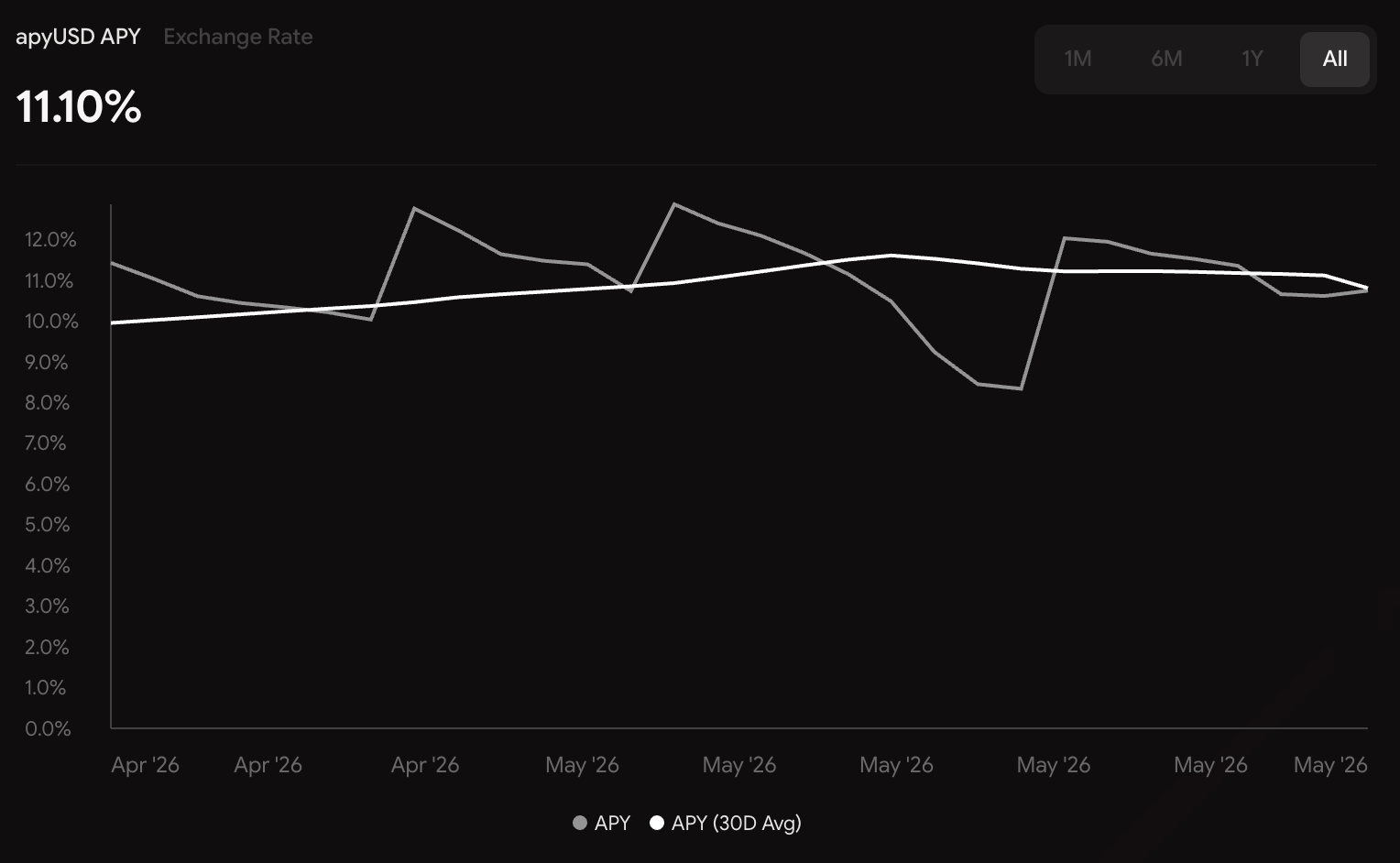
Currently, the real-time annualized yield of apyUSD is approximately around 11%, with an expected annualized yield exceeding 13%. Against the backdrop of continuously declining overall yields on dollar stablecoins, a stablecoin asset with real underlying yield sources reaching double digits is naturally exceptionally attractive.
Furthermore, it's important to emphasize that unlike many stablecoin projects that rely on token subsidies to achieve short-term high yields, Apyx's core yield originates from STRC's dividend payments, making the yield source more stable and sustainable.
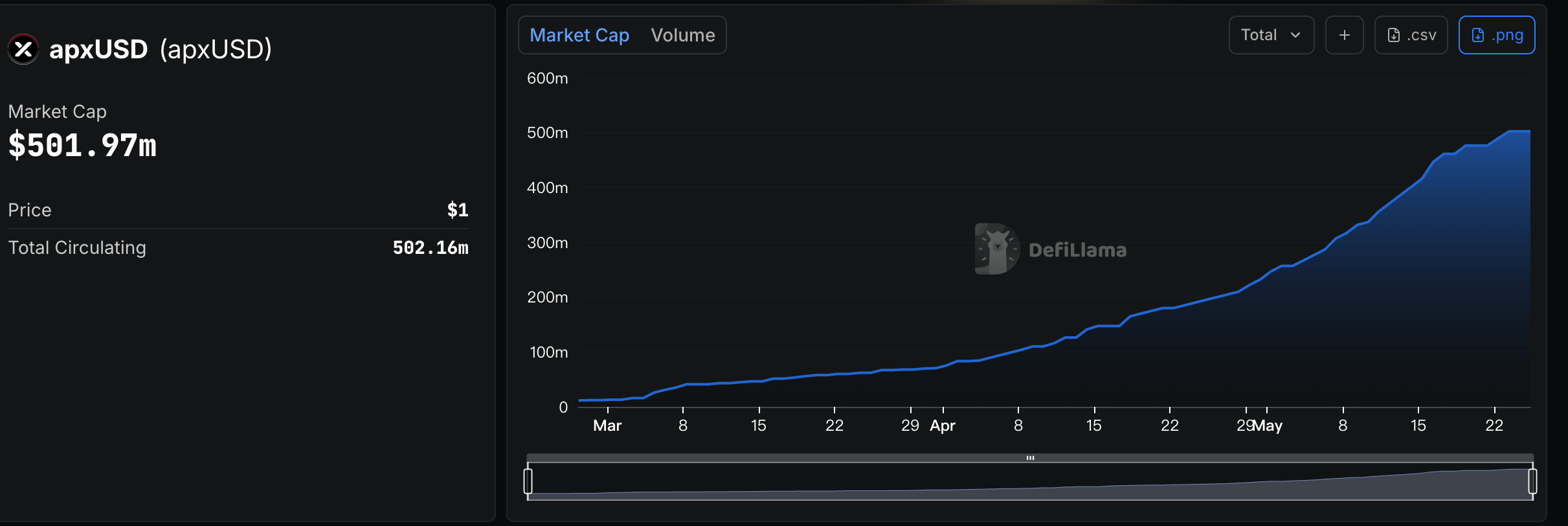
Data from Defillama shows that since its launch at the end of February this year, the issuance scale of apxUSD has rapidly reached 502 million tokens in less than three months, making it the 21st largest stablecoin protocol in the DeFi world by issuance size.
Of course, yield alone is not sufficient to support a stablecoin ecosystem. What truly determines a protocol's ceiling is the asset's composability and liquidity efficiency. In this regard, Apyx has evidently done extensive work – Apyx has already deeply integrated multiple mainstream protocols including Morpho, Curve, and Pendle.
On Morpho, users can use apyUSD as collateral to borrow other assets, enabling operations that simultaneously earn yield and release liquidity. More aggressive players can even further engage in looping strategies to amplify yield exposure. Curve handles the liquidity aspect. By creating trading pools for apxUSD alongside mainstream stablecoins like USDC and USDT, Apyx ensures low slippage even during large-volume swaps, which is crucial for a stablecoin system.
As for Pendle, it might be the most explosive part of the entire Apyx ecosystem. Because Pendle can split yield-bearing assets into PT (Principal Token) and YT (Yield Token), apyUSD is no longer just an asset for "holding and earning yield." It evolves into a tradable, leveragable, and speculative yield product – conservative users can lock in fixed yields via PT, while more aggressive users can amplify their bets on future yields by buying YT.
It is precisely due to this high level of composability that Apyx's ecosystem expansion speed is significantly faster than many traditional stablecoin protocols.
In a sense, Apyx is not just "issuing a high-yield stablecoin"; it seems to be attempting to establish a set of on-chain credit markets centered around STRC.
Points Program and Earning Strategies
In today's DeFi market, "points" are no longer just simple user incentive tools but rather a way to pre-price future token权益. Especially after the market re-entered a phase of liquidity competition, whether a project can continuously attract capital often depends on two things – whether the yield is high enough and whether the token expectations are clear enough.
Apyx's ability to rapidly amass a large TVL in a short time is largely related to its current points system. According to the official roadmap, Apyx's points program adopts a phased approach:
- Season 1 ended on May 22, 2026. The official team has confirmed allocating 5% of the total token supply to early participants in this phase.
- Immediately after Season 1 ended, Season 2 commenced and will run until October 11, continuing to release 6% of token incentives.
- After Season 2 concludes, Apyx will hold its TGE and airdrop on October 13.
This pacing is quite clever. On one hand, the deadlines for each Season naturally create "sprint windows," encouraging accelerated capital inflows before the end. On the other hand, the seamless transition to Season 2 avoids the "TVL cliff" problem common after a first season ends. Most importantly, Apyx has established a clear TGE and airdrop date, giving users more definitive interaction expectations.
For the market, this means Apyx's airdrop expectation is not a short-term event but more like a months-long liquidity war. From a user perspective, the key question becomes "how to earn points most efficiently."
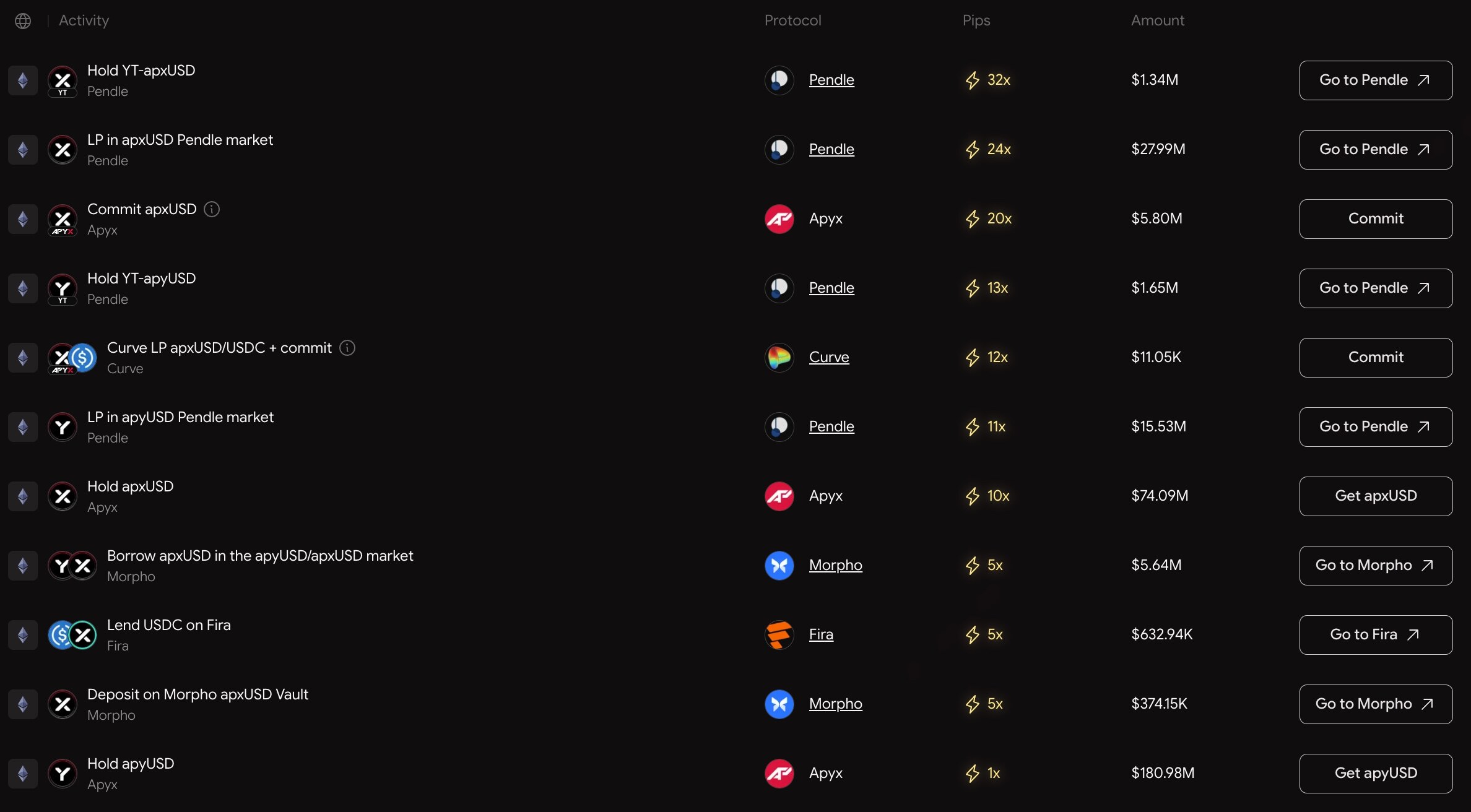
Apyx provides the points earning efficiency for different operations on its official website, broadly categorized into "Basic Mode" and "Advanced Mode."
"Basic Mode" involves simply holding apxUSD (10x points) or apyUSD (1x points). "Advanced Mode" means flexibly utilizing the aforementioned integrated protocols, such as borrowing/lending apxUSD on Morpho (5x points) or providing LP for apxUSD on Curve (12x points). The most efficient strategy inevitably involves Pendle: directly holding YT for apxUSD yields 32x points, while providing LP for apxUSD on Pendle offers a 24x point multiplier.
Competitive Landscape and Apyx's Advantages
As a nascent track still in its very early stages, the STRC-driven stablecoin market currently doesn't have many truly core players. In terms of capital scale, market attention, and ecosystem expansion speed, the projects that have truly formed an influence are essentially only Apyx and Saturn. In a sense, the entire "digital credit stablecoin" track is gradually exhibiting a duopoly competitive landscape.
Although Saturn launched earlier, Apyx has now overtaken it in data metrics. Overall, Apyx's competitive advantages are evident in the following dimensions.
First, absolute TVL scale and underlying asset holding advantages. Apyx established a clear strategic goal in its project positioning – to become the world's largest institutional holder of STRC. By the end of April, its holdings had already reached $125 million (compared to Saturn's $50 million). Once Apyx achieves its strategic goal, it would monopolize the distribution rights for on-chain yields derived from Strategy's digital credit at the source. Furthermore, for a stablecoin, Apyx's TVL size advantage translates to deeper trading pools, lower slippage for large swaps, and more robust liquidity efficiency, enabling it to safely accommodate the entry and exit of large capital.
Second, higher yields without the risk of yield suspension. For the target customer base of Apyx and Saturn, the core demand is consistent and predictable yields. Compared to Saturn's sUSDat, Apyx's apyUSD maintains a ~2% annualized yield advantage in static holdings. Additionally, a very important point is that sUSDat's design is deeply tied to the STRC exchange rate. When STRC falls below its "Watermark" due to ex-dividend or other reasons, yield accumulation for YT-sUSDat completely pauses. Apyx has no such issue.
Third, a clearer TGE timeline and no VC selling pressure. Users in the crypto industry detest "indefinite point PUA." Compared to Saturn, Apyx has explicitly disclosed its TGE date and the timing and token allocation details for each season's points activities, making users psychologically more inclined to stay engaged. Furthermore, Apyx's development did not involve VC funding, only a minimal amount of early investment, partly from the founding contributors themselves. This means no private round institutions can dump on retail investors before the TGE, making the token rewards corresponding to points more favorable.
Potential Risks and Future Outlook
It is crucial to emphasize that Apyx's high yield does not mean "risk-free." Essentially, Apyx remains a yield product built upon a Bitcoin credit structure, not a traditional risk-free dollar asset. Therefore, before discussing its growth potential, one must acknowledge the risk sources behind it.
First, the credit risk of the underlying asset itself. The core logic of STRC is based on Strategy and its Bitcoin balance sheet. In other words, the market's willingness to accept STRC's yield fundamentally relies on the belief that Strategy can continuously leverage its Bitcoin holdings to maintain its credit structure and successfully complete financing, expand its balance sheet, and make interest payments.
If the Bitcoin market experiences extreme volatility, such as a sharp crash in a short period, or a significant decline in market risk appetite for Strategy's leverage model, then STRC's market pricing, liquidity, and yield structure could all be affected. Although this "systemic risk" does not mean the protocol will immediately collapse, it does imply that Apyx's yield source has a degree of correlation with the Bitcoin cycle itself.
Second, the typical DeFi composability risk. Since Apyx is deeply integrated with protocols like Morpho, Curve, and Pendle, its ecosystem is built upon highly complex on-chain composability. The advantage of this structure is its ability to greatly enhance capital efficiency; but the cost is a more coupled risk profile for the entire system.
For example, if a smart contract vulnerability, liquidity crisis, or liquidation mechanism anomaly occurs in one of the underlying protocols, risks could propagate through the entire ecosystem via LP positions, collateral, and yield splitting structures. Especially as looping and high-leverage strategies become more prevalent, market volatility can be further amplified.
Therefore, Apyx is better understood as a "medium-to-high risk, high-yield" on-chain credit asset, rather than a replacement for traditional overcollateralized stablecoins. However, it is precisely this risk stratification that gives Apyx its unique appeal in the current market environment.
Today's stablecoin market faces an increasingly evident problem – yields are rapidly commoditizing. As US Treasury yields fall and traditional arbitrage opportunities narrow, the real yields most stablecoin protocols can offer are becoming increasingly limited. The market needs new sources of yield, and users are willing to bear a certain degree of risk for higher returns.
Over the past few years, from LSD and Restaking to Pendle's yield trading, the entire DeFi market has essentially been validating the same principle – users never shy away from risk; what they truly reject are "assets with an unfavorable risk-reward ratio." The emergence of STRC precisely provides the market with a new "risk vs. reward" option.
In the past few months, the sustained TVL growth of Apyx and the entire STRC track indicates that the market is voting for this narrative with real capital.