一声“尊贵的VIP”背后,Binance、OKX、Bitget在卷什么服务?



Have you ever done the math?
Suppose you're a relatively high-frequency trader with an average monthly trading volume exceeding $1 million. Even a 0.01% difference in fees could accumulate to thousands or even tens of thousands of dollars in additional costs over a year.
During the past bull market, such differences were easily masked by market volatility. A single upward surge or a hot trend, with daily gains of several tens of percentage points, could easily cover most of the transaction costs. However, as the market gradually enters a phase of stagnant volume, more and more traders are beginning to realize: What truly determines long-term returns is no longer just how much you earn per trade. To achieve results in today's market competition, you need more precise management of the risk-reward ratio for each trade.
This has brought a term once distant from the average user back into the spotlight — VIP. In the past, ordinary users approached VIP with a certain defensiveness, subconsciously viewing it as a privilege reserved for the "whales" with tens of millions of dollars in their accounts, far beyond their reach. However, judging by market trends in the first half of 2026, this ingrained perception is being broken. Major exchanges are successively lowering the entry barriers for VIP programs. Compared to the past, where competition relied solely on user acquisition, subsidies, and speed of token listings, exchange rivalry is now distinctly entering a phase of "competing on service."
With exchanges proactively lowering thresholds, for ordinary users — especially those with limited asset sizes but mature trading strategies, the so-called "growth-type" users — VIP is no longer just a status symbol but a tangible efficiency hack to leverage.
Therefore, this article won't discuss market trends or trading strategies. Instead, it will take the perspective of an average user to dissect the VIP programs of several major exchanges like Binance, OKX, and Bitget. Against the backdrop of continuously lowering VIP thresholds and exchanges fully competing on service, whose offering is better suited for today's traders?
Comparison of VIP Programs Across Three Major Exchanges
Before the formal comparison, one issue needs to be addressed. The VIP structures of major exchanges vary significantly, supporting multiple different upgrade paths including trading volume, holdings, borrowing, options, OTC, referrals, and migration.
For ordinary users, there's no need to master all the rules. To help you navigate the complex terms and compare effectively, we can first establish a user segmentation framework based on capital size and trading habits. You can identify your own category to pinpoint the most suitable upgrade path.
- From an operational style perspective, market users can be broadly classified into "low-frequency holders" and "high-frequency traders." The former trade infrequently but maintain a significant asset balance in their accounts over the long term, making the "holdings amount" upgrade path more relevant. The latter trade more frequently, and even with lower capital, their cumulative trading volume can increase rapidly (especially for contract users), making them more focused on "trading volume" upgrade paths and actual fee discounts.
- From an asset size perspective, users can be broadly categorized into "retail traders," "growth-type users," and "whales." "Retail traders" and "whales" need little explanation; the former struggle to meet VIP thresholds, while the latter can easily unlock top-tier VIP benefits across exchanges (where offerings are competitive). The focus here is on the increasingly prevalent "growth-type users" emerging in recent years.
"Growth-type users" are those whose asset sizes haven't yet reached traditional "whale" standards but have developed stable trading habits and actively optimize details like fees, slippage, and capital efficiency. This group is actually the most fiercely contested target demographic for major exchanges, as they hold significant potential to become core future users.
1. Entry Threshold
Between March and April of this year, major exchanges successively lowered their entry barriers.
Binance announced on March 18 that it had reduced the BNB holding requirements and contract trading volume thresholds for VIP levels 1-3: The BNB holding requirement for VIP 1 was lowered from 25 BNB to 5 BNB, and the contract volume requirement dropped from $15 million to $5 million. Additionally, Binance launched the VIP "Rising Star Program," targeting users with an average daily or 30-day average net asset balance of $30,000 (including 5 BNB or more). Eligible users receive exclusive VIP support, access to select events, and a dedicated fast track to Binance VIP status.
OKX announced on March 24 that it had lowered the 30-day contract trading volume thresholds for VIP levels 1-3 (VIP 1 from $10 million to $5 million). On April 8, it announced lowering the threshold for priority customer service access to "current asset balance or 30-day average asset balance not less than $30,000." Although not a direct VIP threshold reduction, it allows eligible users to enjoy service response priority on par with VIP users.
Compared to Binance and OKX, Bitget, from the very beginning of building its VIP system, focused not on "setting high barriers," but on "how to cover more people." A holding amount exceeding $30,000, or a spot trading volume of $500,000, or a contract trading volume of $5 million is sufficient to upgrade to VIP 1. Furthermore, Bitget launched a "VIP Fast Track" campaign on April 2, aimed at precisely incentivizing users currently at V0 or holding only temporary experience permissions, providing additional rewards to lower friction and accelerate their upgrade to formal VIP 1-3 levels.
The VIP upgrade requirements for the three major exchanges are shown in the image below.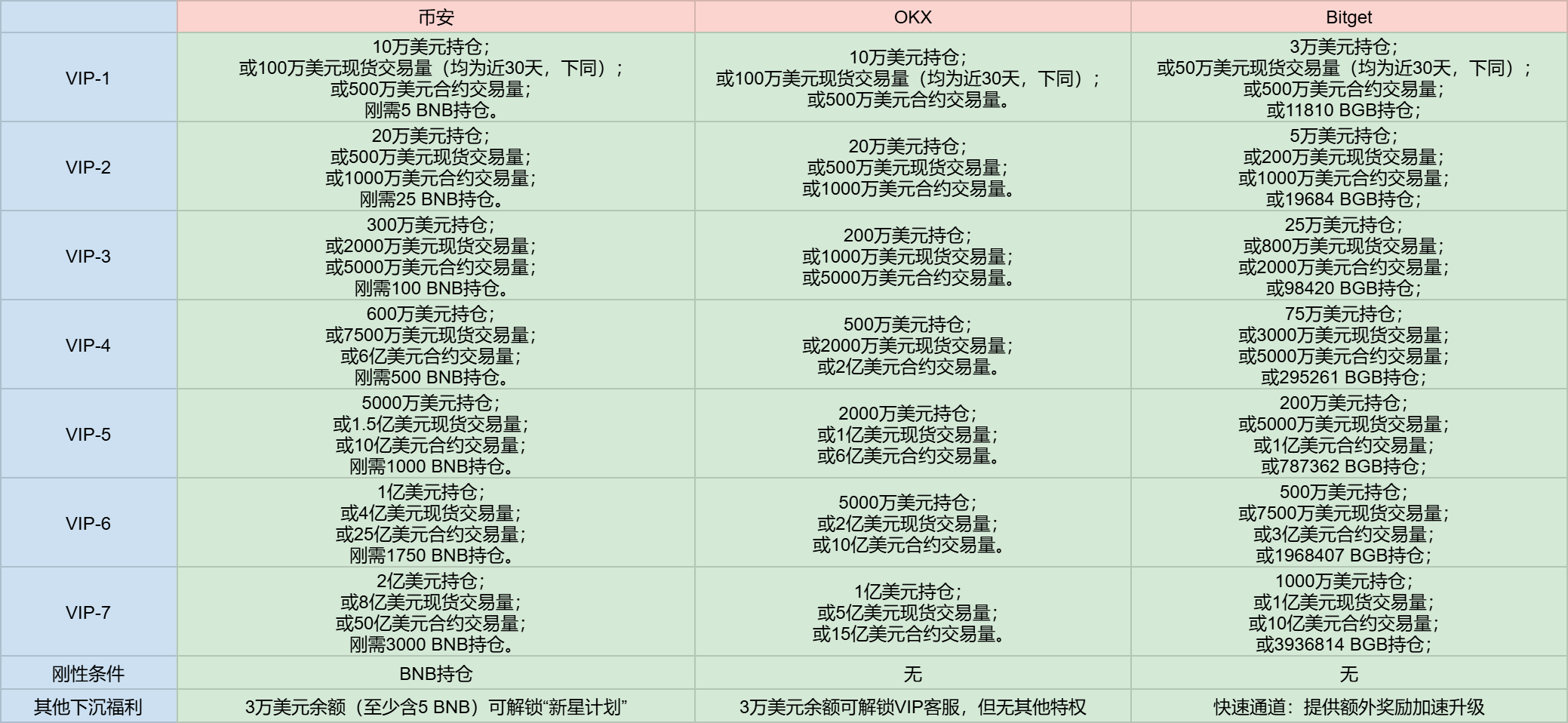
In summary, a holding balance of $30,000 is a user profile segment that major exchanges are all competing for. This holding size basically covers the mainstream user base in the crypto space, especially the "growth-type users" with potential to become core future users. Both Binance and OKX have extended some VIP benefits to this user group, and Bitget has directly set this as the official VIP entry threshold.
Furthermore, it's clear that the difficulty of achieving VIP status at Bitget is significantly lower than at Binance and OKX. Compared to the substantial holdings and volume requirements reaching hundreds of millions or even billions of dollars at the other two exchanges, Bitget only requires $10 million in holdings to unlock the highest VIP-7 tier.
As shown in the chart, if your total holdings are $50,000, you haven't reached the VIP threshold at Binance or OKX, but you can upgrade to VIP-2 at Bitget. If your holdings are $1 million, you reach only VIP 2 at Binance and OKX, but VIP-4 at Bitget. If your holdings are $10 million, you can directly unlock Bitget's highest tier discounts, achieving zero fees for both spot and contract limit orders.
A faster upgrade path means users can more efficiently unlock the exclusive benefits of higher VIP tiers.
2. Asset Supply
Beyond VIP thresholds, another factor increasingly impacting user trading experience is the platform's asset supply capability.
With the continued heat of the RWA and asset tokenization narrative, traditional financial assets like US stocks, precious metals, commodities, and Pre-IPO equity are being brought on-chain with increasing speed. Compared to the past, where competition primarily revolved around cryptocurrencies, more and more trading platforms are evolving towards a "multi-asset, one-stop trading gateway" model.
Looking at the current market landscape, both centralized exchanges like Binance, OKX, and Bitget, as well as emerging DEXs like Hyperliquid and Trade.xyz, are moving in this direction.
For instance, Binance maintains its mainstream trading advantage with its strongest liquidity and asset coverage breadth, recently offering users windows to US stocks and other assets through contract products and derivative tokens. OKX has also launched a TradFi version tracking traditional assets and continues to strengthen its integration of on-chain ecosystems and Web3 trading scenarios, allowing users to directly manage diversified asset allocations on-chain via its wallet. Bitget, on the other hand, pioneered the UEX (Universal Exchange) panoramic trading strategy in September last year, directly bridging the gap between cryptocurrency and traditional finance. It was not only the first exchange to list US stock contracts but also a major source of traffic for Ondo's US stock tokens. Based on recent months' actions, Bitget's asset coverage is continuously expanding, with significant acceleration in areas like US stocks, CFDs, and Pre-IPO.
Personally, I typically use OKX's wallet to buy US stock tokens and then open equal-sized short contracts on Binance to arbitrage funding rates. Recently, I've executed several active trades on Bitget. First, last week I wanted to position in Rocket Lab (RKLB), which was heating up due to SpaceX's impending IPO. I searched several crypto exchanges and found that only Bitget had listed RKLB stock tokens at the time. Second, before the opening of Cerebras Systems (CBRS), the hottest IPO project last week, Bitget was the first among the three major exchanges to list CBRS Pre-IPO contracts, so I opened a small position there. Additionally, I participated in two of Bitget's Pre-IPO new issues (preSPAX and preOPAI) with small amounts, both of which have been rising since their opening. As of writing, the former is quoted at $894, up 37.5% from the subscription price of $650; the latter is quoted at $928, up 28% from the subscription price of $725.
3. Other Benefits
Additionally, the VIP status comes with other minor perks, such as token airdrops, physical gifts, event tickets, private meeting invitations, and global travel opportunities. While these aren't the core factors for choosing a trading platform, they can further influence the long-term experience for highly active users.
Exchanges Enter the 'Service War'
Fee discounts and asset supply are matters of platform "hardware" capability. However, ordinary users need much more. When encountering unexpected situations, the efficiency and accessibility of communication with the platform — the "software" experience — often determines user retention.
As industry dividends peak, the VIP systems of major exchanges are evolving from static numerical rules into a full-fledged silent "war of services." At Binance, even as the industry leader, co-founder Yi He still personally answers user questions on social media daily. OKX has significantly lowered the threshold for its exclusive VIP customer service, extending more comprehensive service capabilities to a larger user base. Bitget has recently emphasized the "Come as you are, you are VIP" service philosophy, pushing its entire VIP account manager team to the forefront — appearing publicly and staying active on X (formerly Twitter), with its Greater China head Xie Jiayin also consistently visible to users. This approach of presenting the real service team in front of users helps lower the psychological barrier for users seeking help.
These are all microcosms of the exchanges' collective focus on "competing on service." In an era of increasingly diverse asset types and complex trading products, the trading experience is no longer solely determined by fee discounts. It encompasses a full suite of service capabilities, including risk control response, product rule synchronization, and problem resolution efficiency. For trading users, "Can I quickly find someone to talk to?", "Can issues be addressed promptly?", and "Are problems solved quickly?" have become more critical components of the platform experience.
The underlying logic is that as the industry shifts towards a zero-sum game for growth, exchanges find it increasingly difficult to achieve high growth through mere traffic expansion. Those who can better serve active users over the long term and accompany their growth will be better positioned to gain an advantage in the next competitive phase.
How Should Ordinary Users Choose?
Arguably, in this "software and hardware service war" initiated by the exchanges, the biggest beneficiaries are the trading users on the front lines. Whether it's lower entry barriers, more transparent growth paths, or more comprehensive service systems, these are fundamentally attempts by exchanges to re-secure core and potential core users during the stagnant growth phase.
Conversely, for ordinary users aiming for better long-term trading management, proactively seizing this valuable "VIP democratization dividend" is key.
So, how should ordinary users choose? Overall, Binance still boasts the strongest liquidity and global depth. OKX holds a clear advantage in its forte — on-chain ecosystem integration. Bitget, through its lower thresholds and more proactive service, tends to cover rapidly growing trading users and offers diversified asset allocation opportunities via its UEX panoramic strategy.
If trading depth and global liquidity are your top priorities, Binance remains the safest choice. If you focus more on the on-chain ecosystem and Web3 trading experience, OKX might be more suitable. However, if you are currently in a rapid growth phase for your trading scale, wish to unlock the full VIP benefits earlier, and have a need to allocate to diverse assets like US stocks and Pre-IPO, then Bitget's system design will likely align more closely with your actual situation.
To some extent, this is perhaps the most noteworthy aspect of this round of industry changes. In the past, VIP seemed like a privilege only accessible to a few whales. Now, more and more platforms are attempting to transform VIP into a capability to serve users earlier and accompany their growth.
For ordinary users, this is arguably the truly valuable change.