US stocks hit new highs day after day—are you starting to get nervous?


- Core Thesis: Although US stocks are continuously hitting new highs, the upward structure is highly concentrated in a few themes like AI and semiconductors, with market breadth deteriorating. The current risk is not that the index has peaked, but rather lies in portfolio management. We need to be wary of a concentrated pullback in the second half of the year, potentially triggered by unmet expectations or changing conditions.
- Key Factors:
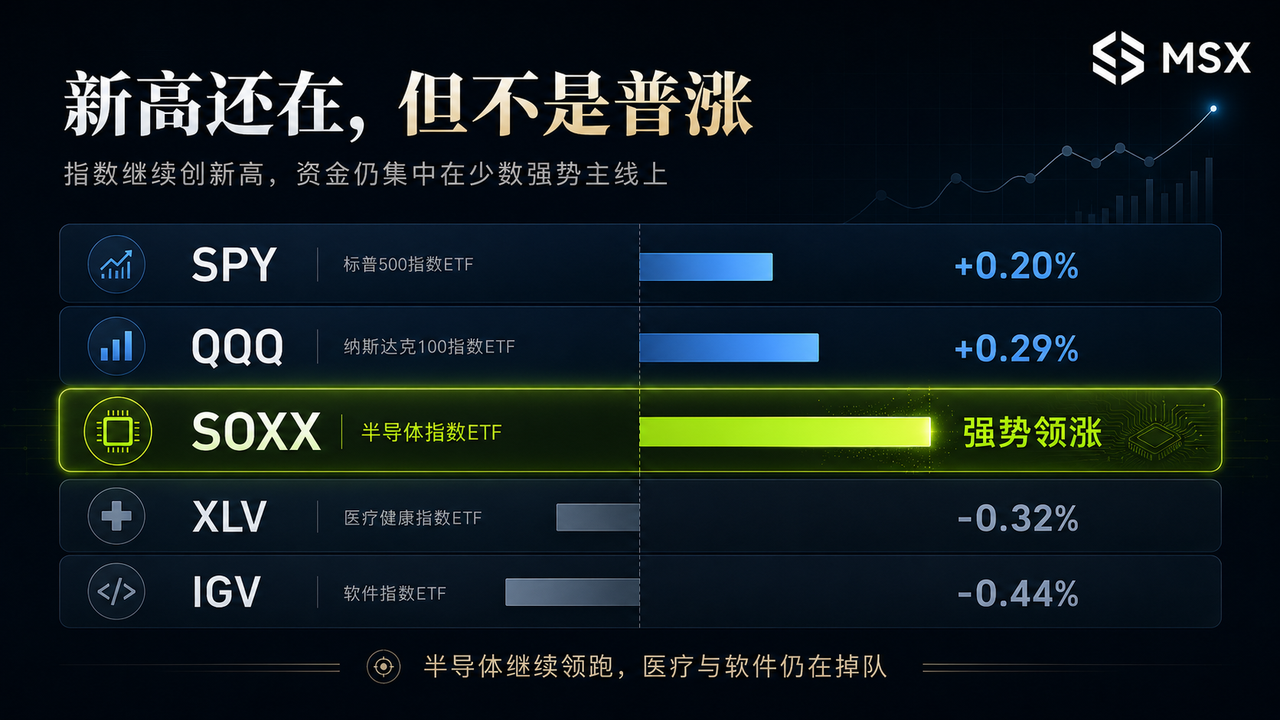
- Significant Market Divergence: Semiconductors (SOXX.M up 1.74%) and technology (QQQ.M up 0.29%) strengthened, but sectors like healthcare (XLV.M down 0.32%) and software (IGV.M down 0.44%) have fallen behind. Capital is only willing to pay for the most clearly defined themes.
- Evolution of Market Characteristics at Highs: The driving logic has shifted from "repairing pessimistic expectations" to "realizing optimistic expectations." Conditions like earnings reports, orders, and gross margins are now scrutinized more harshly, significantly lowering the margin for error.
- Layered Operational Advice: Core assets (with earnings, orders) can be held, but trading positions (emotion-driven, high beta) should be reduced or profit-taking executed according to discipline, avoiding treating short-term profits as long-term conviction.
- Key Risk Signals: Lagging stocks (e.g., healthcare, traditional consumer, SaaS) weakening as the index hits new highs signal that future pullbacks may start from these sectors. Software stocks face valuation challenges from AI's impact on traditional subscription models.
- Short-Term Focus: CPI, PPI, retail sales data from May 12-15, along with options expiration, represent a stress test, examining whether tech weight, semiconductors, and new buying power can continue to support high levels.
- Core Verification Points for H2: Specific conditions such as AI order acceleration, revenue realization, gross margins, cloud capital expenditure, and interest rate cooperation. Optimistic expectations have already been priced in; weakness in any single link could lead to a rapid pullback.
U.S. stocks are still hitting new highs, and that's not up for debate.
At the close on May 11th Eastern Time, the S&P 500 rose 0.2% to 7,412.84, and the Nasdaq rose 0.1% to 26,274.13, continuing to set new closing record highs.
But being strong doesn't mean it's easy to trade.
The issue now isn't whether the indices are up, but what's driving the gains. What's truly pushing the indices higher are still the same old main themes: AI, chips, semiconductors, and data centers. For example, on May 11th:
- The Philadelphia Semiconductor Index rose 2.6%, Intel (INTC.M) rose 3.6%, and Qualcomm (QCOM.M) rose 8.4%.
- The divergence in ETFs was even more direct: SPY.M rose 0.20%, QQQ.M rose 0.29%, and SOXX.M rose 1.74%.
- But the healthcare ETF XLV.M fell 0.32%, and the software ETF IGV.M fell 0.44%.
Looking at the Maitong asset pool, these core ETFs and related stocks already have a relatively clear trading map. They've long laid out the market picture: semiconductors are still surging, the AI hardware chain is still absorbing capital, and money is still only willing to pay a premium for the strongest lines, while healthcare lags, software falls behind, and other sectors increasingly look like background noise.
In Maitong's view, the focus of current market trading is no longer just whether the indices will continue to rise, but whether the structure and breadth behind the rise can support the subsequent rally. We are currently in the most typical state of a high market: capital is still willing to go long, but only to pay for the most certain, most crowded, and strongest positions.
Simply put, the market hasn't shut down risk appetite; it just no longer intends to allocate risk budgets to most stocks. So, when looking at U.S. stocks now, you can't just look at the indices. The stronger the indices, the more you need to look at the structure; the more new highs, the more you need to look at breadth.
Because the real trouble at highs is never that the indices stop rising, but that the indices are still rising while the places where you can make money are getting fewer.
1. Have U.S. Stocks Topped?
What bothers many people most right now isn't being wrong about the direction, but that their positions are starting to feel off.
Sell, and you fear missing out on a continued rally; hold, and you fear a single pullback wiping out previous profits.
This is also the most authentic typical state of a high market. The trend is indeed intact, the main theme is still there. AI hasn't fizzled out, semiconductors haven't weakened, and tech heavyweights are still propping the indices up. As long as the herd mentality doesn't break, U.S. stocks won't automatically fall just because they look too expensive.
The problem is that the current rally is not the same as the rally in the recovery phase from lows. At lows, markets trade on repairing pessimistic expectations. As long as things don't get worse, stock prices have elasticity. At highs, markets trade on the realization of optimistic expectations. If things don't continue to exceed expectations, stock prices may fall first.
These are two completely different markets.
Lows can tolerate mistakes; highs can hardly tolerate any. In other words, buying at lows is about the odds, worrying if it won't rebound; buying at highs is about the speed of realization, worrying why it should be even higher.
So, objectively speaking, the last thing you should do now is to keep pushing your positions higher with the mindset from a low market. Because once earnings aren't strong enough, orders aren't fast enough, gross margins don't hold, capital expenditure falls short of expectations, or inflation and interest rates rear their heads again, the directions that rallied the hardest are often the first to be hit.
This isn't because the logic suddenly vanished, but because the price has already priced in the most optimistic part of the logic.
In short, now is not the time to call a top. Now is the time to reassess your positions.

As for whether U.S. stocks have topped?
I don't think it's time to conclude directly that "U.S. stocks have topped." That's too early – after all, the trend isn't broken, the main theme isn't broken, and the capital hasn't dispersed.
But these three "not broken" points don't mean you can do nothing. What you really need to guard against now is not a sudden crash this afternoon or a direct turn to a bear market at tomorrow's open.
What you really need to guard against is a more significant and concentrated pullback sometime in the second half of the year.
The reasons are not complicated.
This rally has been too concentrated from the start. For example, AI expectations are already very high, the elasticity of semiconductors has been overly traded, options activity is too active, and interest rates and inflation haven't truly created a comfortable enough environment for high-valuation assets.
As long as these conditions continue to align, the indices can certainly keep pushing higher.
But the problem lies here too. The current rally increasingly depends on "no mistakes in any condition." If just one link in the chain breaks, the market could quickly switch from "continued short squeeze" to "concentrated pullback."
Especially since pricing is already very choosy. What the market is trading is no longer a first-level judgment like "will AI grow," but whether AI can consistently exceed expectations, whether semiconductors can keep outperforming, whether capital expenditure can be revised up round after round, whether orders from big tech can be consistently fulfilled, whether high valuations can be sustained by ever-higher expectations. This is the hardest part about being at highs.
It's not that bad companies will fall; good companies will fall too. It's not that the main theme lacks logic; it's that the main theme is too expensive, so expensive that being slightly not good enough is unacceptable.
So, the most important thing at this juncture is not to turn bearish or to keep giving yourself a pep talk, but to reduce the net risk within your portfolio.
2. How to Operate Now?
In one sentence: Keep what should be kept, reduce what should be reduced.
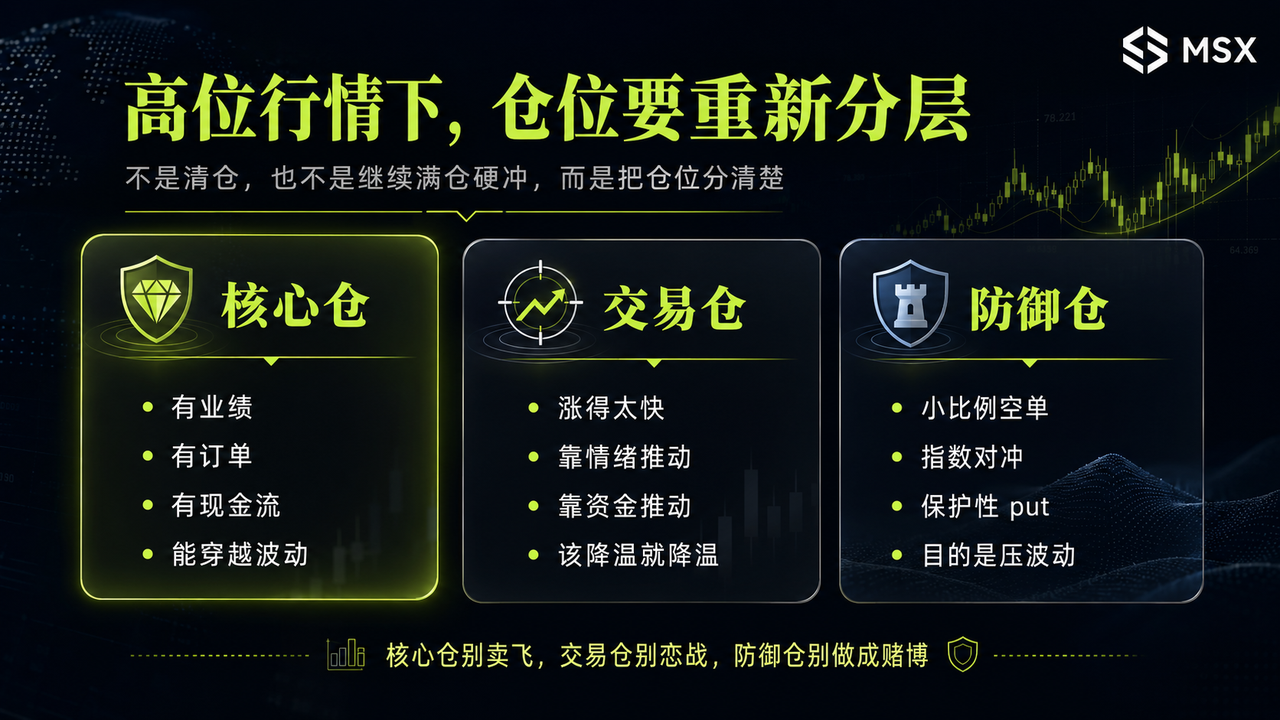
The most important thing next is to re-stratify your positions. Ultimately, not all positions that are rising should be held in the same way.
For example, core assets with genuine earnings, orders, cash flow, and industry position shouldn't be completely sold off just because you're "afraid of highs." Because the most common and expensive mistake in a bull market is not losing money, but selling the real main theme too early and then being afraid to buy it back.
But trading positions cannot be handled this way. Positions that have risen too fast in the short term, mainly driven by sentiment and capital flow, cannot use long-term logic as an excuse. They are trading positions by nature and should be treated as such:
- If they spike on high volume but can't hold the gains, you can reduce.
- If the indices hit new highs but they don't follow, you can reduce.
- If they break short-term trend lines, you shouldn't stubbornly hold.
The easiest mistake to make in a high market is not being wrong about the direction, but treating trading positions as core positions and short-term profits as long-term convictions.
These two things sound like mindset issues, but they are essentially account structure issues. Core positions can withstand volatility because you're buying longer-term logic and stronger fundamentals. Trading positions cannot. Once a trading position loses its elasticity, it's no longer a position; it's a burden.
So, the most important thing to do now is not to handle all positions together, but to first ask yourself clearly which positions you are willing to continue holding through the volatility, and which positions you haven't sold only because they've risen fast, risen strongly, and gotten you excited.
The former can be kept; the latter need to be cooled down.
Besides this, you also need to watch lagging stocks more closely going forward.
For example, on May 11th, SOXX.M continued to rise by 2.39%. What does this mean?
It means the AI hardware chain hasn't fizzled out, the market's strongest style is still continuing, and the herd hasn't dispersed. But precisely because the strongest direction is still surging, you need to pay more attention to the stocks that can't keep up.
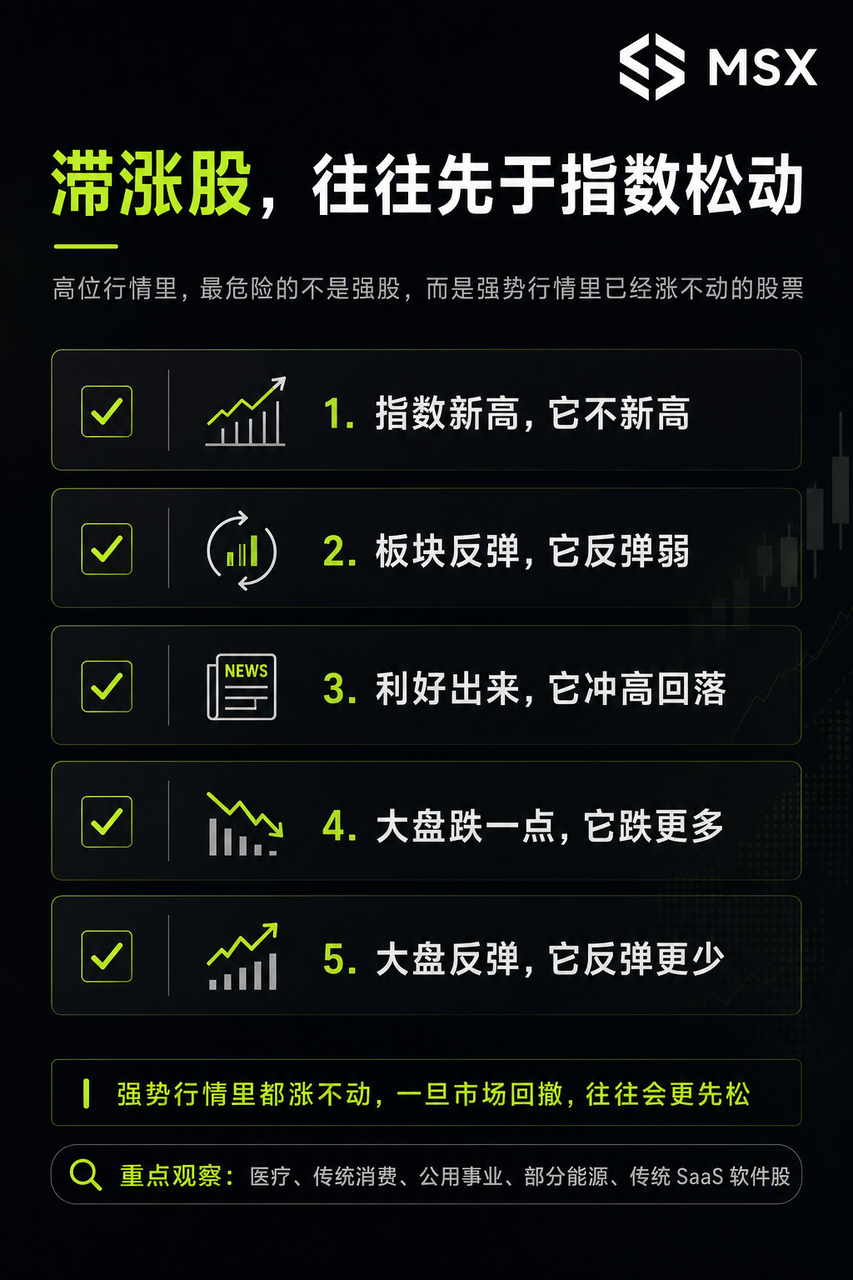
In a high market, the most dangerous things are never the ones everyone knows are strong. The truly dangerous ones are the stocks that can't follow when the indices hit new highs, can't bounce when the sector rebounds, and fall back after positive news is released.
These lagging signals aren't complicated:
- Indices hit new highs, but the stock doesn't.
- Sector rebounds, but the stock's rebound is weak.
- Good news comes out, the stock spikes but falls back.
- The market drops a bit, the stock drops more.
- The market rebounds, the stock rebounds less.
These types of stocks are already dangerous in a strong market.
Because if they can't even rise when the market is good, they are often not the ones to catch up when the market pulls back; instead, they fall first. Therefore, healthcare, traditional consumer goods, utilities, some energy stocks, and traditional SaaS software stocks can all be put on the lagging watchlist.
Software, in particular, deserves a separate look. In this AI bull run, software hasn't been completely without opportunity, but the valuation logic of traditional SaaS is increasingly shaky. Companies like Salesforce (CRM.M), Adobe (ADBE.M), ServiceNow (NOW.M), and Intuit (INTU.M) are certainly not bad companies.
The issue isn't company quality; it's that the market is starting to ask a new question: Will AI help them raise prices, expand revenue, and open up new demand? Or will it instead undermine the old narrative based on per-seat fees and tool premiums?
In other words, the software sector is no longer rising uniformly.
Capital is now very discriminating. It's looking at who can turn AI into incremental revenue, who is just using AI to survive, who can still maintain their valuation, and who is just a high-valuation relic of the old model.
So, going forward, you can't just watch the strongest stocks; you must also watch the laggards. Because the strong stocks determine whether the indices can hold, while the laggards determine where the pullback will start from.
3. The Right Hedge is Defense
At this stage, a portfolio can have defensive positions, but defensive positions aren't for betting on an immediate market turn.
If you hold a heavy long position and don't want to easily sell your core holdings, you can use a small proportion of short positions, index hedges, or protective puts to manage volatility.
The key points are "small proportion" and "manage volatility."
Simply put, it's not about telling you to go all-in short or betting on a market crash tomorrow. The purpose of a short position here is to buy insurance. Because another common mistake people make at this stage is seeing lagging stocks and thinking they can be used as primary defensive positions. This isn't necessarily right.
Laggards can go on the watchlist, and you can use small short positions in them after confirming a breakdown, but they might not be suitable as the core insurance for your portfolio.
Because what a defensive position truly needs to hedge against is not what you dislike, but what you are most afraid of falling.
If the main risk in your portfolio comes from QQQ.M, semiconductors, and AI tech heavyweights, then what you truly need to hedge against is the pullback in these exact directions. For example, if you fear a Nasdaq pullback, look at QQQ.M; if you fear a semiconductor pullback, look at SOX-related directions; if you fear over-concentration in individual stocks, then reduce your high-beta positions yourself.
The most taboo thing at this time is to hold the most crowded tech themes fully while shorting a healthcare or consumer stock that has been weak for a long time, thinking you have completed a hedge.
That's not defense; that's just betting on something else.
Always remember, the goal of a defensive position is never to make big money. Its goal is to make your portfolio suffer a little less during a time when it would otherwise suffer a lot.
4. The Test on May 15th and Outlook for the Second Half
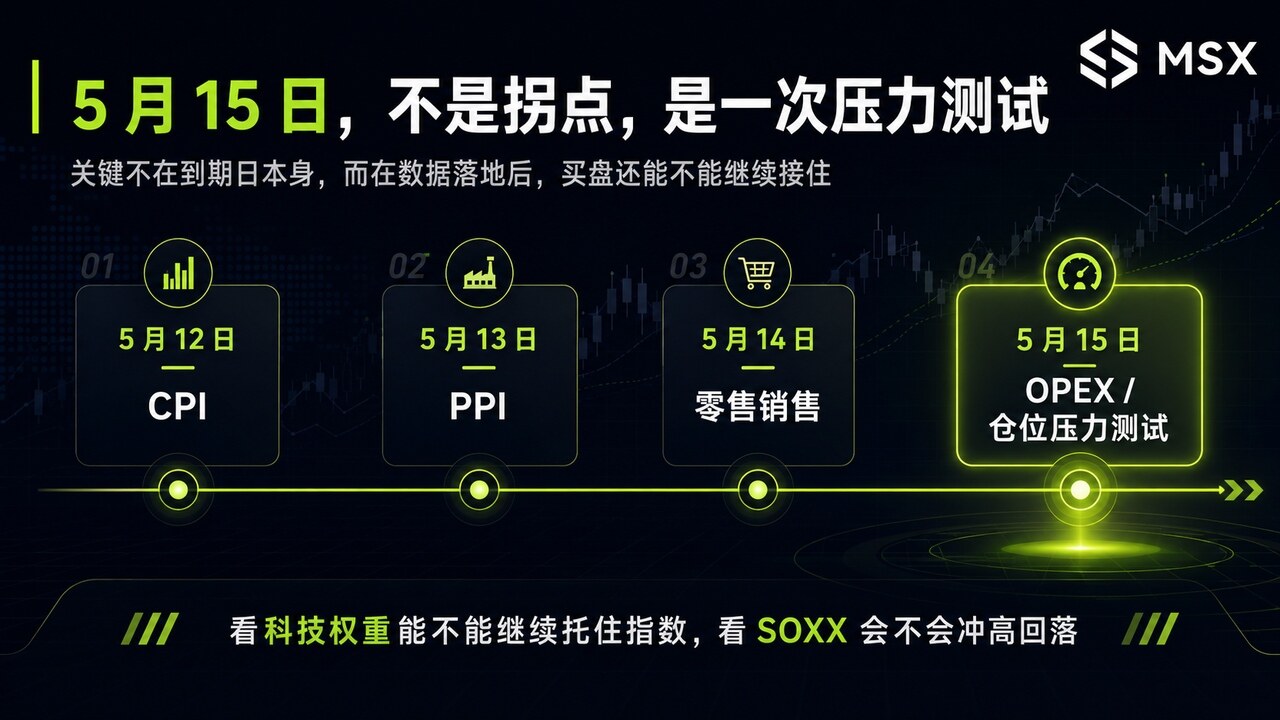
Looking ahead in the short term, May 15th is an unavoidable window.
The reason isn't mysterious. It sits right between a string of important variables. This day is the May standard monthly options expiration, commonly known as OPEX. At the same time, index options like SPX and XSP have long ceased to be just monthly expiration events, and the market's reliance on 0DTE and short-term options is also growing stronger.
So, options expiration itself is worth watching more than in the past.
But what makes May 15th truly important isn't that "it will definitely fall." It's that it coincides nicely after a set of key data releases: April CPI will be released on May 12th at 8:30 AM ET; April PPI will be released on May 13th at 8:30 AM ET; April Retail Sales are scheduled for May 14th at 8:30 AM ET.
This means the market will first digest inflation, producer prices, and consumer data, and then enter the options expiration window. This combination is sensitive enough on its own.
If CPI and PPI are not hot, and Retail Sales are not strong enough to push rates back up, and tech heavyweights hold steady, and semiconductors remain strong, then May 15th would likely just be more high-level volatility. Bulls might even be able to push prices higher using the expiration structure.
But if the data leans hot, causing rates to rear up again, combined with QQQ.M and