Hook narratives are exploding. How to seize the next opportunity for massive gains


- Core Thesis: The Uniswap V4 Hook mechanism, ignited by the three projects $SATO, $uPEG, and Slonks, has transformed DeFi tools for geeks into a narrative of wealth creation for retail investors. It showcases the potential of novel economic models and has unlocked three development paths: narrative arbitrage, composability, and the Unichain ecosystem.
- Key Elements:
- $SATO, $uPEG, and Slonks realized gains of 60x, a $34.44 million market cap, and a 60x increase respectively in the short term. The core lies in V4 Hook's ability to insert custom code into the swap lifecycle, creating new economic models.
- uPEG, linked to a draft naming story ("Unipeg") and Vitalik Buterin's critique, received endorsements from OpenSea's CMO and the Uniswap team. It surged from zero to a $34.44 million market cap in two weeks, catalyzing the V4 Hook narrative.
- Slonks embedded a 214KB AI image generation model into a smart contract, capitalizing on a 4% distortion rate with the motto "mistakes are art." Within five days of launch, its floor price increased 60x, and its single-day trading volume (575 ETH) surpassed that of CryptoPunks.
- SATO exploited a bonding curve arbitrage opportunity on-chain, surging its market cap from $3 million to $40 million with a floating profit of $360,000. This exposed the "dual-state drift" technical vulnerability of V4 Hooks.
- In the short term, the narrative will revolve around "bug-fix plays" (e.g., sat1) for narrative arbitrage. The open-source nature makes forking extremely low-cost, effectively turning every successful project into its own copycat generator.
- In the medium term, composability (e.g., metahook) allows for image generation, NFT swapping, and pricing curves to be implemented within a single pool, defining the ceiling for this track. In the long term, Unichain may become the center through official resource allocation.
If the group chats you're in aren't discussing $SATO, $uPEG, and Slonks yet, you might want to find some new groups.
Slonks had a mint price of less than 0.004 ETH at launch (under 70 RMB), and its floor price surged to 0.123 ETH six days later, a 60x increase. uPEG's unit price was $982, and it took just two weeks to go from zero to a $34.44 million market cap. When SATO's market cap dipped below $3 million, someone directly bottom-fished via the on-chain bonding curve, opening a position of 260,000 SATO. The market cap later surged to $40 million, quickly resulting in an unrealized profit of $360,000.
These aren't just typical "get rich quick" memecoin stories. They all point to the same track: the Uniswap V4 Hook. In just two and a half weeks, these three projects have yanked the entire V4 Hook track from a "DeFi nerd's internal toy" into the mainstream spotlight. Related reading: "Bull Market, New Coins; Will the 'Hook' Concept Become the Track that Ignites the Bull Run?"
For retail investors who missed the early boat on $SATO, $uPEG, and Slonks, how can we seize the next potential opportunity for massive gains? Before discussing that, we need to briefly review how the V4 Hook narrative caught fire.
How Did the V4 Hook Narrative Catch Fire?
In the world before V3, Uniswap was just a currency exchange counter. You swapped ETH for USDC, the price followed the x*y=k formula, and that was it. After V4, the 'hook' was inserted into the swap lifecycle, allowing anyone to insert their own code before, after, or at the moment of adding liquidity.
In fact, Uniswap v4 went live as early as January 30 last year. However, it wasn't until the recent emergence of projects like $SATO, $uPEG, and Slonks that hooks sparked widespread discussion among retail traders.
SATO was the first of the three to take off, launching around mid-April, about a week earlier than uPEG. But it wasn't ignited by a KOL or endorsed by a heavyweight figure like Adam Hollander. Its propagation path was closer to the degen circle. Keywords like "pure on-chain," "fair launch," "no team allocation," and "contract runs itself" directly attracted V4 geeks and bonding curve veterans.
The true explosive point of the V4 Hook narrative came with Unipeg (UPEG). Because the name "Unipeg" holds strong commemorative significance for Uniswap, it was born with built-in narrative and attention.
In 2019, Hayden Adams published a blog post titled "Uniswap Birthday Blog—V0," in which he recalled originally wanting to name the Uniswap protocol "Unipeg," a combination of Unicorn and Pegasus. But Vitalik took one look and said, "Unipeg? That sounds more like Uniswap." So Hayden settled on the name Uniswap.
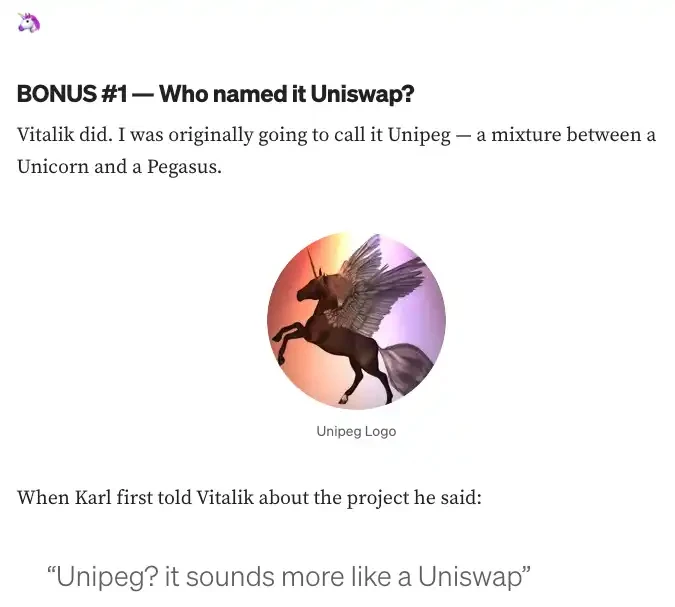
"Uniswap" replaced "Unipeg," becoming the name of a $70 billion DeFi blue chip.
Fast forward eight years to April 2026. An anonymous developer (Twitter account @unipegv4, reportedly linked to the 0xHadrian blog) revived this discarded name, giving it new meaning: Uni + JPEG = uPEG. The NFT circle has long jokingly referred to images as "JPEGs." Since this thing was born in a Uniswap pool, it is Uniswap's JPEG.
This story itself is a viral-grade piece of material. It perfectly closes the loop on four narratives in a single name: Hayden's personal anecdote, Vitalik's lighthearted comment, NFT circle slang, and V4's new mechanism.
The "uPEG" story is easy to tell and easy to spread. This attracted OpenSea CMO Adam Hollander, who tweeted on April 25th: "I'm interested in this concept, buying a bit to try."
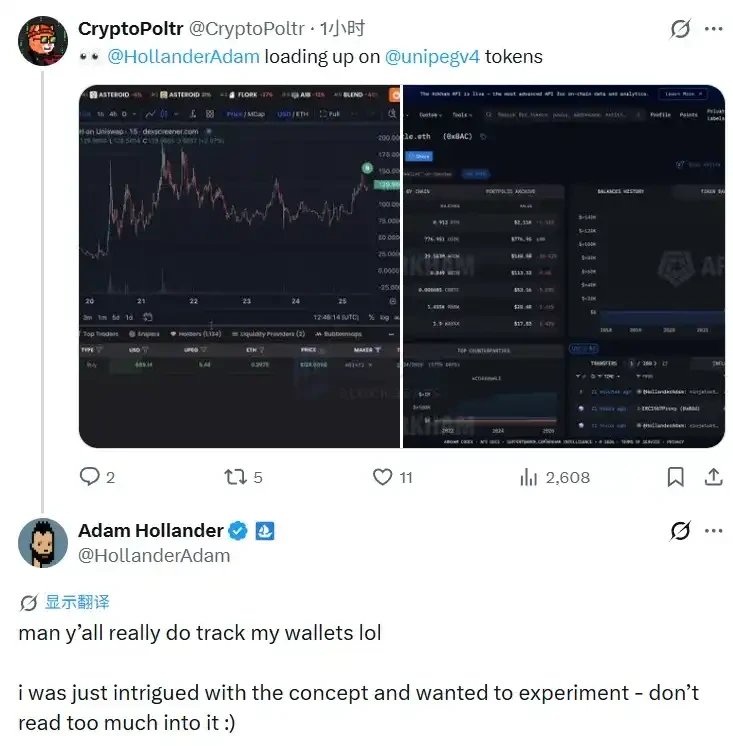
That night, "uPEG" tripled in price. Subsequently, Uniswap team member niko followed suit, followed by Ouroboros co-founder Nafay and meme coin KOL pow, who also posted their uPEG holdings on X platform. In two weeks, uPEG went from zero to a $34.44 million market cap, with a unit price of $982. Related reading: "Market Cap Breaks Through $23 Million to New Highs, What Magic Does the New Image Golden Dog Unipeg Possess?".
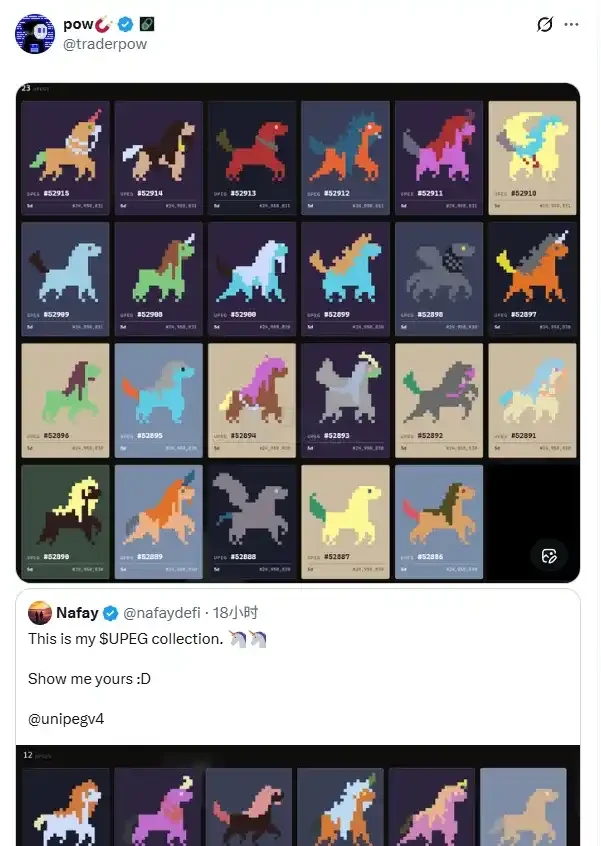
Meme coin KOL pow promoting uPEG
After uPEG, "Slonks" launched on May 1st.
Developer Hirsch did something that sounds paradoxical: he embedded an AI image generation model (only 214KB, roughly the size of a low-resolution phone wallpaper) directly into an Ethereum smart contract. The model's task was to replicate 10,000 CryptoPunks.
But a 214KB model can't remember 10,000 faces. Each image has 576 pixels; the model makes mistakes on about 24 on average, roughly a 4% distortion rate. Only 32 out of 10,000 were perfectly replicated; the rest were all "deformed punks."
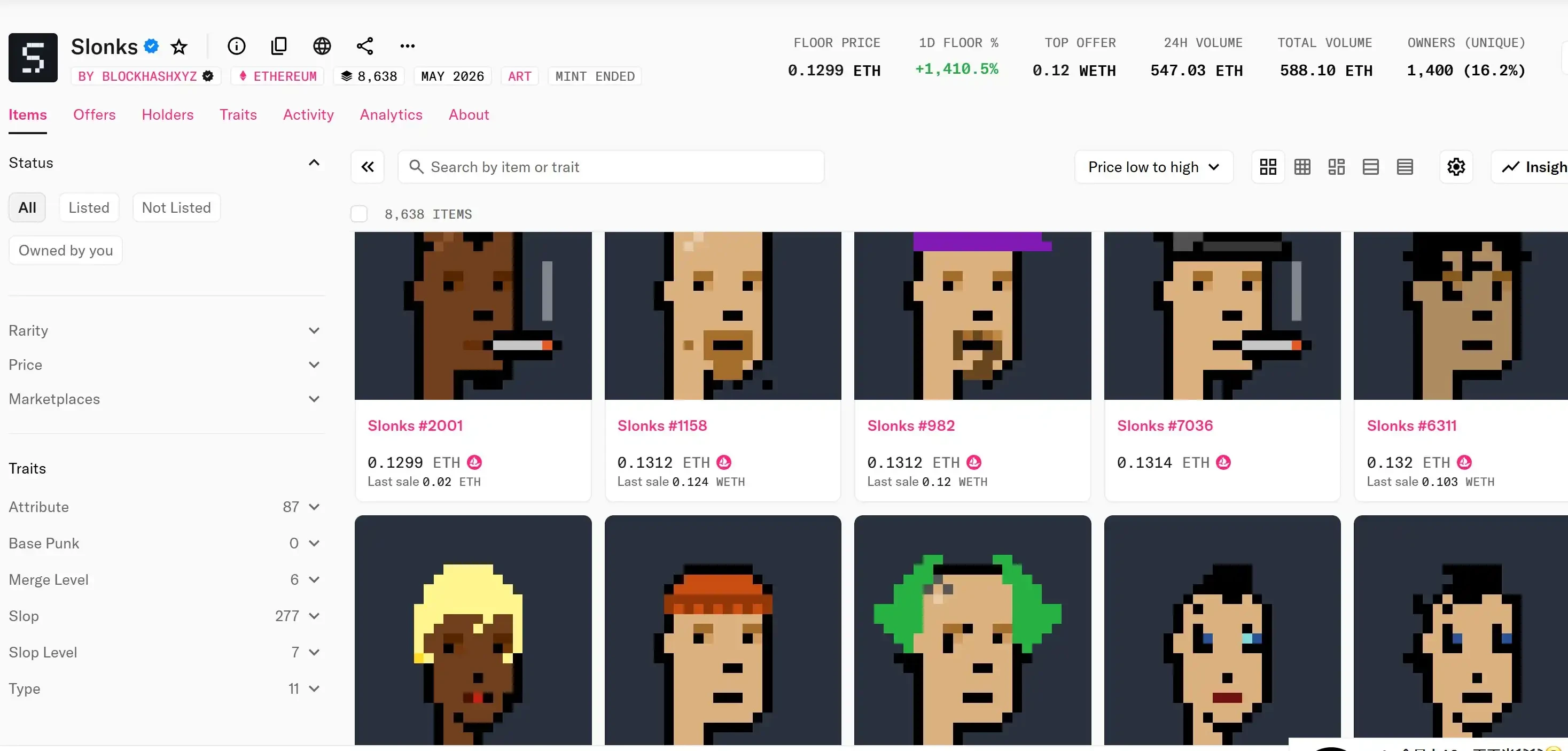
Slop example
Hirsch calls these misdrawn pixels "slop." He then wrote the project's manifesto on Twitter: "The slop is not a bug. It is the medium."
The entire economic model is built on the idea that "the more mistakes, the more valuable." Two Slonks of the same level can be merged; one is burned, the other is upgraded, and the new image's slop only increases. Any Slonk can be sent into the void to mint future $SLOP tokens (not officially launched yet) at a 1:1 ratio based on slop count. Every action is executed through a V4 hook and is verifiable on-chain.
Slonks wasn't an instant hit. In its first few days, it was largely overshadowed by uPEG's $30 million market cap glory. The floor price hovered around 0.005 ETH with little discussion on OpenSea, until NFT veterans like the 798 crew started tweeting about it in relay on X, turning the phrase "mistakes are art" into a shareable meme. Simultaneously, on-chain smart money accumulation, subsequent promotion by KOLs and media, and trending placement on the OpenSea homepage provided traffic distribution. Slonks saw a 60x increase in 5 days.
SATO's key significance is that it fundamentally proved that "V4 hooks can create new economic models." This was the prerequisite for the emergence of uPEG and Slonks.
uPEG's significance lies in translating the DeFi concept of V4 hooks for the NFT circle. Retail investors suddenly realized that hooks aren't just toys for DeFi geeks; they can create things they also want to buy.
Building on the attention dividend created by uPEG, Slonks crafted a stronger story hook and an interesting economic model, further driving the V4 Hook narrative.
What to Watch to Catch the Next Opportunity
For the core foreign V4 Hook circle, the BlockBeats editor mainly recommends the following users:
1. Hayden Adams (@haydenzadams), founder of Uniswap. Importance needs no further elaboration.
2. saucepoint (@saucepoint), the hook godfather at the Uniswap Foundation, author of v4-template. The starter code for almost all hook projects comes from his template.
3. Uniswap official (@Uniswap) and Uniswap Foundation (@UniswapFND). The Builder Update published every Wednesday or Thursday is the most important official signal source for the track.
4. niko (@niko_eth), member of the Uniswap Labs team. You could say he was the crucial baton in the first wave of KOL relay for uPEG.
5. horsefacts (@horsefacts_eth), one of the earliest builders of V4 hooks, a technical trendsetter.
6. Adam Hollander (@AdamHollander), CMO of OpenSea. His deeper background includes being an early ecosystem driver for Hashmasks and Pudgy Penguins. He's a key bridge connecting the DeFi and NFT circles in this wave.
7. Project accounts: uPEG official (@unipegv4), Unimon official (@unimonapp), Slonks official account, SATO official (@Satothedog). Seeing who they follow and interact with can often unearth the next hook project that hasn't been named yet.
Beyond that, we can also monitor some websites related to V4 hooks and Uniswap:
1. HookRank.io is currently the cleanest V4 hook explorer, listing 1300+ hooks. They are sortable by TVL/Volume/Fees, with "New" and "Trending" tags. This is the first place to see hooks that haven't been mentioned on Twitter yet but whose data is already growing.
2. HookAtlas.com is a directory of hook projects with descriptions, suitable for mapping.
3. The Uniswap Foundation Builder Update is on the blog . The foundation publishes it every Wednesday or Thursday. Core users focused on the Uniswap ecosystem won't miss the hottest narratives.
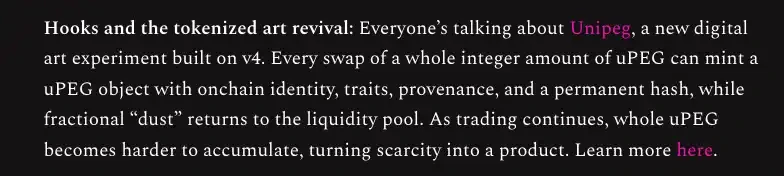
The latest Blog also mentioned community news like 'Hooks, Unipeg', etc.
4. The Unichain Infinite Hackathon competition. Winning projects are almost always seeds, allowing us to identify core projects on Unichain.
5. Dune Uniswap V4 Tracker to see total hooks, TVL distribution, and chain volume distribution.
6. Dexscreener, the commonly used K-line chart website for trading, is useful for monitoring newly created V4 pairs. It serves as an early signal source for projects without KOL hype. For example, uPEG's holder count jumped from 200 to 4000+ in 24 hours – a slope like that is a signal itself.
7. The Trending lists on OpenSea and Magic Eden. Slonks appeared on OpenSea Trending the day after launch; ordinary NFT projects need weeks of marketing to get there. Furthermore, on May 8th, Slonks achieved a single-day trading volume of 575 ETH, surpassing CryptoPunks' 129 ETH. Any new project surpassing CryptoPunks' single-day volume is a track-level signal.
8. The awesome-uniswap-hooks GitHub project. All hook experiment projects are registered here, ideal for discovering early projects with "interesting designs" that don't have tokens yet.
The Next Stage of the V4 Hook Narrative
Based on a purely speculative guess from the BlockBeats editor, if the V4 Hook narrative doesn't immediately fizzle out, the next wave of narratives will likely progress along three lines: short-term SATO bug-fix forks, mid-term hook composability, and long-term Unichain becoming the center of the entire track.
Firstly, the short-term SATO bug-fix forks. There has been considerable discussion in various group chats today.
The reason SATO spawned a "fix fork" like sat1 lies in its hook contract. Any V4 hook that wants to replace Uniswap's standard pricing must maintain its own ledger of "how much money is in the pool" to calculate its curve formula. However, the Uniswap PoolManager also maintains its own real ledger. With two sets of books existing simultaneously, they need to be synchronized with every swap. If the synchronization logic isn't precise, the two numbers will drift apart. In hook engineer circles, this issue is called "dual-state drift."
Drift creates arbitrage opportunities. At some point, the hook internally believes 1 SATO is worth X ETH, but the pool's real reserves show Y ETH. Whoever spots this difference first exploits it first. Those two addresses that made a $360,000 unrealized profit weren't betting on market sentiment; they were exploiting a contract accounting loophole.
sat1 packages itself as "one curve, single state," using only one set of books with no drift. The engineering fix is reasonable, but the narrative is intentional – it tells retail investors "SATO has a bug, I'm the correct version," aiming to steal legitimacy.
This playbook isn't unique to V4. The Bitcoin ecosystem had ORDI, SATS, 1000SATS; the ERC-404 era had Pandora, DN404, ERC-404 V2; the pump.fun era had BankrFun, ClankerFun. Each later entrant claimed to have "fixed the previous one's problem."
The essence of a bug-fix fork isn't technical repair; it's narrative hijacking. It doesn't even need to actually fix anything substantial. It only needs to make "the original has a bug" a consensus on Twitter, and liquidity will flow from the original to the fork.
V4 hooks have reduced the cost of this script to an all-time low. Hooks are open source. Fork a copy, modify three lines of code, and deploy. Every successful hook project comes with its own copycat generator. SATO/sat1 is the first template; uPEG2, Slinks will inevitably follow.
In the mid-term, we can look forward to hook composability.
Currently, one V4 pool can only have one hook. But people are already working on "meta-hooks" – a hook that internally calls multiple sub-hooks to achieve composite behavior.
If this works, it means uPEG's image generation + Slonks' NFT-token exchange + SATO's bonding curve could coexist in the same pool. Swapping once could trigger image generation, alter the pricing curve, and mint an NFT all at the same time.
Possible directions going forward are numerous: swaps triggering music or audio generation (replacing SVG with MIDI, audio is more easily spread than images); swaps serving as identity or reputation systems (updating soul-bound scores with each swap); prediction market hooks (treating swaps as betting actions, Polymarket model running within the LP); time-based hooks (sell tax decreasing the longer you hold); cross-collection fusion mechanics (using hooks to fuse a Pudgy Penguin and an Azuki into a new form, most feasible between CC0 projects).
The BlockBeats editor believes composability is the true ceiling of this track; single-point mechanisms are just demos.
Looking further long-term, Unichain could become the next hot chain.
Not because its technology is vastly superior, but because it has access to the Uniswap Foundation's funds, traffic, and whitelist advantages. Hook projects on Unichain have a much higher probability of being featured in the official Builder Update compared to those on Ethereum mainnet.
For those looking to capture the earliest signals, the BlockBeats editor suggests setting up a dedicated monitor for Unichain: use the Unichain dashboard on Dune to track hook deployment numbers, L2Beat for TVL and active addresses, and the official builder toolkit for new tool updates, etc.