Ray Dalio: Debt, Division, and Disorder – Can the US Avoid Decline?


- Core Thesis: The US is currently not facing a singular market crisis, but rather a major cycle shift where four structural variables—debt, political division, the international order, and technological change—are simultaneously entering a period of reassessment. Bridgewater Associates founder Ray Dalio believes the US is heading towards a "more disorderly era," and its core challenge lies in balancing internal conflict with fiscal constraints within this "time warp."
- Key Elements:
- The debt cycle is constraining national capacity for action. Annual spending (approximately $7 trillion) exceeds revenue (approximately $5 trillion) by about 40%. Persistent deficits have accumulated debt equal to six times annual revenue, severely compressing fiscal space.
- The deep-seated root of domestic political division is the imbalance in the distribution of wealth and benefits. Any plan to reduce deficits inevitably touches upon the question of "who pays more taxes and who receives fewer benefits," transforming fiscal adjustment from a technical issue into a problem of political legitimacy.
- The international order is shifting from "being based on rules" back to "being based on power." The post-war US-led multilateral system lacks effective enforcement mechanisms, making geopolitical conflicts (e.g., Iran, the Strait of Hormuz) once again indicators of major power creditworthiness and security.
- Pressure on the Dollar does not mean the Renminbi will directly take over. The RMB may serve as a medium of exchange in more trade scenarios, but Chinese debt is not an ideal store of wealth. Gold, due to having "no alternative," is re-emerging as a key reserve asset for central banks.
- Technology (AI) is a double-edged sword. It can boost productivity to alleviate debt, but it may also exacerbate wealth gaps, job displacement, and geopolitical security risks. Its overall impact is difficult to predict.
Original Title: A Legendary Investor on How to Prevent America's Coming 'Heart Attack'
Original Author: Emily Holzknecht and Sophia Alvarez Boyd, the New York Times
Original Translation and Compilation: Peggy, BlockBeats
Editor's Note: Against the backdrop of high fiscal deficits, escalating geopolitical conflicts, and the reassessment of dollar creditworthiness, discussions about the United States are shifting from "Is it still the world's strongest economy?" to "Are the institutions, debt, and international order underpinning American hegemony still stable?"
However, when "America is still strong" and "America is falling into disorder" are both true, a more critical question emerges: Is the US facing an ordinary cyclical adjustment, or a fundamental loosening of its long-term order?
This article is compiled from an interview with Ray Dalio on the New York Times podcast "Interesting Times." Dalio, the founder of Bridgewater Associates, has long observed macro-order changes from the perspective of debt cycles, reserve currencies, and the rise and fall of empires.
In this conversation, Dalio dissects the American predicament into a set of more fundamental structural variables: how debt accumulates, how politics becomes polarized, how the international order fails, and whether technology can still offer a new productivity outlet.
First, the debt cycle is changing national capacity. In the past, the US, relying on strong fiscal credit and the status of the dollar as a reserve currency, could finance itself at a low cost for a long time, maintaining military spending, welfare, and global commitments. But now, with spending persistently exceeding revenue, the burden of debt and interest payments is rising, continuously compressing fiscal space. This means debt is no longer just a number on a balance sheet; it gradually becomes a constraint on national capacity: the ability to continue protecting allies, maintaining welfare, and bearing the costs of war will all be limited by fiscal reality.
Second, domestic political division is increasingly tied to the issue of wealth distribution. In the past, political differences in the US could be partially absorbed by growth, taxation, and welfare expansion; different groups, though having conflicting interests, still shared a degree of institutional trust. Now, wealth gaps, value conflicts, and left-right antagonism are overlapping. Any plan to reduce deficits inevitably touches on the question of "who pays more taxes and who receives fewer benefits." This means fiscal adjustment is no longer just a technical issue but a question of political legitimacy. The more reform is needed, the harder it is to reach a consensus.
Third, the international order is shifting from rules back to power. After 1945, the US led the establishment of a world order centered on multilateral institutions, a rules-based system, and dollar credit. Even during the Cold War, the US held overwhelming advantages in finance and institutions. But now, geopolitical conflicts, bloc realignment, and supply chain security issues are eroding the stability of this order. Analogies involving Iran, the Strait of Hormuz, and even the Suez Crisis all point to the same problem: when rules cannot be enforced, markets will eventually reassess the relationship between power, credit, and security.
Fourth, the pressure on the dollar does not mean the RMB will directly take over. Dalio's assessment is more nuanced: the RMB may increasingly become a medium of exchange in trade scenarios, but this does not mean Chinese debt will become the world's most important store of value. The real question is, when fiat currencies generally face devaluation pressure, where will capital seek safe assets? Gold's resurgence as a significant central bank reserve is a manifestation of this uncertainty.
Fifth, AI can either mitigate or amplify the crisis. In the past, technological progress was often seen as a key outlet for the US to fix its debt and growth problems. If AI significantly boosts productivity, it could indeed improve income, growth, and debt-servicing capacity. However, AI is also creating new forms of wealth concentration, job displacement, and security risks. It could be a buffer for fiscal pressure or a new amplifier of social division and geopolitical competition.
If this conversation were to be condensed into one judgment, it would be this: America's problem is not a single crisis, but the simultaneous entry into a reassessment period of debt, politics, the international order, and technological variables.
In this sense, the subject of this article is no longer just whether America is declining, but a larger structural question: when the old order can still function, but its underlying conditions are loosening, how should markets, nations, and individuals reinterpret "security" and "credit"?
The following is the original content (edited for readability):
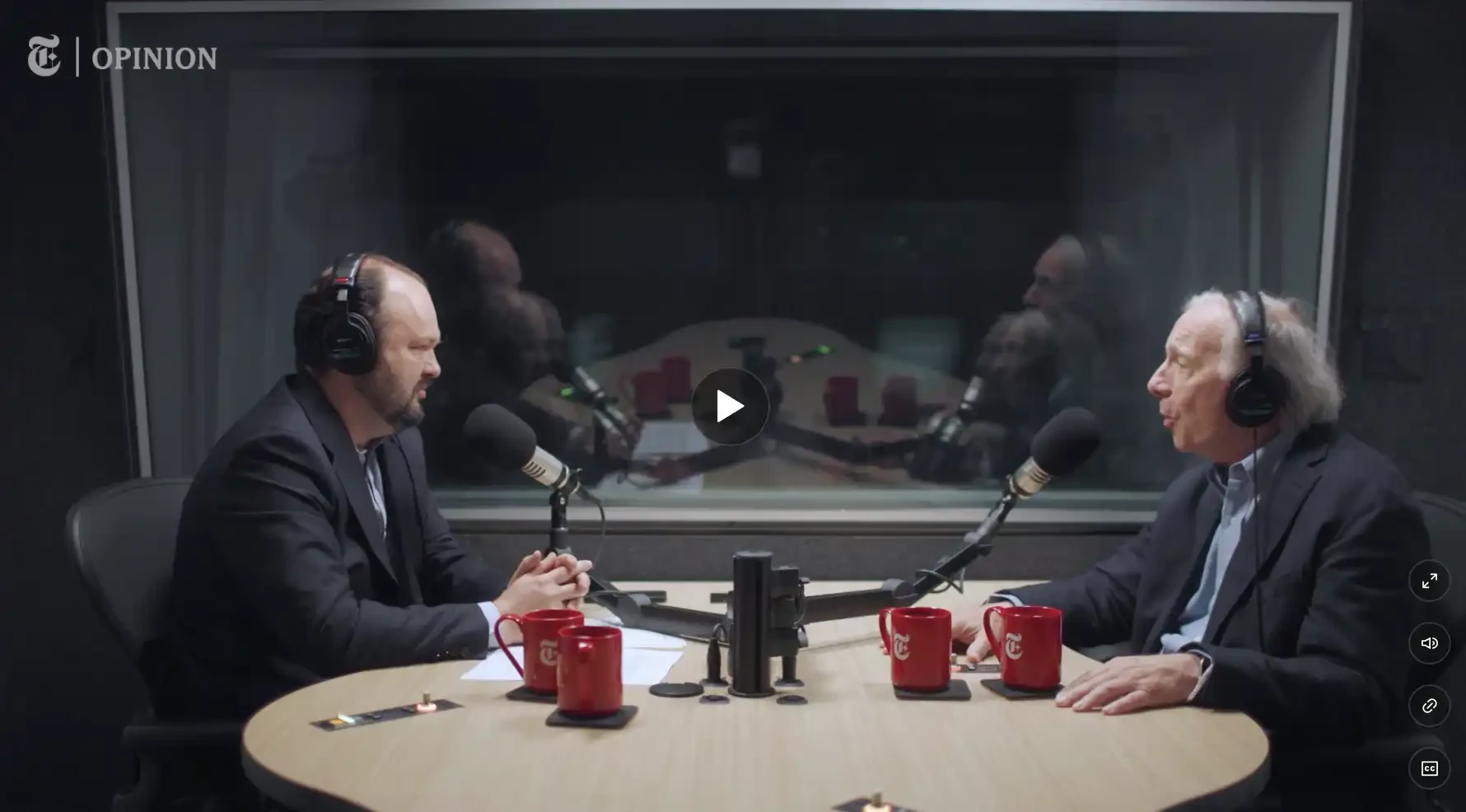
Image Source: The New York Times
TL;DR
·Dalio's core judgment is that the US isn't just weakening temporarily; the big cycle is entering a downward phase.
·America's real risk isn't a lack of money, but debt so high it slowly drains national capacity.
·Deficits are hardest to solve because they inevitably become political conflicts over "who pays and who concedes."
·The underlying cause of US political division isn't just values, but an imbalance in wealth and interest distribution.
·The post-war rules-based order led by the US is failing, and the world is reverting to great power competition.
·The dollar won't be immediately replaced by the RMB, but the world will pay more attention to safe-haven assets like gold.
·AI might save growth, but it could also further tear apart employment, wealth, and security orders.
·Whether America can recover depends not on the market, but on education, social order, and avoiding war.
Original Content
I feel like, recently, we seem to be in a moment of "the end of the American Empire."
Partly, this is due to the stalemate in the Iran conflict; partly, it's Donald Trump putting pressure on America's alliances; and partly, I think, it's a growing feeling that America's biggest rival, China, is watching coldly from the sidelines, waiting for its collapse.
This week's guest has been focusing on this issue for a long time. He has a grand historical theory predicting America's decline. In a way, he's an atypical "Cassandra" figure—constantly issuing warnings, without always being taken seriously.
Ray Dalio built Bridgewater Associates, one of the world's largest hedge funds, from scratch. But nowadays, what he most wants to talk about is no longer just markets and investments, but America's imperial decay, and whether we can still pull the "American Empire" back from the brink.
The following is an edited transcript of a segment from the "Interesting Times" podcast. For the full effect, we recommend listening to the original audio. You can listen via the player above, or on the New York Times app, Apple, Spotify, Amazon Music, YouTube, iHeartRadio, and other podcast platforms.
The Cyclical Logic of the American Crisis
Ross Douthat (Host): Ray Dalio, welcome to "Interesting Times."
Ray Dalio (Founder of Bridgewater Associates): Thank you. It's interesting to be on "Interesting Times" during "interesting times."
Douthat: That's what everyone says. You're a man who has built a career making bets, and over the last few decades, quite a few of your judgments have paid off. Lately, you've been saying that the United States of America, right now, might not be a particularly good bet.
So, for someone observing America, trying to decide whether to bet on the "American Empire" maintaining its dominant position in the 21st century, what are the important forces or key factors they should be watching?
How Debt Drains National Capacity
Dalio: I want to correct that characterization first. I'm not saying America is a bad bet, or a good bet. I'm just describing what's happening.
One thing I've learned in my roughly 50 years of investing is that many events very important to me had never happened before in my lifetime, but they had happened many times in history.
So, I started studying the last 500 years of history, trying to understand the reasons for the rise and fall of reserve currencies and the empires behind them. You see a certain pattern repeating. There is indeed a "big cycle," and it typically starts with the formation of a new order.
There are three types of order: monetary order, domestic political order, and international world order. These are three important, evolving forces.
Look at the first force: monetary order. There's a debt cycle within it. When debt rises relative to income, and debt service payments rise relative to income, it squeezes other spending, whether for a country or an individual—
Douthat: Or an empire.
Dalio: Any entity!
Douthat: Yes.
Behind Political Division is the Distribution of Money
Dalio: That's the problem. For example, the US now spends roughly $7 trillion a year and takes in about $5 trillion in revenue—so spending is about 40% higher than revenue. This deficit has persisted for a while, leading to accumulated debt roughly six times its income—here income means the actual money the government collects.
Correct. But the result of this is that the currency itself gets devalued. That's how the mechanism works. And that's why there are long-term debt cycles, short-term debt cycles, monetary cycles, and economic cycles—they push the economy from recession to overheating to the next recession.
Related to this is the domestic political and social cycle, which is closely linked to monetary issues. When there are huge wealth and value gaps within a society—
Douthat: You mean the gap between rich and poor?
Dalio: Between rich and poor, and between groups with different values. When these differences become irreconcilable, political conflict arises, and it becomes so serious that it risks the entire system.
So, I think the first cycle is happening. I also think the second cycle is happening—the irreconcilable divide between the political left and right. We can expand on that later.
The World Order is Returning to Power Politics
Douthat: And how do the international factors play in?
Dalio: The same logic applies internationally. After a war, a dominant power emerges, and that power establishes a new world order. By order, I mean a system. This current order started in 1945.
Douthat: For us, that's true. The US was the dominant power building that system.
Dalio: Exactly. The US built a system that largely modeled itself on US institutions, intending to be representative. The UN, for example, was a multilateral world order. Different countries could operate within it, and theoretically, there was supposed to be a rules-based system.
But the problem is, if there's no enforcement mechanism, the system isn't truly effective. It was an idealistic system, and while it lasted, it was a beautiful one. But now, we no longer truly have a multilateral, rules-based system.
We're going back to a state that existed before 1945, for most of history: geopolitical divides keep emerging, like what's happening now around Iran.
How are these divides resolved? You don't take it to the International Court of Justice, wait for a ruling, and then have it enforced. Ultimately, what matters is power.
Douthat: True. But even during the heyday of the "rules-based international order," for most of that history, the US was in a constant conflict with the Soviet Union.
Dalio: Right.
Douthat: So the Cold War was ongoing. The window where the system operated purely without major power conflict was relatively short. And even then, American power was ultimately the decisive power, right?
Dalio: Of course. Because the Soviet Union didn't have real power. It had military power, but at the end of WWII, the US held about 80% of the world's monetary wealth, half of global GDP, and was the dominant military power. So, we had the ability to provide funds, and those receiving them valued the money. In contrast, the Soviet system was only a very limited part of it. From a financial perspective, it was practically bankrupt, certainly not a significant power.
Douthat: So, the military balance of power was real, but in the balance of financial power, it was basically America calling the shots.
Dalio: Right. Fortunately, under the doctrine of Mutual Assured Destruction, we didn't actually use that military power. Still, I remember the Cuban Missile Crisis—I was a kid watching, and we didn't know if there would be a nuclear exchange. But it didn't come to that, and later the Soviet Union collapsed.
Douthat: In your cyclical view of history, what role do contingent events play?
Dalio: All events happen in succession. I think the key question is: do they lead to disputes? And in a world without a court system to resolve disputes—domestically and internationally—how are these disputes resolved?
Take what's happening in the Middle East, especially related to Iran. There are conflicts, and they escalate into war because there's no other way to resolve them. Now the world is watching: can the US win this war, or will it lose?
We tend to look at this in black and white terms: who will control the Strait of Hormuz? Who will control nuclear materials? Can the US win this war?
We should also see the alliance dynamics behind this. Russia and Iran tend to support each other, just as there are supporting forces on the other side.
Douthat: To reiterate, what makes this moment special compared to the last few decades is that the other side's camp is stronger?
Dalio: It's the change in relative power and the breakdown of the old order. Also, huge creditor-debtor relationships are involved. For instance, when the US runs large deficits for a long time, it has to borrow. This becomes very dangerous during conflicts. Interdependence is also a factor.
In other words, in a higher-risk world, you need to be self-sufficient. History tells us you can be cut off at any time. Either side can be cut off.
Douthat: Yes. I'm very interested in how these factors fit together. Suppose the Iran situation ends with people thinking the US lost the war, or at least didn't achieve its goals. Maybe the Strait of Hormuz is still open, but the Iranian regime remains in power, and there's a perception that the US tried something and failed. Do you think that perception would then affect people's judgment of America's creditworthiness?
Dalio: I just spent about a month in Asia, meeting leaders and others from various countries. The impact of this is very significant, much like when Britain lost the Suez Canal—because Egypt controlled it. That was seen as the mark of the end of the British Empire. In other words, this is a very big deal.
Douthat: Right, that was in the 1950s.
Dalio: Exactly. And that was when people stopped wanting to hold British debt and such. Now, different countries are thinking: Will America still protect us? Or has America lost the ability to protect us? Because the American public doesn't want a long, drawn-out war, so wars must be quick, low-cost, and—
Douthat: Popular, right?
Dalio: Popular.
Douthat: And our wars aren't usually very popular nowadays. But I want to dwell on the Suez analogy because I find it interesting. Many people are using it. In the Suez Crisis, Britain, France, and Israel basically tried to retake control of the Suez Canal after Egypt nationalized it.
So there are obvious parallels with Iran: a key chokepoint for global trade, a conflict between Western powers and a regional power. But it seems to me the key to the Suez incident was that Dwight Eisenhower and the US essentially told Britain: No, you can't do this.
Therefore, the crisis of confidence in the British Empire, the pound, etc., partly stemmed from the realization, as you said, that this was the post-WWII order, and the US was the dominant power.
So, does that mean China needs to play a similar role now? Does a similar moment need to happen for people to truly lose confidence in the US? To abandon the old hegemon, do people first need to see a new hegemon emerge?
Dalio: By the way, I don't think China will become a traditional hegemon. We can discuss that later.
Douthat: I'm very interested in that.
Dalio: But what I'm saying is that at the time, it was a combination of British debt issues and its obvious loss of power. Britain's decline had already started before the Suez Crisis, because people realized the US wasn't just a world power, but in a better fiscal position.
Douthat: So, if the analogy holds, what is the equivalent today? If people decide America is no longer as trustworthy as we thought, less likely to repay its debts, etc.—maybe this relates to your point about China and whether it will become the new hegemon—will people turn to China? Will they abandon the dollar as a reserve currency? If people lose confidence in the US, where will the money flow?
Dalio: I'll share my view. But I also want to say this is typical of every cycle. For example, when Britain replaced the Netherlands, the process was similar. Britain was financially stronger and more capable. The Netherlands lost, and a transfer from the Dutch Empire to the British Empire occurred; the Netherlands at the time held the reserve currency and debt. Similar things happened repeatedly in the same way.
So, you don't necessarily need a specific figure, like President Eisenhower—
Douthat: No,