






2026's U.S. stock market gains are starting to make me uneasy


- Core Thesis: The main storyline of the global capital markets in 2026 has shifted to the memory chip sector. Driven by surging AI demand and a highly monopolized supply side, stocks like Micron and SanDisk have seen astonishing gains. Their profitability and market frenzy have triggered collective chasing by both institutions and retail investors. However, historical industry patterns suggest that price declines could be far more rapid than anticipated.
- Key Elements:
- Memory chips become the 2026 capital market theme: Based on Justin Sun's year-end 2025 callout prices, SanDisk, Western Digital, Seagate, and Micron have surged 515%, 280%, 256%, and 222% respectively. Driven by Samsung and SK Hynix, the Korean stock market rose 76% for the year.
- Memory monopoly and super profits: SK Hynix, Samsung, and Micron control 92% of global DRAM capacity. SK Hynix's net profit surged 398% in Q1 2026, with an operating margin of 72%, higher than Apple's 43% gross margin.
- Extreme institutional aggression: Google, Microsoft, etc., have placed "no price cap, no quantity limit" orders with Micron. SK Hynix's entire 2026 HBM capacity is already sold out. Wall Street's earnings per share estimates for SanDisk in 2026 were raised by 172% within three months.
- Unusual supply-side restraint: The three major memory manufacturers have collectively chosen not to expand capacity, with capital expenditure growth at only 14%, far below the 30%-50% typical of historical boom periods, creating an "OPEC-like" supply-side coordination situation.
- Short-selling risk signals: Citron Research shorted SanDisk in February 2026, citing its cyclical nature, the lack of a moat for a commodity product, and the fact that major shareholder Western Digital is selling shares at a 25% discount to the market price. Yet the stock still hit new all-time highs.
- Historical iron law and price risk: A 30-year iron law of the memory industry is that prices rise slowly but fall fast. In the 2018 supercycle, it took less than two quarters for prices to halve from the peak. Given the current high profits, supply release is only a matter of time.
"Making money in A-shares can prove you have strength, wealth luck, boldness, skill, vision, insight, and patience.
Making money in U.S. stocks can only prove you have money parked in U.S. stocks."
This is the current dilemma for most people trading U.S. stocks in 2026.
Those who quietly bought U.S. memory stocks, casually deleted the app, and decided to "lie flat," only to log back in one day and find their accounts had multiplied several times over.
Driven by the U.S. stock market, A-share memory stocks also started to take off.
Meanwhile, people in the crypto space shifted from discussing memes and altcoins to talking about U.S. stocks: "I live in daily fear of U.S. stocks going up and BTC going down."
New account holders are firing soul-searching questions in group chats: How is it so easy to make money in U.S. stocks?
1. What's Actually Driving the U.S. Stock Rally?
The clear capital market theme globally in 2026 is memory.
Justin Sun was among the first to call out the memory sector in late 2025.
Netizens calculated that if you bought U.S. memory concept stocks when Justin Sun made his call:
If you bought Micron, you'd be up +222%; if you bought Seagate, up +256%; if you bought Western Digital, up +280%; if you bought SanDisk, up +515%.
If you had invested 500,000 yuan in SanDisk stock a year ago, you would now have 15 million yuan.
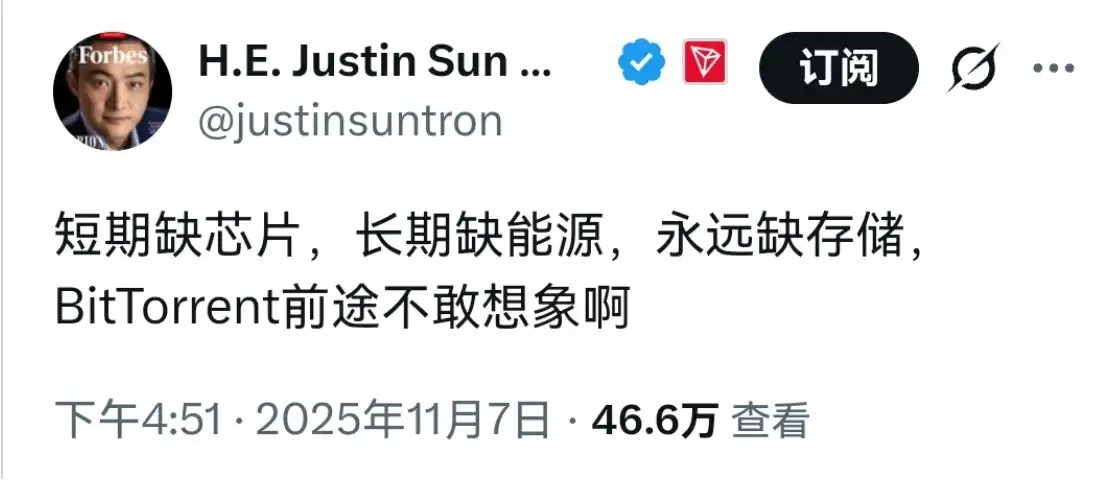
So, what exactly is memory?
Memory chips are the components in computers and phones responsible for storing information. There are two types: DRAM handles short-term memory, temporarily storing data during program operation; NAND handles long-term memory, holding your photos and files. When you choose between 128GB or 256GB for a phone, that capacity refers to NAND.
There are fewer than five manufacturers globally capable of producing both types.
Over the past year, the stocks of these five companies have surged as follows:
SanDisk, spun off from Western Digital in February 2025, an older company making USB drives and SSDs, saw its stock price increase up to 22 times.
Micron, a cyclical stock shunned by fund managers for a decade, surged over 550% in a year, with gross margins climbing from 18% to 56%. Apple's gross margin is around 43%, already considered extremely profitable in tech; Micron's is now higher.
SK Hynix is up 123% this year. Samsung is up 94%.
Seagate and Western Digital both hit all-time highs.
Then there's South Korea.
Samsung and SK Hynix together account for over 30% of the weight in South Korea's KOSPI index. In 2025, they helped drive the entire Korean stock market up 76%, making it the top-performing major index globally for the year.
Two memory manufacturers posted explosive earnings, lifting an entire country's stock market.
The price action is even more direct. DDR4 memory chips were $1.45 at the start of 2025 and surged to $17 by February 2026, nearly a 12-fold increase in a year. A Kingston 16GB RAM stick in Huaqiangbei went from 200 RMB to 800 RMB. If you've recently found phones and computers more expensive, part of the reason lies in these stocks you didn't buy.
SK Hynix's net profit for Q1 2026 surged 398%, with an operating profit margin of 72%. Samsung Electronics' overall operating profit skyrocketed 755% year-on-year.
Selling 100 RMB worth of memory yields 72 RMB in profit and 28 RMB in cost. This isn't business anymore; it's mining.
2. Institutions Lost More Rationality Than Retail Investors
In a typical market, institutions are the ones in suits, saying "we are long-term fundamentally bullish," while retail investors are the ones yelling "let's go!" in group chats.
In the 2025-2026 memory sector, institutions went crazy first.
Google, Microsoft, and Amazon started placing open-ended orders with Micron – "no price limit, no quantity limit."
The term "no price limit" is worth considering. It means you pay whatever price is quoted, without negotiation. This type of procurement is usually seen in wartime governments buying munitions.
In 2025-2026, it appeared for tech companies buying memory modules.
Broadcom locked in supply for three years, until 2028.
SK Hynix stated at its investor conference: "HBM production capacity for 2026 is already completely sold out."
Completely. The entire year.
HBM is high-end memory specifically paired with AI chips. For every AI chip Nvidia sells, it needs a corresponding HBM. Globally, only SK Hynix, Samsung, and Micron can produce HBM, with SK Hynix holding about 57% market share. "Completely sold out" means one of the most critical components for global AI infrastructure has no excess capacity for the entire year of 2026.
Then came the analysts.
Within three months, Wall Street's consensus estimate for SanDisk's 2026 earnings per share was raised by 172%. Citigroup predicted server DRAM average selling prices would rise 144% year-on-year in 2026. Nomura stated the super cycle would last at least until 2027, with meaningful supply increases coming no earlier than 2028. Melius, after the stock had already risen hundreds of percentage points, upgraded Micron to a Buy rating, adding "still has 41% upside over the next 12 months," without batting an eye.
DeepMind CEO Hassabis publicly stated that general constraints on the memory supply chain are limiting large-scale AI deployment. Intel CEO Lip-Bu Tan said the memory shortage won't ease before 2028.
Following this, SK Hynix secretly filed an application with the SEC to issue ADRs on U.S. stock exchanges, seeking to raise up to $15 billion. A company with all its capacity sold out and a 72% profit margin decided to raise more money in New York, arguing that the Korean market undervalues it, while U.S. investors better understand AI and are willing to pay higher prices.
A-shares followed suit.
De Ming Li hit the daily limit up, Biwin Storage surged, Longsys rose 41%. Smaller player Xiangnong Xinchuang projected Q1 net profit growth of 6714% to 8747% – a four-digit increase. Topics in finance groups shifted from "Should I buy CSI 300?" to "Which one is better, Micron or SK Hynix?" People who didn't know how to spell HBM two months ago were now educating others on the fundamentals of high-bandwidth memory in group chats.
Even many dating groups are discussing memory stocks.
3. The Most Ironic Scene
On February 24, 2026, Citron Research announced a short position against SanDisk, offering three reasons.
First, memory is a cyclical stock. In 2008, 2012, and 2018, every period of high profitability ended in a crash. Current capacity is already twice the peak of 2018, and supply release is just a matter of time.
Second, SanDisk sells a commodity.
"Nvidia has a moat; SanDisk is just a commodity." Nvidia's moat is the CUDA software ecosystem, which nearly all global AI models run on, making switching extremely costly.
SanDisk's SSDs? Samsung could make identical ones tomorrow, possibly even cheaper.
Third, major shareholder Western Digital is aggressively selling down its SanDisk stake at a 25% discount to the market price.
Selling their own stock at a 25% discount. One possibility is they urgently need cash. Another is they think the stock will be cheaper later. Neither scenario suggests confidence in the future.
Two trading days later, SanDisk rebounded and subsequently continued to hit new all-time highs. Citron's report circulated in various finance groups, becoming meme material.
One question everyone glossed over: Exactly whose accounts did those shares sold at a 25% discount end up in?
4. Making Money in U.S. Stocks: As Easy as Breathing?
The world's three most profitable memory companies, at the height of their profits, collectively chose not to expand production.
SK Hynix's HBM-related capital expenditure in 2025 fell 50% year-on-year, officially citing concerns about supply glut in 2027. Samsung's DRAM capacity growth in 2026 is only about 5%, far below demand growth.
The entire industry's capex growth rate is only 14%, compared to a typical 30% to 50% during historical expansion cycles.
These three companies control 92% of global DRAM production capacity and simultaneously chose not to expand. In any other commodity market, this has a name: supply-side coordination. OPEC did this with oil, resulting in the 1973 oil crisis. The memory chip market is even more concentrated than OPEC; the combined market share of these three firms exceeds that of thirteen oil-producing countries.
Investors interpreting "manufacturers' restrained capacity expansion" as a positive signal is logically sound; prices can indeed be sustained longer. But what this structure means for the buyers on the other end isn't covered in any analyst report.
Two equally compelling narratives can explain this rally.
First: AI's demand for memory represents a structural change. AI models in the inference era need to remember increasingly long contexts, requiring an order-of-magnitude leap in memory. The top three memory manufacturers control 92% of capacity, and new fabs can't come online until at least 2027. The gap won't close before then.
Second: It's the same as every previous cycle. The narrative for the 2000 dot-com bubble was "the internet changes everything," which was true. The narrative for the 2008 subprime crisis was "housing prices won't fall nationally," which also held up historically. The real issue was never whether the story was right, but whether prices had already priced it in prematurely.
The memory industry has an iron law unbroken for 30 years: prices rise slowly and fall very fast.
During the 2018 super cycle, from peak to a 50% decline took less than two quarters.
No one knows when this peak will come. Not even those selling at a 25% discount – or rather, especially them. Because they are selling chips, and chips are most efficiently sold to those who are currently believing the story.
Last time you bought a phone, upgrading from 128GB to 256GB cost you an extra three or four hundred RMB. That three or four hundred yuan travels along a supply chain, gets divided layer by layer, and a small portion eventually ends up in SK Hynix's 72% operating margin, in Samsung's 755% profit growth, and in all those stocks you didn't buy.
And it ultimately culminates in you opening any social media app and seeing someone else's soul-searching question: How is it so easy to make money in U.S. stocks?


