






复盘「美股版本之子」:Leopold Aschenbrenner的持仓逻辑全拆解


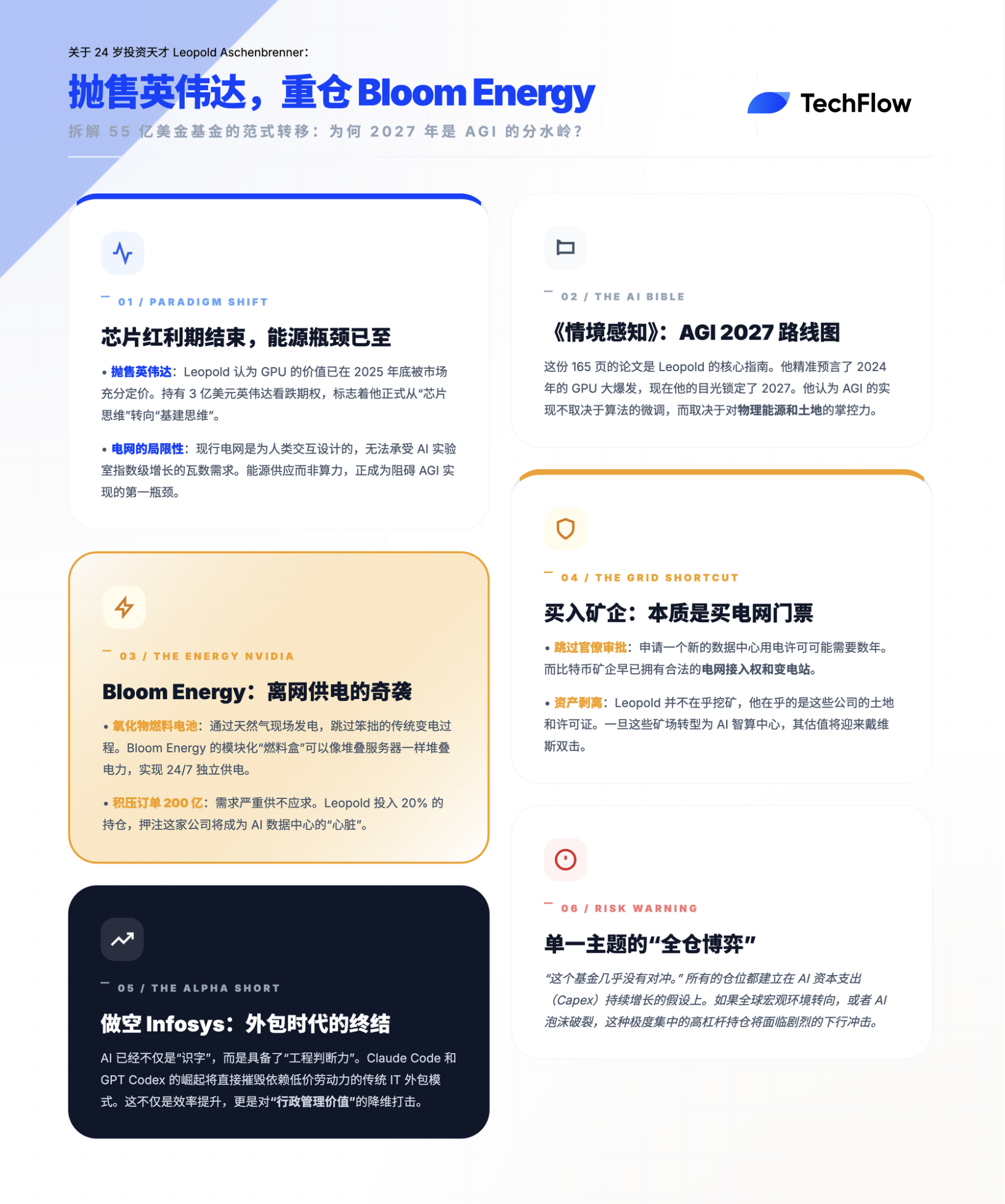
- Core Thesis: The AI hedge fund managed by 24-year-old Leopold Aschenbrenner grew from $1 billion to $5.5 billion in one year. Its core strategy involves anticipating AI development bottlenecks, shifting investments from GPUs to energy and infrastructure, with a concentrated bet on Bloom Energy and Bitcoin miners pivoting to AI.
- Key Elements:
- Leopold liquidated GPU-related stocks like Nvidia and Broadcom, believing their value is fully priced in, and shifted focus to energy and grid bottlenecks that AI will face.
- His largest holding, Bloom Energy, makes up 20% of the portfolio (approximately $855 million). The company uses solid oxide fuel cells to convert natural gas into electricity, enabling modular, rapid deployment without relying on the existing power grid.
- He made significant investments in Bitcoin mining companies, aiming to leverage their existing land and power interconnection permits as a "shortcut" for building AI data centers, bypassing lengthy approval processes.
- Leopold is shorting the IT outsourcing firm Infosys, arguing that AI models like Claude Code are already powerful enough to automate the cheap labor services it provides.
- His investment philosophy has shifted from software to the physical world (manufacturing, energy, infrastructure), viewing these un-automatable sectors as the future core bottlenecks.
Compiled & Edited by: DeepTech Flow

Host: Josh Kale; Ejaaz Ahamadeen
Podcast Source: Limitless Podcast
Original Title: Forget NVIDIA| This 24-Year-Old's $4.5B Bet on AI's Real Problem (Leopold Aschenbrenner)
Release Date: March 4, 2026
Key Takeaways
Recently, everyone’s been talking about Leopold Aschenbrenner—24 years old, $5.5 billion AI hedge fund, the wonder kid of the US stock market. But most discussions stop at "he's impressive" and "he made a lot of money." Not much content has actually dissected his portfolio's logic.
Two months ago, Limitless Podcast did an episode, analyzing his 13F filing trade by trade:
Why he sold NVIDIA, why he poured 20% of his portfolio into a company making fuel cells, why he scooped up a bunch of Bitcoin mining stocks, and why he shorted Infosys. The episode barely got any traction back then. Looking back now, many of the judgments have been largely validated, making it worth a thorough review.
Highlights of Key Insights
On Leopold Aschenbrenner's Investment Performance
- "Last year he was managing $1 billion... Today, just one year later, that $1 billion has grown to $5.5 billion."
- "His fund was launched at the end of 2024 with an initial size of $255 million. And in just 6 months, his fund outperformed the S&P 500 by 8 times."
- "In a 165-page article titled 'Situational Awareness', he essentially predicted we would achieve AGI by 2027."
A Shift in Investment Paradigm: From Chips to Infrastructure
- "He sold NVIDIA, Broadcom, TSMC, Micron. These are major AI infrastructure companies."
- "By the end of 2025 or early 2026, he believes the market has largely priced in the value of GPUs."
- "He shifted his focus to the primary bottlenecks investors haven't fully appreciated yet—Energy and Infrastructure."
- "The existing power grid was designed for humans, not for the massive AI demands we face today. This is the core of his current investment focus."
Core Heavy Holding: Bloom Energy
- "Bloom Energy is his largest investment, making up 20% of his entire portfolio... He built a massive position in this company, totaling $855 million."
- "Bloom Energy developed a device called a solid oxide fuel cell... It can directly convert natural gas into usable electricity for data centers. It's modular and can be deployed quickly."
- "Their backlog of demand is $20 billion. Revenue grew about 34% in 2025, and they expect another 40% revenue growth in 2026."
- "If you use a product like Bloom Energy's gas turbine, you don't need to rely on the grid at all. You just install it right next to the AI data center."
Infrastructure and the Bitcoin Mining "Shortcut"
- "Leopold invested heavily in CoreWeave. He made his biggest leveraged bets in core GPU infrastructure and energy supply."
- "He invested in many Bitcoin mining companies... The reason is that these companies possess the two key elements needed for AI infrastructure: land and power."
- "He is acquiring these companies to get their permits and grid interconnection rights. Normally, getting these permits takes months or even years."
- "It's a bit like taking over a bar that already has a liquor license, rather than applying for a new one yourself and waiting years. It's a very smart 'shortcut'."
Short Thesis and the End of IT Outsourcing
- "He holds a short position in a specific company, which is Infosys... Their business model relies entirely on offering cheaper labor than Western countries."
- "He realized these models are now powerful enough to automate not just simple tasks but also quite significant IT processes, so he took a massive short position against this company."
Investment Philosophy: A Return to the Physical World
- "Pure software companies are going to become very difficult in the future. This shift isn't just about building around architecture; it's about investing in the physical world—manufacturing, factories, energy, and infrastructure."
- "These are areas that can't be built by AI; they are hardware and infrastructure that require manpower, permits, and legislation."
- "Energy is the only resource that no one can get enough of... It all revolves around one core idea: powering the future."
The Young Investment Prodigy: Leopold Aschenbrenner
Josh Kale:
There's a guy named Leopold Aschenbrenner, and he's 24 years old. We covered him last year on an episode when he was 23, managing $1 billion, focused on investing in emerging frontier AI concepts and technologies. Today, just one year later, that $1 billion has grown to $5.5 billion.
This guy, much younger than both of us, just had a generational performance, making more money in AI than any other fund in the world. More importantly, AI is the hottest market right now, meaning competition is incredibly fierce. So clearly, this guy Leopold is doing something different.
Just last week, his latest quarterly 13F filing was released, and we finally got a peek into his recent trading activity. So we're going to dig into these documents and see exactly what this guy did to grow his AUM from $1 billion to $5.5 billion.
Insights from the 13F Filing
Ejaaz Ahamadeen:
He accomplished this in 12 months. His fund was launched at the end of 2024 with $255 million. Within just 6 months, it outperformed the S&P 500 by 8 times, growing to $2 billion. Since we last discussed his Q3 fund report on the show, his fund has grown another $1.5 billion. So, he's truly in a generational breakout phase.
He's very young, and he made a significant shift, but it all aligns with his so-called "bible"—a 165-page essay titled 'Situational Awareness'. In this essay, he basically predicted that we will achieve AGI by 2027. In this grand essay, he detailed his view on how the AI revolution would unfold. His predictions have been almost entirely correct. He successfully foresaw the GPU infrastructure boom, and now he's pointing to another very important shift, which we'll dive into.
The Shift from Chips to Infrastructure
Josh Kale:
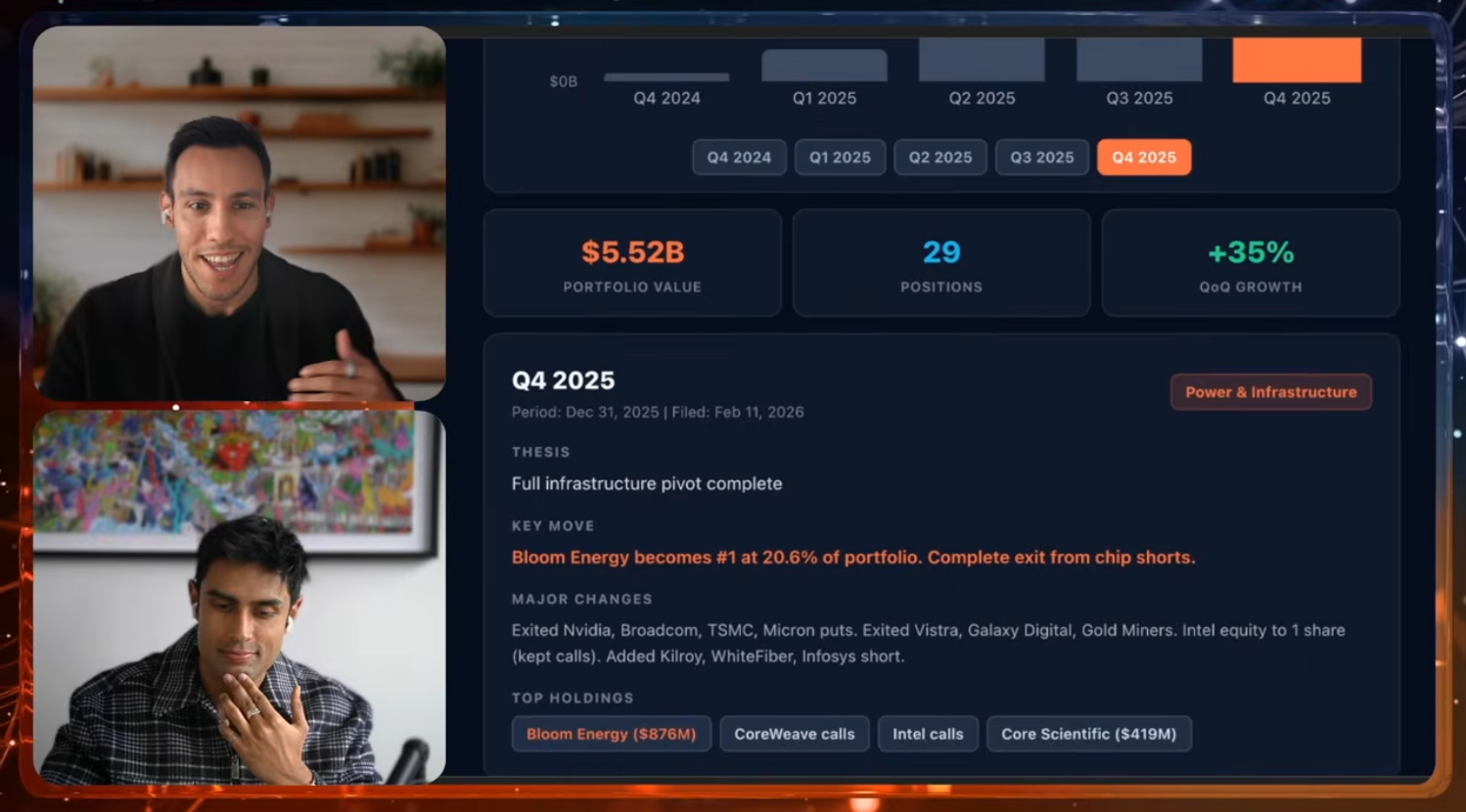
I think the entire investment thesis is shifting from chips to infrastructure. What we're seeing on screen now is very interesting. He used Claude to create a document that walks us through the entire change log from last year to this year. Maybe we can start with what he sold, because the size of the positions he sold is significant, including NVIDIA, where he sold $300 million worth of put options in a single quarter.
Ejaaz Ahamadeen:
You'll notice that many of the stocks he sold are very popular companies that many people are investing in right now. So the question is, why did he sell $1 billion worth of stock in these companies? He sold NVIDIA, Broadcom, TSMC, Micron. These are all major AI infrastructure companies.
He actually made money selling NVIDIA stock; he had $300 million in puts, meaning he likely profited from the decline in NVIDIA's stock price over the past few months. So the question is, why did he do this?
In his 165-page thesis, he mentioned that by late 2025 or early 2026, he believes the market has largely priced in the value of GPUs. This value primarily comes from companies like NVIDIA and Broadcom that make these chips, which are then stacked and used by AI labs like OpenAI and Anthropic for model training.
And now, he's turning his focus to the primary bottlenecks that investors haven't fully appreciated yet—Energy and Infrastructure. Currently, a major issue facing many AI labs is: First, they have too many GPUs; Second, the existing power grid was designed for humans, not for the massive AI demands we face today. This is the core of his current investment focus.
Selling NVIDIA Puts
Josh Kale:
Seeing him sell NVIDIA puts and completely exit his NVIDIA position is fascinating to me. Because when I talk to my friends or average people on Wall Street, NVIDIA is the company everyone talks about, the biggest investment target. And seeing him walk away from NVIDIA, I think it's another proof that he's always a step ahead, always looking at what's next, not what's hot. What's next, in his view, is infrastructure, the shift from chips to information.
This is probably where we can get into his new investments, because these are the stocks you should be paying attention to. These are the assets he currently holds, the bets he thinks will grow. If he's right, we should see pretty substantial returns from these. What are the new additions to his portfolio this quarter?
Ejaaz Ahamadeen:
There's a very neat portfolio breakdown chart here, categorizing all of Leopold Aschenbrenner's investments by the AI tech stack. We can see the investments are divided into categories like Power Generation, Real Estate & Facilities, Compute & Colocation, Connectivity, Storage & Memory, and Chips & Silicon.
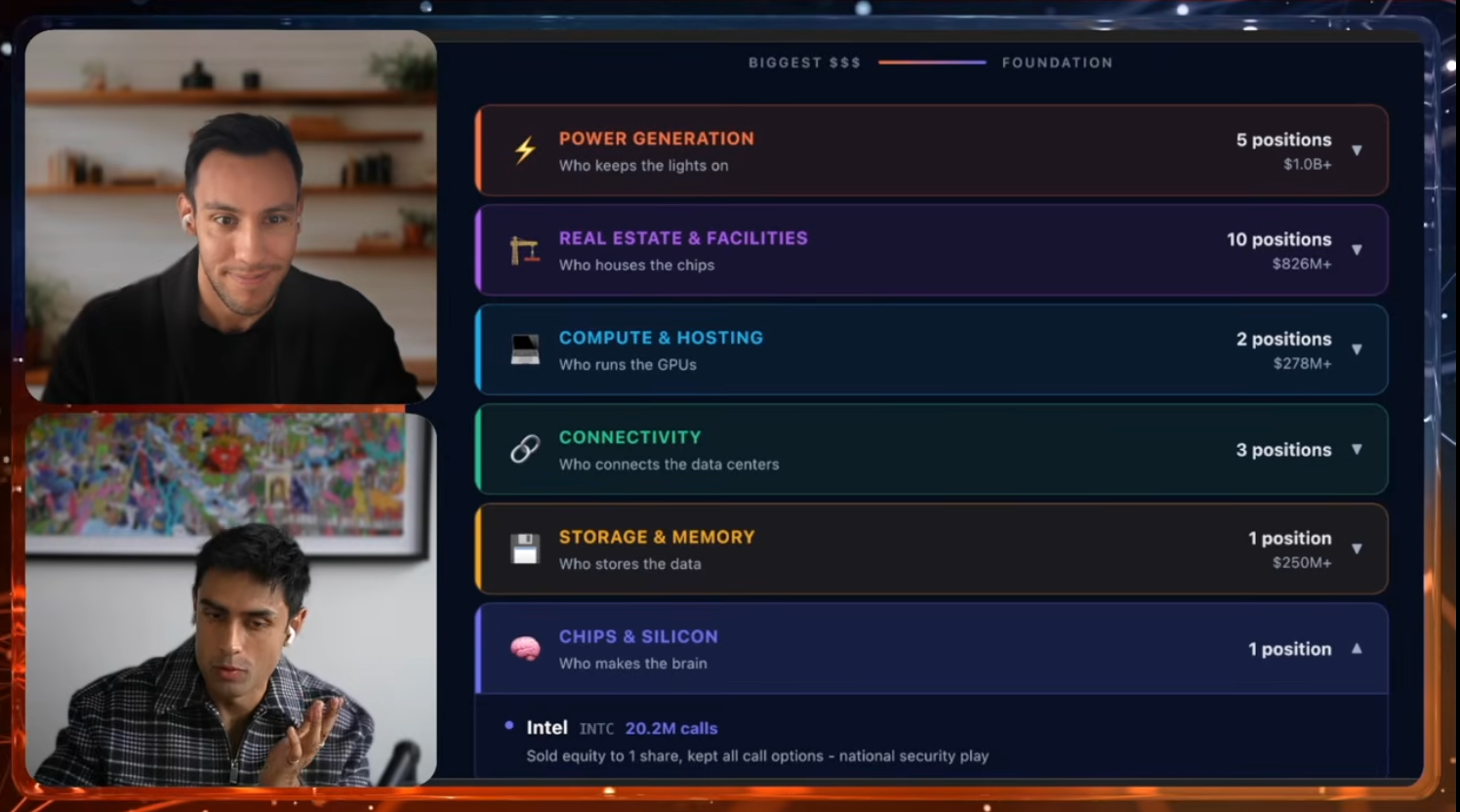
Actually, I want to add something to what I just said. I noticed he did a very clever trade with Intel. He sold off his stock positions but still holds a huge long position. This way, he freed up liquidity to put into other companies. And the main company he poured a lot of money into is in the Power Generation sector, called Bloom Energy. This company was almost unknown about three months ago, but they specialize in making power generation turbines for AI data centers.
He built a massive position in this company, totaling $855 million. It shows $876 million here, but the filing says $855 million.
Bloom Energy: The Power Innovator
Josh Kale:
Bloom Energy is his largest position, making up 20% of his entire portfolio. This is completely unrelated to the chip space, a totally different direction. I looked into their business, and it’s quite interesting.
Bloom Energy developed a device called a solid oxide fuel cell, an advanced technology that generates electricity on-site from natural gas. Normally, when natural gas is delivered to a data center, it needs to be heated and cooled through turbines—a very clunky energy production process. Bloom Energy’s 'fuel boxes' can directly convert natural gas into usable electricity for the data center. It's modular, can be deployed quickly, and doesn't seem to have a supply shortage issue. As far as I know, they plan to produce 2 gigawatts of power this year.
It's a very interesting energy play. I've been looking for the "NVIDIA of energy"—the "chip manufacturer" of the energy world. I haven't found a perfect equivalent yet, but maybe Bloom Energy could become that company.
Ejaaz Ahamadeen:
I also looked into their latest earnings, as they are a public company. Their backlog of demand is $20 billion. Revenue grew about 34% in 2025, and they expect another 40% revenue growth in 2026. Clearly, demand far outstrips supply.
You mentioned solid oxide fuel cells. What makes their gas turbines particularly attractive is that they don't need to rely on the existing power grid. As I mentioned earlier, the current grid is under huge pressure because humans need energy, and AI data centers need energy, leading to higher energy prices in regions hosting AI data centers. If you use a product like Bloom Energy's gas turbine, you don't need to rely on the grid at all. You just install it right next to the AI data center and get low-cost, efficient power for training or inferencing your GPUs and data centers.
Companies like Broadcom and CoreWeave will need this kind of energy, especially the hyperscalers and AI labs. This reminds me of the game Civilization. It's like moving your infrastructure and energy production right into your small settlement to power its growth—what's happening here is very similar to that scenario.
Josh Kale:
It's clear that there isn't a shortage of energy, the problem is who can produce the most of it. They do have a very large order backlog, but the question is, can they manufacture enough to meet it? Manufacturing capacity becomes a key issue here. In many of these investments, we're entering a world of 'atoms,' where manufacturing truly matters. I'd love to dive deeper in the future to see if they can actually scale production. But for now, this is undeniably a very important investment area, making up 20% of his portfolio. So what other notable positions are in his new portfolio?
Ejaaz Ahamadeen:
He also added about $300 million to CoreWeave. Imagine you're an AI lab and you need GPUs. Buying GPUs from a company like


