Agent Economy Infrastructure: A Comprehensive Research on the Web4.0 Landscape


- Core Viewpoint: The essence of Web4.0 is the evolution of AI Agents from human-assistive tools into independent economic participants on the internet. This transformation is hindered because the traditional financial system cannot accommodate machine logic, necessitating reliance on permissionless blockchain infrastructure to provide identity, payment, and rule-enforcement capabilities.
- Key Elements:
- The traditional financial system structurally excludes AI Agents due to issues like identity verification, contract signing, and payment fees, preventing them from becoming independent economic entities.
- Blockchain constructs the three-layer core infrastructure for the Agent economy—identity, payment, and finance—through "wallet as identity," stablecoin micro-payments, and smart contracts.
- The current protocol layer is focused on filling three major gaps: x402 payment, ERC-8004 identity, and MCP tool invocation, to build the minimal protocol stack required for Agent operation.
- The landscape is structured bottom-up across four layers: decentralized compute (e.g., Bittensor), identity/trust (e.g., Oasis ROFL), payment/settlement (e.g., Bank of AI), and vertical applications (e.g., Midaz).
- From an investment perspective, the sector is in a phase of concentrated infrastructure development, where narrative precedes widespread adoption. The battle for underlying standards is still undecided, and application layers capable of turning protocols into commercial closed loops represent the key opportunity for the next phase.
Abstract
The core proposition of Web4.0 is the migration of the execution subject—AI Agents are evolving from human assistants into independent economic participants on the internet. The underlying driver of this shift is the structural exclusion of AI Agents by the existing financial system. Whether it's account opening, contract signing, or micro-payment settlement, traditional financial infrastructure is fundamentally incompatible with the machine-native behavioral logic. Permissionless blockchain networks, however, provide Agents with an alternative path to bypass these limitations—wallet as identity, stablecoin as settlement, and smart contracts as rules.
This report systematically outlines the evolution of Web4.0 from narrative to infrastructure. At the protocol layer, three key gaps are being addressed: the x402 payment standard, the ERC-8004 identity standard, and the MCP tool invocation protocol, collectively forming the minimal viable protocol stack required for Agents to function as independent economic entities. At the sector layer, the report scans representative projects across four tiers from the bottom up:
● Bittensor and io.net provide decentralized computing power supply.
● Oasis ROFL has taken an early lead in integrating TEE at the ERC-8004 verification layer.
● Bank of AI (based on the TRON ecosystem) packages the x402 and 8004 protocols, MCP, Skills, and OpenClaw extensions into a one-stop Agent financial operating system for developers.
● Midaz demonstrates the Skills product paradigm of "Built for Agents, Visualized for Humans" at the application layer.
From an investment perspective, the Web4.0 sector is currently in a window of concentrated infrastructure development: the battle for standards is not yet settled, on-chain real commercial volume is still in the early validation stage, and the narrative overall leads actual implementation. The window for first-mover advantage in underlying infrastructure is narrowing, while vertical application layers capable of transforming protocol capabilities into commercial closed loops will be the most noteworthy opportunities in the next phase.
Keywords: Web4.0, AI Agent, Agentic Economy, Decentralized Infrastructure
1. Introduction: Why Web4.0 is Suddenly Everywhere
Over the past year, the concept of Web4.0 has seen a dramatic increase in frequency within crypto research reports and AI industry gatherings. Alongside the "Lobster Fever" sparked by OpenClaw, the wave of AI Agents has swept the globe, leading more people to realize that the underlying logic of this technological wave is fundamentally different from previous AI booms.
Web4.0 currently lacks a strict definition, but its core proposition is becoming increasingly clear—Web4.0 = Web3.0 + Agent. This means combining blockchain infrastructure with AI Agents to propel AI Agents into becoming the new active subjects of the internet, fundamentally altering the participant structure of the network.
The capital market's response to this thesis has arrived. Dragonfly completed a $650 million new fund raise in February 2026, with partner Haseeb publicly stating, "Crypto wasn't designed for humans; it was designed for AI Agents." Concurrently, key pieces of the infrastructure layer have also fallen into place during this period: In May 2025, Coinbase launched the x402 payment protocol, providing the first standardized channel for machine-native settlement between Agents. In August 2025, the Ethereum Foundation and others spearheaded the proposal of the ERC-8004 identity standard, providing a verifiable trust foundation for cross-organizational Agent collaboration.
Narrative, capital, and infrastructure—these three forces are resonating intensely within the same time window. This is precisely the signal of Web4.0 moving from concept to a tangible sector.
This report will systematically outline the core logic, infrastructure gaps, and sector landscape of Web4.0. It will focus on analyzing representative projects across four tiers: computing power, identity, payment, and application. Using Bank of AI as a case study, it will explore the complete closed-loop path for the Agent economy from protocol to product, providing a reference framework for evaluating investment opportunities in this sector.
2. What is Web4.0: The Core is the Agentic Economy
2.1 From Web1.0 to Web3.0: The Execution Subject Has Always Been Human
Reviewing the three developmental stages of the internet, each leap has expanded the depth of human-network interaction. The Web1.0 era enabled one-way information reading (Read), with users browsing static pages via portals. The Web2.0 era established two-way interaction and content creation (Read/Write), with mobile internet and cloud computing giving rise to social media and the platform economy. The Web3.0 era introduced ownership confirmation of digital assets (Read/Write/Own), where blockchain technology allowed users independent control over on-chain assets for the first time. Despite continuous technological evolution, these three stages share a fundamental premise: the core subject of network interaction has always been human. Whether browsing web pages, publishing content, or signing on-chain transactions, the ultimate decision-maker and executor is a natural person, representing a typical Human-to-Machine (H2M) interaction model.
2.2 Definition of Web4.0: Migration of the Execution Subject to AI Agents
"Web4.0," as the next stage of internet evolution, currently has multiple definitional paths in academia and industry.
● The European Commission released its "Web 4.0 and Virtual Worlds Strategy" in July 2023, defining it as a fusion of AI, the semantic web, and immersive technologies.
● In the crypto-native research context, this concept was first systematically proposed by former OpenAI researcher Sigil Wen and his founded Conway Research around 2026, viewing the combination of AI Agents and decentralized crypto infrastructure as the core feature of Web4, succinctly expressed as:
Web4.0 = Crypto Infrastructure + Intelligent Execution Subject (AI Agent)
Figure 1: Annotations by Sigil Wen on the Web 4.0 Official Website
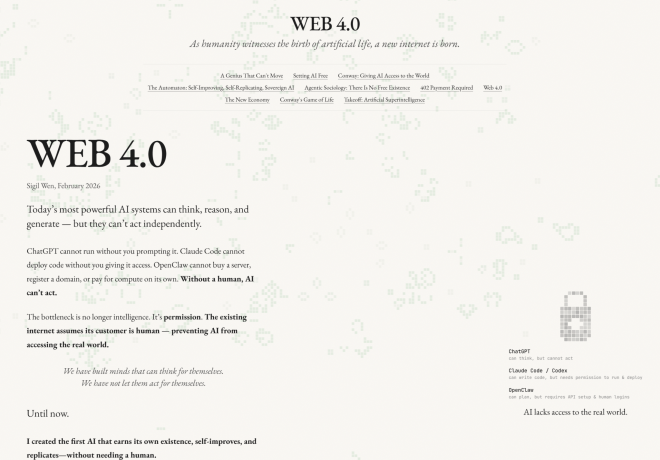
Source: Web4.ai
Within this framework, the network's active subjects will shift massively from humans to autonomously operating AI Agents. Humans will primarily assume the role of intent publishers, while specific execution tasks such as information retrieval, service procurement, cross-chain interaction, and value settlement will be autonomously completed by Agents. This new form, where machines are the primary economic participants, is referred to by the industry as the Agentic Economy. Its interaction model also shifts from H2M (Human-to-Machine) to M2M (Machine-to-Machine) automated commerce.
Table 1: Evolution of Execution Subjects and Infrastructure Across Internet Stages
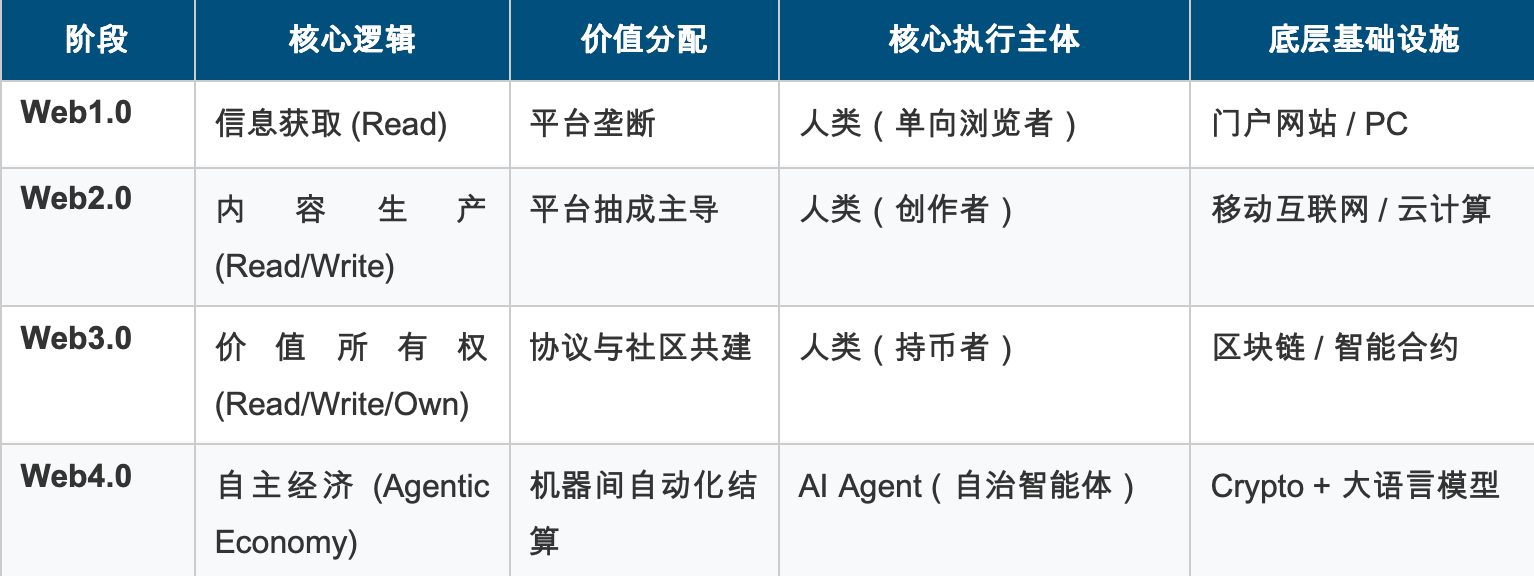
Source: Compiled by PKUBA Research
2.3 Three Core Elements of the Agent Economy
An AI Agent capable of truly participating in economic cycles must possess three core capabilities simultaneously: perception, decision-making, and action. Perception and decision-making capabilities have been preliminarily addressed with the rapid development of large language model (LLM) technology in recent years. However, the capability for action represents the largest current infrastructure gap—the existing financial system is strictly built upon the identities of natural persons or legal entities. AI Agents cannot open accounts at commercial banks or legally apply for credit cards, which directly confines AI to operating only at the information layer.
Table 2: Comparison of the Three Elements of the Agent Economy and Their Maturity
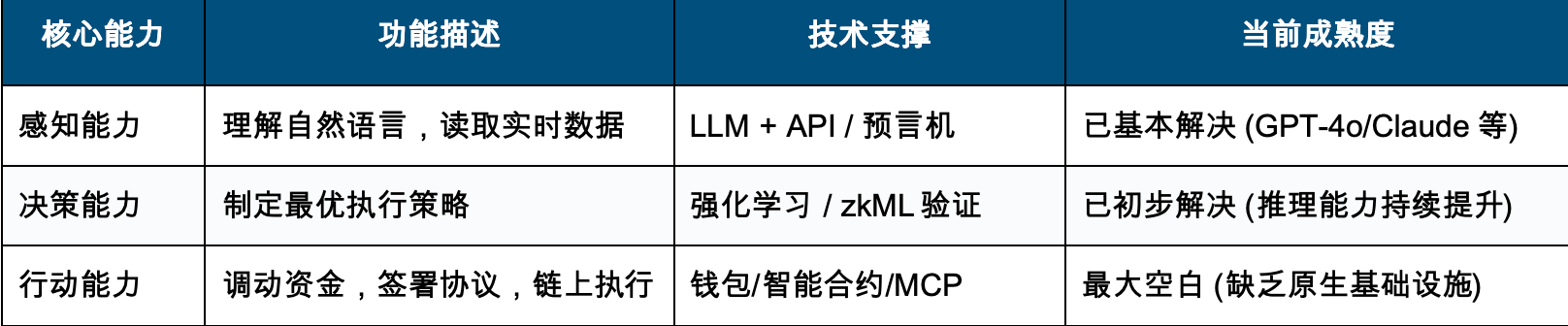
Source: Compiled by PKUBA Research
This reality directly leads to the core proposition of Web4.0: How to build underlying protocols that allow Agents to bypass traditional financial restrictions? The answer points to existing Crypto infrastructure, because only permissionless blockchain networks can provide AI Agents with verifiable digital identities and native automated settlement channels. This is also the fundamental reason why Web4.0 must rely on Crypto infrastructure.
3. Why Web4.0 Needs Crypto
3.1 Structural Exclusion of AI Agents by the Traditional Financial System
The core obstacle to the commercial implementation of AI Agents is not insufficient model capability, but rather the limitation of Agents' "right to act" within the real commercial system. Specifically, the traditional financial system is built upon real-name authentication of natural persons or legal entities: opening an account requires identification documents or business licenses; payment gateways require binding phone numbers and multi-factor authentication. An AI program running in the cloud has neither a legal identity nor the ability to independently sign legally binding contracts. Lacking legitimate fund deployment rights and an independent economic identity, Agents can only serve as "information processing tools" assisting humans, unable to truly act as economic activity subjects.
A deeper mismatch lies in payment granularity. The pricing logic of traditional card networks (taking Stripe as an example: standard rate of 2.9% + $0.30 per transaction) is designed for human consumption scenarios—assuming transaction amounts are sufficiently large and frequency sufficiently low. However, the typical behavior of Agents is恰恰相反: high frequency, micro-amounts, and pay-per-call. A $0.001 API call cannot even cover the fixed handling fee within the credit card system.
Table 3: Payment Characteristics Comparison: Human Users vs. AI Agents
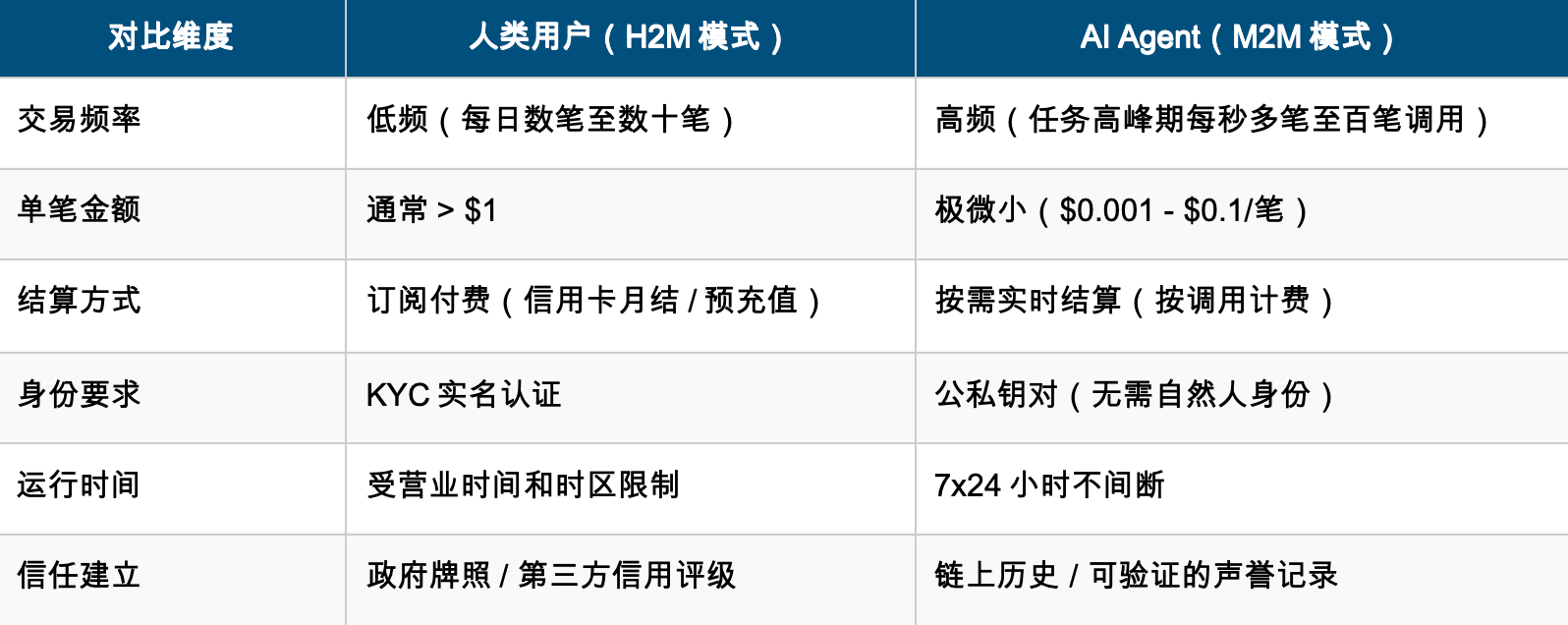
Source: Compiled by PKUBA Research
3.2 The Three Layers of Infrastructure Crypto Provides for Agents
Crypto provides the Agent economy with a bottom-up economic behavior stack—from identity, to payment, to financial services.
First Layer: Identity Layer—Wallet as Identity. In a permissionless blockchain network, generating a digital identity requires no approval from any centralized institution; it only requires local code to generate a public-private key pair in milliseconds. An AI Agent can instantly create an independent wallet address for itself or its derived subtasks, serving as an objective on-chain identity and asset carrier. This layer completely strips away the premise that "financial accounts must be tied to a natural person."
Second Layer: Payment Layer—Programmable Settlement on a Pay-Per-Call Basis. Smart contracts and stablecoins compress fund flows into code logic. Taking the x402 protocol, released by Coinbase in May 2025 and now promoted by Cloudflare, Google, Visa, AWS, Stripe, and others, as an example: it repurposes the long-idle "402 Payment Required" status code in the HTTP protocol, allowing the server to directly return a payment request within an HTTP request. The client (human or Agent) can then obtain the resource by completing an on-chain signature with a stablecoin like USDC. Single transaction fees can be as low as fractions of a cent, with no need for subscriptions, API keys, or pre-funding. This makes micro-payment business models, which traditional payment channels could never economically support, viable for the first time.
Third Layer: Financial Layer—The 7×24 Programmatically Accessible DeFi Network. DeFi is a global, non-stop, standardized-interface protocol network. Modules like DEXs, lending, and yield aggregators can be directly invoked via code. Agents can autonomously perform operations like asset swaps, collateralization, and hedging, treating "financial capabilities" as tools to call, no longer reliant on manual approval or business hours.
These three layers together constitute the essential infrastructure for an Agent to function as an independent economic subject: identity gives it existence, payment gives it action, and DeFi allows it to accumulate and deploy resources.
3.3 The Adaptation Gap in the Existing Web3.0 Ecosystem
However, the fit between Crypto and Agents currently remains more at the underlying protocol layer—the ledger, stablecoins, and smart contracts themselves are Agent-friendly. But the application layer is still designed for human users. Mainstream DApps and wallets rely on graphical interfaces, requiring users to read pop-ups via browser extensions and click to confirm signatures with a mouse. AI models, however, excel at system-level API and structured data interaction and do not inherently possess visual operation capabilities.
This mismatch of "protocol-layer fit, interaction-layer misalignment" is precisely the gap that a new batch of infrastructure projects is attempting to bridge. Machine-native payment protocols like x402, Google's AP2 (Agent Payments Protocol) which integrates with x402, and Anthropic's MCP (Model Context Protocol) with its support for paid resources are all reconstructing Web3.0 from "human-facing" to "simultaneously machine-facing." The true implementation of Web4.0 depends on the completion of this adaptation upgrade.
4. The Three-Layer Infrastructure Gap of Web4.0
For an Agent to autonomously upgrade into an independent economic entity capable of mobilizing funds and signing agreements, a new protocol stack based on M2M business logic must be constructed between the underlying blockchain and the upper-layer AI models. Currently, this protocol stack is in a phase of concentrated construction, with its core gaps divided into three layers: Payment Layer, Identity & Reputation Layer, and Interaction & Tool Invocation Layer.
Table 4: Comparison of Web4.0's Three-Layer Infrastructure Gaps and Evolution
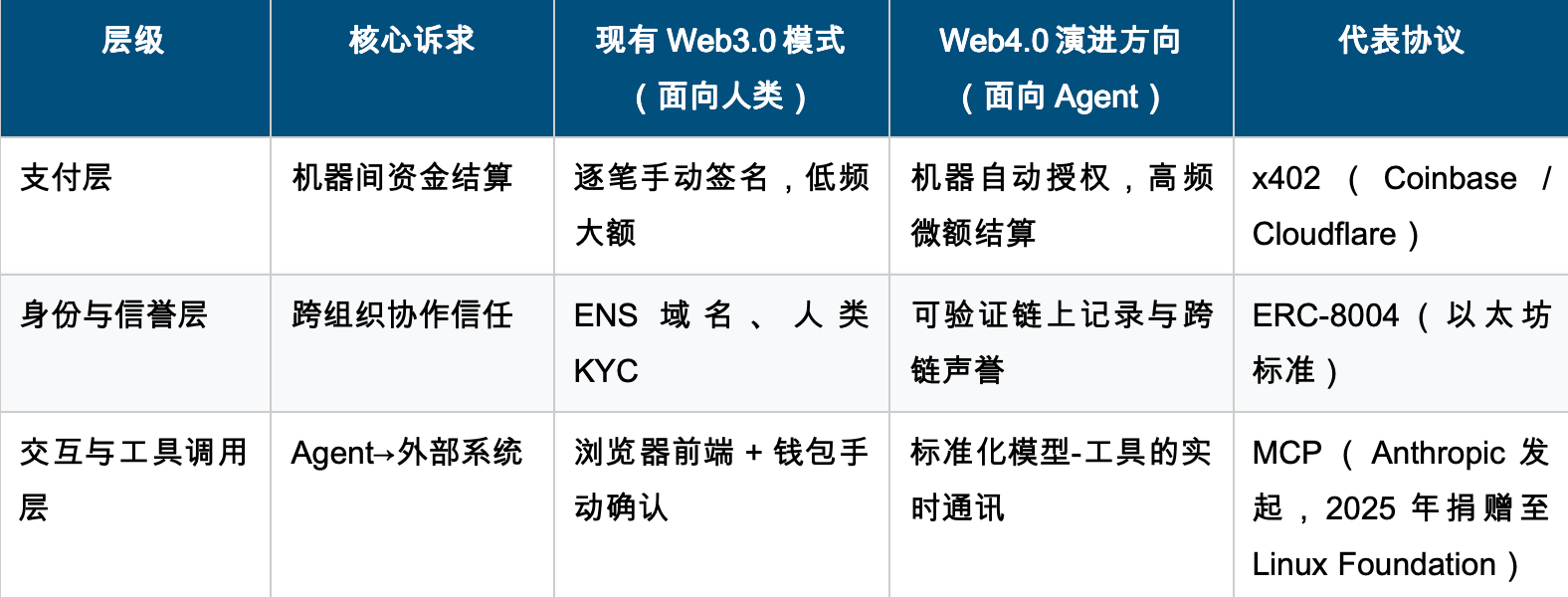
Source: Compiled by PKUBA Research
4.1 Payment Layer Gap: The x402 Protocol
The business pain point addressed by x402 is precisely that traditional payments cannot support Agent micro-commerce. In the Agent economy, the most typical transaction scenario is API calls between machines, with single settlement amounts potentially as low as $0.001 to $0.01. The table below shows the fee rates of traditional payments versus x402, clearly illustrating that due to fixed fees in traditional payment networks, they are essentially unable to provide profitable commercial services in micro-payment scenarios.
Table 5: Cost Comparison of Different Payment Methods in Micro-payment Scenarios
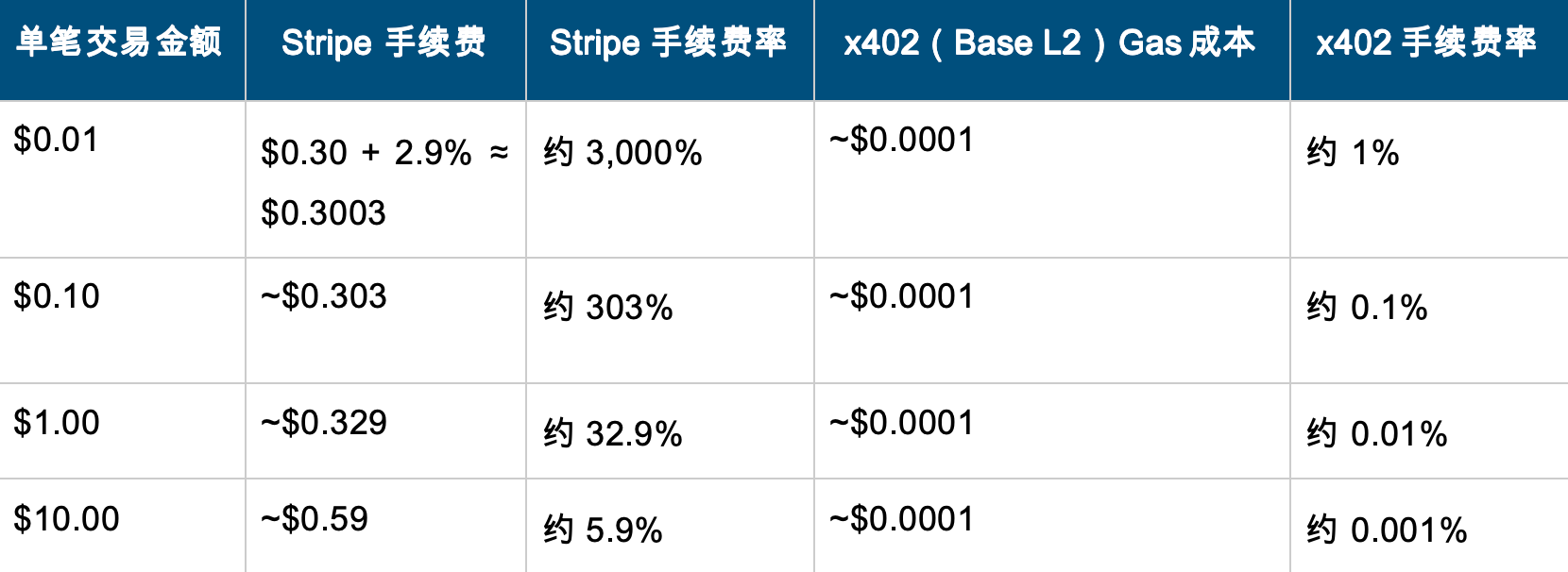
Source: Stripe official standard rates; Base L2 on-chain Gas fee magnitude reference from on-chain explorer public data.
Note: The x402 protocol layer itself has zero fees; the cost in the table is only the underlying network Gas fee. Coinbase's official facilitator provides 1,000 free settlement transactions per month, with a fee of $0.001 per transaction beyond that.
Based on this, x402 utilizes the 402 status code in the HTTP protocol: "402 Payment Required." This protocol code originated from the underlying encoding rules of HTTP in the 1990s. At that time, status codes starting with 4xx indicated client errors, and 402 specifically represented an error due to failed payment (Payment Required).
However, with the proliferation of digital currency as financial infrastructure, on-chain payments provided a new utilization path for the HTTP 402 code. In May 2025, Coinbase officially launched the x402 protocol based on this, transforming it into a functional open payment standard.
Figure 2: Schematic Diagram of Core x402 Workflow Steps
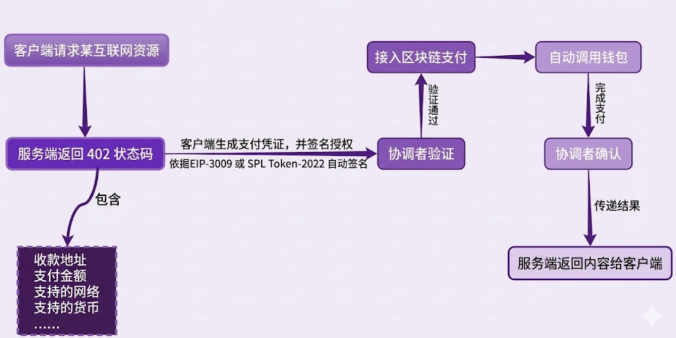
Source: Pharos Research
Regarding ecosystem and adoption, as of early 2026, the x402 protocol has been deployed on multiple mainstream networks including Base, Solana, Polygon (PoS), BNB Chain, and Avalanche.
● Among these, Base has accumulated approximately 119 million transactions and about $35 million in cumulative transaction volume, serving as one of the primary execution environments.
● Solana has repeatedly surpassed Base in daily volume since late 2025. According to official disclosure by the Solana Foundation, Solana contributed about 65% of x402 transaction volume since 2026.
However, actual adoption saw a significant decline in early 2026: According to Artemis on-chain data, after reaching a peak of approximately 3.8 million daily transactions and about $2 million in daily volume in February 2026, x402 activity rapidly declined. The average daily volume in March 2026 was only about $28,000, with an average transaction size of about $0.20. Analysis estimates that about half were self-generated or test transactions rather than real commercial behavior, indicating that genuine demand is still in the early validation stage.
On the governance front, Coinbase and Cloudflare announced the joint launch of the x402 Foundation on September 23, 2025. By April