AI Agent Trading Really Makes Money: Turning 100 U into 200,000 U in 8 Days


- Core View: The AI Agent trading system "Lana" achieves significant returns in the short term by building a trend-following strategy that combines social sentiment, price volatility, and on-chain data. Its core lies in strict stop-loss discipline and a model where a minority of trades contribute the majority of profits.
- Key Elements:
- The system grew its capital from 100 U to 200,000 U in 8 days. Its strategy does not predict the market but focuses on following established trending movements.
- The token selection logic has three layers: capturing social sentiment heat from Binance Square; filtering tokens showing volatility on the gainers list; observing changes in open interest to gauge capital positioning.
- It employs dynamic risk management, starting with a 20% stop-loss, later optimized to a fixed loss of about 200 U per trade, but adjusts based on token characteristics (e.g., new listings).
- The profit model does not rely on winning every trade. Instead, it strictly stops losses on most trades, with a few tokens (e.g., ORDI, RAVE) contributing the vast majority of profits.
- The system was trained by feeding it data from Hyperliquid smart wallets and basic contract metrics, undergoing continuous conversational correction and behavioral distillation to mimic a human decision-making framework.
Recently, the AI Agent trading system "Lana" has gone viral, turning 100 USDT into 200,000 USDT in just 8 days. As of April 16th, the account's total balance exceeded 250,000 USDT.
According to its creator, Lana (@lanaaielsa), the reason for building this trading system was simple.
During the BSC bull market in October last year, a friend of his invested 100,000 USDT chasing get-rich-quick narratives, only to lose almost everything in a market pullback. The remaining 10,000 USDT was moved on-chain to continue trading and was also completely lost, leading to their exit from the market. Recently, with the resurgence of altcoin discussions, he judged that a new round of market making (MM) conditions might be emerging. Being unfamiliar with secondary market trading and candlestick analysis himself, he chose to leverage AI to build a trading system: using Claude to write scripts that scrape high-engagement posts and frequently discussed tokens from Binance Square, and then combine them with gainers lists to filter volatile assets for trading. The system initially used a 20% stop-loss, later optimized to a fixed loss of approximately 200 USDT per trade, and only followed trends in one direction. Simultaneously, Lana is also responsible for posting live trading records on Binance Square, generating profit screenshots, and managing the account.
Sounds simple, right? But upon closer inspection, Lana is not just a simple automated order script; it's an operating system with its own trading logic.
How does Lana trade and achieve profits?
1. Rigorous Asset Selection Logic
Judging from the trading records, Lana does not predict market trends but only follows them, meaning it focuses on trend-following and capturing tokens that have already started moving. Assets involved include: Binance Life, RAVE, ORDI, BASED, TRUMP, SIREN, 1000SATS, 1000RATS, EIGEN, PIXEL, EDGE, BAN, ASTER, AIA, FIGHT, GENIUS, CL, BTC, GIGGLE, HYPE, BLESS, PUMP, HEMI, CFX.
The filtering criteria can be roughly divided into three layers:
First, the Sentiment Layer: Lana scrapes the number of posts, discussion frequency, and sentiment direction on Binance Square to find tokens repeatedly mentioned within a short timeframe.
Second, the Price Layer: Only when tokens filtered by the sentiment layer also appear on the gainers list and show significant price movement does further filtering trigger, indicating a higher probability of a trending market.
Finally, by observing OI (Open Interest) changes, it filters for tokens where "OI is increasing but the price hasn't fully reacted yet," used to judge if there is capital positioning early.
2. Clear Stop-Loss Standards
In the early stages of Lana's operation, a fixed 20% stop-loss was used, later optimized to a "fixed loss amount," meaning regardless of position size, the maximum loss per trade is controlled at around 200 USDT.
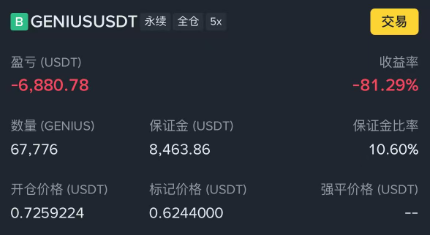
From historical trading records, most losses fall within this range. However, there are trades that exceeded the stop-loss standard. For example, GENIUS once had an unrealized loss exceeding 6,880 USDT but was not closed. Lana personally explained: "Because GENIUS is a new token, new tokens have higher volatility, so a wider stop-loss is set. Early positions with leverage were typically 500 USDT corresponding to a 200 USDT stop-loss. Later, when position sizes increased to 10k or 25k, the corresponding stop-loss amount became higher."
3. Dynamic Take-Profit Standards
Unlike stop-losses, this system does not set fixed take-profit points. It primarily decides whether to continue holding through periodic reassessments, for example, re-evaluating the probability of the current asset rising or falling at regular intervals. It can be understood as continuously asking one question: If I didn't have a position now, would I still buy it?
From historical trading data, the vast majority of profits are concentrated in a few tokens, such as "Binance Life," "RAVE," "ORDI," etc., while most other trades end with small losses or small gains.
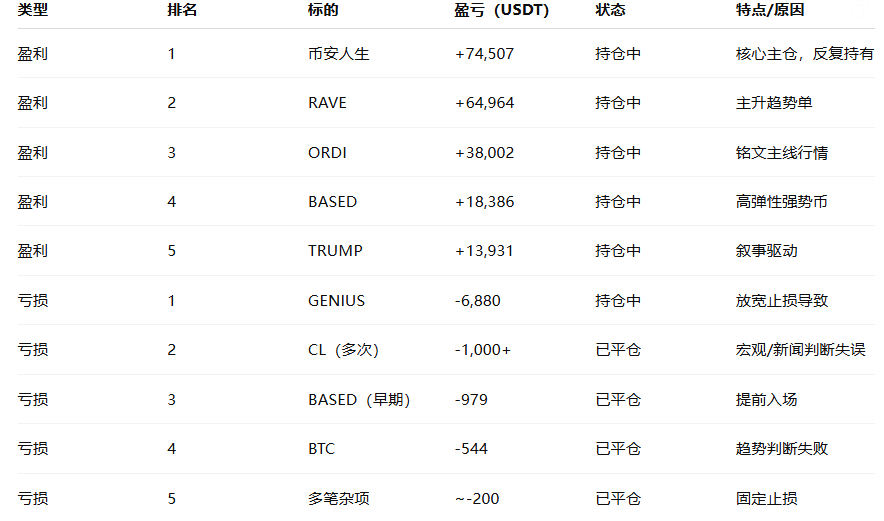
Notice? Lana doesn't make money on every trade; it relies on a few trades making huge profits, while strictly stopping losses on the majority of trades.
How was Lana trained? Is the methodology replicable?
1. Data Feeding Sets the Tone
The initial strategic prototype of this system came from Lana's observation of the behavior of some wallets on Hyperliquid that maintained long-term stable profitability. They mostly traded in only one direction, not frequently switching between long and short. Therefore, one of the most important data sets fed to the AI was the trading behavior of 'smart wallets' on Hyperliquid, allowing the AI to systematically learn how to make money through trading. Basic contract metrics and some on-chain data were also fed to the AI, enabling it to form its own framework by understanding these wallets' operations.
Of course, besides on-chain behavioral data, the system continuously scrapes sentiment and market data as supplements:
- Discussion density and trending content on Binance Square;
- Gainers lists and price volatility;
- Basic contract metrics like OI changes.
2. Dialogue Refinement Establishes the Framework
After the AI learns basic operational techniques, the next step isn't about acquiring more information, but about how to filter and constrain this information, i.e., establishing a clear decision-making framework for the AI.
Judging from its usage, the system's judgment logic wasn't set in one go; it was more likely gradually shaped through continuous operation and feedback. Initially, the AI might make judgments based on single signals, such as mistaking short-term hype for a trend signal or frequently switching directions. But with deeper usage, these deviations were gradually corrected, focusing its decisions more within the range expected by the strategy.
3. Behavioral Distillation Defines the Trading Style
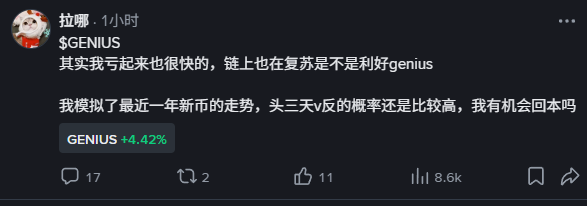
After completing data input and establishing the decision-making framework, the system didn't stop at the level of "standardized judgment." It further introduced distillation of individual behavior. The operator fed the system their own and other X bloggers' tweet content, enabling the AI to learn specific modes of expression. This made the AI less of a cold trading machine, at least appearing more humanized in its expression.
If we break down the entire process, it's more like "creating a person."
From the initial data feeding to build the skeleton, allowing it to understand what's happening in the market; to forming the structure through continuous correction and constraints, giving it stable judgment boundaries; to behavioral distillation filling in the details, allowing it to gradually possess decision-making paths and preferences closer to a human's.
The final result is not just an execution tool, but a "Lana" capable of making consistent choices in a complex market.
It doesn't rely on emotion, nor does it seek to predict. Instead, it uses a repeatedly verified method to participate in the market and amplify results.