






Anthropic's one trillion vs. DeepSeek's 10 billion


- Core View: By comparing the financing paths of Anthropic and DeepSeek, the article reveals the fundamental differences between top AI companies in China and the US in terms of development models, capital dependence, and future visions, reflecting two distinct development logics and power structures within the global AI industry.
- Key Elements:
- Anthropic's Capital Feast and Growth Pressure: Its implied secondary market valuation briefly surpassed $1 trillion, with annualized revenue skyrocketing from $9 billion to $30 billion, yet profitability is not expected until 2027, facing the cyclical pressure of balancing growth and profit.
- DeepSeek's Independent Stance and Strategic Shift: Founder Liang Wenfeng, citing chip constraints and decision-making independence, rejected external funding for three years. A recent plan for its first funding round targets a valuation exceeding $10 billion, marking a shift from pure research to commercial exploration.
- Dramatic Reversal in Market Landscape: According to Ramp data, Anthropic captured 73% of new enterprise AI spending in March 2026, far surpassing OpenAI's 27%, with its enterprise product Claude Code being the core driver.
- Geopolitical and Ideological Bets Behind Capital: Anthropic's investors (e.g., sovereign wealth funds, Wall Street giants) are betting on US-led "safe and trustworthy" AI; DeepSeek's potential investors are betting on China's technological autonomy and open-source ecosystem.
- Divergent Philosophies: Closed vs. Open Source: Anthropic remains fully closed-source, selling a "trust premium"; DeepSeek advocates for open-source culture, ceding definition power to the community, embodying two different propositions for the future governance of AI.
- Shared Core Challenge: Both companies face the long-term test of justifying their massive valuations to capital markets, with different paths but an uncertain final outcome.
Original Author: Lin Wanwan
On April 17, 2026, the AI fundraising circle was buzzing with excitement again.
A screenshot went viral among investors: Anthropic's implied valuation had quietly crossed a line on secondary market and derivatives platforms like Caplight and Ventuals: $1 trillion.
Briefly, but truly, surpassing OpenAI.
No official announcement, no press release, no statement from CEO Dario Amodei. Just the Pre-IPO market voting with its wallet.
Investors got excited looking at the revenue curve. Anthropic's annualized revenue surged from $9 billion at the end of 2025 to $30 billion. Four months, 233%. Then they started spreading the word: the AI crown has changed hands.
Let's be clear about one thing. Anthropic's latest official post-money valuation was $380 billion after its Series G round in February 2026. Several VCs have since offered valuations of $800 billion or higher, but Anthropic hasn't accepted them.
That $1 trillion figure is the implied number on secondary market platforms.
Almost on the same day, another piece of news emerged from Hangzhou.
DeepSeek is planning its first external fundraising since its inception, targeting a valuation exceeding $10 billion and aiming to raise at least $300 million. The first time in three years.
One is being force-fed capital, chased all the way to the trillion-dollar doorstep. The other has kept capital at bay for three years, then chose a moment it deemed right to crack the door open just a sliver.
Reading these two pieces of news together reveals the same underlying story: this spring, the two most important AI companies from two different nations have reached the boundaries of their respective paths.
Anthropic's List of Alignments
First, Anthropic.
On February 13, 2026, Anthropic completed its Series G funding round, raising a total of $30 billion at a post-money valuation of $380 billion. The lead investors were Singapore's sovereign wealth fund GIC and hedge fund Coatue. Co-investors included Blackstone, Goldman Sachs, J.P. Morgan, Qatar Investment Authority, Temasek. Nvidia committed up to $10 billion, and Microsoft up to $5 billion.
Read that list aloud: Singapore sovereign fund, Qatar sovereign fund, America's largest investment banks, Nvidia, Microsoft.
This is a list of alignments. Global capital is voting with real money: AI's voice should remain in the United States, in the hands of this company.
Two months later, the report card arrived.
According to data from corporate spend management platform Ramp, in March 2026, a staggering 73% of new funds from enterprises making their first AI service purchase flowed to Anthropic. OpenAI's share dropped to 27%. Just 10 weeks prior, the split was an even 50:50.
The core weapon is Claude Code, with annualized revenue exceeding $2.5 billion, more than doubling since early 2026, and enterprise subscription users quadrupling.
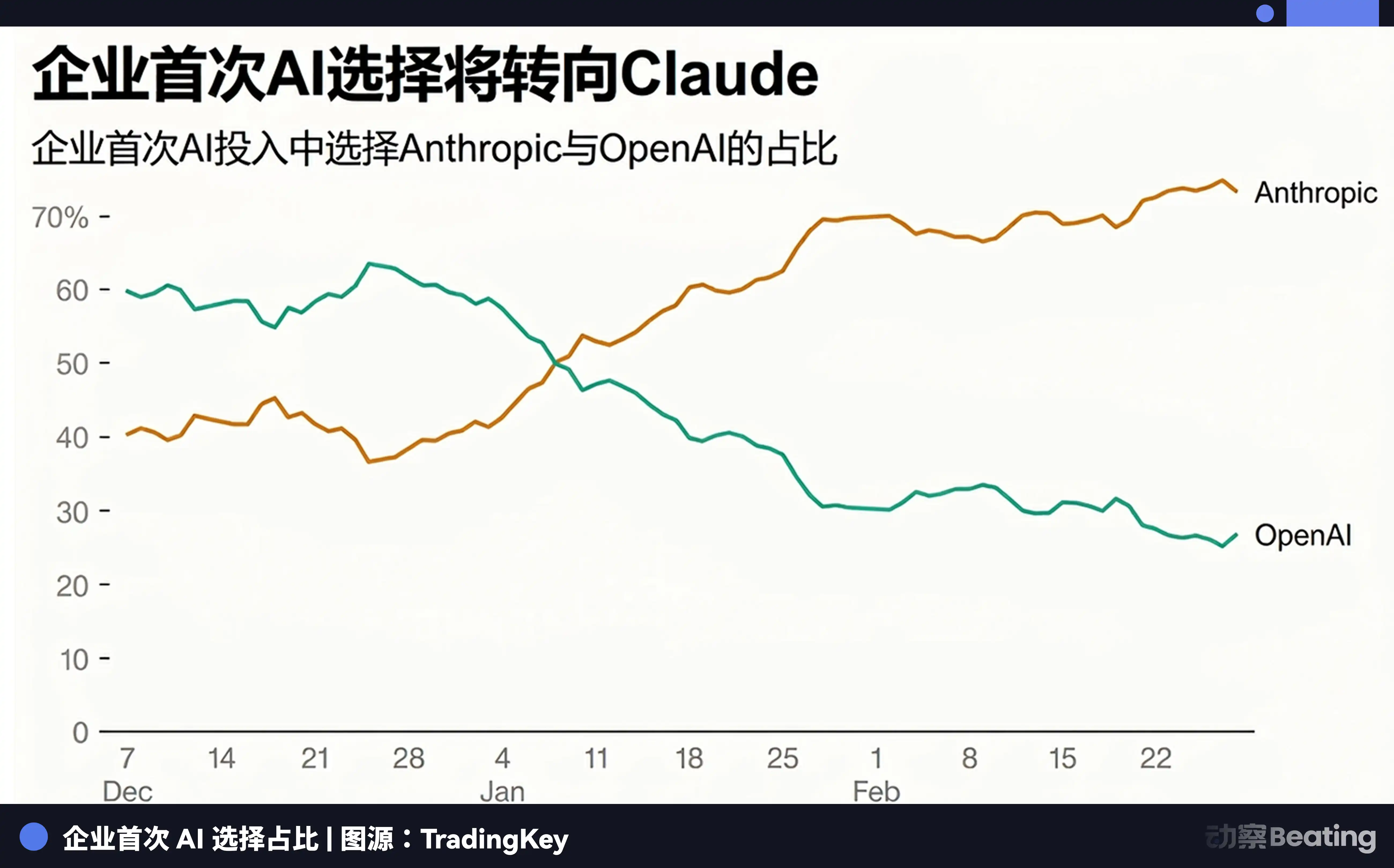
This reversal can be understood this way. OpenAI is building a consumer-facing Disneyland, charging admission based on foot traffic. Anthropic is building a toll road into the core systems of enterprises. The toll is much more expensive than a ticket, and once a vehicle is on that road, it's not easy to switch lanes.
Just days after Anthropic announced its overtaking, an internal memo written by OpenAI's Chief Revenue Officer, Denise Dresser, was leaked, accusing Anthropic of inflating revenue by approximately $8 billion using "gross accounting methods."
When customers purchase services through platforms like AWS or Google Cloud, Anthropic reportedly books the entire amount paid by the customer as revenue, including the portion that must be shared with the cloud service provider. Excluding this portion, Anthropic's true revenue is around $22 billion, not exceeding OpenAI's $25 billion.
The wording of this document reads more like two former colleagues airing each other's dirty laundry.
Understanding this memo requires context. Anthropic's private market valuation is around $600 billion, a significant premium over its last funding round. Meanwhile, OpenAI's secondary market valuation is about $765 billion, a roughly 10% discount from its last round. The former employer is starting to feel pressure in the capital markets. Issuing this document serves both to attack the competitor and to steady its own ranks.
Then there's that discordant number amidst the celebratory noise. Anthropic is not expected to be profitable until 2027. $30 billion in annualized revenue, a $380 billion valuation, each funding round setting new records, yet profitability is still a distant prospect. The higher the valuation, the greater investor expectations, the faster the cash burn, and the more urgent the next funding round becomes. Anthropic cannot actively break this cycle; it can only sustain it by running fast enough. This is its invisible wall.
And DeepSeek? It Left the Entire Investment World Waiting for Three Years
Now, Liang Wenfeng.
After R1 exploded in popularity, the entire Chinese investment scene was thrown into disarray. Zhu Xiaohu, the one who had just said he "wasn't optimistic about startups doing large models," publicly stated that price wasn't too important anymore; the key was to be involved. Tencent executives visited. Alibaba executives visited. Various VCs took turns knocking on the door.
Rumors of Alibaba investing $1 billion surfaced. Rumors of a $700 million Series C surfaced. One after another, each one subsequently denied.
And just like that, Liang Wenfeng left the entire investment world waiting outside his door. For three years.
His reason was one sentence: "There are no short-term financing plans. The problem we face has never been money; it's the embargo on high-end chips."
Huanfang Quant provided DeepSeek with its initial R&D funding of 3 billion RMB, entirely supported by the profits of the quantitative hedge fund. He truly wasn't short on money. He was short on chips, and financing couldn't solve the chip problem.
As for why he wouldn't accept investment, he had another concern: external investors coming in might interfere with company decisions.
Reading Liang Wenfeng's background, one senses a consistent thread. Born in 1985 in Zhanjiang, Guangdong, he studied at Zhejiang University's School of Information and Electronic Engineering. After graduation, instead of finding a job, he went straight into quantitative investing. He founded Huanfang Quant in 2015. In 2019, he invested nearly 200 million RMB of his own money to build the computing cluster "Firefly One," equipped with 1,100 GPUs.
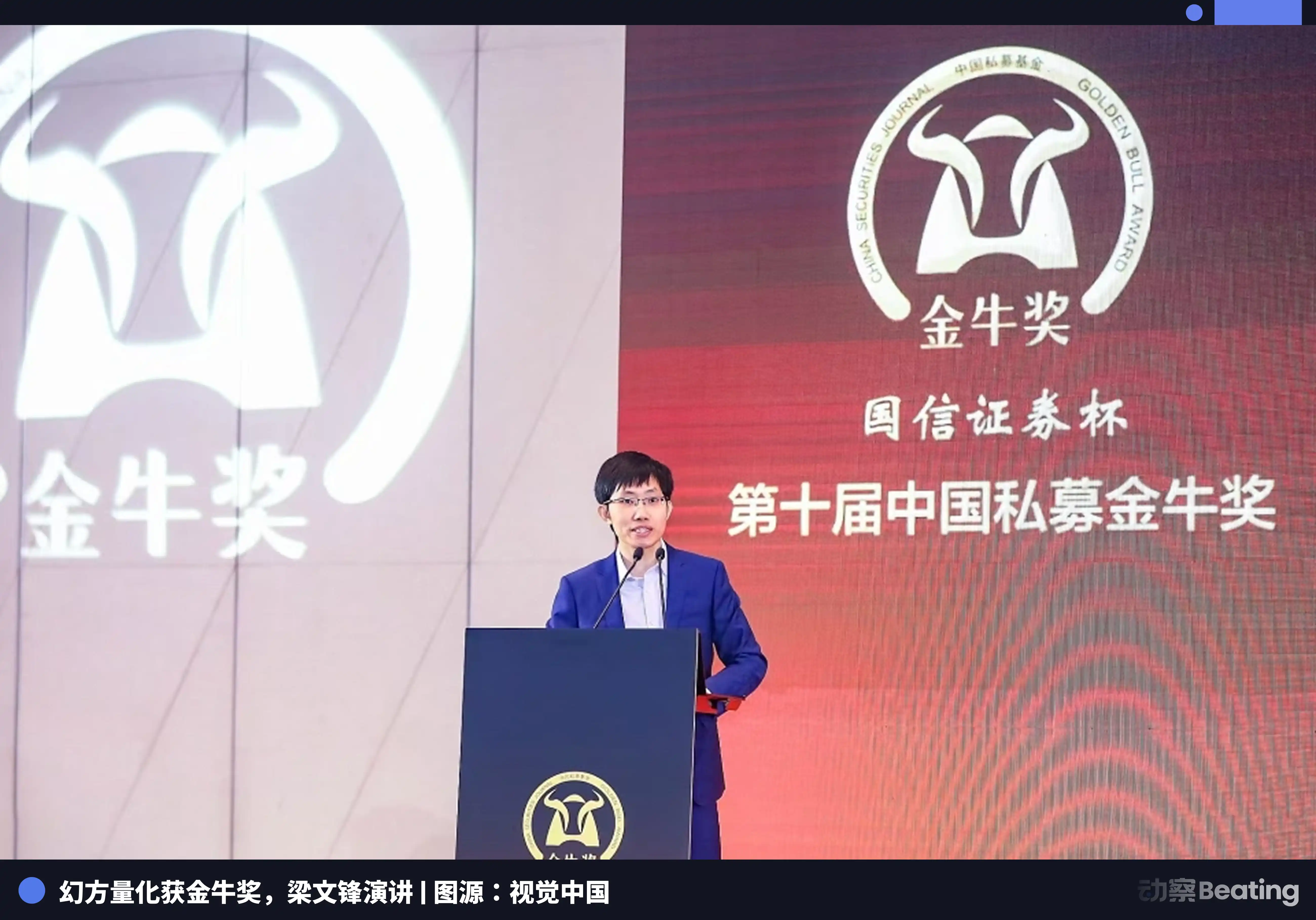
As soon as the A100 launched, he beat many enterprises to become one of the first in the Asia-Pacific region to get the chips. In 2021, he invested another 1 billion RMB to build "Firefly Two," equipped with about ten thousand A100s. In 2023, he redirected that computing power towards building large models and founded DeepSeek.
In everything he does, there's an engineer's style of pre-judgment: prepare the tools first, then get to work. Refusing financing was one of his tools.
But now, that tool is starting to fail.
DeepSeek's absolute salary figures are not low, but they cannot match the equity incentives and valuation premiums offered by market giants like ByteDance, Alibaba, and Tencent. Liang Wenfeng has begun pushing for company valuation work, clarifying option pricing to give the team more certainty.
Without external financing, there is no market-based valuation. Without market-based valuation, there is no option value. For a top engineer, working at DeepSeek might mean you're changing the world, but you can't produce a share certificate that calculates your wealth.
In January 2026, Zhipu rang the bell on the Hong Kong Stock Exchange. MiniMax followed closely with its own IPO. Options at peers were being cashed out. The talent pressure on DeepSeek was becoming increasingly real.
Another issue was being forced to the surface: DeepSeek and Huanfang's executives were still discussing whether the company should shift from being "primarily focused on research" to "building a business that generates substantial revenue and eventually profits." The discussion itself is a crack in the door.
This first fundraising targets a valuation exceeding $10 billion, while the company's valuation in 2025 was approximately $3.4 billion. If the fundraising is completed, the valuation will achieve a several-fold leap. $300 million against a $10 billion valuation represents a dilution of less than 3%. This number is extremely restrained, like someone placing a hand on the doorknob to feel the temperature before opening, confirming no danger, then gently pushing it open.
Liang Wenfeng used three years of independence to win himself the greatest bargaining chip. He opened the door at the moment he felt most confident.
Two Civilizations at the AI Table
Putting these two stories together, a hidden thread emerges.
Anthropic's Series G investors: Singapore's GIC, Qatar Investment Authority, Blackstone, Goldman Sachs, Nvidia, Microsoft.
Behind this list lies a complete logic: AI's voice should remain in the United States; "safe, trustworthy" AI is the next infrastructure. Every dollar invested is betting on this judgment.
DeepSeek's first fundraising, with potential investors including Alibaba, state-owned funds, and other leading domestic institutions, marks the first time Chinese capital has publicly priced a top-tier AI research institution. It's betting on another logic: technological autonomy, open-source ecosystems, domestic computing power.
Two lists, placed on the same table, represent two civilizations making their respective bets.
Closed-source and open-source are also choices between two power structures in this game.
Anthropic is fully closed-source, relying on enterprise trust premium. Its monthly active users generate $211 in revenue. What it sells, besides model capability, is a sense of assurance backed by experts. You don't need to understand it; you just need to trust it.
Liang Wenfeng says open-source is "more of a cultural act than a commercial one; contributing to open-source earns us respect." The former concentrates the definition of "what is good AI" in the hands of a few. The latter hands it over to global developers for discussion.
These are two political propositions about the future of AI.
But both companies face the same core question: When you grow large enough, what do you use to prove you're worth that price?
Anthropic's answer is revenue growth and enterprise clients, but profitability waits until 2027, with the former employer constantly nitpicking on the sidelines. DeepSeek's answer is still taking shape.
Epilogue
This race still has no referee.
Anthropic's valuation is racing towards a trillion, with profitability likely waiting until 2027. How long are the world's most astute sovereign funds and top investment banks willing to wait? AI's history is short enough that no one has seen how a company of this scale makes a soft landing, nor how it crashes hard. Everyone is groping in the dark, just in different postures.
DeepSeek's problem is the cost of choice. After financing, external shareholders come in. How long can Liang Wenfeng protect the independence he has guarded so fiercely? Once the door is opened, no founder in the world has been able to fully control what comes through it.
Dario Amodei positions himself as "an explorer finding a third path between the two narrow roads accelerating towards heaven and plummeting towards hell." Those close to Liang Wenfeng say AGI is his ultimate goal; money and commercialization are lower priorities.
Two individuals, each believing they are doing something more important than fundraising.
The capital market doesn't believe in faith; it only believes in the income statement.
Three years from now, or five, when we revisit this bill: Did the company whose valuation once raced towards a trillion prove it was worth that price? Did the company that used three years of independence to earn respect, then decided to take its first step, hold onto its original intent?
Both paths remain unfinished.


