






The "Practicality" of Blockchain is Accelerating Its Implementation


- Core View: The South Korean government's pilot of blockchain-based deposit tokens for fiscal payments marks the "practicality" of blockchain technology being embraced by mainstream systems. This trend will have a long-term impact on the market valuation of blockchain assets with real-world application scenarios.
- Key Elements:
- The South Korean government will pilot the use of blockchain deposit tokens for paying business advancement fees in Q4 2026, aiming to enhance fund transparency and prevent misuse.
- This deposit token is pegged 1:1 to fiat currency and adopts a non-intermediary payment structure, which is expected to exempt small merchants from credit card fees, achieving substantial cost reduction.
- This move is a real-world case of a sovereign state embedding blockchain technology into its core fiscal system, indicating its practicality is moving from the periphery to the center.
- In the long term, such fundamental changes will prompt the market to re-evaluate the value of blockchain projects capable of interacting with the real world.
- For traders, the short-term impact of such news is difficult to trade directly, but it provides a crucial framework for observing the industry's long-term development.
Blockchain's "Practicality" is Accelerating Its Real-World Adoption
On April 16, South Korea's Ministry of Economy and Finance announced a seemingly low-key but potentially far-reaching piece of news: starting from the fourth quarter of this year, government departments in Sejong City will pilot the use of blockchain-based deposit tokens to disburse and pay business promotion fees, replacing the current government procurement card system.
It sounds like a technical administrative reform. But breaking it down, its significance may be much greater than it appears on the surface.
First, this is not "cryptocurrency payment," but deposit tokens—a type of blockchain-issued digital certificate pegged 1:1 to fiat currency. Technologically similar to stablecoins, their issuer is a government-authorized institution, and their use cases are strictly limited: they can only be used within predefined industry sectors and during specified time periods. The purpose of this design is clear: to enhance the transparency of fund usage and prevent misappropriation and abuse. Every payment is recorded on-chain, immutable and traceable.
Second, it attempts to solve a long-standing problem plaguing small merchants: credit card processing fees. Under the current government procurement card model, merchants must pay a certain percentage in fees to card networks. The blockchain-based deposit token system employs a non-intermediary payment structure, which in theory can significantly reduce or even eliminate these fees. For small businesses operating on thin margins, this could represent tangible relief.
More importantly, this is a real-world case of a sovereign government embedding blockchain technology into its fiscal payment system. It's not a proof-of-concept, not a whitepaper, but a pilot project scheduled to launch in Q4 2026. If successful, South Korea plans to gradually expand its scope of application. This means blockchain is no longer just a niche interest for the "crypto crowd"; it is being adopted by mainstream fiscal systems as a more efficient and transparent tool.
Placed within the context of the crypto market, this news points to a longer-term trend: the "practicality" of blockchain is moving from the periphery to the center.
Over the past few years, market pricing for cryptocurrencies has largely focused on "speculative value"—price increases driven by strong narratives, and declines by tight liquidity. However, the South Korean case suggests another narrative: when governments, corporations, and institutions begin seriously using blockchain technology to solve real-world problems, the industry's fundamentals undergo a slow but irreversible shift.
Of course, this change won't be reflected on price charts overnight. But it will influence the market's judgment on "what constitutes truly valuable assets." Blockchain projects that can connect to real-world application scenarios may gain more stable support over a longer time horizon.
For the average trader, this shift in "fundamental narrative" is often difficult to trade directly. You wouldn't heavily invest in a particular coin simply because "the South Korean government is using tokens to disburse funds"—the impact of such an event is indirect, long-term, and hard to quantify. What you can do, however, is use lighter tools to test the market's reaction when such news emerges.
This is precisely the applicable scenario for MGBX's Event Contracts.
The design of Event Contracts is simple: choose "Up" or "Down" within a specified period. Settlement is automatic upon expiry, with potential profit or loss known at the time of order placement. It doesn't require you to study funding rates, worry about liquidation, or monitor positions to top up margin. You only need one judgment—for example, "The South Korean government adopting blockchain payments is sentimentally positive for the crypto market and may drive up related sectors in the short term"—and then quickly express that judgment. If correct, you take the profit; if wrong, you lose a fixed cost, and you can start fresh with the next contract.
It doesn't guarantee you'll make money, but it allows you the opportunity to participate in market pricing with the lowest friction cost in the immediate aftermath of new information.
As for the Echo points system, let's explain it differently this time.
You can think of it as a "behavior archiver." Every trade you make on MGBX, every invitation you send, every verification action you complete is automatically archived and then converted into a digital certificate called xMGBX. This certificate doesn't care whether you made a profit or loss on that specific trade; it does one thing: records the traces of your participation and finds opportunities to turn those traces into tangible things—like an airdrop allocation for a new project, or a small piece of a future platform token.
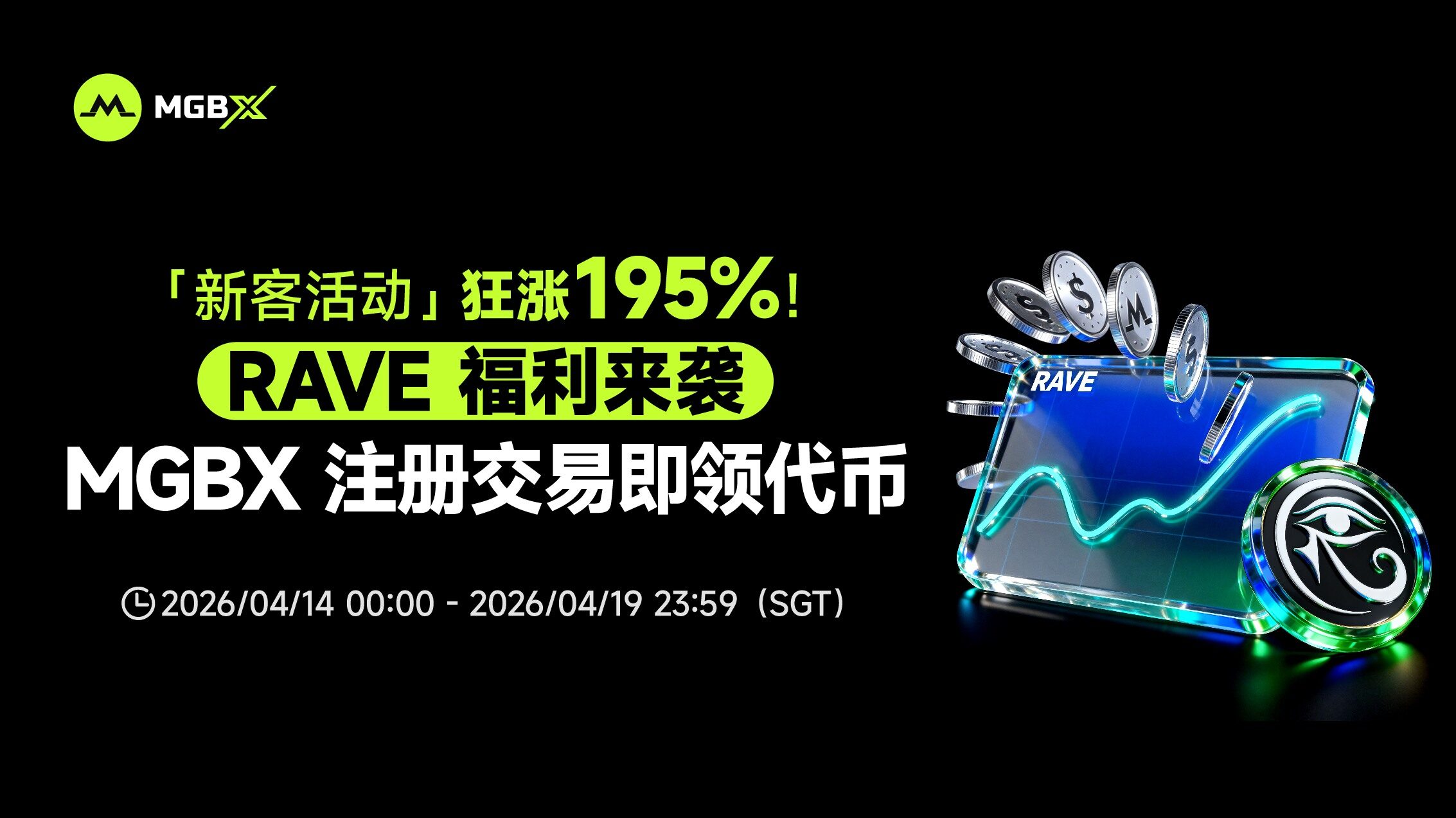
Meanwhile, MGBX's ongoing RAVE New User Campaign (April 14-19) provides a short-term entry point: new users who complete registration, KYC, and corresponding trading volume tasks can receive RAVE token rewards. RAVE itself has experienced significant volatility over the past week, and such high-profile tokens are often more sensitive to macro news (like the South Korean government adopting blockchain) and exhibit stronger volatility.
Returning to that news from South Korea.
A sovereign nation starting to use blockchain tokens to pay government expenses won't cause Bitcoin to skyrocket instantly. But it is a signal: blockchain technology is being taken seriously by mainstream systems. For traders, the value of such a signal lies not in "immediately going long," but in providing a long-term observation framework. Within this framework, blockchain assets that can generate real-world interaction may be repriced at some future point in time.
And before this "repricing" arrives, what you need is not prediction, but a set of tools that can be used repeatedly for low-cost trial and error.
MGBX's Event Contracts, the Echo points system—they aren't meant to help you "catch every opportunity," but to provide you with more convenient ways to participate when you decide to do so.
👉 Go to the official website to download MGBX: https://mgbx.com/
Company: MGBX
Email: business@mgbx.com
Official Business Contact: @MGBXVIP
This article does not constitute investment advice. Digital asset trading involves high risk. Please make rational judgments and prudent decisions.


