






Where Opportunities Hide Amid Unclear Trends


- Core View: The current cryptocurrency market is in a high-level consolidation phase, driven by a complex interplay of macro, geopolitical, and capital factors. The core challenge for trading has shifted from directional prediction to the management of risk, tools, and discipline.
- Key Elements:
- The market is jointly driven by three main themes: macroeconomics, geopolitics, and capital flows. Events like the US-Iran ceasefire affect risk appetite, leading to the repricing of capital across various asset classes.
- Rumors of a "Bitcoin-denominated transit fee" connect crypto assets to real-world energy flows, expanding the narrative space while also increasing price volatility uncertainty.
- The greatest current trading risk is being distracted by short-term noise. Focus should be on core signals like trend structure, key price levels, and trading volume, coupled with sound position management.
- Tools like event contracts can transform market events into probabilistic trades, suitable for high-volatility periods, but their use must be predicated on strict risk control and discipline.
- The core of trading capability lies in risk management and execution discipline, not market prediction. Corresponding strategies must be adopted for different market phases (trending, ranging, event-driven).
Over the past week, Bitcoin's rally has been stronger than many anticipated. Amidst continuous influences from geopolitical and macroeconomic news, its price has steadily climbed, breaking through key resistance levels and subsequently consolidating at higher ranges. Major assets like Ethereum have followed suit, with market sentiment noticeably warming up, although overall volatility has not significantly subsided.
Simultaneously, the crude oil market has been pushed higher by geopolitical tensions, with supply-side uncertainties being amplified. Against this backdrop, Trump announced a phased ceasefire arrangement between the US and Iran, lasting two weeks, with the opening of the Strait of Hormuz as a key condition to advance subsequent negotiations, rapidly altering expectations for the Middle East situation.
More controversially, market rumors emerged that "Iran plans to levy Bitcoin-denominated transit fees on oil tankers in the Strait of Hormuz," simultaneously thrusting crypto assets, energy pricing, and geopolitics into the spotlight. On one side is the changing reality of the energy system, and on the other, the amplified potential for crypto payments, making the market structure even more complex.
In an environment of an uptrend combined with high-frequency event-driven news, the market is transitioning from single-direction trading to a phase dominated by news, capital flows, and sentiment.
In this context, this episode of MGBX Space invited four guests to discuss the current market structure and trading strategies from different perspectives.
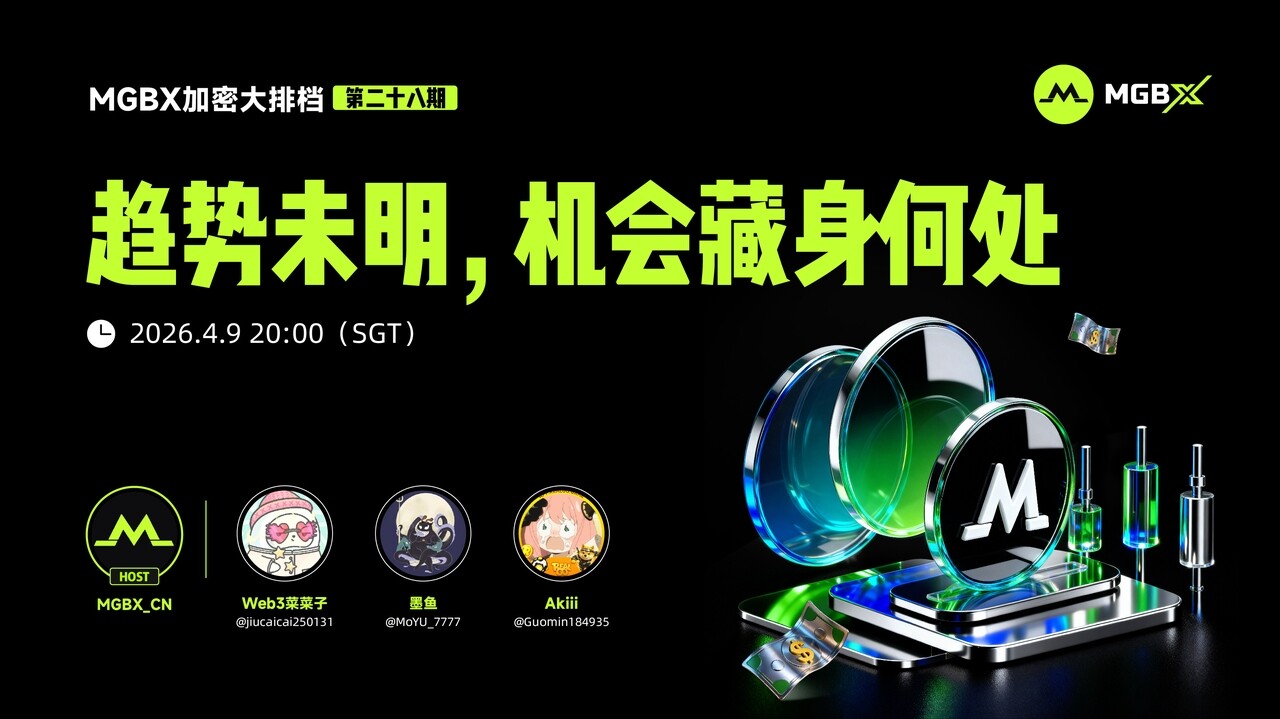
Addressing the first question, with the market currently in a high-level consolidation phase, which signals are influencing medium-to-long-term trends, and are they converging or diverging?
Teacher Caicaizi believes this market cycle is still jointly driven by three main themes: macroeconomics, geopolitics, and capital flows. Events like the US-Iran ceasefire directly impact risk appetite, leading to a repricing of capital between safe-haven and risk assets. In the short term, assets like gold and the US dollar show some convergence, but the rhythm between crypto assets and the US tech stock sector has already begun to diverge.
She emphasizes that news is merely a trigger; what truly determines the medium-to-long-term direction is the sustained flow of capital. The key variable is where large capital repeatedly participates.
The second question revolves around the impact of the Strait of Hormuz and rising oil prices.
Teacher Moyu states that the most direct transmission is the repricing of energy. Rising oil prices first affect cost bases like transportation, chemicals, and manufacturing. Concurrently, market capital typically splits into two paths: one flows into safe-haven assets and commodities, while the other puts short-term pressure on risk assets.
Furthermore, the discussion around "Bitcoin-denominated transit fees" creates a new imagined connection between crypto assets and real-world energy flows. While this enhances the narrative potential, it also increases price volatility uncertainty.
The third question concerns trading strategies during consolidation phases.
Teacher akiii believes that the greatest risk in the current environment is not directional judgment, but having decisions interfered with by short-term noise. Trading should focus as much as possible on core signals, including trend structure, key support/resistance levels, and changes in trading volume, rather than frequently chasing news-driven fluctuations.
At the execution level, position management is particularly crucial. One should avoid emotional adding to positions or over-concentrating holdings, instead using a phased approach to control risk. Simultaneously, it's important to rationally utilize MGBX platform tools, such as take-profit and stop-loss orders. Their core function is not to limit profits but to define risk boundaries in an uncertain environment.
The final question focuses on MGBX's newly launched event contracts.
Teacher Wangzai explains that event contracts essentially transform market events into probability-based trading tools. Examples include ceasefire progress, oil price changes, or policy news. Traders don't need to judge long-term trends but rather assess the probability of event outcomes.
The core methodology involves small-position trial-and-error and strict risk control, avoiding heavy bets on single outcomes. With clear discipline, this tool is more suitable as a supplementary trading method during periods of high volatility and dense event activity. However, without proper risk control, it can also amplify emotional trading.
Overall, the consensus formed in this discussion is relatively consistent: in the current environment, opportunities still exist, but what truly creates a performance gap is not the judgment of market direction, but rather risk control capability, tool utilization ability, and execution discipline.
In a market characterized by high volatility and high information density, the core of trading ability lies not in prediction, but in management.
Therefore, MGBX is also continuously improving its trading system and tool structure, including event contracts, the Echo points system, and foundational features like spot and futures trading.
Among these, event contracts provide a probability-based trading method for event-driven markets, allowing traders to avoid purely emotional judgments during high-volatility phases. The Echo points system creates a long-term incentive mechanism through trading and participation behaviors, enhancing the user's continuous engagement experience. Meanwhile, tools like spot trading, futures, and copy trading constitute a multi-layered trading infrastructure.
Different market phases correspond to different strategy choices: follow the trend in trending markets, control risk in consolidating markets, and seek probability-based opportunities in event-driven markets.
For traders, what's more important is not capturing every market move, but maintaining consistent risk boundaries and execution capability in any environment.
The value of tools is precisely reflected here.
👉 Download MGBX from the official website: https://mgbx.com/
Company: MGBX
Email: business@mgbx.com
Official Business Contact: @MGBXVIP


