Two Acquisitions in One Day: OpenAI Buys "Narrative," Anthropic Buys "Barriers"


- Core Viewpoint: OpenAI and Anthropic exhibit significantly different acquisition strategies ahead of their IPO sprints, stemming from their distinct revenue structures and market anxieties: OpenAI engages in "breadth procurement" to solidify its consumer-driven valuation narrative, while Anthropic conducts "precision acquisitions" to lock in enterprise clients and build industry barriers.
- Key Elements:
- Differences in Acquisition Volume and Direction: OpenAI has completed 15 cross-domain acquisitions over three years, totaling over $770 billion; Anthropic has completed only 3, each precisely corresponding to specific layers of its product technology stack.
- Revenue Structure Drives Strategy: Approximately 60% of OpenAI's revenue comes from the consumer end (ChatGPT subscriptions), hence its acquisition of TBPN aims to influence the public discussion framework; Anthropic derives about 80% of its revenue from the enterprise side, with acquisitions focused on increasing industry switching costs.
- Anthropic's Vertical Deep Dive: Within six months, through launching industry tools, obtaining compliance certifications, and acquiring Coefficient Bio, it has systematically entered and deepened its layout in the life sciences field.
- IPO Competition and Market Impact: Both companies target IPOs around the end of 2026, with valuations nearing $1 trillion and over $60 billion respectively. Their massive fundraising could absorb significant market liquidity, creating direct competition.
- Strategic Adjustment Focus: OpenAI recently cut multiple non-core projects to focus on enterprise products; Anthropic continues to deepen its penetration into vertical industries to build customer barriers.
On April 2nd, OpenAI and Anthropic each announced an acquisition. OpenAI purchased the tech livestream show TBPN, while Anthropic spent approximately $4 billion in stock to acquire the AI biotech startup Coefficient Bio. Both companies are sprinting towards their IPOs by the end of 2026, but their shopping lists point to entirely different anxieties.
15 vs. 3. This is the number of acquisitions completed by OpenAI and Anthropic, respectively, over the past three years.
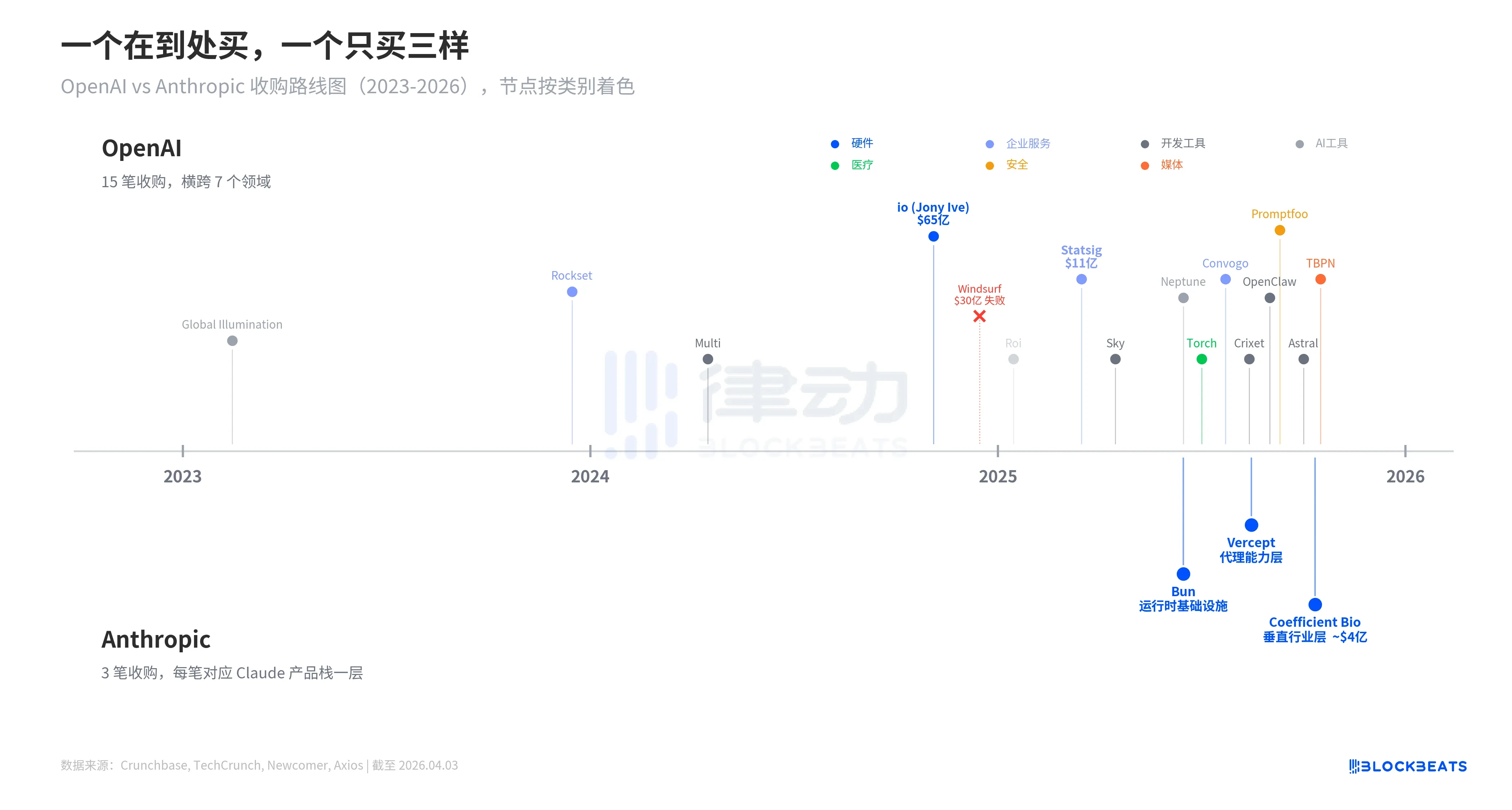
According to Crunchbase statistics, OpenAI has completed 15 acquisitions since 2023, spanning seven areas: hardware, enterprise services, developer tools, healthcare, security, media, and consumer. Six were completed in the first three months of 2026 alone. The total disclosed value of these transactions exceeds $7.7 billion, with the largest being the $6.5 billion acquisition of io, an AI hardware company founded by former Apple designer Jony Ive, in May 2025.
Anthropic has made only 3. In December 2025, it acquired the JavaScript runtime Bun to complete the underlying infrastructure for Claude Code. According to Anthropic's official announcement, the acquisition of Bun coincided with the disclosure that Claude Code had reached $1 billion in annualized revenue. In February 2026, it acquired the computer use agent startup Vercept to enhance Claude's autonomous operation capabilities. On April 2nd, it acquired Coefficient Bio to enter the life sciences R&D pipeline. Each acquisition precisely corresponds to a technical layer in the Claude product stack.
It is worth noting that OpenAI also had one failed transaction. In May 2025, OpenAI reached a $3 billion acquisition intent with the code editor Windsurf (formerly Codeium). However, according to IT Pro, due to IP clauses in Microsoft's contract, OpenAI could not protect Windsurf's technology from being accessed by Microsoft, and the deal fell through in July. This failure also reflects a structural constraint of OpenAI's "broad procurement" model.
This density difference is not accidental. It reflects the two companies' vastly different revenue structures and the resulting distinct anxieties.
Revenue Structure Determines Acquisition Direction
According to Sacra estimates, OpenAI's annualized revenue as of February 2026 was approximately $25 billion, with about 60% coming from the consumer side (ChatGPT subscriptions) and 40% from the enterprise side. Its 15.5 million paying users form the foundation of OpenAI's revenue. For a company about to IPO, a high consumer-side proportion means public sentiment directly impacts the valuation narrative.
This explains why OpenAI bought TBPN. According to Axios, TBPN is a daily live-streamed tech talk show, with $5 million in ad revenue in 2025 and a target of over $30 million for 2026. After the acquisition, OpenAI retained its editorial independence while hiring former Postmates executive Dylan Abruscato to oversee ad monetization. The logic behind buying a tech podcast lies not in its revenue, but in its ability to continuously influence the public discourse framework around AI topics.
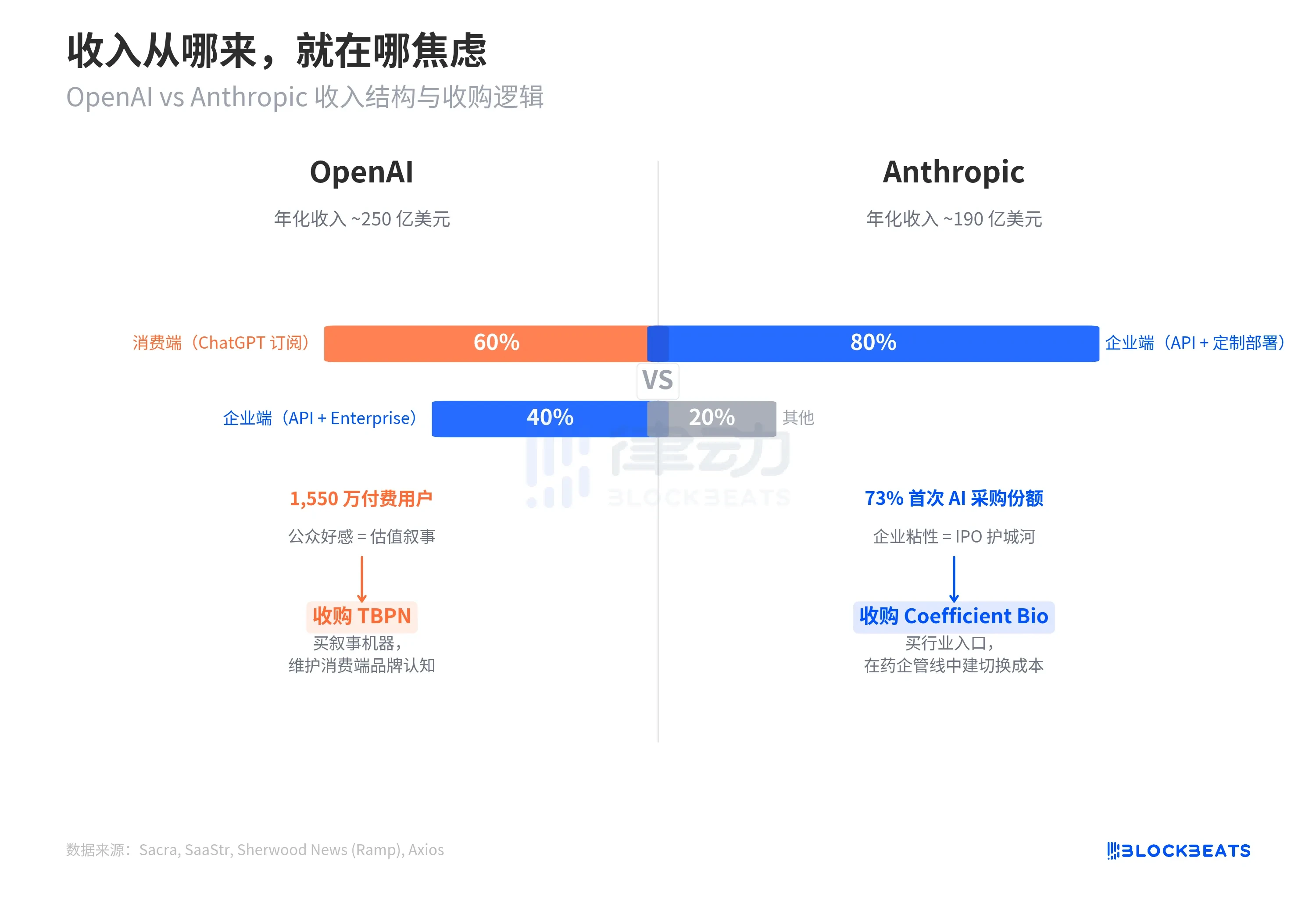
Anthropic's anxiety points in a completely different direction. According to Ramp data cited by Sherwood News, Anthropic currently holds 73% of the market share for first-time AI procurement enterprise clients, up from 50% ten weeks ago. As reported by SaaStr, approximately 80% of Anthropic's revenue comes from the enterprise side. For enterprise clients, choosing an AI vendor is a high-switching-cost decision. Anthropic's IPO narrative needs to prove that these enterprise clients won't churn.
Three Strategic Moves in Six Months
Coefficient Bio was not an impulsive acquisition. Viewed within the sequence of Anthropic's actions over the past six months, the logic is clear.
In October 2025, Anthropic launched Claude for Life Sciences, integrating with research databases like PubMed and UniProt, enabling Claude to assist with literature reviews and experimental design. In January 2026, at the JPM26 conference, it launched Claude for Healthcare, obtaining HIPAA compliance certification and formally entering the healthcare system. On April 2nd, it acquired Coefficient Bio, gaining full-process AI capabilities for drug R&D.
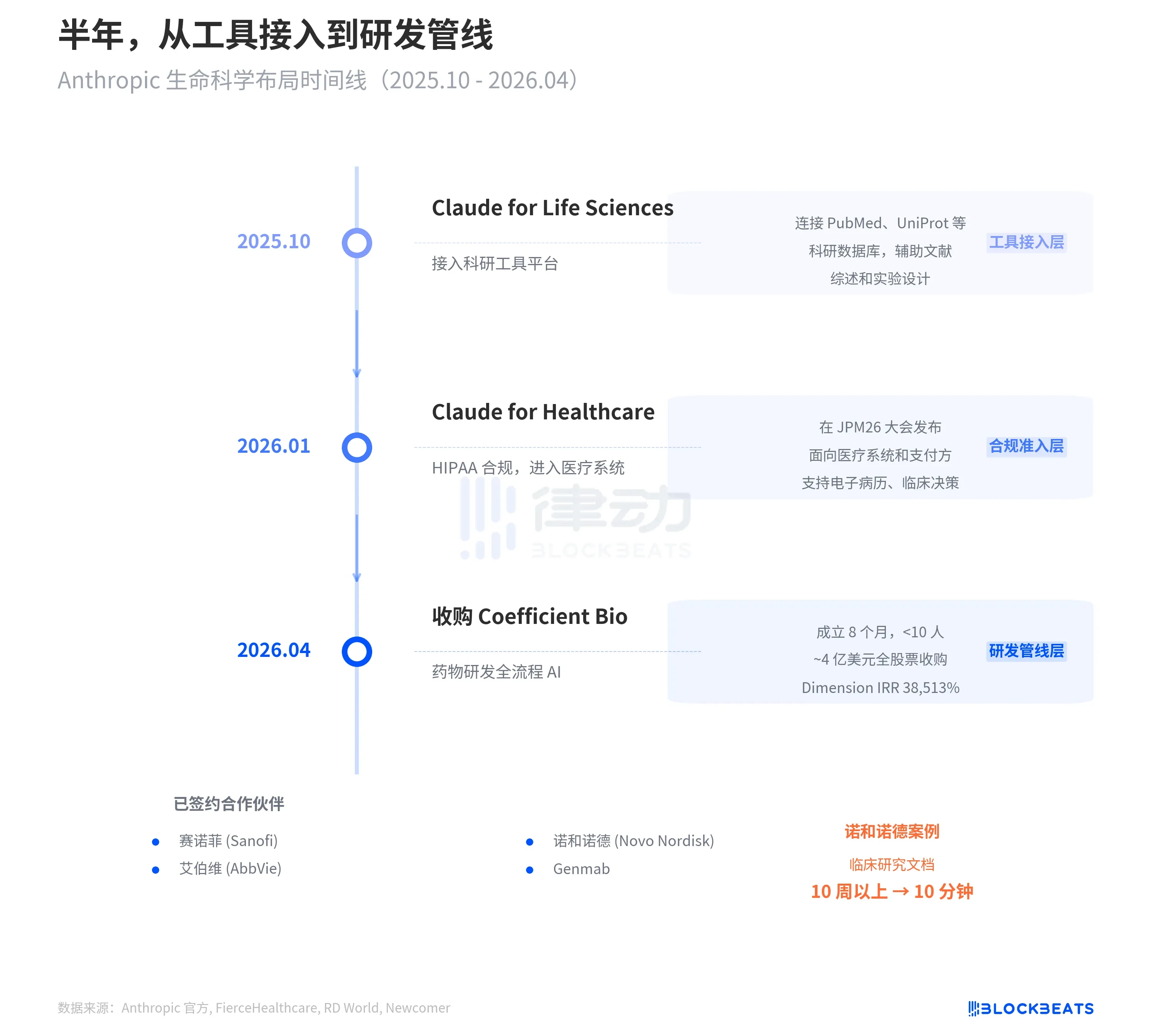
In six months, it progressed from the tool integration layer to the compliance access layer, and then to the R&D pipeline layer. According to Newcomer, Coefficient Bio was founded just 8 months ago, has fewer than 10 employees, and is approximately 50% owned by the venture capital firm Dimension. Anthropic completed the acquisition with about $4 billion in stock. In a letter to its LPs, Dimension claimed the IRR on this investment reached 38,513%.
This figure itself indicates that Anthropic is not buying a company's revenue or product, but rather a team plus an industry entry point. According to reports from Anthropic's official channels and RD World, pharmaceutical companies like Sanofi, Novo Nordisk, AbbVie, and Genmab are already using Claude's life sciences tools. The Novo Nordisk case is particularly typical, where clinical study document processing time was reduced from over 10 weeks to 10 minutes.
Two Balance Sheets, One Countdown
According to reports from WinBuzzer and The Tech Portal, Anthropic has hired Goldman Sachs and JPMorgan Chase to lead its underwriting, targeting an IPO as early as October 2026 with a fundraising scale exceeding $60 billion. OpenAI's target is Q4 2026 or Q1 2027, with a valuation nearing $1 trillion. According to analysis by Tom Tunguz, if OpenAI, Anthropic, and SpaceX all IPO in the same year, these three alone could absorb over $3 trillion in market liquidity.
Both are making final strategic adjustments before their IPOs. According to CNBC, OpenAI CEO Fidji Simo internally announced the cancellation of projects including Sora, the Atlas browser, hardware initiatives, and instant checkout features, stating the company is "like entering a red alert" and needs to focus on enterprise and agent products. Anthropic's path is to continue deepening into vertical industries like life sciences, using industry switching costs to lock in enterprise clients.
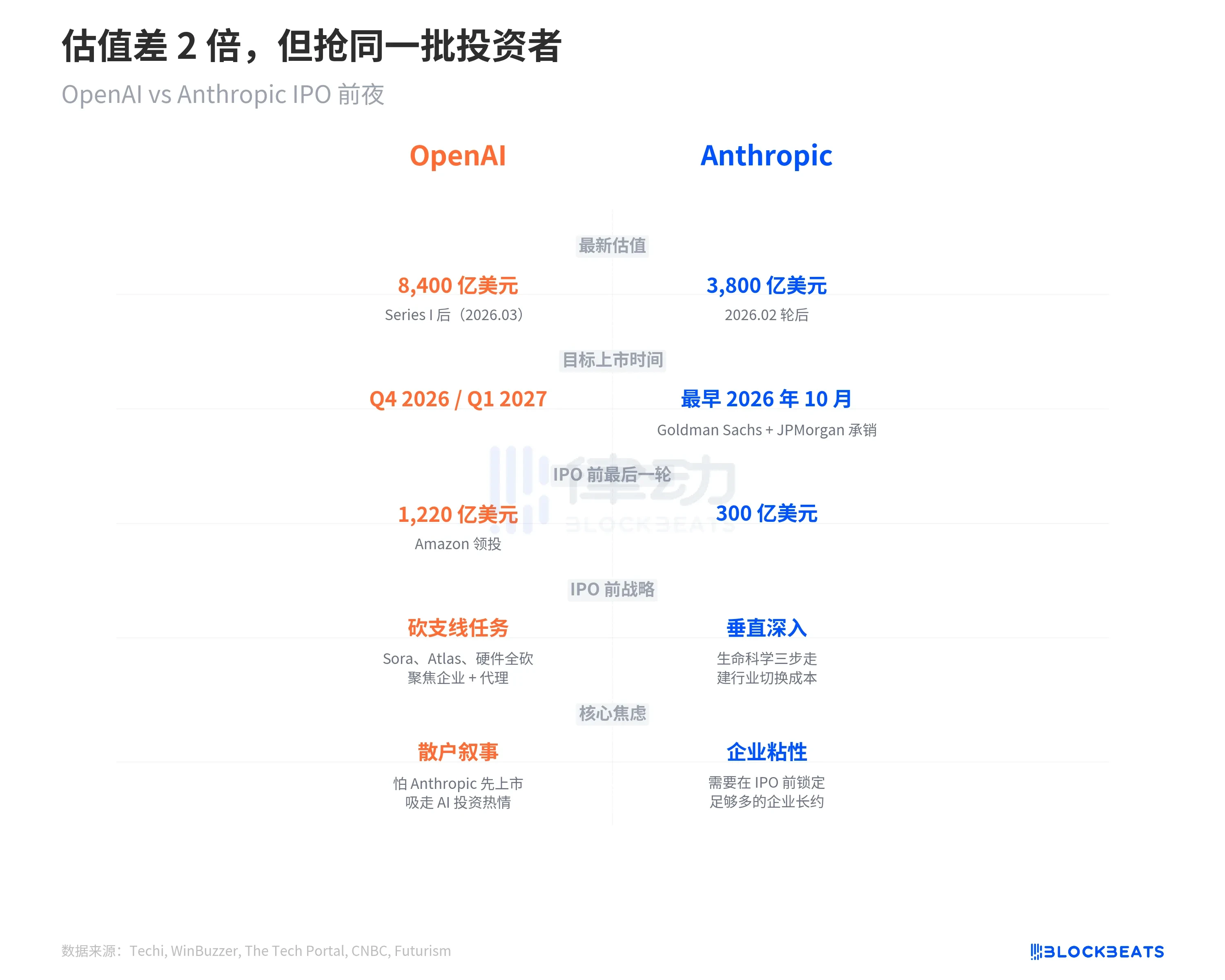
According to FinancialContent, OpenAI's board is concerned that if Anthropic goes public first, it could siphon off the pent-up retail investor enthusiasm for AI. The valuations of the two companies differ by more than 2 times, but they are competing for the same pool of investor capital. The two acquisitions on the same day: one buying a narrative machine, the other buying an industry entry point.