






Stop Betting on Gut Feelings: AI Is "Picking Up Money" on Polymarket


- Core Viewpoint: The article proposes a model for systematic arbitrage on the Polymarket prediction platform using AI tools. Its core profit logic lies in capturing and structuring the probability gap between market pricing and authoritative data (e.g., NOAA weather forecasts), achieving stable returns through automated strategies.
- Key Elements:
- Market Opportunity: Significant mispricing exists in Polymarket's weather markets between retail intuition and high-precision NOAA probability data (e.g., 94% confidence), forming the basis for arbitrage.
- Research Automation: Perplexity AI can complete in-depth research within 10 minutes, analyzing 47+ information sources to quickly identify high-profit niche markets, profitable wallet patterns, and optimal data sources (e.g., NOAA).
- Strategy & Risk Control: The agent built on Claude possesses adaptive decision-making capabilities, allowing it to dynamically adjust positions based on confidence levels and set daily loss limits (e.g., $50) to control risk.
- Execution Scalability: Bots can scan over 60 markets every 2 minutes, achieving high-frequency coverage unsustainable for humans, transforming tiny spreads (e.g., $0.36 profit per trade) into substantial daily returns through scale.
- Competitive Advantage: This model compresses research, strategy, and execution into a continuous chain, lowering the barrier to entry for individuals while raising the competitive standard for those relying on manual operations and experiential judgment.
Original Title: How Perplexity + Claude Replace an Entire Analyst Team on Polymarket
Original Author: @0xwhrrari
Original Compilation: Peggy, BlockBeats
Editor's Note: This article introduces a method for identifying arbitrage opportunities on Polymarket and systematically executing them: using Perplexity to conduct research and locate discrepancies between data and market pricing; using Claude to build trading logic, manage risk, and automate execution; and finally, completing the trades and realizing profits on Polymarket.
The author's core thesis is that profits come from "structured information asymmetry." Market prices largely reflect collective intuition, while data (such as weather forecasts) provides probability distributions. When a misalignment occurs between the two and is consistently captured by a system, it can be transformed into stable trading opportunities. Claude is the brain, Polymarket is the wallet, and Perplexity is the eyes. Together, they form a complete arbitrage loop.
This model, on one hand, lowers the barrier to entry, enabling individuals to possess capabilities close to a "team-level" capacity. On the other hand, it raises the competitive standard. Once research, analysis, and execution are compressed into a continuous pipeline, relying solely on experience or manual operations will find it increasingly difficult to compete with systematic strategies.
For the average participant, a more realistic path is to first find certainty through research, then leverage systems to amplify returns. Whoever can operationalize this methodology earlier is more likely to achieve consistent, stable returns in these seemingly simple markets.
The following is the original text:
Among the top 20 traders on Polymarket, 14 are actually bots. One Claude-based agent turned $1,000 into $14,216 in 48 hours; while another agent based on OpenClaw was liquidated to zero on the same platform in the same timeframe.
The difference isn't in code quality, but in preparation.
One agent was simply fed a generic prompt and told "go trade on Polymarket"; the other was backed by a complete research system: which niche to trade, who is already profitable, where the data comes from, and the underlying mathematical logic.
Perplexity AI handles the research, Claude handles the coding, and Polymarket handles the payouts.
Here is the complete breakdown. Recommended to bookmark.
You can try:
- Perplexity: perplexity.ai
- View Strategies: polymarket.com
- Copy Trading Bot: t.me/PolyGunSniperBot
- Telegram Channel: rari lr
Research Layer: From Zero to Strategy in 10 Minutes
Polymarket has dozens of trading categories: politics, crypto, sports, weather. Most people choose based on gut feeling, which is where losing money begins.
With just one deep research query, Perplexity can scan 47+ information sources in under 3 minutes: including Polymarket's API documentation, Reddit posts where traders share P&L screenshots, and Twitter analyses dissecting wallet behavior.
More importantly, every conclusion comes with citations and source links—not unsubstantiated raw text, but "verifiable data" you can click on and check.
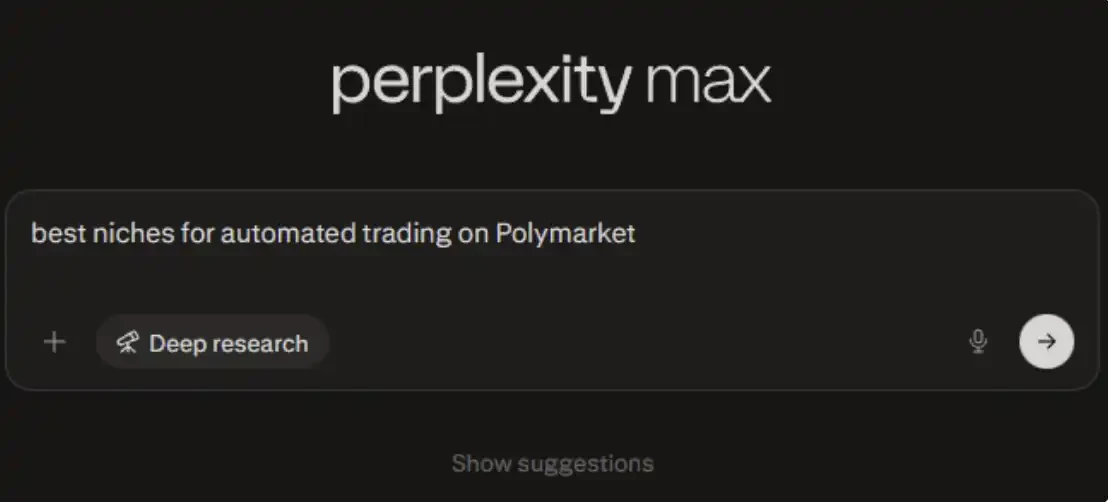
The breakdown emerges almost instantly:
BTC 5-minute markets: The arbitrage window is only 2.7 seconds. This is the realm of High-Frequency Trading (HFT). You need colocation servers and a budget of at least six figures.
Sports arbitrage: Profit margins are typically 1–3%, requiring at least $5,000 in capital to justify the execution risk.
Weather markets: Profit margins are 3–4 times higher, with entry possible at $100. Most participants are retail traders pricing based on intuition.
After the first answer, Perplexity AI proactively suggests follow-up research questions:
"Want to compare NOAA with other weather forecast providers?" — Yes.
"Want to look at Polymarket's fee structure?" — Yes.
"What's the historical accuracy of weather forecasts across different timeframes?" — Yes.
It further dug up multiple trading wallet profiles. The system even automatically extracted data not present in the API: entry timing patterns, average position sizes, trade frequency distribution. This kind of analysis, if done manually by tracking wallets one by one, could take a junior analyst an entire day.
The commonalities among these wallets are very clear: fully automated, running 24/7, zero emotional decision-making. No one is sitting at a computer clicking a mouse—these bots trade based on mathematics.
The third query further narrowed the focus: What is the optimal data source for US weather markets?
Perplexity compared NOAA, OpenWeatherMap, and AccuWeather, conducting a systematic evaluation across multiple dimensions: accuracy, cost, update frequency, and API availability.
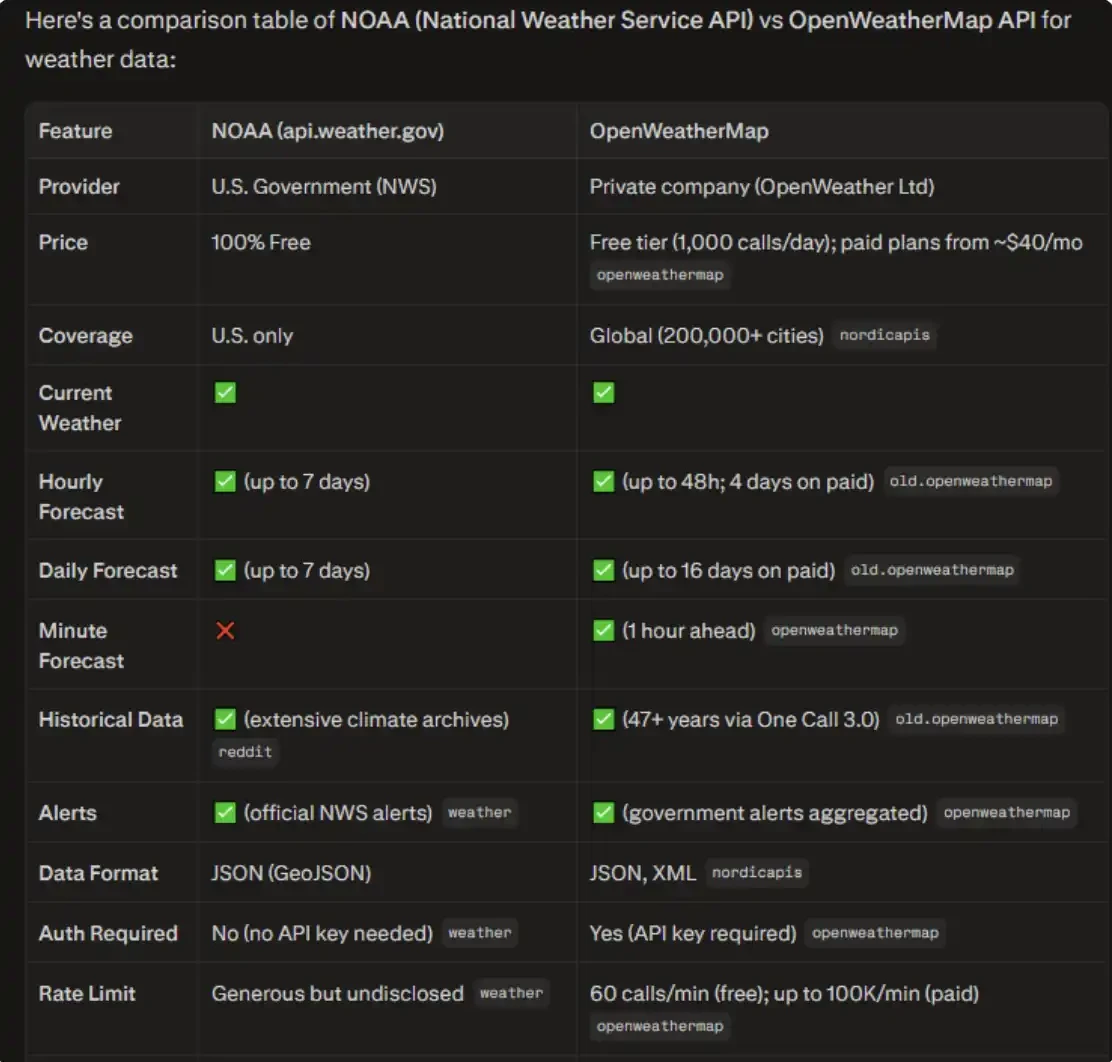
NOAA outperforms on all truly critical metrics. Free, 94% accuracy for 24–48 hour forecasts, based on decades of satellite data and supercomputer modeling, hourly updates, open API, and virtually no rate limits within reasonable usage.
With just three queries and ten minutes, you have a complete strategy map: which niche market to target, who is already profitable, and where the data source is.
Without Perplexity, the same research would often take 4 to 5 hours, flipping between Twitter, Reddit, various documentation pages, and academic papers, with no guarantee you'd find the right sources.
The Mathematical Logic Behind the Advantage
Polymarket's temperature markets are binary markets: "Will New York's temperature be above 72°F this Saturday?" There are only two answers: Yes or No. Final settlement is either $1 or $0.
But who prices these markets? Retail traders. They check the weather app on their phones, maybe glance at the 7-day forecast. They don't pull NOAA's probability distribution data.
The result: NOAA gives a 94% probability confidence for a certain temperature range, but the market prices it at only 11 cents.
This is the structural misalignment between what the data shows and the collective market perception.
For example, NOAA believes there's a 94% probability New York will be in the 74–76°F range on Saturday, while the price for this range on Polymarket is only 11 cents. So the bot buys at 11 cents. As more information is gradually digested by the market over the next few hours, the price rises to 45–60 cents. The bot sells at 47 cents. Profit per share: +36 cents.
Operating on a $2 position yields a profit of +$6.50. Running 10 such trades a day equals $65.
A single trade doesn't look impressive. What's exciting is the result after scaling.
This is also why Perplexity's model council is important. The query about "optimal position size" wasn't handled by a single model—it was run concurrently on Claude, GPT, and Gemini.
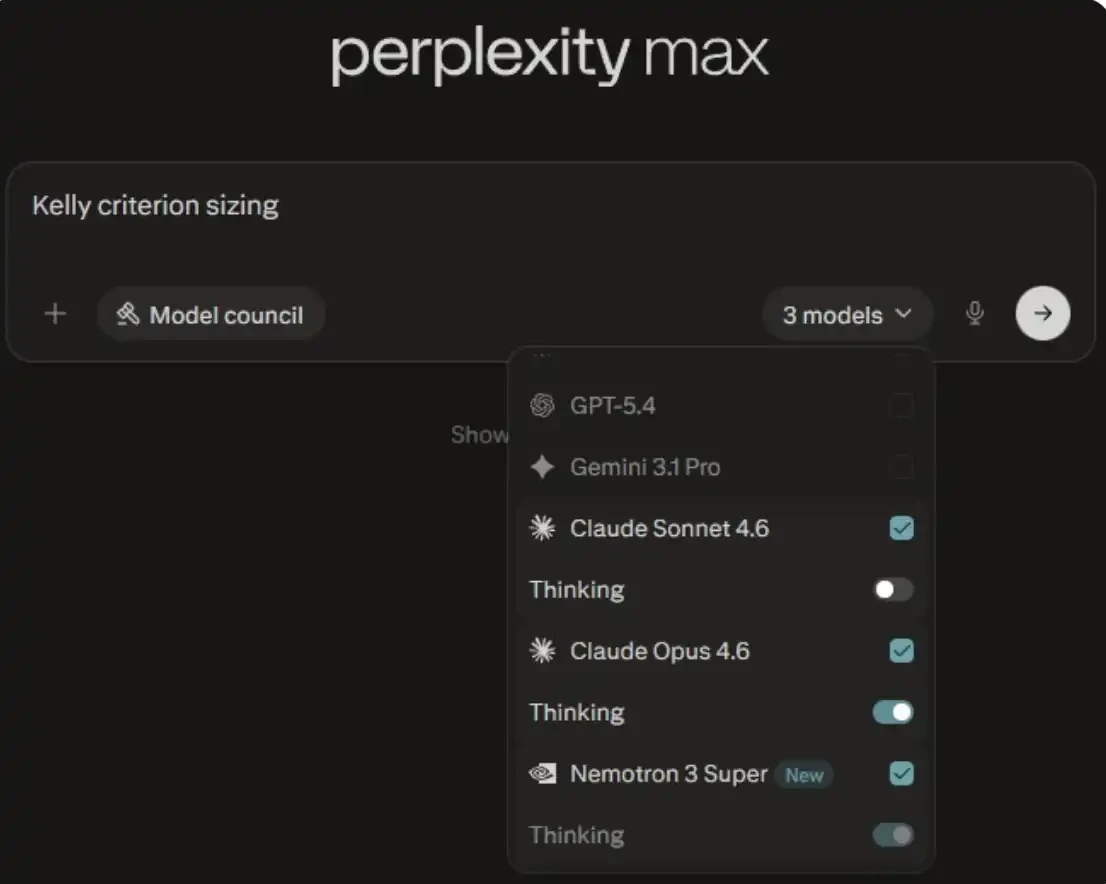
The final answer isn't the "opinion" of one model, but the result of convergence among three large models.
When Claude, GPT, and Gemini independently calculate and arrive at the same Kelly position sizing ratio, it's no longer a possible "hallucination output," but a cross-verified result.
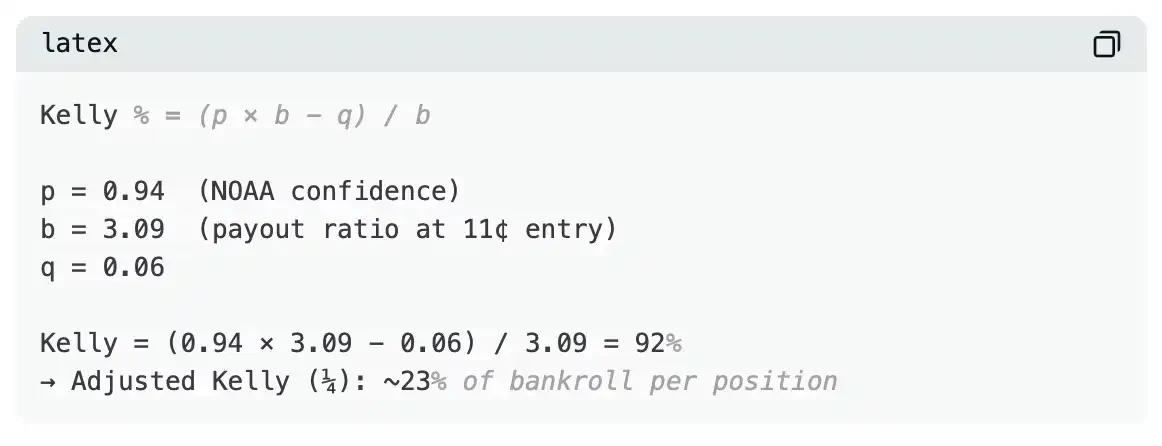
In practice, if the capital is only $100, no single position should exceed $2.
Conservative? Absolutely. But NOAA still has about a 6% error rate. Without proper position control, one wrong trade could wipe out the day's entire profit. 6 cities, over 10 temperature ranges per city—that means over 60 markets available to scan daily.
Perplexity's multi-source analysis further aggregated three independent meteorological studies, confirming that NOAA's 94% forecast accuracy within 24 hours is actually a conservative estimate—accuracy tends to be even higher for core metropolitan areas with denser weather station coverage.
And this bot scans the markets every 2 minutes. At this rate, it completes 720 scans across the 60+ markets daily. This level of coverage is impossible for a human to sustain.
Claude as the "Brain"
The entire system is divided into three modules: Scanner, Parser, Executor.
NOAA Scanner:
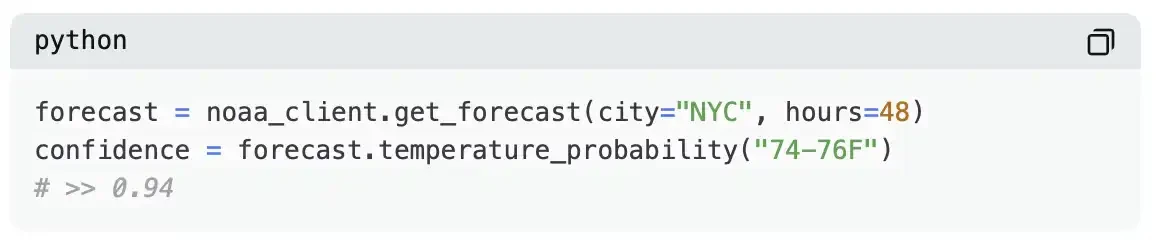
Polymarket Parser:
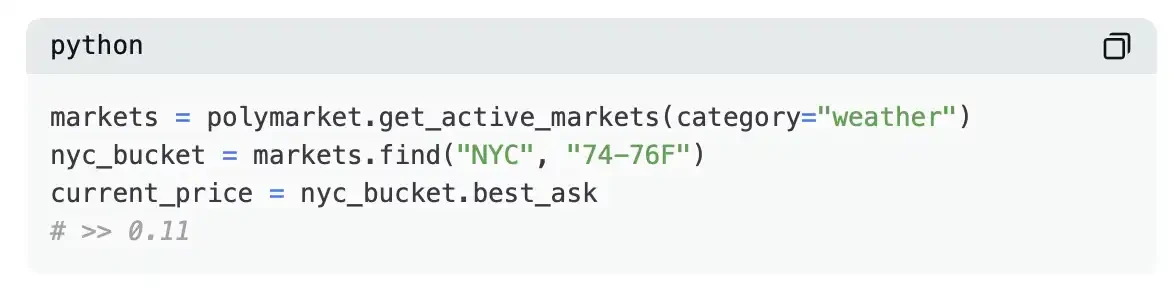
Decision Logic:
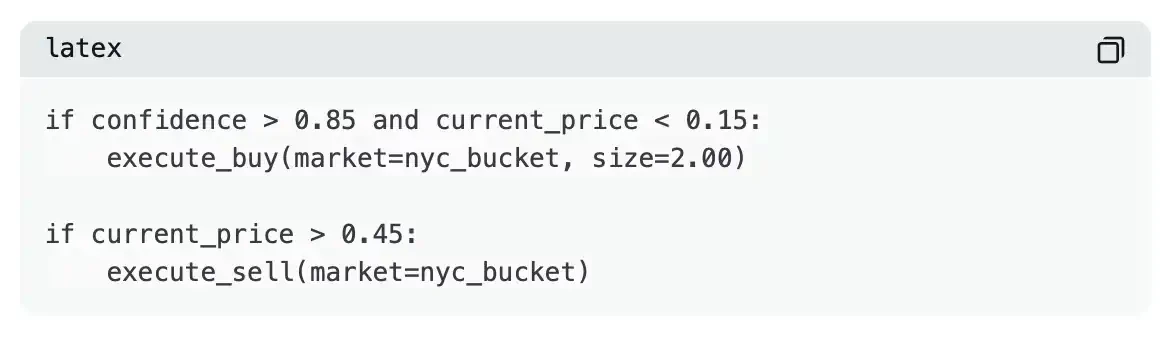
Telegram Report Module:

A regular script only executes if/then logic: condition met → buy. That's it. A Claude-based agent reads "context."
For example, a hurricane is approaching? NOAA data, originally updated hourly, shifts to every 30 minutes. The agent recognizes rising prediction instability and automatically reduces position size. It also reads news feeds, monitors sentiment shifts on Twitter, cross-validates multiple data sources—dynamically adjusting its confidence before actually placing an order.
This is the difference between a calculator and an analyst.
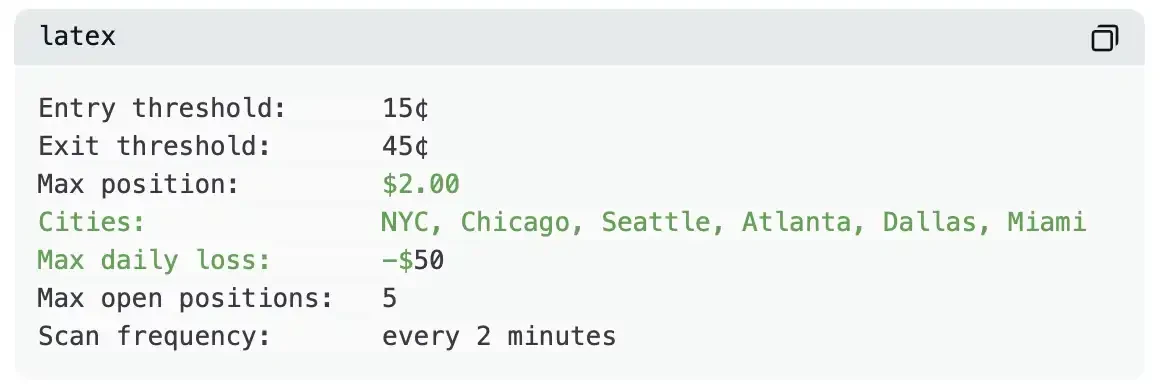
Entering at 15 cents, with NOAA confidence above 85%, means at least a 5.6x misalignment between the true probability and the market price.
Exiting at 45 cents locks in a 3x return on every successful trade.
Setting a daily loss limit of $50 means the worst day loses at most half the capital—then the bot automatically shuts down, resuming the next day.
The System Stack
Perplexity AI addresses the research layer gap: niche market selection, data source identification, mathematical validation, risk assessment—all based on verifiable citations and sources.
Claude addresses the execution layer gap: code generation, logic implementation, and real-time adaptive decision-making.
Polymarket is the monetization layer.
Why Perplexity is an Asymmetric Advantage
Most people underestimate the "research" step. They jump straight to writing code, directly executing a strategy—then wonder why the bot starts losing money on day one.
Perplexity isn't a search engine with a chat interface; it's essentially a research infrastructure.
Multi-Model Consensus Mechanism
Your query isn't given to one model; it runs simultaneously on Claude, GPT, and Gemini. When three models independently arrive at the same answer, you're no longer facing a "possible hallucination," but a cross-verified signal.
All Conclusions Have Citations
Every judgment can be traced back to a source. Not "I think NOAA's accuracy is 94%," but: here's the research paper, API documentation, and Reddit discussions verified by traders with real P&L. You can click and check each one.
The Depth of Deep Research
Parsing 47+ information sources in under 3 minutes: academic papers, API docs, trading forums, Twitter data analysis. The output isn't a pile of links, but an executable strategy.
Automatic Generation of Follow-up Questions
It not only answers questions but tells you what to ask next: "Want to compare different forecast sources?" "Want to break down the fee structure?" It's building the complete research path for you.
The Compounding Effect of Speed
10 minutes of research replaces 4–5 hours of manual searching. This isn't a convenience improvement; it's a structural advantage. While others are still scrolling Reddit, your bot is already running and generating profit.
Claude is the brain; Polymarket is the wallet; and Perplexity is the eyes.
Without it, you're trading blind; with it, you see the entire board before placing your bet.
Research Layer → Strategy Layer → Execution Layer → Profit, Perplexity is the first step. And the first step is precisely where 90% of traders fail.
Don't skip it.
Most people will read this, nod, and go back to manual trading. Those who truly act are already opening Perplexity in another tab, running their first Deep Research query: niche market, profitable wallets, data sources, Kelly position sizing...
The distance from "knowing" to "doing" is just one prompt.
When you earn your first $6.50 in a weather market, come back and read this content—you'll understand it completely differently.


