






Bittensor to the Left, Virtuals to the Right: Two Flywheel Paradigms for AI Crypto Projects


- Core Viewpoint: This article compares the core mechanisms of two AI crypto projects, Bittensor subnets and Virtuals agents. It points out that Bittensor incentivizes infrastructure development through an emissions mechanism, which has high barriers to entry and weak distribution. In contrast, Virtuals drives application-layer innovation through a trading volume-driven model, featuring low barriers to entry and strong distribution. Both share similarities in their liquidity flywheel effects.
- Key Elements:
- Bittensor competitively incentivizes subnet development through a daily emission of 3,600 TAO, whereas Virtuals relies on a trading volume-driven model similar to pump.fun, enabling teams to rapidly accumulate capital.
- Launching a Bittensor subnet is costly (currently around $300,000) and requires teams to have mature planning. Virtuals has an extremely low launch barrier, featuring a "60-day plan" that allows for low-cost trial and error.
- Bittensor is based on an independent blockchain with complex infrastructure and a high learning curve, limiting retail participation. Virtuals is deployed on the Base chain, with intuitive concepts and easy purchasing, facilitating rapid adoption.
- Both have a liquidity flywheel for their core tokens (TAO/VIRTUAL): demand for tokens within their ecosystems (subnet tokens/agent tokens) drives up the price of the core token.
- Bittensor subnets mostly focus on capital-intensive infrastructure like computing and inference, while Virtuals agents are more oriented towards consumer-facing application-layer products.
Original Author: 0xJeff
Original Compilation: AididiaoJP, Foresight News
This article aims to provide a brief comparison between Bittensor subnets and Virtuals agents to help understand their respective flywheel mechanisms, differences, and similarities.
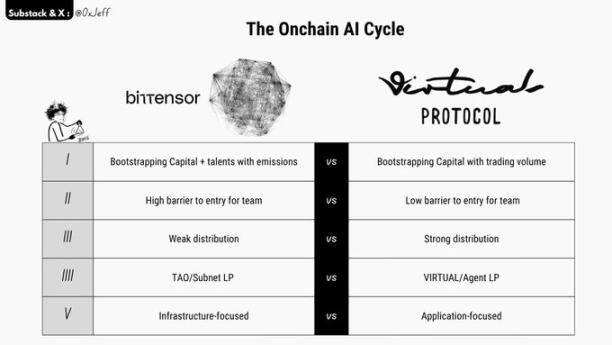
1. Guiding Capital and Talent via Emission Mechanisms vs. Guiding Capital via Trading Volume
Bittensor guides subnet development through its TAO emission mechanism. Subnets are responsible for introducing the most innovative projects (or revenue-generating businesses) and compete for a share of the daily 3,600 TAO emission.
Subnets also guide contributors (including miners performing tasks and validators verifying the miners' work) through their alpha token emission mechanisms. The emission mechanism and the incentive coordination mechanism across stakeholders have been embedded since the project's inception.
Virtuals adopts a model similar to pump.fun, guiding development through trading volume. High trading activity translates into capital accumulation for agent projects. Agent teams can use their own emission mechanisms to incentivize user participation.
This model has significant advantages during market cycles with high speculative token demand—teams can rapidly accumulate capital, gain product attention and market interest, thereby driving project launch and development.
2. High Entry Barrier vs. Low Entry Barrier (For Teams)
Launching a subnet on Bittensor requires significant investment. Currently, acquiring a subnet slot costs 871 TAO (approximately $300,000), with the price fluctuating based on demand and the auction mechanism. This means subnet teams typically need a mature concept, a clear plan, and solid execution capabilities.
To successfully operate a subnet, owners must ensure that the set tasks or objectives contribute to the research and development of their AI product/solution, while preventing miner cheating, ensuring validators effectively perform their verification duties, generating revenue through business development and customer partnerships, and maintaining investor confidence through buyback mechanisms.
The subnet token price needs to maintain an upward trend to attract more TAO inflows, increase the subnet's emission share, and consequently attract higher-quality contributors for mining.
In contrast, the barrier to launching an AI agent token on Virtuals is lower, requiring no initial cost to start, making it easier to test new concepts with minimal capital.
Virtuals also features a "60-Day Plan," allowing founders to test new ideas and issue tokens during this period. If product-market fit is not found within 60 days, the related funds are reclaimed, and investors can retrieve a portion of their invested capital.
3. Weaker Distribution Capability vs. Stronger Distribution Capability
Bittensor operates independently on a blockchain built using the Polkadot Substrate framework, making cross-chain bridging difficult. It lacks DeFi primitives and is not configured with common infrastructure like the Ethereum Virtual Machine or Solana.
This results in a high entry barrier for the Bittensor ecosystem. Furthermore, related learning materials are filled with complex terminology, increasing the difficulty for new users to learn and understand. Consequently, its community members are mostly technical professionals willing to invest time in deep research, with relatively low retail participation.
In comparison, Virtuals has a lower barrier to understanding. Its team excels in marketing, brand communication, and distribution. Retail users can more intuitively grasp concepts related to AI agents, agent payments, and bots.
Since Virtuals is deployed on the Base chain, the purchase process for AI agent tokens is convenient. The time from users learning about a project, forming a bullish view, to making a purchase decision is short. This is also a key reason for its rapid adoption from late 2024 to 2025 (earlier in time than Bittensor).
Currently, Bittensor is gradually entering the mainstream spotlight with pushes from Jason, Chamath, Barry Silbert (DCG and Yuma), and the community, leading to increased attention. However, the purchase process for its subnet tokens remains relatively complex, and the issue has not been fundamentally resolved.
4. TAO/Subnet Liquidity Pools vs. VIRTUAL/Agent Liquidity Pools
Bittensor and Virtuals share a key similarity in their liquidity pool flywheel mechanisms.
Investors wishing to purchase subnet alpha tokens must hold TAO to do so. Therefore, rising demand for alpha tokens will drive up the price of TAO.
Similarly, within the Virtuals ecosystem, rising demand for AI agent tokens will also drive up the price of VIRTUAL.
The advantage of this mechanism becomes more pronounced if the core tokens (TAO or VIRTUAL) can circulate within the ecosystem without outflow—for example, if various project parties retain value by trading goods and services among themselves.
5. Infrastructure-Oriented vs. Application-Oriented
Bittensor subnets mostly focus on infrastructure or capital-intensive businesses, such as decentralized computing, inference, training, drug discovery, and quantum experiments.
Since Bittensor can provide over $10 million in annual funding for high-quality subnets and attract top-tier talent, its model is suitable for driving ambitious, high-difficulty, high-investment concepts.
Virtuals agent teams, on the other hand, mostly focus on the application layer and consumer-facing agent products. Since agent tokens have a low initial price, if a team can launch a high-quality consumer-grade product, it can leverage the token's market hype to quickly attract attention and propel project development.
Thanks to Virtuals' advantages in distribution, the flywheel effect for AI agent tokens demonstrated faster growth rates and higher price increases during periods of extreme market activity (e.g., late 2024 to early 2025).


