






From "U.S. Stocks on the Chain" to Interest Rate Gaming, Crypto Trading is Entering a New Stage


- Core View: The global trading market is shifting from single-asset gaming to multi-market linkage. The core drivers are the on-chain tokenization process of traditional securities and changes in macro liquidity expectations. This requires traders to possess cross-market analysis capabilities and is driving trading platforms to evolve into multi-asset infrastructures.
- Key Elements:
- The U.S. SEC's approval for Nasdaq to advance its securities tokenization pilot marks the entry of traditional assets like U.S. stocks onto the chain into the implementation phase under a regulatory framework.
- Divergence in the Federal Reserve's interest rate policy and geopolitical risks have amplified market expectations for a liquidity turning point, prompting accelerated capital flow and repricing across different asset classes.
- Crypto assets like Bitcoin are exhibiting dual attributes as both risk assets and liquidity hedges. Their increasingly complex linkage with traditional assets (such as U.S. stocks) is becoming a new source of trading signals.
- Market volatility is divided into two stages: sentiment-driven and capital repricing. Trading advantage depends on distinguishing between the two and possessing cross-market observation capabilities.
- Trading platforms (e.g., MGBX) are evolving into multi-asset trading infrastructures covering crypto assets and U.S. stock contracts, adapting to this trend through compliance layouts (e.g., U.S. MSB license) and incentive activities.
While the market is still digesting the Middle East situation and the interest rate path, a more fundamental change is quietly taking place—traditional securities markets are accelerating their migration to the blockchain.
Recently, the U.S. Securities and Exchange Commission (SEC) formally approved Nasdaq's plan to advance a securities tokenization pilot, allowing stocks and ETFs to be settled and cleared on-chain while sharing liquidity with traditional order books. This means that "on-chain U.S. stocks" is no longer just a concept but has officially entered the implementation stage within the regulatory framework.
Almost simultaneously, the Federal Reserve sent a new signal: maintaining interest rates unchanged, but internal divisions have emerged, with some members even advocating for an earlier rate cut. Against the backdrop of ongoing uncertainty in the Middle East and rising oil prices, market expectations for a liquidity turning point have been amplified once again.
One is the restructuring of asset forms, the other is the repricing of capital costs. These two threads are jointly pointing to a trend—global trading markets are moving from "single-asset competition" to "multi-market linkage."
In this context, trading logic is also changing. In the past, traders were often confined to seeking opportunities within a single market. However, as asset boundaries gradually break down, the speed of capital flow between different markets has significantly accelerated. The interrelationships between gold, the U.S. dollar, tech stocks, and crypto assets have also become more complex.
Bitcoin exhibits a "dual nature" in this process: it is both a high-volatility risk asset and, at times, plays the role of a liquidity hedge. When U.S. tech assets and the crypto market are simultaneously influenced by macro expectations, the synchronization and divergence between the two are gradually becoming a new source of trading signals. This means that strategies relying solely on single-market judgments are gradually becoming ineffective.
Looking at actual trading performance, this change is becoming increasingly evident. During unexpected events or shifts in macro expectations, markets typically go through two stages: the first stage is driven by sentiment, with rapid price fluctuations and a surge in trading volume; the second stage involves the repricing of capital, gradually forming a new price range. The real difference in trading lies in the ability to distinguish between "sentiment-driven volatility" and "capital-driven trends," as well as possessing cross-market observation capabilities.
It is precisely under this changing market structure that the role of trading platforms is beginning to shift. They are no longer just matching trades but are gradually evolving into "multi-asset trading infrastructure." Taking MGBX as an example, its platform is forming a more complete trading ecosystem: it not only covers mainstream crypto assets but also introduces contract products for U.S. stocks, indices, and more, enabling users to execute cross-market trades on a single platform. This structure echoes the current trend of "securities tokenization."
In terms of trading experience, through a high-performance matching system, AI-assisted trading, and a slippage compensation mechanism, MGBX enhances execution efficiency while improving stability during extreme market conditions. At the user ecosystem level, the Echo points mechanism binds trading behavior with long-term incentives, gradually transforming users from short-term trading participants into long-term ecosystem participants.
Regarding compliance, MGBX already holds a U.S. MSB license and has expanded into the European regulatory system (e.g., VASP registration in Poland), becoming one of the few platforms with multi-regional compliance capabilities.
Building on this foundation, the platform has also begun to implement the "cross-market trading" trend through specific scenarios. The recently launched "Global Market Trading Week: U.S. Stocks & Crypto Crossover Challenge" precisely aligns with this new market trend. The event is designed with "cross-market participation" at its core. Users can not only trade mainstream crypto assets like BTC and ETH but also try U.S. stock contracts such as MSTR, AMZN, and COIN. By completing trading tasks and milestone goals across different markets, users can share a prize pool totaling 10,000 USDT.
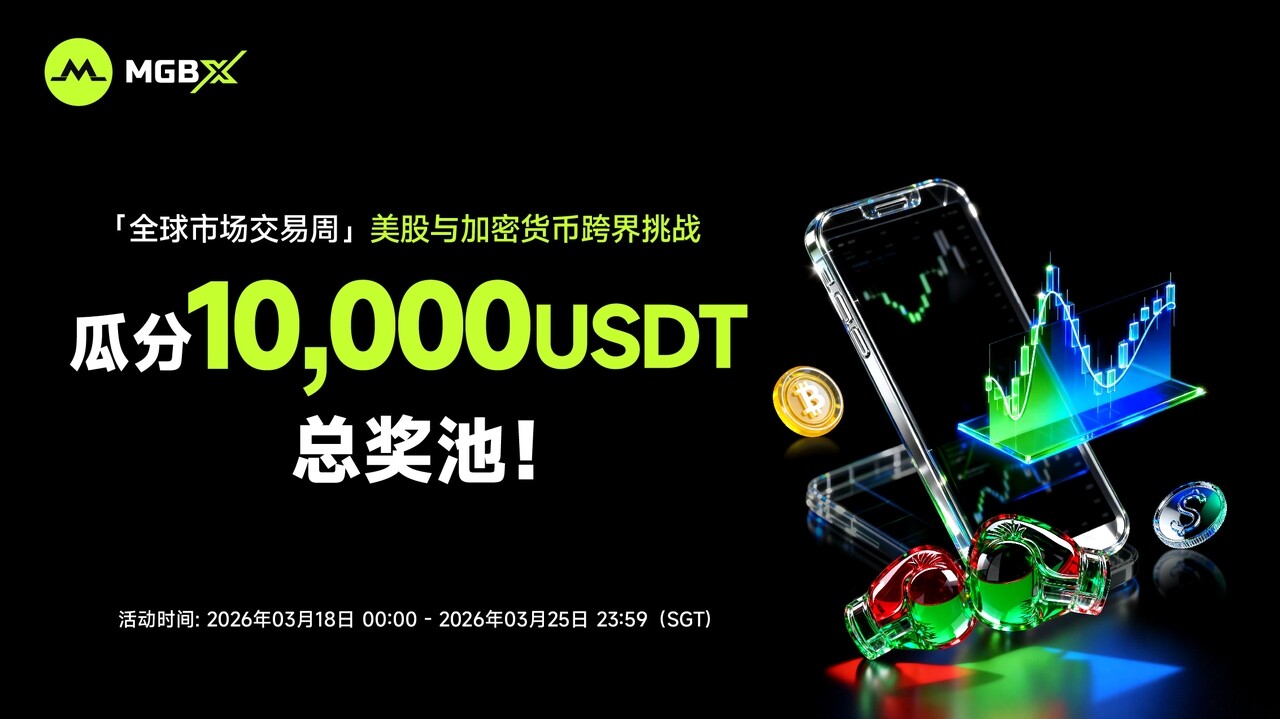
Unlike simple trading incentives, this event is more like an expansion of traders' horizons: by combining U.S. stocks and crypto assets, it helps users develop a cross-market trading perspective; through trading volume thresholds and dual-market participation mechanisms, it encourages traders of different styles to actively experiment; and the platform's incentives and Echo points system naturally reinforce the habit of long-term participation.
From a broader market perspective, whether it's the advancement of U.S. stock tokenization, the uncertainty of interest rate policies, or volatility brought by geopolitical risks, all are pushing the market from being "driven purely by price" to being "driven by structure." Price fluctuations are merely the surface; what's more core is the interaction of capital flows, asset forms, trading mechanisms, and participant behavior.
In this environment, a trader's advantage no longer depends solely on judging price movements but increasingly on the ability to understand the linkage between different markets, identify the rhythm differences between sentiment and capital, and maintain steady operations amidst high volatility. The value of a platform also lies in how it balances compliance, product offerings, and incentive mechanisms to provide traders with support for cross-market participation. Platforms like MGBX, with their multi-asset trading structure, global layout, and dual regulatory qualifications, are becoming crucial nodes connecting different markets and exploring new trading logics.
👉 Visit the official website to download MGBX: https://mgbx.com/
Company: MGBX
Email: business@mgbx.com
Official Business Contact: @MGBXVIP


