






Now is the Best Time to Interact with Polymarket (Exclusive Tutorial & Strategy Guide)


- Core Viewpoint: Polymarket is offering a concentrated liquidity subsidy of up to $2 million for the NCAA "March Madness" tournament, providing ordinary users with an excellent operational window to obtain LP rewards with relatively low risk and high efficiency.
- Key Elements:
- Unprecedented Subsidy Scale: This $2 million subsidy will be concentrated and distributed across 63 games in less than a month. Compared to the platform's total historical subsidy of $13 million, the subsidy intensity for this single event is significantly higher.
- Clear Operational Threshold: Users need to place orders for at least 1000 shares within a maximum price spread of ±1¢ for specified events to automatically accumulate LP rewards, which are distributed daily (requires a minimum of $1).
- Strategy to Reduce Risk: It is recommended to choose games with later start times, as their initial trading volume is low and probability fluctuations are minimal, effectively avoiding "inventory risk" in market making.
- Specific Operational Advice: Use the Split function to prepare shares for both sides, place orders at positions like "Market +2" which are close to the market price but slightly conservative to balance profit and risk, and cancel orders about 1 day before the game starts.
- Empirical Profit Demonstration: The author accumulated $4.31 in LP rewards (to be distributed the next day) after placing orders in a selected game for about 7 hours, verifying the feasibility under the current conditions of high subsidies and low volatility.
Original | Odaily (@OdailyChina)
Author|Azuma (@azuma_eth)
Earlier this year, Odaily compiled an article by data analyst arise titled "Data Modeling: How to Improve the Quality of Polymarket Interactions?".
The core logic of the article was that, considering about 80% of users have never received even $1 in Polymarket liquidity (LP) subsidies, while everyone is frantically competing for trading volume, a more efficient interaction strategy is actually to do everything possible to accumulate LP rewards.
So-called "LP rewards" are real cash subsidies distributed by Polymarket for specific prediction markets to improve the platform's liquidity conditions. All reward details can be viewed in real-time on the official Rewards page (https://polymarket.com/rewards).
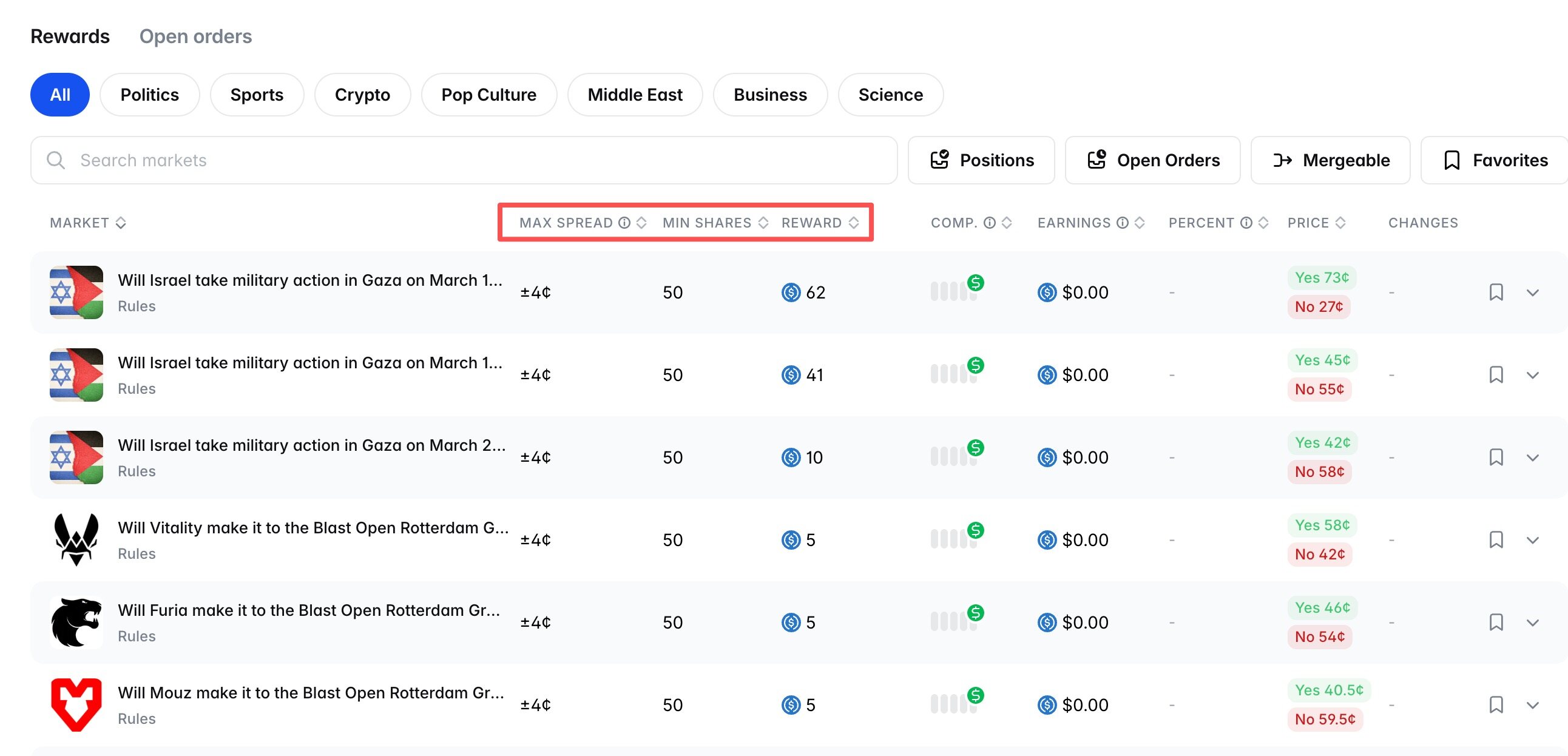
Users first need to select an event that is subsidized, then place an order of at least the specified amount (Min Shares) within the designated price spread (Max Spread) to automatically accumulate LP rewards. The closer the order price is to the market price, the higher the efficiency of earning rewards. LP rewards are distributed daily at 8:00, but only rewards over $1 are paid out.
Although the rules for obtaining LP rewards are not complicated, the inherent difficulty of market making in prediction markets is naturally higher (refer to "Only One in Ten Prediction Markets Survives Until Year-End, Not an Exaggeration"). Coupled with the $1 minimum threshold for daily reward distribution, many ordinary users with limited capital find it difficult to accumulate rewards when attempting to operate, and may even suffer capital losses due to inventory risk.
However, currently, Polymarket provides an excellent window of opportunity — with the arrival of the NCAA "March Madness," Polymarket has announced it will provide $2 million in LP subsidies for related events.
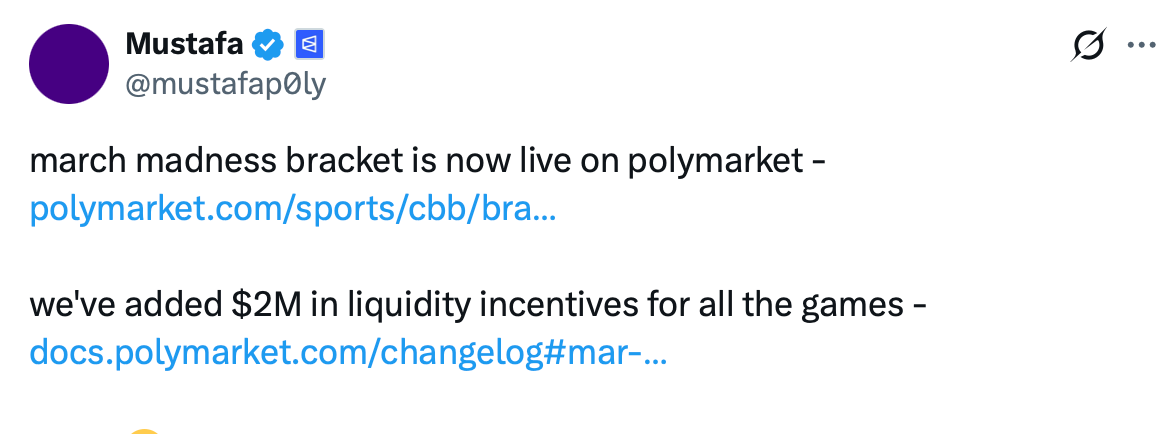
It's important to note that to date, the total LP subsidies Polymarket has distributed for all subsidized events is only $13 million. This $2 million+ subsidy will be concentrated over the next less than a month into specific 63 games — this directly implies an increase in subsidy intensity per single event, and also represents an excellent opportunity for ordinary users.
Next, Odaily will guide you step-by-step through the process of market making in NCAA-related events and briefly mention a few points I believe are worth noting.
First, open Polymarket's Rewards page. After clicking on Rewards, you can sort all events by subsidy intensity. It's easy to see that the events with the highest subsidy intensity on Polymarket currently are all NCAA "March Madness" games. (I have been providing liquidity on Polymarket for the past few months and have never seen subsidy intensity at this level.)
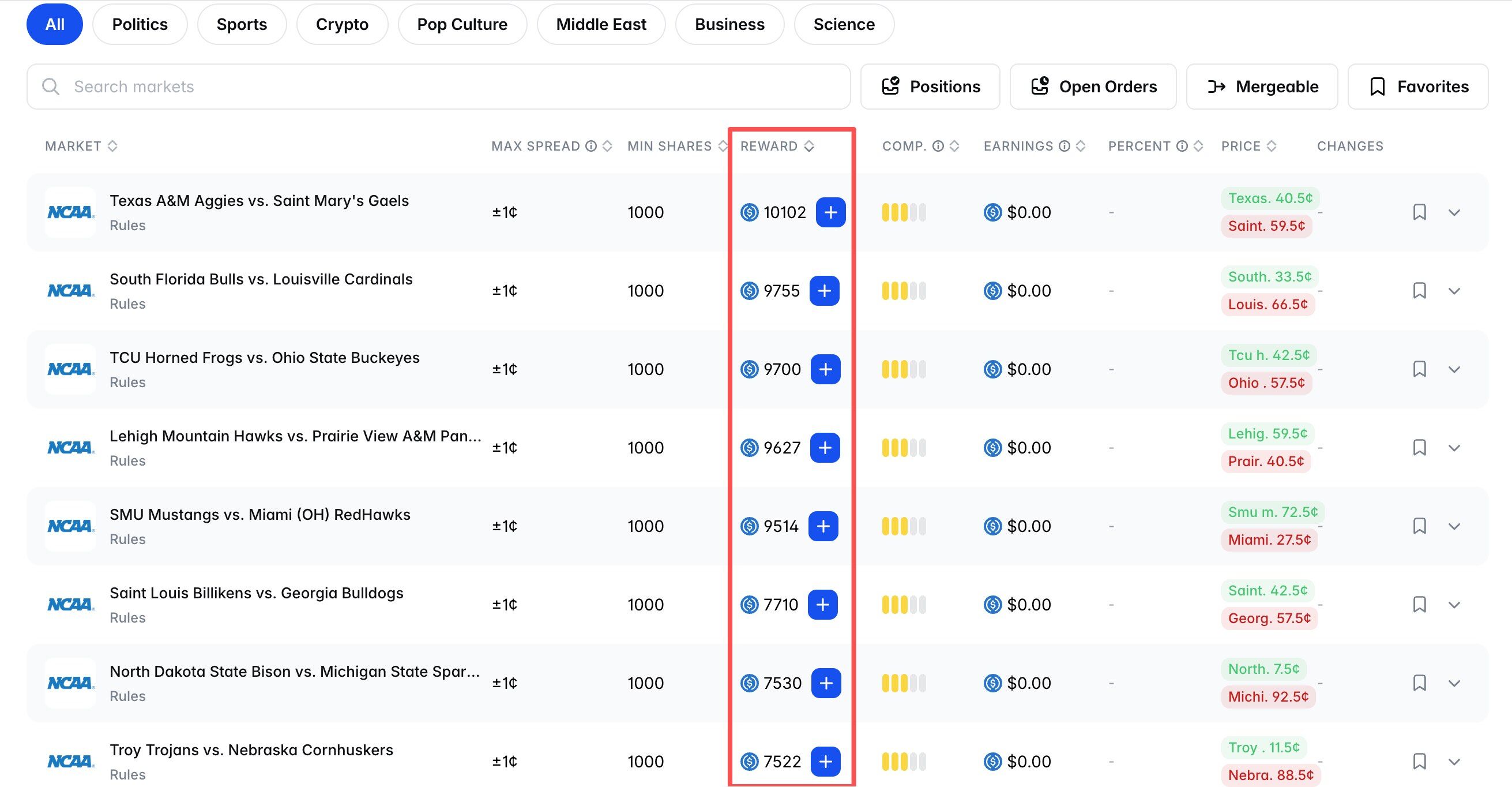
The next most important step is selecting a pool. It's worth adding that the COMP (Competitive) column on the right side of Rewards indicates the current competition level for providing liquidity in that event. Theoretically, greener is better (representing less competition), but in practice, the competition gap has largely been leveled by professional market-making capital, so what you'll mostly see is "three yellow bars," meaning the current competition is "medium."
Here, it's more advisable to choose games with later start times. For example, I chose to allocate funds to the "University of Iowa vs. University of Houston" game on March 19th EST (March 20th Beijing time).
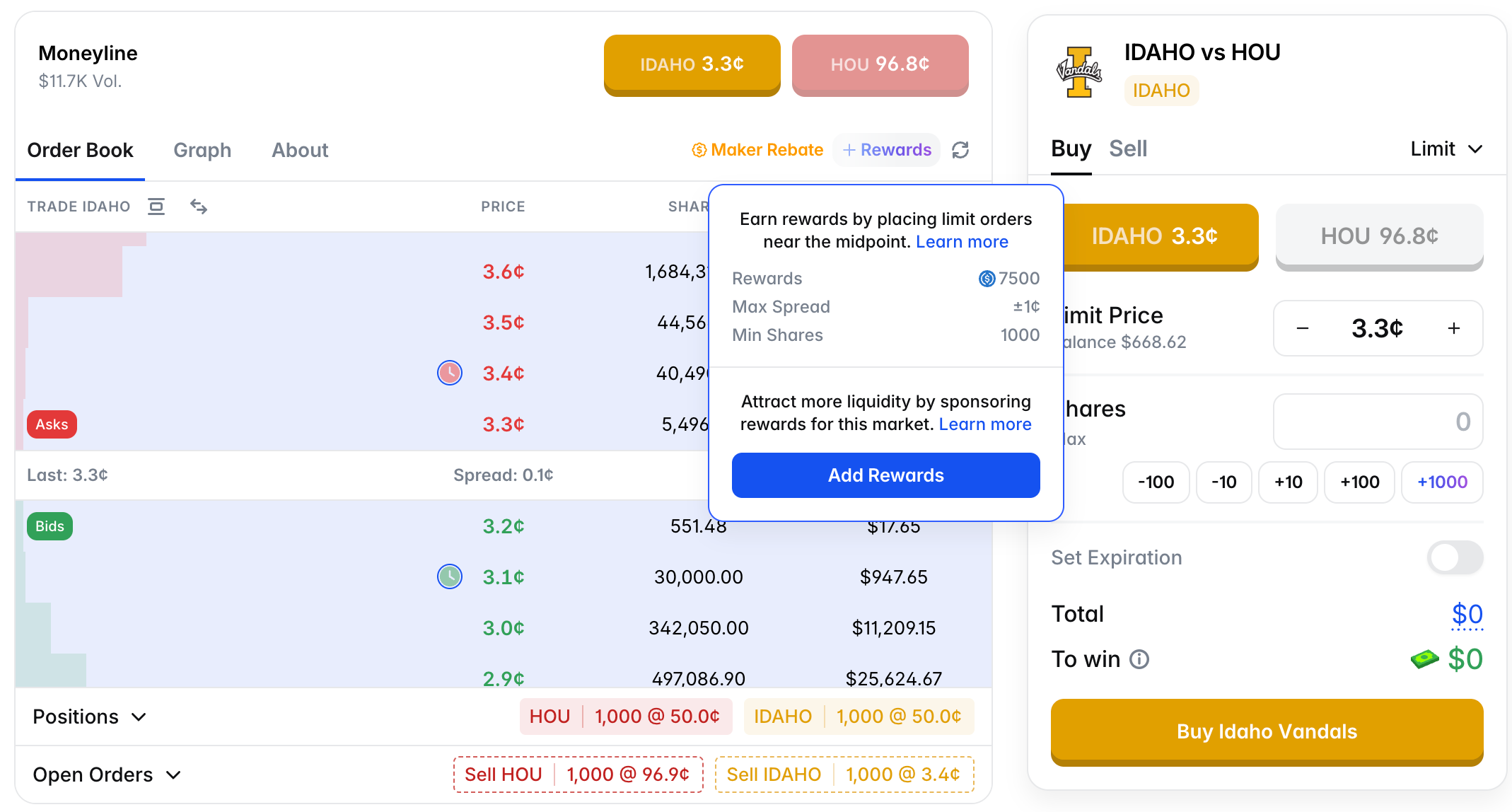
The reason later start times are better is that the trading volume peak for a single sports event on Polymarket often arrives shortly before the game starts, while Polymarket has already begun injecting subsidies. As shown above, the total trading volume for the "University of Iowa vs. University of Houston" game starting the day after tomorrow is currently only $12,000. With a certain liquidity base, lower trading volume often means smaller fluctuations.
The chart below clearly shows the probability fluctuation since this game was listed on Polymarket. You're seeing it right — it's two straight lines!
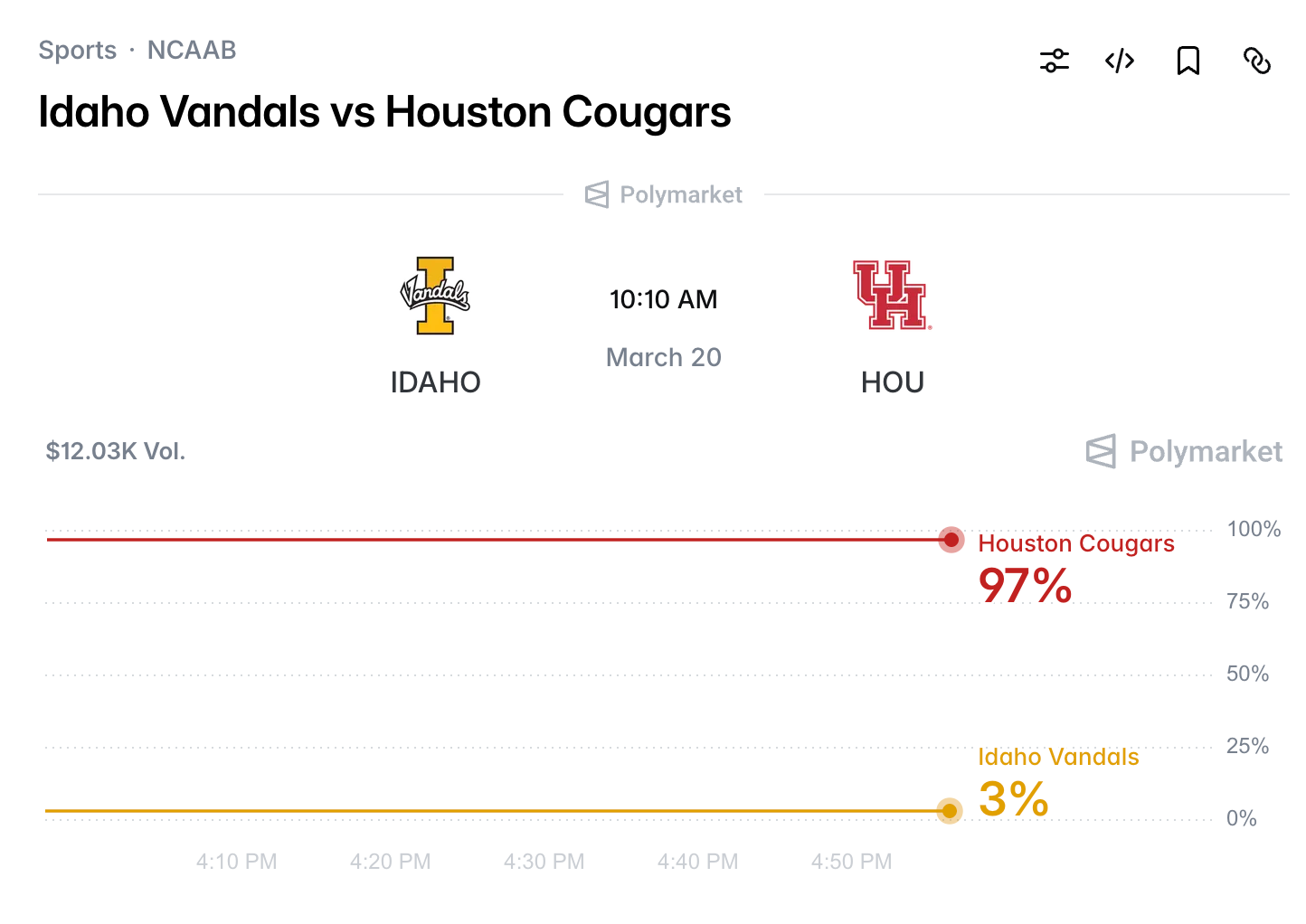
Extremely small fluctuations mean users can temporarily avoid "inventory risk," the biggest risk source in market making. Simply put, you don't have to worry too much about sudden one-sided price movements causing your one-sided order to be filled while the market price has moved to an unfavorable direction.
Once you've found a pool (it doesn't have to be this one; I entered this one in the morning, you can look for later ones based on the time), it's time to provide liquidity. Polymarket's liquidity requirements for all NCAA games are a minimum of 1000 shares, with a maximum spread not exceeding ±1¢.
Compared to placing buy orders, it's more recommended to use Polymarket's Split function to split $1000 (the minimum requirement) into equal bilateral shares (which can be reverse-minted into $1000 via the Merge function), and then place sell orders on both sides.
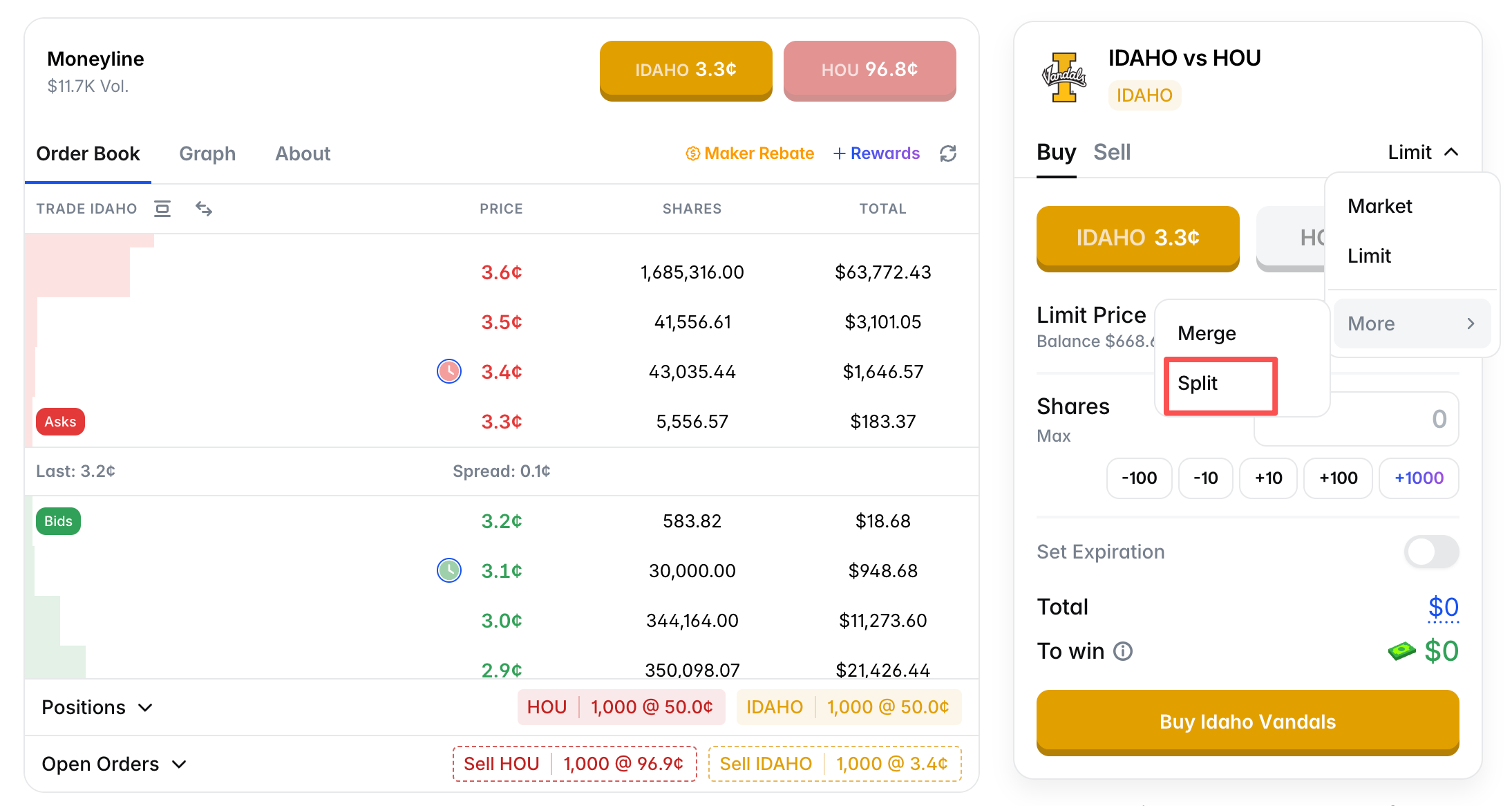
As for the specific price points for placing orders, that depends on your own risk appetite. The closer to the market price, the higher the efficiency of earning LP rewards. However, considering inventory risk, I still prefer placing orders at the "second-best" price level, and then paying attention to price fluctuations, trying to ensure the orders don't get filled — if filled, the order amount no longer meets the requirements, and you also need to consider how to handle the shares on the other side.
Finally, regarding order cancellation timing, it's recommended to cancel orders at least 1 day before the game starts (also suggested to cancel while sleeping, and re-enter after 8:00 the next day when the new daily cycle begins). Then look for later games. If interested in continuing, you can repeat the above operations.
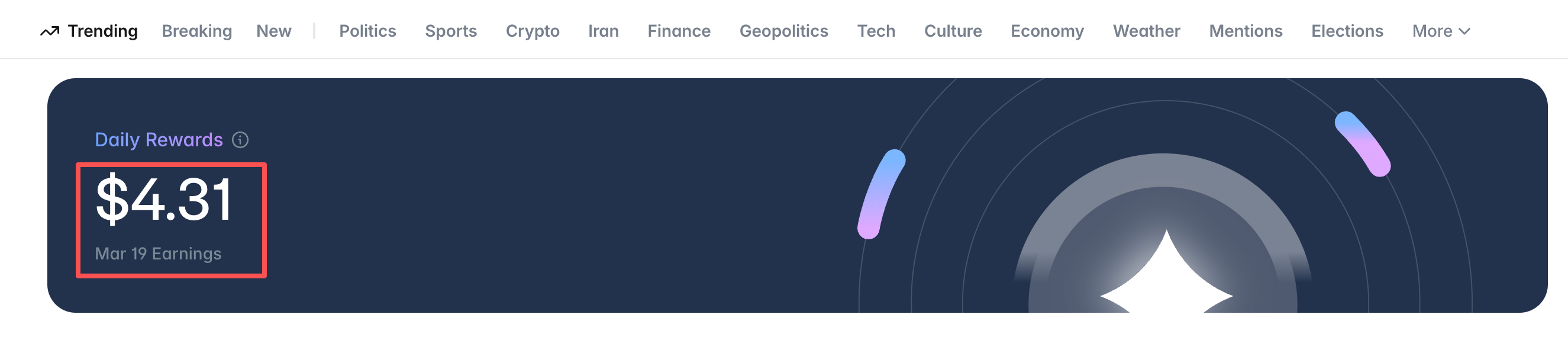
Finally, here's the data. I placed the orders around 10:00 AM. The probability for this game didn't fluctuate at all in the interim. Although I said to keep an eye on it, I didn't really do much. As of 5:00 PM, the LP rewards earned are $4.31 (to be distributed tomorrow).
The profit is small, but the key is to enrich your interaction behavior on Polymarket. Compared to a few days ago, when you might have needed to compete with the market for relatively low subsidies, under the current subsidy intensity and event fluctuation conditions, this operation can almost be considered brainless.
Finally, a quick advertisement: Friends interested in prediction markets are welcome to join our TG chat channel for casual discussion anytime: https://t.me/OdailySeer


