Decoding the March CPI Week: Understanding Crypto Market Changes from U.S. Treasury Yields to Stablecoin Fund Flows


- Core View: The March 2026 CPI data is a key macro signal affecting the crypto market. By altering market expectations for Federal Reserve policy, interest rates, and global liquidity, it dominates the price movements of crypto assets in the short term.
- Key Factors:
- After the CPI data release, the market quickly reprices interest rate expectations, directly impacting U.S. Treasury yields (~4.1%), real interest rates (~1.7%-1.8%), and the U.S. Dollar Index (~98.7). These are core indicators for judging the tightness of financial conditions.
- When CPI exceeds expectations, it typically leads to rising real interest rates and a stronger dollar, tightening global liquidity and putting pressure on risk assets like crypto. Conversely, it may improve the liquidity environment and boost risk appetite.
- Due to its 24/7 trading, high leverage, and fragmented liquidity structure, the crypto market often reacts to macro events like CPI more rapidly than traditional markets, and volatility can be amplified.
- Traders need to comprehensively monitor on-chain liquidity indicators such as total stablecoin market cap (~$297-300 billion), along with open interest and funding rates in the derivatives market, to gauge fund flows and market sentiment.
- The March CPI week is a dense window of macro events. Its data will influence subsequent PCE inflation data and market expectations ahead of the FOMC meeting, thereby rapidly reshaping judgments about the rate cut path.
Quick Takeaways
- Why CPI is Important for the Crypto Market: U.S. CPI is around 2.4% year-on-year in early 2026. Any unexpected change in inflation data can quickly alter market expectations for the Federal Reserve's policy path and global liquidity.
- Market's Immediate Reaction: Whenever CPI is released, Bitcoin and Ethereum often experience significant price swings within minutes as traders immediately reprice macro risks and interest rate expectations.
- Interest Rate Signals: The 10-year U.S. Treasury yield (around 4.1%) and the 10-year real interest rate (around 1.7%–1.8%) are key indicators for judging whether financial conditions are tightening.
- Dollar Liquidity Channel: When the U.S. Dollar Index (DXY around 97–100) strengthens, it often signals rising yields and tightening liquidity, which may lead to a decline in risk appetite in the crypto market.
- Policy Timing Window: This CPI release is scheduled before the March 13 PCE inflation data and the March 17–18 FOMC meeting, potentially quickly influencing market expectations for the future pace of rate cuts.
- Key Liquidity Indicators: Traders typically focus on real interest rates, the DXY trend, derivatives positioning structure, and the support provided to the crypto market by the stablecoin liquidity pool, which is worth approximately $297 billion.
Why the March CPI Week is Crucial for the Crypto Market
For the crypto market, the March CPI week represents a typical macro "critical window period." During this timeframe, multiple important macro data points are released in quick succession, potentially rapidly changing the global market's overall assessment of interest rates, liquidity, and risk assets. Specifically, the market will sequentially face the March 11 U.S. CPI data, the March 13 PCE inflation indicator, and the March 17–18 Federal Reserve FOMC policy meeting. When such key events cluster, the market often undergoes rapid repricing, as each data point has the potential to reinforce or alter expectations for the Fed's policy path.
Among this series of macro data, CPI is usually the first significant inflation signal released. Although the Fed's official inflation target is the PCE indicator, financial markets often react first to CPI data, particularly reflected in changes to U.S. Treasury yields, real interest rates, and the Dollar Index—variables that are core indicators influencing global liquidity.
If inflation data comes in higher than market expectations, real interest rates tend to rise, and the dollar may strengthen, thereby tightening financial conditions and putting pressure on high-risk assets, including crypto assets. Conversely, if inflation data is lower than expected, Treasury yields typically fall, the liquidity environment improves, market risk appetite may recover, providing support for the digital asset market.
March 2026 CPI Week Schedule and Market Rhythm
Entering the March 2026 CPI week, global financial markets will face a highly concentrated macro data window. Multiple key economic indicators will be released in a short period. This "data-intensive period" often significantly increases market volatility, as each data point can reinforce or change the market's judgment on the Fed's policy path.
For crypto market participants, the focus is not just on the CPI number itself. The more critical question is: After the CPI release, do real interest rates, the Dollar Index, and the global liquidity environment change? These macro variables are often important drivers behind the price movements of Bitcoin, Ethereum, and the overall crypto market.
March 2026 Macro Catalyst Event Window
DateEventWhy Crypto Traders Should CareMarch 7U.S. Non-Farm Payrolls (NFP) ReportStrength of the labor market affects wage inflation and further influences interest rate expectationsMarch 11Consumer Price Index (CPI)The first key inflation signal, potentially driving rapid volatility in real rates and the Dollar IndexMarch 13Producer Price Index (PPI)Upstream inflation indicator, affecting market judgment on PCE inflation trendsMarch 13Personal Consumption Expenditures Price Index (PCE)The Fed's most-watched inflation gauge, used to verify or correct market expectations set by CPIMarch 17–18Federal Reserve FOMC Meeting (includes dot plot)Policy path and rate projections may reshape the rate cut timelineMarch 18Federal Reserve Press ConferenceOfficials' rhetoric and policy guidance will impact interest rates, forex, and global risk assets
This structure of clustered macro events compresses the market's uncertainty range in a short time. In other words, market volatility often stems not from the data "release" itself, but from the data changing market expectations for future policy.
For example:
- If CPI is higher than market expectations, real interest rates may rise, the dollar strengthens, global liquidity tightens, putting pressure on risk assets including crypto assets.
- If CPI is lower than expected, the market may reprice the rate cut path, real rates fall, the dollar weakens, risk appetite recovers, and the crypto market finds it easier to gain funding support.
It's worth noting that as the crypto market operates 24/7,Bitcoin (BTC) andEthereum (ETH) typically experience price fluctuations within minutes of the CPI release. In contrast, traditional financial markets often take longer to complete the repricing of macro expectations.
From a trading strategy perspective, CPI week is often seen as an important time window for macro position adjustments. Professional traders closely monitor whether the data changes the market's core judgment on interest rates, the dollar, and global liquidity, and reassess the allocation direction for risk assets accordingly.
Macro Transmission Chain: From CPI to Crypto Asset Prices
To understand why a traditional macro data point affects crypto market trends, one must look at the transmission mechanism of macro information within the financial system. After inflation data is released, the market doesn't just focus on the number itself but quickly reassesses the interest rate path, cost of capital, and global liquidity environment.
In most cases, this impact unfolds along a relatively clear transmission chain:
CPI Release → Change in Inflation Expectations → Adjustment of Fed Policy Expectations → Change in Bond Yields → Dollar Movement → Change in Financial Conditions → Risk Assets → Crypto Market
When CPI is higher than market expectations, investors typically believe the Fed needs to maintain a relatively tight policy environment for a longer period. This expectation often pushes U.S. Treasury yields higher and strengthens the dollar, thereby tightening global financial conditions and creating periodic pressure on risk assets, including crypto assets.
Conversely, if CPI is lower than expected, the market may increase expectations for future rate cuts, pushing bond yields lower and weakening the dollar. In such an environment, global liquidity usually sees marginal improvement, risk appetite increases, and crypto assets like Bitcoin and Ethereum are more likely to attract capital attention.
Similar macro reactions frequently appear in traditional stock markets. For example, core stock indices like the S&P 500 Index typically fluctuate with changes in interest rate expectations. On digital asset platforms supporting tokenized stock trading, such as the SPYON/USDT trading pair (used to track S&P 500 performance), traders can observe within the same trading environment how macro liquidity changes simultaneously affect traditional risk assets and the crypto market.
In this macro transmission process, the following key indicators are particularly worthy of market participants' attention:
IndicatorWhy the Market CaresPotential Market ImpactU.S. 10-Year Treasury YieldReflects economic growth expectations and policy rate directionRising yields typically pressure risk assets10-Year Real Interest Rate (TIPS)Measures the real cost of financing after inflationRising real rates signal tightening financial conditionsU.S. Dollar Index (DXY)Reflects global capital demand for dollar assetsA stronger dollar often suppresses risk asset performanceTotal Stablecoin Market CapMeasures internal liquidity levels in the crypto marketGrowth in stablecoin supply usually indicates potential buying power increase
How Inflation Affects Global and Crypto Market Liquidity
Within the macro financial system, inflation data is often a key variable affecting global liquidity. After inflation data is released, the market quickly reassesses the interest rate path, real yields, and the dollar liquidity environment. These changes affect not only traditional financial markets but also, through capital flows and shifts in risk appetite, transmit further to the crypto asset market.
IndicatorLatest LevelMarket ImplicationU.S. CPI Inflation~2.4% (YoY)While inflation remains above the Fed's 2% target, the overall trend is gradually declining10-Year TIPS Real Yield~1.77%Higher real rates imply financial conditions remain relatively tight10-Year Breakeven Inflation Rate~2.28%Market long-term inflation expectations remain relatively stableMOVE Index~70Interest rate market volatility is at a moderate level, with potential for amplified swingsGlobal Stablecoin Supply~$297–300 BillionForms an important liquidity foundation for the crypto market
Although inflation is gradually declining towards the Fed's 2% target, any unexpected change in CPI can still quickly disrupt the market's judgment on the policy path. When inflation data exceeds expectations, the market often reprices a longer period of tight policy, pushing real yields higher. Higher real yields typically attract capital inflows into dollar assets, strengthening the Dollar Index (DXY) and tightening financial conditions globally. Conversely, if inflation data is lower than expected, the market may reprice the future rate cut path, pushing real yields lower and weakening the dollar. In this scenario, the global liquidity environment usually improves marginally, risk appetite recovers, and the crypto asset market finds it easier to attract capital attention.
IndicatorDataMarket ImplicationOil Price Shock Transmission10% oil price increase → ~0.4 percentage point rise in inflationEnergy price changes affect CPI and inflation expectationsPost-Pandemic U.S. Inflation CycleAverage ~3%–4%Triggered Fed rate hike cycle and tightened liquidityGlobal Stablecoin Liquidity~$300 Billion Market CapProvides core liquidity for crypto trading and DeFi activities
Historical experience shows that inflation shocks often affect global markets through two core channels: interest rates and exchange rates. When inflation expectations rise, central banks may delay rate cuts or maintain higher rates for longer, increasing financing costs and altering the direction of global capital flows.
The crypto market is not outside the macro system. In fact, due to the 24/7 trading mechanism and the high-leverage structure of derivatives markets, the digital asset market often reflects macro changes faster than traditional markets. Therefore, for an increasing number of traders, monitoring inflation data, interest rate trends, and dollar liquidity has become an important reference framework for understanding crypto market cycles.
What Crypto Traders Need to Focus on During CPI Week
During the CPI release period, what truly changes is often not the data itself, but the market's reaction to the data. For experienced traders, more important than simply watching the inflation number is observing the immediate changes in key indicators like interest rates, the dollar, liquidity, and derivatives positioning. These signals often reflect shifts in market risk appetite earlier. The following indicators are core variables that many professional traders closely monitor before and after the CPI release.
U.S. Treasury Yields
After CPI data is released, U.S. Treasury yields typically fluctuate rapidly within seconds. If yields rise significantly, it often means the market is repricing a longer period of tight monetary policy.
 The bond market remains an important macro signal for observing risk asset trends. On March 10, 2026, the 10-year U.S. Treasury yield was approximately 4.11%, reflecting investor positioning and expectation changes ahead of the CPI release. This data can quickly influence market judgment on the interest rate path and liquidity environment. (Source: TradingView)
Among these, a rapid rise in real yields is often more detrimental to speculative assets, as it increases the opportunity cost of holding non-yielding assets (like Bitcoin), thereby suppressing demand for risk assets.
U.S. Dollar Index (DXY)
The U.S. Dollar Index (DXY) reflects global capital demand for dollar assets. When the dollar strengthens, liquidity in the global financial system typically tightens, as a large volume of international trade and financial transactions are denominated in dollars.
 The Dollar Index is around 98.7, reflecting global forex market capital allocation ahead of CPI week. Typically, a stronger dollar implies tightening financial conditions and may be accompanied by a decline in speculative asset risk appetite. (Source: TradingView)
For the crypto market, a stronger dollar often signals declining risk appetite, which is why many traders view DXY as an important macro indicator for observing crypto market liquidity.
Stablecoin Liquidity
Within the crypto ecosystem, stablecoins are one of the core carriers of fund flows. By observing changes in the total stablecoin supply, market participants can gauge whether capital is entering or exiting the crypto market.
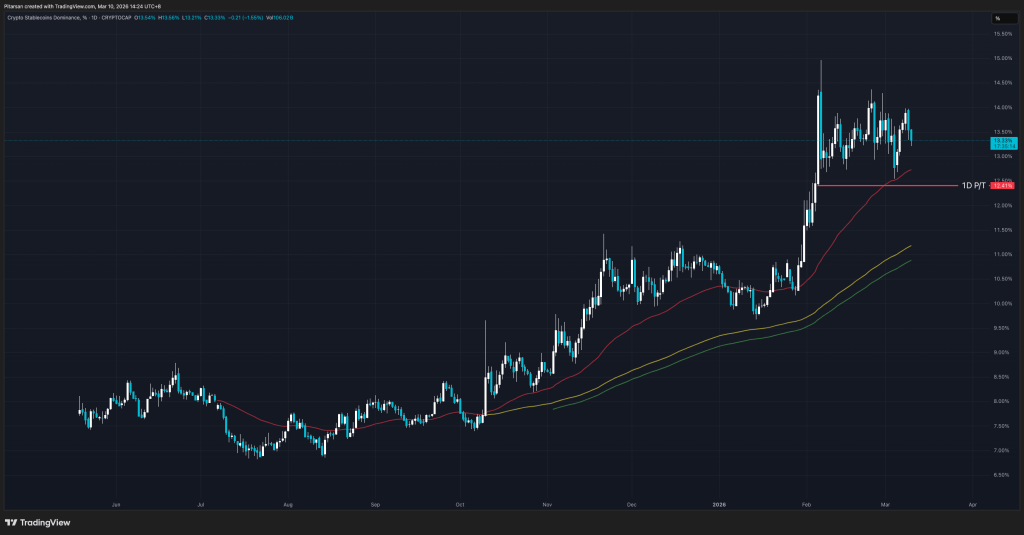 The current stablecoin market cap share is approximately 13%, meaning a significant portion of crypto market funds remain in the form of cash-equivalent assets like USDT and USDC. These funds constitute potential liquidity that may be reallocated into digital asset markets when market risk appetite recovers. (Source: TradingView)
Derivatives Market Positioning
Around the CPI release, the crypto derivatives market often experiences amplified volatility and rapid position adjustments. Professional traders typically focus on the following indicators:
- Open Interest (OI)
 Source: Coinglass
- Funding Rate
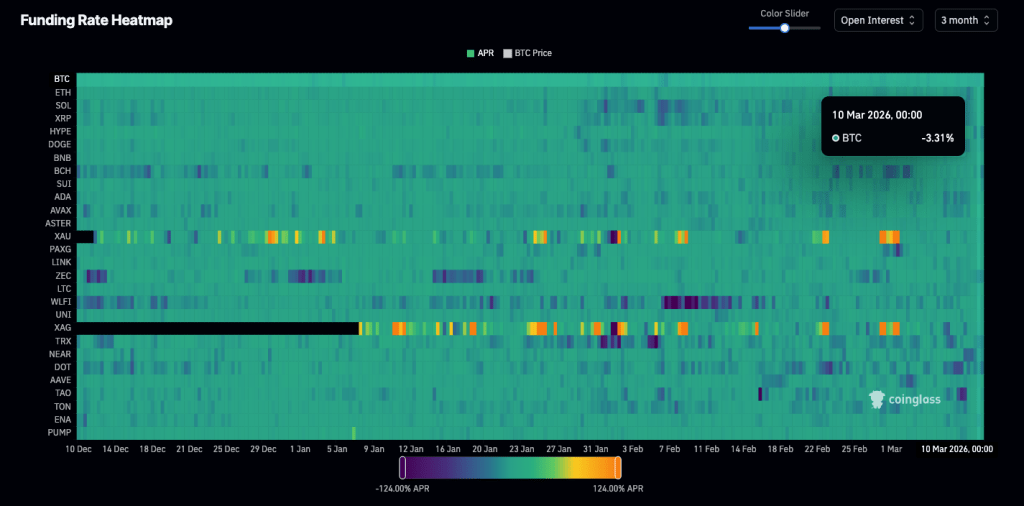 Source: Coinglass
- Liquidation Clusters
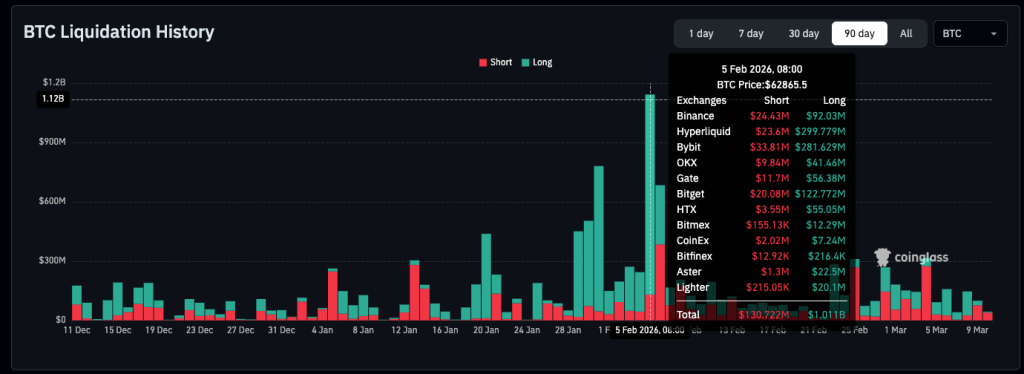 Source: Coinglass
These indicators help determine whether the market is becoming overly crowded in a particular direction. Due to the prevalence of high leverage in crypto markets, when macro events like CPI occur, they often trigger cascading liquidations, amplifying price volatility. From a trading practice perspective, CPI week is often not just a data release event but a crucial moment for market position repricing. By comprehensively observing interest rates, the dollar, stablecoin liquidity, and derivatives structure, traders can more fully understand the actual impact of macro data on the crypto market.
Interpreting CPI Surprises: What the Market is Really Watching This Week
The core question the market is focused on this week is: whether the recent rise driven by energy prices is beginning to spread to core inflation, especially service prices and wage levels. Previous oil price volatility has already raised concerns that the disinflation trend may slow, and investors are watching for signs of broader price pressures.
Current market consensus expects CPI year-on-year around 2.4%, with core CPI around 2.5%, roughly in line with recent data