






SEC Drops Cases, CZ Pardoned, Justin Sun Settles: Trump's Crypto Business Gains Momentum


- Core Viewpoint: The article points out that during the Trump administration, the intensity of U.S. crypto regulatory enforcement has systematically weakened. The biggest private beneficiary of this policy shift is precisely the crypto projects associated with the Trump family. Through mechanisms such as token sale revenue sharing and the USD1 stablecoin, they have directly converted increased market activity into substantial income.
- Key Elements:
- Policy Retreat: Since early 2025, the SEC has dropped or terminated at least a dozen crypto-related cases, including withdrawing the lawsuit against Binance and Trump's pardon of Changpeng Zhao (CZ), significantly reducing legal friction in the industry.
- Private Benefit Mechanism: The Trump Organization generated $802 million in revenue from crypto operations in the first half of 2025, primarily from the World Liberty Financial project, with 75% of its token sale revenue flowing to Trump family entities.
- Key Distribution Channel: Justin Sun invested at least $75 million into World Liberty tokens. Furthermore, approximately 2 billion of the early supply of the USD1 stablecoin was highly concentrated in a single channel from MGX to Binance investments, helping it rapidly grow into the sixth-largest stablecoin (with a circulation of about $4.4 billion).
- Macro Impact of Stablecoins: Research from the Bank for International Settlements indicates that net inflows into dollar-denominated stablecoins can influence Treasury yields. Their growth is now embedded within the financial system, simultaneously raising concerns among banks about deposit outflows.
- Legislation and Conflicts of Interest: The deadlock in U.S. stablecoin legislation partly stems from banking industry opposition to interest-bearing features and controversies over ethical clauses related to Trump-associated projects, highlighting the structural conflicts arising from private policy benefits.
Original Author: CryptoSlate
Original Compilation: TechFlow
Introduction: This article goes beyond simply reporting the settlement between Justin Sun and the SEC, placing this $10 million settlement within a larger policy landscape. Since the Trump administration took office, the SEC's enforcement pressure on crypto giants has systematically receded, and the biggest beneficiary of this retreat is precisely Trump's own token and stablecoin projects. Using quantifiable data ($802 million in revenue, $4.4 billion USD1 circulation), the article outlines the transmission mechanism between policy and private gain, making it essential reading for anyone following the direction of US crypto regulation.
Full text is as follows:
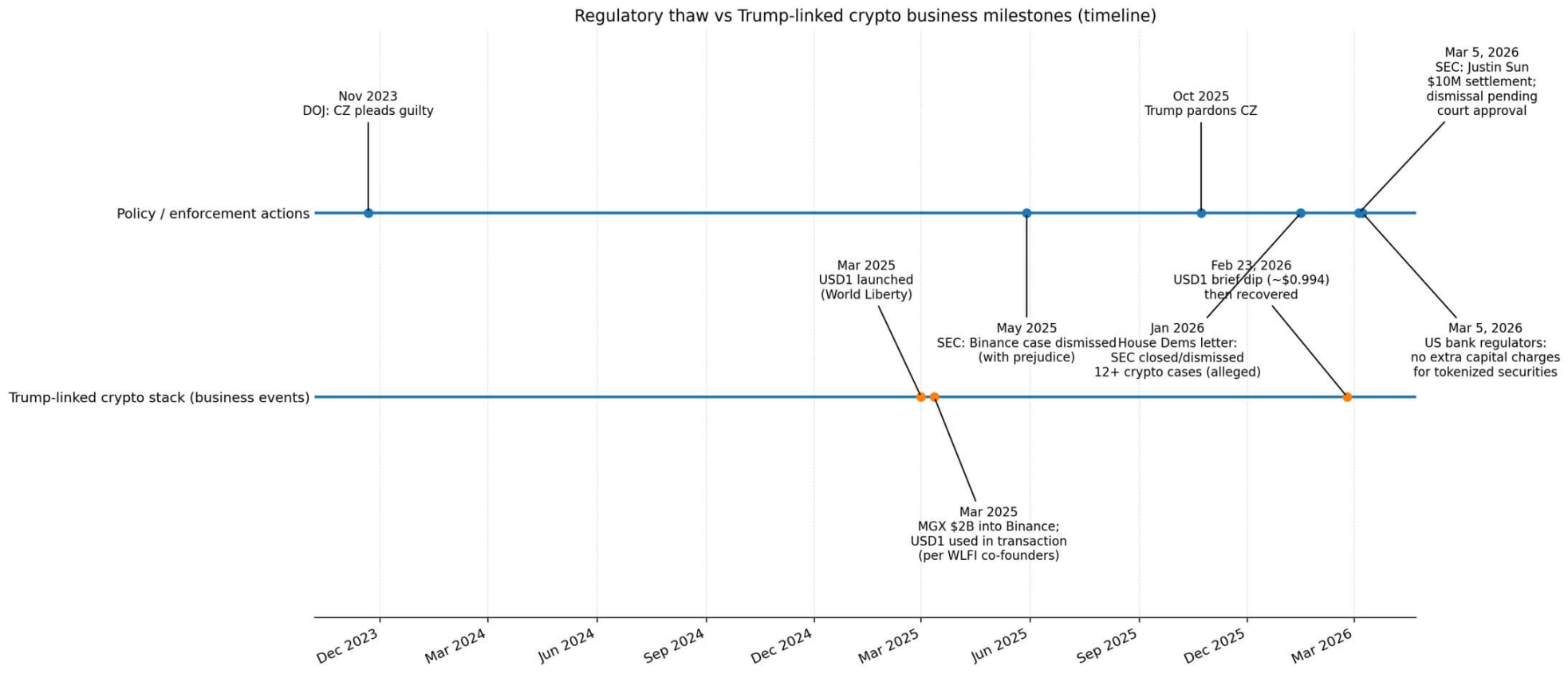
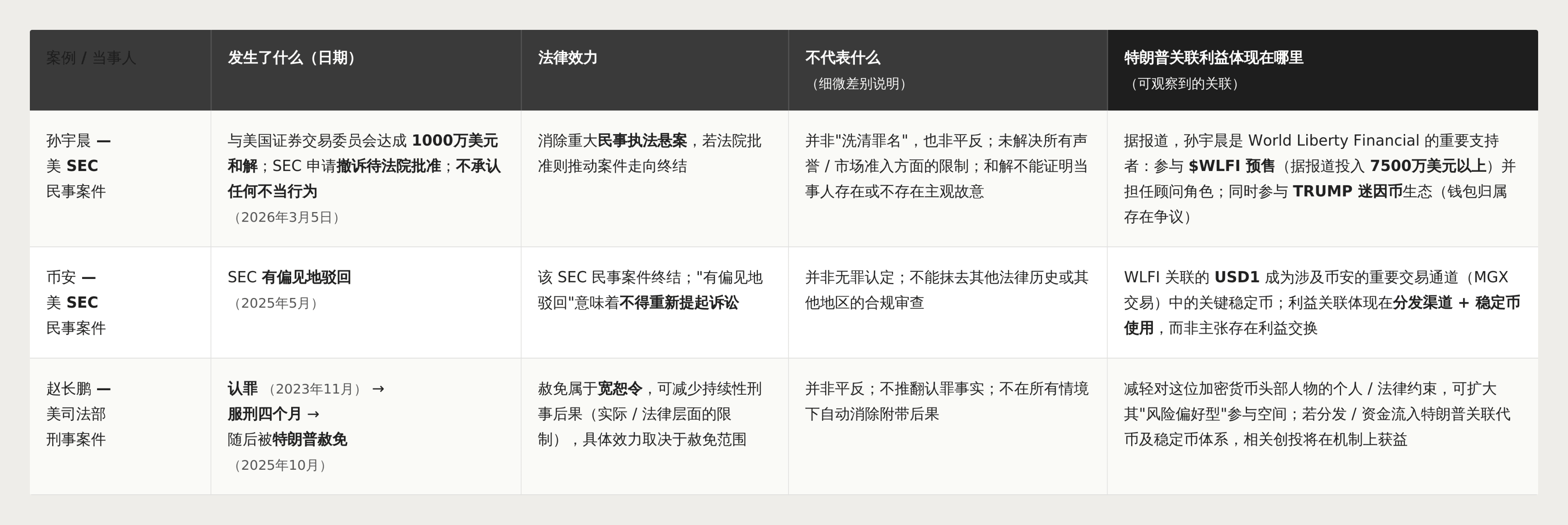
On March 5, Justin Sun reached a $10 million settlement with the SEC, resolving a civil fraud lawsuit. The case alleged he profited $31 million through wash trading-like operations and undisclosed celebrity promotions.
The settlement is subject to court approval and does not include any admission of wrongdoing, leading to the dismissal of the case.
On the same day, US banking regulators announced that banks holding tokenized securities and traditional securities would not face additional capital requirements. This technology-neutral classification represents another brick removed from the wall of crypto regulation.
Sun's settlement coincides with the one-year anniversary of the Trump administration's regulatory pullback.
In May 2025, the SEC's civil lawsuit against Binance was dismissed with prejudice. In October 2025, Trump pardoned Binance founder Changpeng Zhao (CZ) — who had pleaded guilty in November 2023 to charges of anti-money laundering and operating an unlicensed money-transmitting business, paid billions in fines, and served a four-month sentence.
In January 2026, a joint letter from Democratic members of the House Financial Services Committee noted that the SEC had dismissed or terminated at least a dozen crypto-related cases since January 2025.
The beneficiaries are not just the overall US crypto market. Trump's own crypto network has quietly positioned itself to capture outsized private gains from the distribution channels and business relationships controlled by these entrepreneurs.
Tokenomics at the President's Proximity
In less than a year, two globally renowned crypto entrepreneurs have successively shed major US legal constraints.
Sun's settlement ends the civil fraud case but is not a finding of innocence. Binance's SEC civil lawsuit was dismissed with prejudice. CZ's pardon is an act of clemency, not an overturning of the facts to which he pleaded guilty.
Meanwhile, crypto projects linked to the Trump family have become direct beneficiaries of the crypto market's renewed activity.
Reuters estimated that the Trump Organization generated $802 million from crypto operations in the first half of 2025 alone, far exceeding other business lines, with the token economics of World Liberty Financial accounting for the largest share.
World Liberty's gold documents stipulate that 75% of token sale proceeds, after operational expenses, flow to Trump family entities. The stablecoin component USD1, launched in March 2025, added another revenue stream through collateral reserve yields, which Reuters estimated could generate tens of millions annually at scale.
Sun became one of the most visible buyers of World Liberty tokens, investing at least $75 million into the WLFI token presale and joining as an advisor.
He also participated in the TRUMP Memecoin ecosystem, with reports linking a "SUN" wallet and HTX-related activity to significant holdings, though specific attribution remains debated.
Binance's intersection with the Trump crypto ecosystem connects via another channel: Abu Dhabi-backed MGX invested $2 billion in Binance in March 2025, the largest institutional-level transaction in crypto history.
A World Liberty co-founder confirmed that USD1 was used in that MGX-Binance transaction.
Reports found that when USD1's total circulation was only about $2.1 billion, approximately $2 billion USD1 was held in a single wallet, highlighting how a single pipeline dominated early supply.
By February 2026, according to Artemis data, USD1 had grown to become the sixth-largest stablecoin, with a circulation of approximately $4.4 billion.
On February 23, USD1 briefly dropped to around $0.994, which World Liberty called a "coordinated attack" on its X account, but the peg quickly recovered.
USD1's highly concentrated early supply via the MGX-Binance channel, followed by growth, created a distribution advantage that World Liberty's revenue structure could directly monetize.
The Feedback Loop from Policy to Profit
This business design means: the retreat of enforcement and the gradual guidance from regulators are both reducing friction.
Less friction leads to more activity, and more activity enables the monetization of Trump-linked token and stablecoin economies.
Trump becomes the largest private beneficiary of these outcomes without personally orchestrating the regulatory results. This overlap is mechanical: when legal pressure is lifted from participants controlling distribution channels—like Binance's exchange listing power or Sun's investment capacity—projects that capture this renewed activity benefit, and World Liberty's token and stablecoin structures are precisely positioned at these key nodes.
Stablecoins have evolved from niche crypto infrastructure to macro-level collateral. A February 2026 Bank for International Settlements working paper found that a two-standard-deviation net inflow into dollar stablecoins could depress three-month Treasury yields by about 2.5 to 3.5 basis points, rising to 5 to 8 basis points during periods of Treasury scarcity.
Stablecoin growth now generates measurable demand for safe assets, embedding these tools into interest rate and Treasury pipelines.
A European Central Bank working paper documented a "deposit substitution mechanism": stablecoin adoption reduces retail deposits, limiting bank intermediation activity.
Eurozone evidence provides a rigorous analytical framework for US banks' opposition to stablecoin interest-bearing features. This directly corresponds to the current US legislative impasse. The Clarity Act is stalled again, primarily due to bank opposition to stablecoin interest (fearing accelerated deposit outflows) and ongoing disputes over ethics and anti-money laundering clauses involving Trump-linked projects.
According to DeFiLlama data, the total stablecoin market cap is approximately $313 billion, with 30-day growth of 3.7%. Even without new legislation, the US is functionally lowering the operational cost of crypto businesses, and Trump's crypto ecosystem has positioned itself as a "toll booth" for distribution growth.
Second-Order Beneficiaries and Structural Constraints
The first-order private beneficiaries are Trump's crypto network. The second-order public beneficiary is the overall US crypto market—reduced enforcement risk premiums, accelerated product launches, more US-facing projects going live.
This distinction is important because it separates correlation from causation without ignoring observable benefit flows. Settlements are not findings of innocence, dismissals are with prejudice, pardons are clemency, not factual reversals.
Even if a direct link between enforcement outcomes and private business ties cannot be proven, the distribution and revenue outcomes are visible and quantifiable.
SEC Chairman Paul Atkins stated in February 2026 that the agency was rehiring after previous White House-led staff reductions. He responded to accusations that the SEC's dismissal of crypto cases was politically motivated, noting many decisions were made before his tenure.
The thaw extends beyond individuals. US regulators now favor "exemptive relief" for tokenized securities experiments, while the UK favors sandbox approaches. This divergence creates cross-border friction, even as US policy overall leans permissive.
The next constraint may not be legal, but legislative and political.
Banks view stablecoins as a deposit substitution threat. Ethics clauses in proposed legislation could structurally limit the scale of Trump-linked projects even as the market grows, or they could be toothless, allowing for faster expansion.
Entrepreneurs who have been cleared in civil court or pardoned in criminal cases will still face reputational and market access constraints if future enforcement agencies take a harder line.
Regulatory pressure could re-emerge as policy risk rather than pure legal risk.
Why This Matters
The concentration of benefits to Trump's crypto projects raises conflict-of-interest questions, without needing to prove a quid pro quo.
Revenue sharing, stablecoin reserve yields, and distribution touchpoints are all documented in public filings and reports. Policy shifts—reduced enforcement, gradual guidance, civil dismissals, and pardons—have reduced friction.
The private capture of this reduced friction is most evident in projects where tokenomics and stablecoin growth translate directly into presidential-linked revenue.
Trump did not need to be the biggest beneficiary of the regulatory retreat. The beneficiary's identity is observable.
As Trump-era regulators lifted legal pressure from crypto's leading figures, the clearest private upside accrued to Trump's own token and stablecoin system, with the broader US market as the second-order beneficiary. This pattern holds regardless of motive, and the numbers make it legible.


