From the Strait of Hormuz to the Crypto Market: How Oil Price Shocks Alter Global Liquidity


- Core Viewpoint: The article points out that while oil and crypto assets may seem unrelated, they are closely connected through global liquidity. Changes in oil prices can quickly transmit to the crypto market by affecting inflation, interest rates, the US dollar, and risk appetite, making crypto a leading indicator for sensing shifts in the macro environment.
- Key Elements:
- In early 2026, market expectations were for a loose oil supply. The IEA predicted supply growth would far outpace demand, with Brent crude oil price expectations around $58 per barrel, suggesting potential easing of inflationary pressures.
- In March 2026, geopolitical risks in the Strait of Hormuz escalated, with approximately 20 million barrels per day of oil transportation facing potential disruption. This rapidly shifted the market narrative from "supply glut" to "supply shock," pushing oil prices above $100 per barrel.
- Rising oil prices can increase inflation expectations, US Treasury yields, and the US dollar, thereby tightening global liquidity and creating pressure on risk assets like crypto assets.
- The crypto market can gain exposure to oil prices through synthetic assets or derivatives (such as OIL/USDT perpetual contracts), allowing traders to directly participate in macro themes within the crypto environment.
- Asia, as a core global oil-importing region, is highly dependent on Strait of Hormuz shipments, meaning energy shocks in this region can rapidly transmit to global inflation and financial conditions.
On the surface, oil and crypto assets seem to have no connection. One revolves around oil fields, pipelines, and shipping, while the other operates on blockchains and digital exchanges. But at a macro level, they are actually connected by the same force: global liquidity.
Changes in crude oil prices affect inflation expectations, interest rate paths, the US dollar's trajectory, and market risk appetite. When these variables shift, the direction of capital flows changes accordingly, and the crypto market is often one of the first asset classes to feel this change.
At the beginning of 2026, the market narrative was quite simple. The International Energy Agency (IEA) projected global oil demand growth for that year to be approximately 850,000 barrels per day (b/d), while supply growth could reach 2.4 million b/d. With supply growth significantly outpacing demand, inventories were expected to accumulate continuously. The U.S. Energy Information Administration (EIA) even forecasted an average annual Brent crude price of around $58 per barrel.
Under such expectations, many institutions believed oil price pressure would be limited, and inflation risks might gradually ease.
But the oil market never runs according to predictions for long.
In March 2026, as tensions suddenly escalated around the Strait of Hormuz, this globally critical energy transit chokepoint began to capture market attention. In a short period, oil prices rapidly broke through $100 per barrel, and the market narrative changed accordingly.
The original story of "ample supply" suddenly became one of "potential supply shock."
And this is precisely where oil prices begin to influence global market liquidity.

Key Takeaways
- Oil is a significant macro signal. Approximately 20 million barrels per day of crude oil transit the Strait of Hormuz, accounting for about 20% of global oil consumption, making the energy market highly sensitive to geopolitical risks.
- Oil prices directly impact financial conditions. Rising crude oil prices tend to push up inflation expectations, U.S. Treasury yields, and the U.S. Dollar Index (DXY), thereby tightening global liquidity and putting pressure on risk assets, including crypto assets.
- The market consensus in early 2026 was for loose supply. Institutions projected global oil demand growth of about 850,000 b/d, while supply growth could reach 2.4 million b/d. Supply clearly outpacing demand suggested inventory builds and potential downward pressure on prices.
- But geopolitical risk swiftly altered the market narrative. Tensions in the Strait of Hormuz in March 2026 placed approximately 15 million b/d of crude oil and 4.5 million b/d of refined products at risk of potential disruption, forcing a rapid reassessment of the previous "supply glut" expectation.
- Refined product markets can amplify inflationary pressures. When supplies of diesel, jet fuel, and gasoline tighten, transportation and logistics costs often rise rapidly, further reinforcing inflation expectations.
- Oil is both a macro signal and a tradable theme. Trading instruments like the OIL/USDT perpetual contract enable investors to directly participate in oil price movements within a crypto trading environment, capturing macro market opportunities.
Why Crude Oil Remains a Key Macro Signal for Global Markets
Crude oil remains one of the most important commodities in the global economy because it directly impacts a vast array of real economic activities. From transportation, refining, and logistics to industrial production and household energy expenditures, nearly all critical economic links are closely tied to crude oil prices. Therefore, once the oil market experiences disruption, its effects often rapidly spread from a singular supply issue to a broader macroeconomic shock.
For financial markets, oil price changes typically exert influence through several channels:
- Impacts inflation levels. Crude oil prices, transmitted through fuel and transportation costs, can push overall inflation higher or lower.
- Affects corporate costs and consumer purchasing power. Oil price changes alter corporate production costs and impact consumers' real purchasing power.
- Influences trade structures and exchange rate trends. For economies with high dependence on energy imports or exports, oil price volatility often affects trade balances and currency movements.
- Alters market risk sentiment. When oil price volatility is linked to geopolitical events, it often has a noticeable impact on global market sentiment.
When oil prices rise, inflation expectations typically follow, the US dollar may strengthen, and overall financial conditions may tend to tighten. Conversely, if oil prices fall due to ample supply, inflationary pressures may ease, and the global market's liquidity environment may improve.
China serves as a classic case study for observing how oil price shocks transmit to the global economy. As the world's largest crude oil importer, China relies on imports for about 70% of its oil consumption, a significant portion of which comes from the Middle East. This means that once supply disruptions occur in the Persian Gulf region, Asian energy markets and global trade flows are often quickly affected.
Image source: Freepik.com
Simultaneously, China has also built up a sizable strategic and commercial petroleum reserve, with an overall storage capacity covering over 100 days of net import demand. Therefore, when supply risks emerge, the market often first reacts with rising oil prices and shipping costs, rather than immediate physical shortages. However, even so, rising energy costs can still transmit through increased manufacturing costs, further feeding into global inflationary pressures.
Understanding the Crude Oil Market: Physical Supply vs. Financial Pricing
To understand why oil prices affect broader financial markets, one must first grasp how the oil market itself operates. Crude oil is not an asset with a single price but a global system composed of a physical supply chain and a vast financial market, both continuously interacting to jointly determine price trends.
The Physical Layer
The physical market for crude oil begins with upstream exploration and production, followed by multiple stages including transportation, storage, refining, and final distribution.
Because the refining stage is crucial in the entire supply chain, crude oil supply and refined product supply do not necessarily change in sync. For example, when refinery capacity is affected by maintenance, accidents, or declining profit margins, markets for refined products like gasoline and diesel can still tighten even if crude supply is ample. Therefore, many oil price fluctuations are driven not only by production changes but also closely linked to bottlenecks in refining capacity and logistics.
The Financial Layer
Beyond the physical market exists a massive financial market. Crude oil prices are typically reflected through global benchmark prices, derivative contracts, and regional price differentials. Currently, the two most important global benchmarks are:
- Brent Crude
- West Texas Intermediate (WTI)
They provide pricing references for the majority of global crude oil trading.
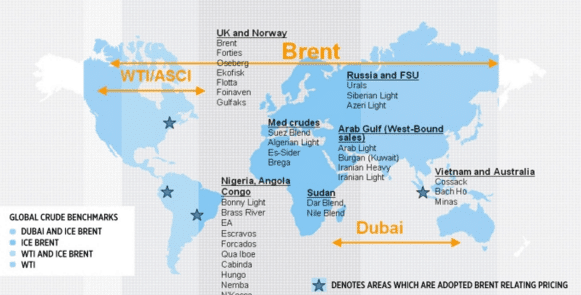
Image source: CroftSystems.net
In financial markets, derivative instruments like futures, options, and swaps enable market participants to hedge risks, manage inventory exposure, or express macroeconomic views. Standardized contracts play a key role here. For example, one CME WTI crude oil futures contract represents 1,000 barrels of oil, allowing institutional investors to allocate and trade large-scale energy assets with high efficiency.
When benchmark prices like Brent or WTI fluctuate, the information conveyed to the market often extends beyond the energy sector itself. Oil price changes typically also reflect factors such as global economic growth expectations, inflation trends, geopolitical risks, and transportation logistics conditions. Therefore, in macro analysis, oil prices are often seen as an important indicator for observing the global economy and liquidity environment, not merely a price signal for a single industry.
Key Data Reference Indicator Verified Data Market Significance IEA 2026 Demand Growth Forecast 0.85 mb/d Slowing demand growth reinforces supply glut expectations IEA 2026 Supply Growth Forecast 2.4 mb/d Supply growth outpacing demand implies a looser market EIA 2026 Global Inventory Build Average 3.1 mb/d Inventory builds typically suppress near-term prices EIA 2026 Brent Average Price Forecast $58/barrel Lower oil prices suggest inflationary pressures may ease CME WTI Contract Size 1,000 barrels Standardized contracts support institutional-scale trading
How the Oil Supply Cycle Affects Inflation and Market Liquidity
The oil market typically exhibits distinct supply cycles, with different phases exerting varying impacts on the global financial environment.
- Tight Supply Phase: When supply is disrupted or demand is unexpectedly strong, oil prices often rise rapidly. Rising energy costs push up inflation expectations, simultaneously strengthening the US dollar and creating upward pressure on interest rates. In this environment, global financial conditions usually tighten, and overall market risk appetite declines.
- Balanced Supply-Demand Phase: When supply and demand roughly match, oil prices typically stabilize, market volatility decreases, and spillover effects on the overall financial environment are relatively limited.
- Supply Surplus Phase: When production exceeds demand and inventories accumulate continuously, oil prices often face downward pressure. If the price decline is driven by ample supply rather than weak demand, this process often has a "disinflationary" effect, easing inflationary and interest rate pressures while improving market liquidity conditions.
Entering early 2026, many institutions predicted the oil market might enter this "supply surplus" phase. Multiple energy agencies projected that global oil supply growth would outpace demand growth, while inventory levels might continue to build.

From 2023 to 2025, WTI crude oil prices generally fluctuated within a $60–$90 per barrel range, reflecting a relatively balanced market. However, as geopolitical tensions escalated around the Strait of Hormuz in March 2026, disrupting regional production and shipping routes, the market narrative shifted rapidly, pushing prices above $100 per barrel. (Image source: TradingView)
But this phenomenon also highlights a key issue: falling oil prices do not necessarily constitute a positive for the market. Price declines can stem from ample supply but can also signal weakening demand.
Furthermore, refined product markets often amplify this effect. Price changes for products like diesel, jet fuel, and gasoline typically react faster than crude supply itself because refining capacity and transportation routes are more susceptible to constraints during sudden events. When refined product supplies tighten, transportation and logistics costs rise swiftly, pushing up inflation expectations and further reinforcing upward pressure on interest rates and financial conditions.
Strait of Hormuz Risk, Oil Price Volatility, and Global Market Pressure
The oil market is extremely sensitive to geopolitical events, one key reason being that a significant proportion of global oil supply must transit through a few critical maritime chokepoints. The Strait of Hormuz is precisely the most important strategic passage among them. In 2024, approximately 20 million barrels per day of oil transited this strait, accounting for about 20% of global petroleum liquids consumption. About 84% of the crude oil and condensate flowing through it heads to Asian markets, making the region particularly sensitive to the stability of this passage.
This regional dependency holds significant meaning for global markets because Asia is the core region for global oil demand growth. China, India, Japan, and South Korea are all highly reliant on energy supplies from the Middle East. Once Gulf region transportation is affected, refining production, shipping logistics, and manufacturing costs can all be rapidly impacted. Given Asia's pivotal role in global trade and industrial production, energy shocks in the region can easily transmit globally, subsequently pushing up inflationary pressures and tightening global financial conditions.
It's worth noting that the market does not need to wait for the strait to be completely closed to react. Even partial disruptions are enough to create noticeable pressure on the supply chain. Increased shipping risks can push up transportation and insurance costs, tankers may be forced to take longer detours to avoid risks, and regional supply flow speeds may slow. These factors often drive energy prices higher and rekindle market concerns about inflation.
Precisely for this reason, the potential supply risks around the Strait of Hormuz in March 2026 quickly captured global market attention. Prior to this, many institutions still believed the 2026 oil market might be in a phase of supply surplus. But as geopolitical risks suddenly heated up, the market began reassessing supply expectations, once again realizing that structural changes in the oil market can occur far faster than model predictions.
Geopolitical Shock Variable and Implication Variable Verified Data Market Implication 2024 Strait of Hormuz Crude Transit Volume ~20 mb/d Once obstructed, immediately impacts global supply-demand balance Share of Global Oil Consumption ~20% Energy shock can rapidly evolve into a macro shock Share of Hormuz Crude/Condensate Flowing to Asia 84% Extremely high exposure for Asian importers Reuters March 2026 Scenario Potential Affected Crude ~15 mb/d Supply concerns can swiftly change oil market narrative Potential Affected Refined Products in Same Scenario ~4.5 mb/d Refined product tightness can amplify inflation pressure
For the crypto market, this transmission is indirect, yet its impact is very direct. When oil triggers geopolitical pressure, financial markets often exhibit the following changes:
- Increased market volatility
- Heightened demand for the US dollar
- More entrenched inflation expectations
- Declining risk appetite for market leverage
Because the crypto market operates 24/7 and remains one of the world's most liquid speculative markets, it often absorbs and reflects such macro pressure first.
Emerging Tokenization and Synthetic Oil Exposure in the Crypto Market
As the digital asset market matures, investors increasingly seek to participate in broader macro themes without leaving crypto trading infrastructure. Oil is gradually becoming part of this discussion, though the participation methods differ from traditional commodity holding models.
In practice, most oil exposure in the crypto market today is not achieved through tokenized physical crude oil but through synthetic assets or derivatives that track crude oil benchmark prices to gain price exposure.
This structure reflects the practical difficulty of tokenizing physical commodities. True physical tokenization requires clear legal ownership, storage verification, and custodial links to real-world infrastructure. These requirements complicate large-scale implementation.
In contrast, financial instruments based on price tracking are easier to design and circulate on trading platforms.
Therefore, current oil exposure in the crypto market typically appears in three main forms:
- DeFi Synthetic Assets: Mapping oil price movements through collateral mechanisms and oracle systems.
- Exchange Derivatives: Particularly trading products like perpetual contracts.
- Explorations in Tokenized Commodities within the RWA (Real World Assets) Sector.
Overall, this structure is highly similar to traditional financial markets. In traditional markets, investors also typically participate in oil trading through price-based financial instruments, rather than taking physical delivery. Within this framework, the OIL/USDT perpetual contract launched by XT.com provides traders with a convenient way to directly express views on energy market trends within a crypto asset trading environment.
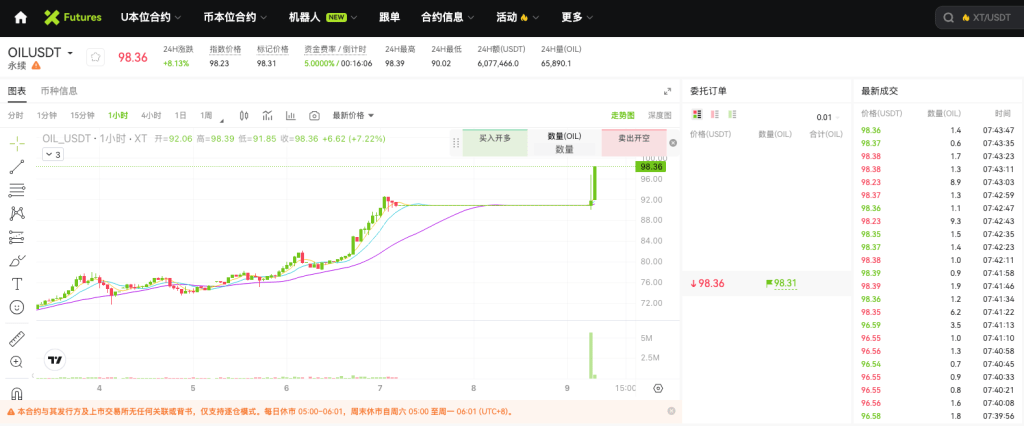
The OIL/USDT perpetual contract trading pair is now live on XT.com.
What Crypto Traders Need to Watch in the Oil Market
Oil prices are usually discussed in the context of the energy market, but in reality, they also provide important signals for the overall financial environment. For digital asset market participants, paying attention to oil price changes helps understand shifts in inflation expectations, currency dynamics, and overall risk appetite.
When observing the oil market, the following indicators are particularly worth watching:
- Inventory Changes: If inventories accumulate continuously, it usually indicates relatively loose supply and may ease inflationary pressures.
- Supply Disruption Risks: Strategic chokepoints like the Strait of Hormuz, major export ports, and key pipelines can swiftly alter market supply expectations once disrupted.financeinvestXT.COMWelcome to Join Odaily Official CommunityRecommended Articles