






Decoding Trump's "War Playbook": A Complete Signal Guide for Investors


- Core Viewpoint: By analyzing the historical patterns of the Trump administration's handling of geopolitical and trade conflicts, the article distills an observable market rhythm framework of "conflict-escalation-pricing-negotiation." It argues that understanding this model helps investors identify changes in risk premiums and potential turning points amid market volatility.
- Key Elements:
- Consistency in Conflict Patterns: Trump often employs a similar "public pressure-escalation-final negotiation" strategy towards both allies and opponents when pursuing economic or military objectives, as seen in the trade war, the Venezuela incident, and the current Iran situation.
- Key Tactics Include Friday Actions: Major policy or military actions are frequently announced on Friday evenings (after U.S. stock market close) to leverage the weekend as a buffer against market shocks and create space for subsequent negotiations.
- Market Pricing Follows a Specific Rhythm: Markets often rebound initially due to expectations of a "quick deal," but as conflicts persist, they gradually reprice for long-term risks (e.g., supply chain disruptions), leading to soaring oil prices and falling stock markets.
- Negotiation Triggers and Financial Feedback: Conflict escalation drives up oil prices and inflation, which may, in turn, impact Trump's core policy goals (such as lowering gasoline prices), thus becoming a catalyst for pushing negotiations. Financial markets themselves become part of the game.
- Agreement Reached Accompanied by Sharp Repricing: Once a credible resolution framework emerges, markets experience sharp reversals in asset prices as risk premiums dissipate, often presenting opportunities for "smart money" to position.
Original Title: President Trump's CONFLICT Playbook, An Investor's Step-by-Step Guide
Original Author: @KobeissiLetter
Original Compilation: Peggy, BlockBeats
Editor's Note: Amid escalating tensions in Iran and market volatility, investors are most prone to fall into emotional interpretations of the news itself. However, from a longer-term perspective, the multiple trade conflicts, geopolitical frictions, and policy games surrounding the Trump administration often follow a similar pattern: first establishing pressure through public rhetoric and deterrence, then gradually escalating actions, and finally returning to the negotiating table after risks and bargaining chips have sufficiently accumulated.
This article attempts to start from this "conflict-escalation-pricing-negotiation" framework to outline the decision-making patterns of the Trump administration over the past year or so, breaking it down into a set of observable market rhythms. For financial markets, the real key is not just the event itself, but how the market prices in the worst-case scenario and how quickly it reverses when uncertainty subsides.
Within this framework, oil prices, stock market volatility, and capital flows into safe-haven assets often not only reflect risk but also become part of the political game. Understanding this logic may help in seeing the market mechanisms behind the news in a highly uncertain environment.
The following is the original text:
The Iran war is escalating. Over the past 12 months, we have systematically analyzed all geopolitical conflicts involving President Trump. What happens next? This clear guide below will explain the potential future scenarios and what these changes mean for investors and financial markets.
Before we begin, please bookmark this article—it will become an important reference for market movements over the next 2 to 4 weeks.
On January 17, 2026, we released our first "playbook," titled the "Tariff Playbook." At that time, President Trump was continuously increasing tariff pressure on the EU while pushing his strategic plan to acquire Greenland. This article ultimately proved to predict the outcome of Trump's latest round of tariff wars almost to the exact date. So, how did we do this?
Since President Trump's inauguration on January 20, 2025, we have spent hundreds of hours systematically analyzing news developments related to Trump's geopolitical and trade wars. Through this research, we identified a very clear pattern: when Trump attempts to achieve an economic or military objective, he often employs a similar set of negotiation and pressure tactics when dealing with both U.S. allies and adversaries.
Throughout 2025 and early 2026, we have consistently used this pattern recognition as a key component of our investment strategy. Today, we believe it is an appropriate time to share this methodology with the X platform and the broader public. We hope this can help everyone find a reference framework amidst market volatility.
Step One: The Starting Point of All Conflicts is Almost Always the Same
First, we need to review how the Iran war began.
This conflict did not truly start with the first strike on Iran on February 28—in fact, its seeds were sown two months earlier.
In the weeks leading up to the war, President Trump repeatedly posted messages stating: "a massive Armada is heading to Iran," and continuously urged Iran to "make a deal."
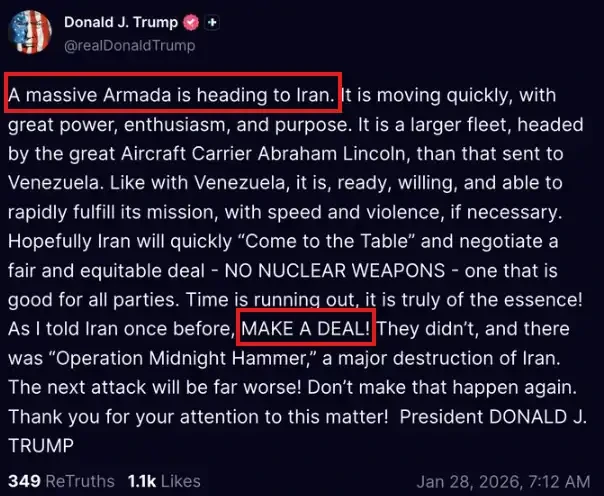
President Trump — Truth Social (January 28, 2026)
The Iran war is the largest war President Trump has been involved in during his second term. But if you review the situation over the past 6 to 8 weeks, you'll find that the strategy Trump employed is almost logically identical to the tactics he used in his previous trade wars, and even in the capture of Venezuelan President Maduro.
Why is that?
Of course, from the perspective of specific U.S. military actions, they are not exactly the same. But in terms of the underlying strategy of negotiation and pressure, they follow the same historical pattern.
For example, look at this post from November 29, 2025: Trump announced the "complete closure of airspace over and around Venezuela." It's important to note that this statement was made over a month before the U.S. ultimately captured President Maduro. In other words, before the actual action took place, Trump had already released intense pressure and deterrence through a series of public statements and military signals.
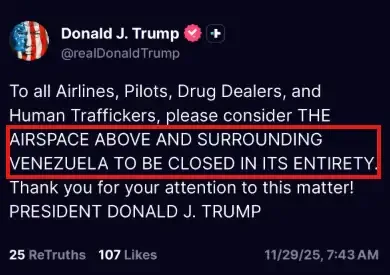
President Trump — Truth Social (November 29, 2025)
Next, look at this post by President Trump on Truth Social. In fact, between January 1 and January 18, we saw multiple similar posts from Trump.
In these posts, Trump stated, "it is time to acquire Greenland," and continuously pressured and threatened Denmark. And just days later, President Trump imposed broad tariff measures on the EU.
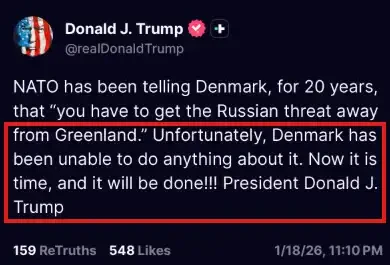
President Trump — Truth Social (January 18, 2026)
Clearly, the first step in Trump's "War Playbook" is to exert intense verbal pressure on the target through public statements to force them to "make a deal."
Step Two: Strategic Posturing and Actual Deployment
The second step typically manifests as visible strategic preparation: reinforcing deterrence and credibility through military or policy actions before launching a full-scale operation.
On the Iran issue, this step included: the redeployment of military forces; public coordination with allies; and the so-called "Armada" that Trump sent to the Middle East.
A similar pattern appeared during the Venezuela incident. At that time, the U.S. first announced the closure of airspace and regional military deployments, while the actual action against President Maduro occurred much later.
This path is equally clear in trade wars: often starting with investigations, administrative reviews, and public notices, before tariffs are actually implemented.
For example, look at a news item from August 11, 2025. President Trump met with Intel CEO Lip-Bu Tan. Just days before, Trump posted on Truth Social that Lip-Bu Tan had "serious conflicts of interest and must resign immediately, with no other solution."
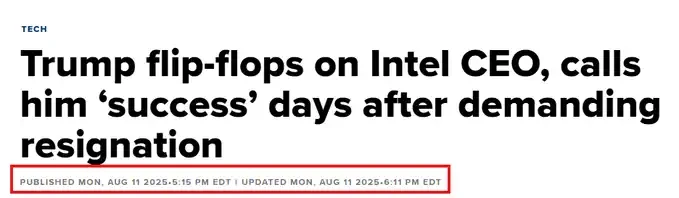
A few days later, the Trump administration announced it had reached an "agreement" with Intel to acquire a 10% stake in the company. As shown below, this investment yielded over 80% returns in less than two months.
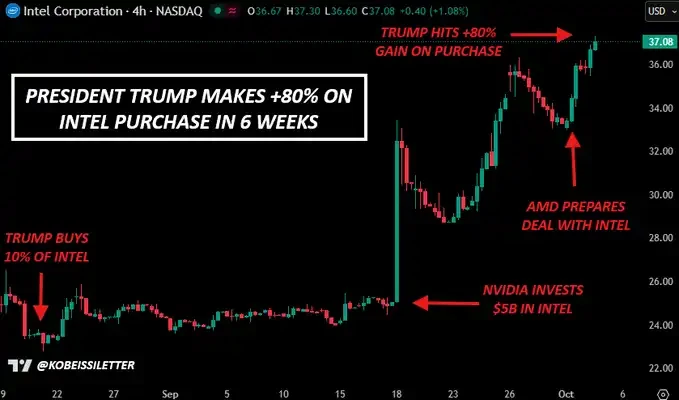
Again, President Trump's goal is almost always to strike a "deal."
In some cases, the conflict ends at the second stage. After the initial threats and pressure serve as "setup," both sides reach an agreement through negotiation, and the situation is resolved at this stage.
If not resolved, it proceeds to the third step.
Step Three: The Friday Night "Strike"
When Trump's initial pressure fails to yield results, he typically escalates further, turning to military force or economic warfare.
A very stable tactical feature in Trump's escalation pattern is the timing. Many major announcements, key strikes, or sudden policy changes often occur on Friday nights—after the U.S. stock market has closed, and before liquidity in the futures market has fully formed.
Why choose this timing? Because Trump is highly sensitive to sharp financial market volatility.
Here are some significant actions that occurred on Friday nights or Saturday mornings:
U.S.-Israel joint airstrike on Iranian nuclear facilities — June 21
U.S. military strikes on drug vessels in the Caribbean — September 1
Threat to impose 100% tariffs on China — October 10
Closure of Venezuelan airspace — November 29
Military operation in Nigeria — December 25
U.S. airstrike on Iran — February 28
In fact, since 2025, multiple geopolitical or policy actions have occurred after the Friday market close. This timing is considered a deliberately arranged strategy.
If a major geopolitical event erupts during trading hours, the market's price discovery mechanism often quickly becomes disordered: market liquidity immediately drops, algorithmic trading amplifies volatility, and intraday wild swings can easily trigger panic chain reactions.
In contrast, announcing actions on Friday night creates a buffer period.
Investors, institutions, and governments can use the entire weekend to: digest information, assess risks, consult advisors, and simulate various scenarios.
By the time the market reopens, all parties have a more informed judgment of the situation.
For the Iran event, this critical moment was February 28. Typically, on the Sunday of the same week (before futures open), Trump often releases signals about a "potential deal," providing the market with a moderating expectation.
But this time, that clearly didn't happen, so the situation entered the fourth step.
Step Four: Risk Premium Spreads Across Asset Classes
After the shock event of the third step, when the futures market opens at 6 PM ET on Sunday, asset prices across classes typically experience sharp volatility.
However, the market often still doubts whether the conflict will persist long-term.
The reason is simple: everyone knows that Trump ultimately often wants to strike a deal. Therefore, the initial sharp volatility seen in stocks, commodities, and bond markets often partially retraces before the stock market opens on Monday.
For example, look at the market performance on March 2 (the day before we wrote this article): the movements in crude oil prices and the S&P 500 index at that time exemplified this typical market reaction pattern.
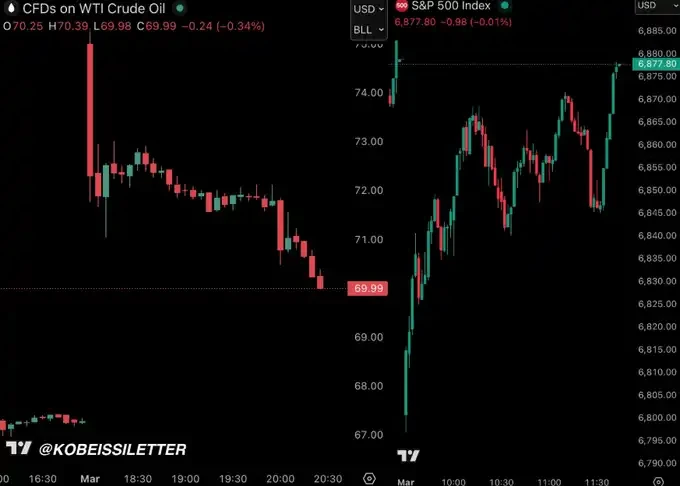
S&P 500 & WTI Crude Oil — March 2, 2026
WTI crude oil prices gave back about 70% of their gains at one point, and the S&P 500 even turned positive yesterday. However, today, this trend reversed again—oil prices hit new highs, while stocks refreshed their recent lows.
This change occurred because President Trump knows: the market also knows he likes to "make deals." Therefore, although the market once bet that this conflict would end quickly, the reality is often that the conflict continues to escalate.
Now, the situation has entered the fifth step.
Step Five: Trump Hints the Conflict Could "Last Forever"
When investors expect Trump to "take a step back" and quickly buy the dip, the market is often caught off guard by sudden changes. As headlines worsen, many believe Trump will soon start reducing pressure on the target. However, the reality is often the opposite.
As indicated by statements on March 2, Trump now says, "war can go on forever," and claims the U.S. has "unlimited mid-to-high-end weapons."
Note that the word "forever" is placed in quotes. This is actually a tactical phrasing: the message Trump is conveying is—he doesn't want the war to truly last indefinitely, but if necessary, the U.S. is fully capable of doing so.
This is also a negotiation tactic.
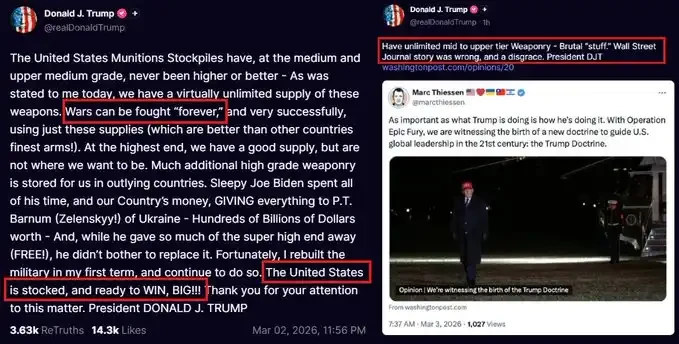
President Trump — March 2 & March 3, 2026
Since the outbreak of conflict between the U.S.-Israel and Iran, and even before the war truly began, our judgment has consistently been: President Trump does not benefit from a prolonged war. Even with recent rhetoric about a "forever war," we maintain this view.
Why? Because the Trump administration's three most important current policy goals include: being a "peace president"; lowering inflation; and reducing U.S. gasoline prices to $2 per gallon.
And getting entangled in a prolonged war with Iran would directly contradict these core policy objectives. Especially in a critical midterm election year, a conflict that erupts and persists in the short term would significantly impact these agendas.
Step Six: The Market Begins Pricing in a Prolonged Conflict
As of March 3, the sixth step in our "playbook" seems to have begun manifesting.
Look at the following market performance:
Brent crude oil prices rose above $85 per barrel for the first time in nearly two years;
Previous gains in U.S. stocks have been completely erased, with new weekly lows being set;
Market risk-off sentiment rapidly intensified, with capital accelerating its flight from risk assets.
That day, the Dow Jones Industrial Average fell by approximately 1100 points.
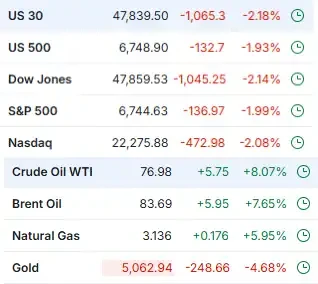
U.S. Markets & Commodities — March 3, 2026
At this current stage, the market is no longer assuming this is just a brief, symbolic military clash.
Oil prices rising above $85 per barrel reflect not a weekend skirmish, but the pricing in of supply chain risks, rising tanker insurance costs, and the potential partial closure of the Strait of Hormuz.
Meanwhile, U.S. stocks falling to new weekly lows is not just an immediate reaction to a news headline, but a reassessment of conflict duration risk.
This is precisely the psychological turning point that Trump's strategy attempts to create.
During the first decline, investors often choose to buy the dip because they think a deal is imminent. During the second decline, investors still buy, believing the escalation is temporary. By the third decline, the market's positioning structure truly begins to adjust.
So-called "Smart Money" can often consistently identify moments when market sentiment becomes excessively skewed in one direction, especially as retail participation rises.
In 2025, our investment strategy was largely based on this: how to anticipate the market's next turn by recognizing Trump's historical patterns in economic conflicts.
As shown below, since 2020, our investment strategy returns have approached five times that of the S&P 500 index. In 2025 alone, our S&P 500 trading strategy achieved a 21.8% return, significantly outperforming the index itself. The reason is our ability to identify key shifts in stock market sentiment and trends ahead of time.
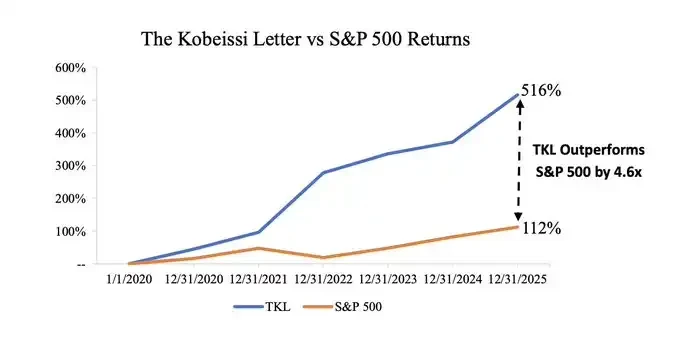
The Kobeissi Letter Strategy Performance (2020–2025)
This brings us to the seventh step.
Step Seven: The Emergence of "Conditional De-escalation Signals"
Before explaining this step, a point needs clarification: the time span between steps six and seven is highly uncertain. For example, in the early 2025 trade war, this phase lasted for months before a tariff "pause" finally emerged on April 9. This turn was largely driven by pressure from rapidly spiking U.S. Treasury yields, as shown below.
Typically, some kind of catalyst always emerges, prompting Trump to choose to back down or ease tensions. This factor could be:
The conflict target proactively offering to "make a deal";
Or a significant change or pressure signal emerging in the financial markets.
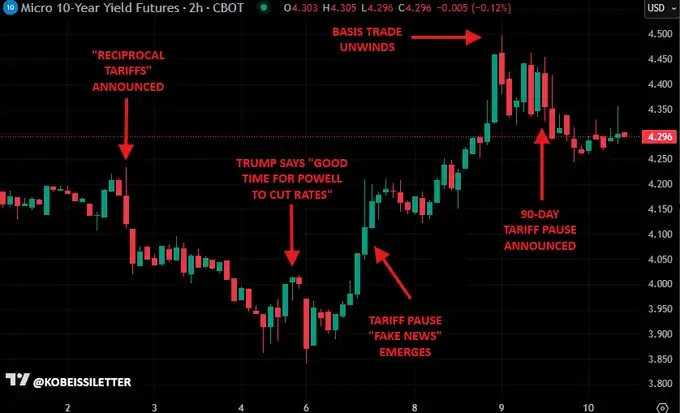
10-Year Treasury Yield — April 9 Tariff "Pause"
After risk premiums in stocks, commodities, and fixed income markets have significantly widened, Trump often begins releasing carefully crafted signals of easing. It's important to note that such statements usually do not signify a genuine concession.
In the context of the Iran war, the situation could turn in two ways: either a change in the Iranian government, or the occurrence of a major event with structural implications for the U.S. and even the global economy.
At this stage, official rhetoric gradually shifts towards conditional resolution paths. Statements begin emphasizing that negotiations are possible if certain conditions are met; meanwhile, terms like "talks," "consultations," or "framework agreements" gradually enter the narrative. The core purpose of this stage is to test the reactions of both the adversary and the financial markets without relinquishing strategic initiative.
Recent examples include:
The October 2025 tariff agreement Trump reached with China;
The Greenland-related agreement with the EU in


