






Arthur Hayes: Middle East Flares Up, Time to Be Bullish on Bitcoin


- Core Viewpoint: Through historical analysis, the article points out that US military actions in the Middle East have often been accompanied by the Federal Reserve's accommodative monetary policies. Based on this, the author infers that if the Trump administration takes significant action against Iran in the future, it could trigger interest rate cuts or quantitative easing again, thereby benefiting risk assets like Bitcoin.
- Key Elements:
- Historical data shows that since the 1990 Gulf War, following major US military conflicts in the Middle East, the Federal Reserve has often responded with interest rate cuts or accommodative policies to address economic uncertainty.
- After the 1990 Gulf War, the Fed chose to cut rates despite rising oil prices to counter a weakening economic trend.
- After the start of the "Global War on Terror" in 2001, the Fed swiftly cut rates by 50 basis points to stabilize market confidence shaken by the terrorist attacks.
- When Obama expanded troop presence in Afghanistan in 2009, the Fed was already in a zero-interest-rate and quantitative easing environment, providing ample liquidity for the war.
- The author believes that if the Trump administration pushes for "regime change" in Iran, the Fed will face political pressure to finance massive war expenditures through accommodative monetary policy.
- Based on this logic, the author's suggested trading strategy is: wait until the Fed clearly pivots to an accommodative stance in coordination with geopolitical actions before aggressively buying crypto assets like Bitcoin.
Original Title: iOS Warfare
Original Author: Arthur Hayes
Original Compilation: Peggy, BlockBeats
Editor's Note: From the Gulf War to the Global War on Terror, and then to the Afghanistan "Surge," U.S. military operations in the Middle East have almost defined the international political cycle of the past few decades. Accompanying these wars are not only geopolitical conflicts and massive fiscal expenditures but also a frequently overlooked variable: monetary policy.
This article reviews several key war inflection points since 1990, tracing the subtle relationship between war, fiscal pressure, and Federal Reserve policy: following multiple Middle East conflicts, the Fed has often responded by cutting interest rates or implementing easing policies to stabilize the economy and financial markets. Based on this, Arthur Hayes (co-founder of BitMEX) offers a market-oriented observation: when geopolitical conflicts escalate and fiscal spending expands, a loose monetary environment often follows, which could also have a significant impact on risk assets, including Bitcoin.
The following is the original text:
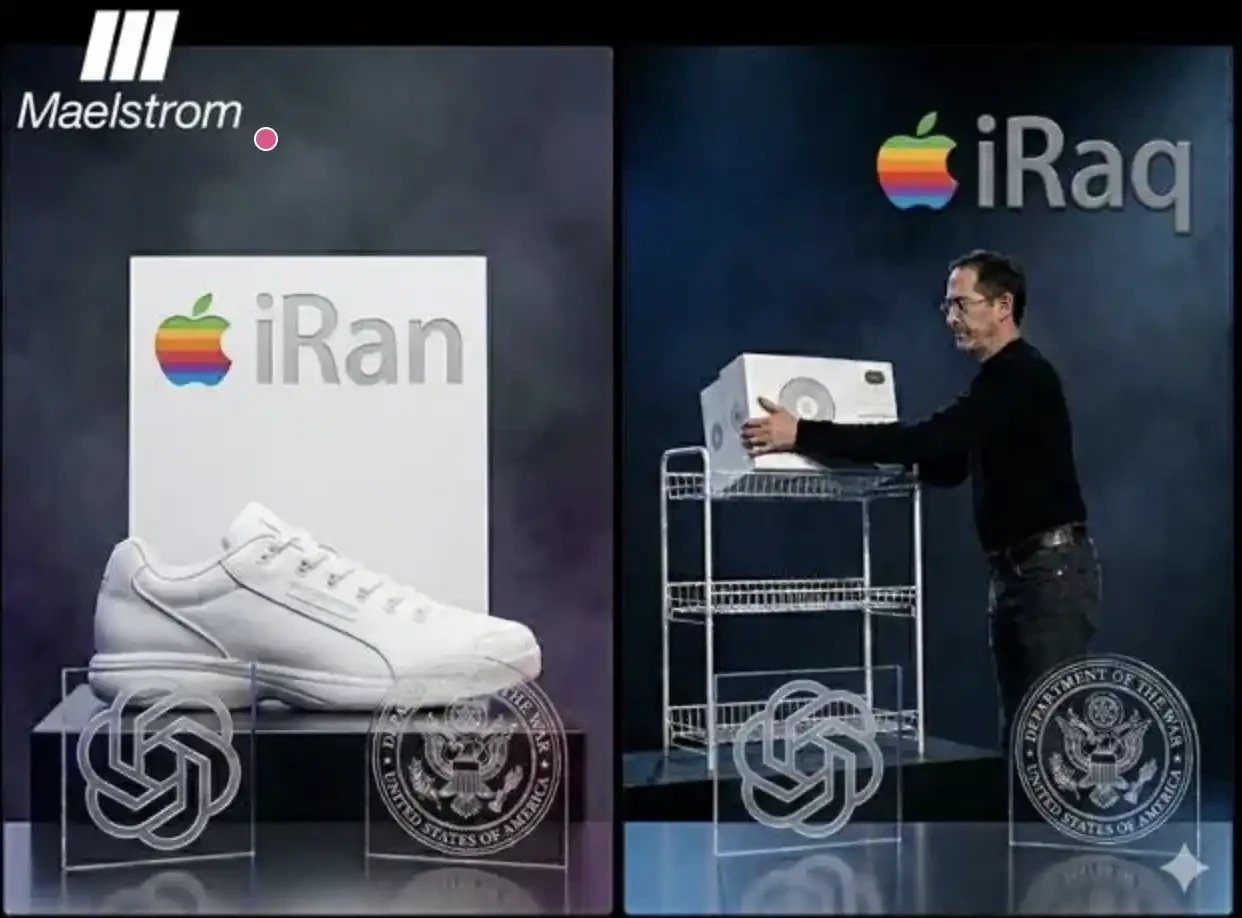
At the behest of the "most peaceful president" in American history, Donald J. Trump, the U.S. "War Department" has teamed up with OpenAI to launch an offensive proxy AI weapon: a lethally effective new Apple iOS. Once this operating system is implanted into a country's network infrastructure, it attempts to drive a "regime change." Such regime changes are often accompanied by indiscriminate bombing of military and civilian infrastructure, causing massive casualties, with costs running into hundreds of billions, or even potentially trillions, of dollars.
After the local political resistance is crushed, a new political elite, propped up by the U.S., takes the stage. They siphon funds from American taxpayers on one hand and extract resources from the local society on the other, depositing these funds into their asset pools in J.P. Morgan private wealth accounts. Over time, public discontent with this "Vichy-style regime," similar to those the U.S. has installed in the Middle East, accumulates, often culminating in its violent overthrow. What replaces it is typically a more localized, and often more reactionary, oppressive, or even bloodthirsty political structure.
At this point, the entire "sales cycle" is complete, and OpenAI can smoothly roll out its next-generation product. Are you already eagerly anticipating an OpenAI IPO priced on "infinite future P/E"?
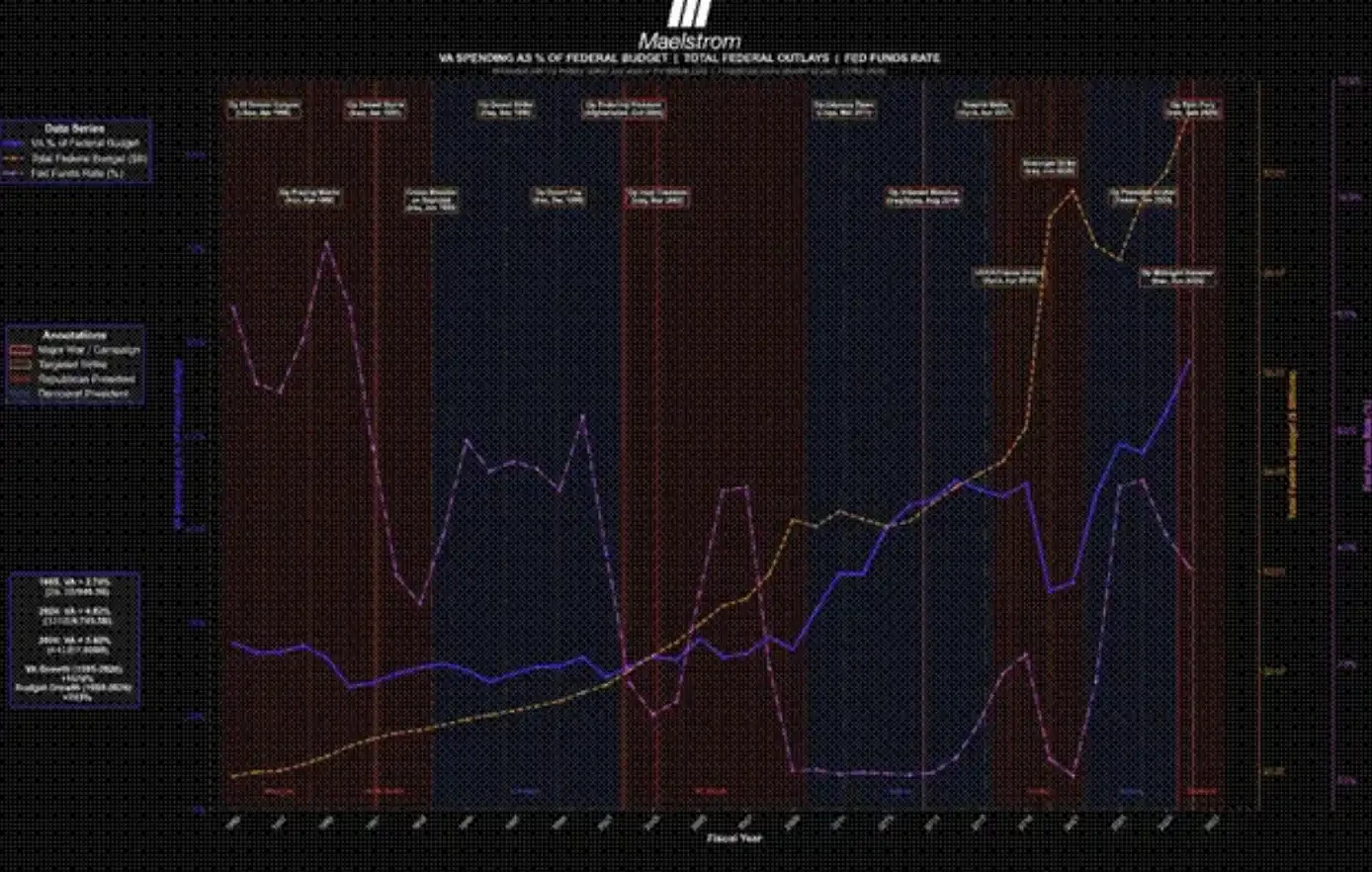
Since 1985, the year my consciousness began recording human experience in this so-called "quantum continuum," the crusades of the "Pax Americana" against Middle Eastern oil-producing nations and key geostrategic nodes of oil and gas pipelines, all in the name of "justice," have scarcely ceased. Please take a look at this chart generated by Perplexity's latest Computer model to appreciate its "spectacle."
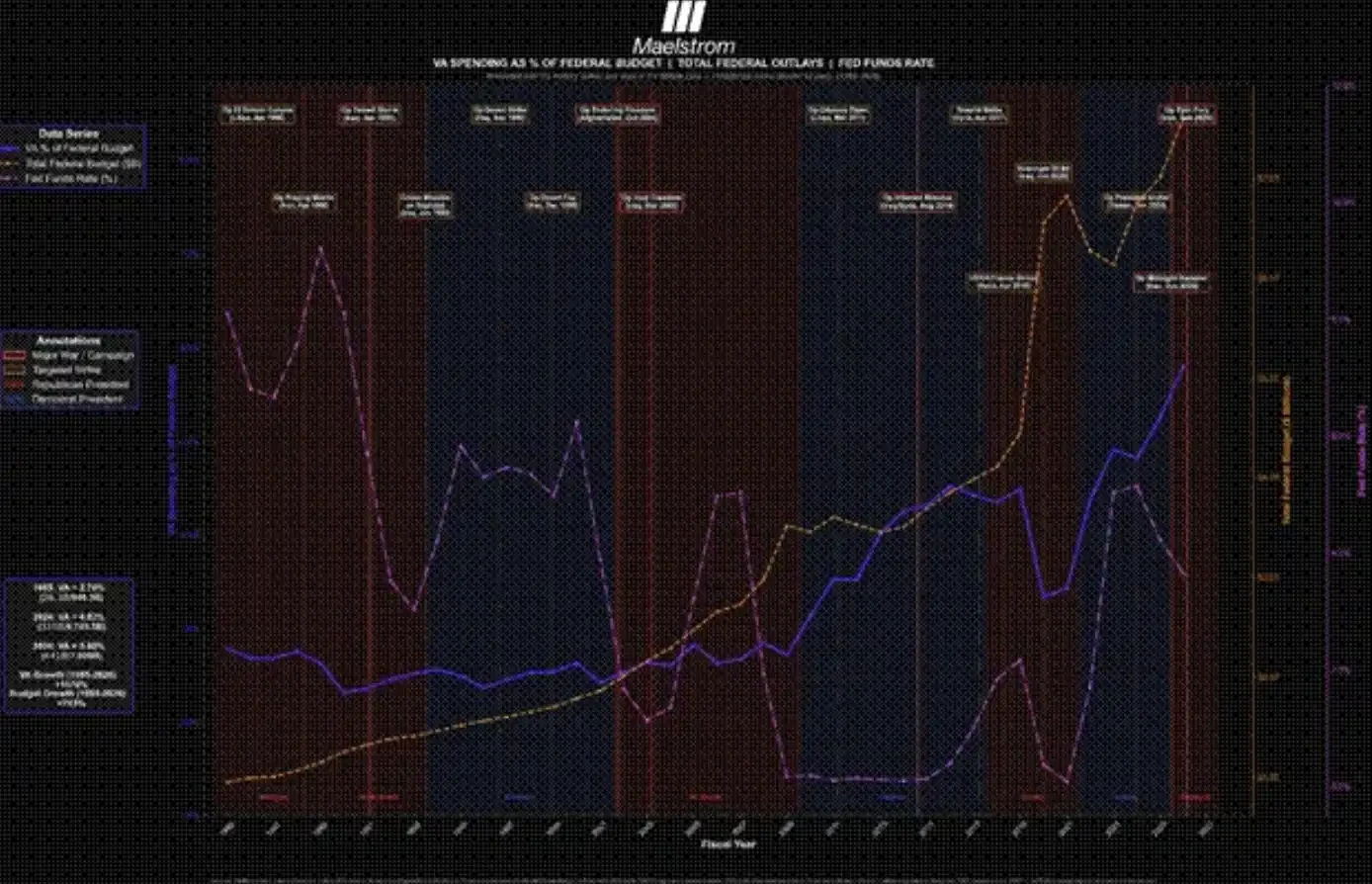
At a macro level, this chart attempts to depict the human cost of war. It centers on three metrics: the share of the U.S. federal budget allocated to the Department of Veterans Affairs (VA), the total nominal federal government expenditure, and the effective Federal Funds Rate. The chart also marks a series of representative (though not exhaustive) U.S. missile strikes or full-scale wars against Middle Eastern nations.
Data-wise, spending on veteran care has grown at nearly twice the rate of the overall federal budget. More importantly, and the focus of this article, almost every time the "Pax Americana" launches a major "war of choice" in the Middle East, the Federal Reserve tends to quickly lower the price of money shortly thereafter. Although every U.S. president in my lifetime has tried to convince the public that those Middle Eastern wars, which look like video games on the evening news, don't inflict real pain on the only "important humans" in the universe—American soldiers—the data clearly shows that America's obsession with Middle Eastern military adventures is devouring American lives in an extremely costly manner.
The so-called "ovarian lottery" landed me on this continent, defined by the squiggly lines humans call the "United States." In my forty years of life, whether under "Red Team" Republican presidents or "Blue Team" Democratic presidents, missiles have been launched, or full-scale wars initiated, against some Middle Eastern country "deserving of a strike." It's as if once elected president, senior bureaucrats take you into some super-secret room, clamp your testicles in a vice, and make you swear: during your term, you must make at least one Middle Eastern country feel the "fiery heat of democracy," or face the consequences.
Regardless of whether you believe the various popular conspiracy theories explaining why the U.S. bombs a particular Middle Eastern country, this chart presents a fairly clear fact for my lifetime: since 1985, every U.S. president has engaged in military conflict with one or more Middle Eastern nations. Therefore, when President Trump now talks about possibly "assassinating" Iran's Supreme Leader Khamenei and openly supports a "people's revolution" to overthrow Iran's theocratic regime, we investors have to consider: as Trump embarks on this "political rite of passage" experienced by every U.S. president before him, how will our investment portfolios be affected?
Considering I'm just a simple-minded, somewhat "toxically masculine" crypto bro, my logic for judging Bitcoin's rise and fall is actually quite straightforward.
The longer Trump invests time in an extremely expensive nation-building exercise like Iran, the more likely the Federal Reserve is to fund the "Pax Americana's" new military adventure in the Middle East by lowering the price of money and increasing its supply.
To test this hypothesis, let's review the history of Federal Reserve policy actions following every major Middle Eastern military conflict since 1985.
1990 Gulf War: "The Father" (President George H. W. Bush)
At its first meeting after the war began, the Fed chose to hold rates steady but hinted that monetary easing might be necessary if the war dragged on.
Here is a direct quote from the FOMC statement, retrieved and compiled for me by Perplexity.
August 21, 1990: "Increased uncertainties associated with developments in the Middle East and their possible effects on economic performance short of expectations have made the formulation of effective monetary policy especially difficult." "A number of members thought that developments were likely to point in one direction—toward some easing of policy at some point to counter the weakening in the economy that was evident before the rise in oil prices."
The Fed subsequently cut rates at its November and December 1990 meetings, describing the war in somewhat euphemistic terms as a significant uncertainty affecting its decisions. The Gulf War ended in March 1991.
"The substantial declines in business and consumer confidence likely reflect not only developments in the Middle East but also uncertainty about future developments in that region and their implications for oil prices."
In other words, the Fed chose to ease policy even as soaring oil prices created inflationary pressures.
2001 Global War on Terror (GWOT): "The Son" (President George W. Bush)
The "Global War on Terror" unfolded rapidly after the Twin Towers of the World Trade Center in New York collapsed. Soon after, Iraq and Afghanistan became targets of cruise missile interrogations. To stabilize economic confidence, the Fed almost immediately accelerated its pace of rate cuts.
At an emergency meeting following the attacks, then-Fed Chairman Alan Greenspan, known as "The Maestro," stated: "Clearly, last week's events have created at least a higher degree of fear and uncertainty, which has put significant downward pressure on asset prices and increased the probability of asset price deflation, the implications of which for the economy are obvious. Accordingly, I propose lowering the target for the federal funds rate by 50 basis points."
Essentially, if confidence in the "Pax Americana" system wavers and causes asset prices to fall, the Fed must act swiftly. And the prescription, as always, is cheaper and more abundant money.
Another Fed statement reveals the fact that, when necessary, the Fed will fulfill its duty to assist the government in financing the war machine.
November 6, 2001: FOMC Statement
"Although the necessary reallocation of resources to enhance security may restrain advances in productivity for a time, the long-term prospects for productivity growth and the economy remain favorable."
2009 "The Surge": "The Holy Spirit" (President Barack Obama)
The ordinary people of Iraq, Syria, and Afghanistan might have thought a Nobel Peace Prize-winning president wouldn't rain hellfire on their countries. That expectation proved illusory, and false hope is often the most lethal.
While Obama didn't start a new large-scale Middle Eastern war, he did expand the troop presence in the Afghanistan war (the so-called "Surge"), which he viewed as a "war of necessity."
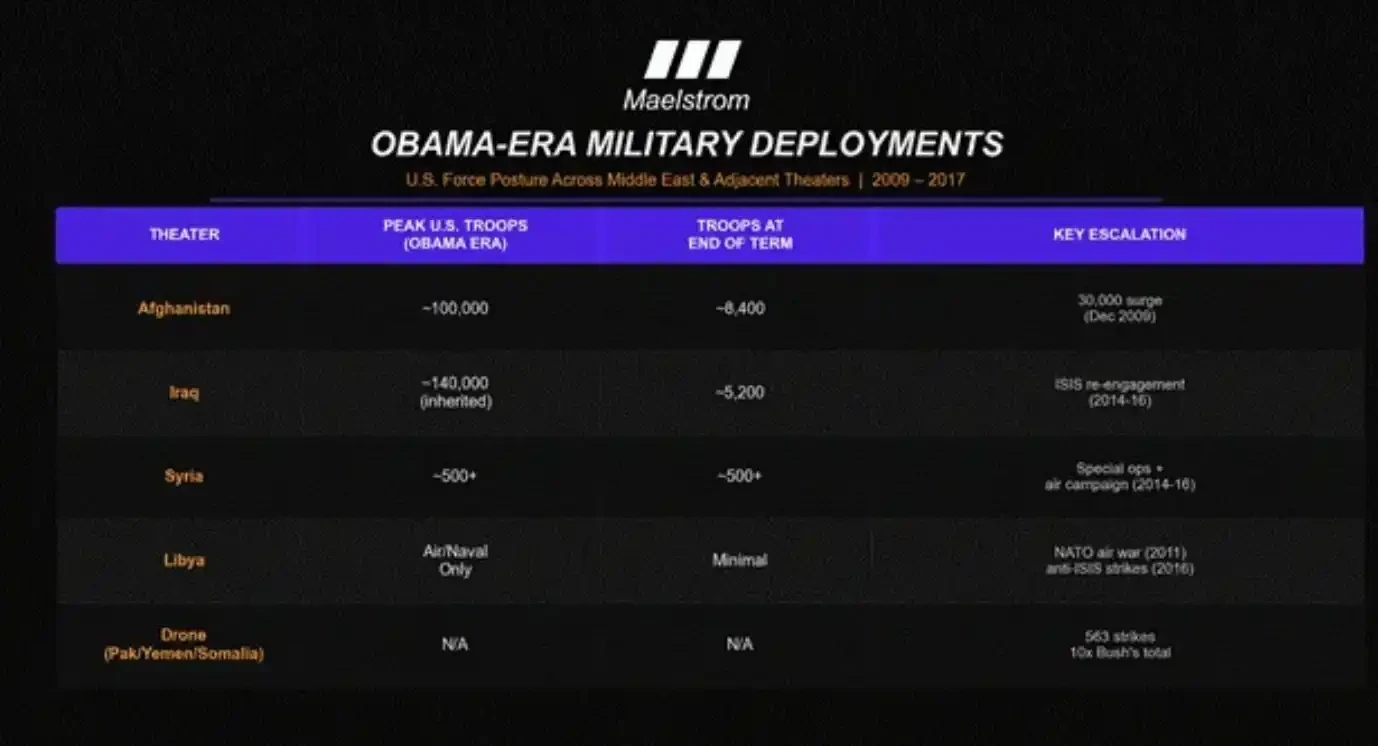
Given that the Fed had already cut rates to zero by late 2008 and had begun "printing money" on a massive scale through Quantitative Easing (QE), there was almost no further monetary policy action to take when Obama expanded troop deployments to the Middle Eastern theater. The cost of money was already near zero, and liquidity was supplied almost limitlessly. America's war machine and its contractors feasted accordingly.
2026 Iran: "The Messiah" (President Donald Trump)
Fate seems to have played a rather ironic joke: after surviving an assassination attempt during the 2024 presidential campaign, Trump almost seems "resurrected." As Kanye sang: "Jesus walks." I guess I can talk about Kanye now—since he's "bowed down and submitted," right?
Trump's performance in office, and the re-election prospects of his "Red Team" Republican lawmakers in the November elections, will largely depend on whether financial asset markets rise or fall, and whether oil prices decline or rise. Since the fall of the Shah of Iran in 1979, driving regime change in Iran has been a longstanding obsession of the bipartisan elite political class in the U.S. In this context, the Fed has full political "cover" to ease monetary policy significantly. If the Fed fails in its duty to finance the plan to "rebuild Iran as an American client state" with cheaper, more abundant money, it would be seen as "unpatriotic."
Trading Strategy
At this moment, we don't know how long Trump will remain interested in reshaping Iran's political structure—it could cost hundreds of billions, even trillions, of dollars. We also don't know how much political pain, from geopolitical and financial market pressures, he can withstand before pulling back.
Therefore, the more prudent approach is to first observe how the situation develops.
The real time to "go big" is after the Fed cuts interest rates or restarts the money printers to align with the government's policy objectives in Iran. That's when to load up on Bitcoin, and quality "altcoins" like $HYPE.
Take care, friends.


