






Stop Comparing Bitcoin to Gold—It's Now a High-Volatility Software Stock


- Core View: Bitcoin's current behavior more closely resembles that of a high-volatility software stock rather than digital gold. Its 30-day rolling correlation coefficient with the software stock ETF (IGV) has reached approximately 0.73, and this high correlation has persisted for over 18 months. This is primarily driven by institutional capital flow patterns, shared sensitivity to the macro liquidity environment, and the amplifying effect of MicroStrategy.
- Key Factors:
- The 30-day rolling correlation coefficient between Bitcoin and the software stock ETF (IGV) reached around 0.73 in late February 2026. A correlation exceeding 0.5 has been sustained for over 18 months, far longer than a typical short-term style rotation.
- In 2025, when the macro environment favored safe-haven assets, gold hit a record high while Bitcoin's price was halved. Capital flow data showed institutions favored gold, strongly refuting Bitcoin's "digital gold" narrative.
- The launch of Bitcoin ETFs changed the institutional trading framework, integrating Bitcoin and software stocks into the same decision-making process. This leads to synchronized capital flows, creating a self-reinforcing cycle and generating persistent selling pressure due to unrealized losses in institutional holdings.
- Both Bitcoin and software stocks are highly sensitive to macro factors such as real interest rates, market liquidity (M2), Federal Reserve policy, and overall risk appetite (VIX index), classifying them as "long-duration" assets.
- MicroStrategy, as a publicly traded company holding a large amount of Bitcoin, creates a two-way amplifying loop between its stock price, the software sector, and Bitcoin sentiment, intensifying the synchronicity of their price movements.
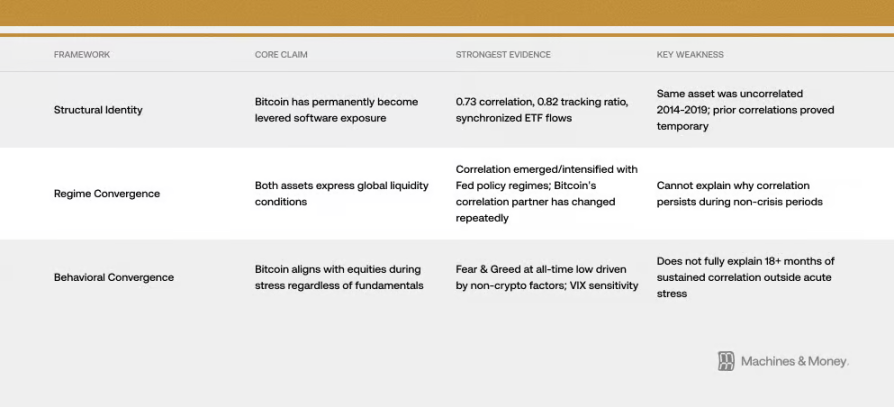
- Three potential future frameworks exist: a permanent identity shift, cyclical convergence, or behavioral convergence during market panic. Current evidence more strongly supports the cyclical convergence explanation.
Original Author: Machines & Money
Original Compilation: AididiaoJP, Foresight News
Everyone is Asking the Wrong Question
Since hitting its all-time high of $126,000 on October 6, 2025, Bitcoin has fallen by 50%.
Gold, however, reached a new all-time high of $5,595 on January 29, 2026.
Since Bitcoin's peak, gold has risen over 25%, while Bitcoin's price has been halved.
The crypto market's "Fear & Greed Index" plunged to an unprecedented 5 on February 6, a figure more extreme than during the COVID-19 pandemic or the FTX collapse, and has since only barely recovered to the teens.
Commentators in the crypto space have once again started the age-old debate: Is Bitcoin digital gold?
But this question itself is flawed. It assumes Bitcoin's identity as an asset is fixed. In reality, Bitcoin's behavior has demonstrably shifted multiple times under different macroeconomic regimes. In 2017, it moved with gold. In 2021, it moved with tech stocks. And from late 2024 to the present, it has been tightly coupled with software stocks.
A more practical question for institutional investors is: What is driving Bitcoin's price action in the current liquidity environment?
Based on evidence up to February 2026, the answer is: Bitcoin is currently behaving like a high-volatility software stock. Whether this is a temporary alignment due to shared sensitivity to the same macro factors, or a permanent redefinition of Bitcoin's role in portfolios, remains to be seen, but the data is becoming harder to ignore.
How Strong is This Correlation? How Long Has It Lasted?
The relationship between Bitcoin and IGV (an ETF tracking software stocks) has grown progressively tighter across three distinct phases:
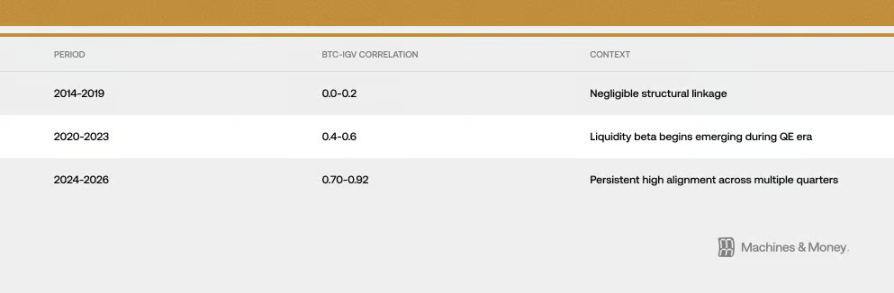
By late February 2026, their 30-day rolling correlation coefficient reached approximately 0.73. More importantly, this high correlation above 0.5 has persisted for over 18 months. This duration significantly exceeds the typical 3-6 month period of a short-term style shift but is not yet long enough to constitute a permanent change across a full market cycle (4-7 years).
The recent sell-off has made the relationship even more apparent. By late February 2026, IGV was down about 23% year-to-date, while Bitcoin was down 19-20%. The IGV software ETF is facing its worst quarter since the 2008 financial crisis. Over the past one and three months, Bitcoin and IGV have moved almost in lockstep, meaning their percentage moves have been very similar. During the decline, Bitcoin's volatility has been about 1.1x to 1.3x that of software stocks, lower than the commonly assumed 2x to 3x.
An important caveat: During market stress, short-term correlations can spike between any assets, regardless of fundamental linkage, due to a simultaneous drop in risk appetite. However, this high degree of synchronization has lasted over 18 months, suggesting something more substantive than random noise. Still, this alone does not prove causation or that the relationship will last forever.
2025: A Major Test for the "Safe Haven" Identity
If there was ever a year to test Bitcoin's ability to hedge against currency debasement, 2025 was it. It was a year of accelerating fiscal expansion, a weakening dollar, escalating geopolitical risks, persistent inflation, and growing market expectations for Fed rate cuts.
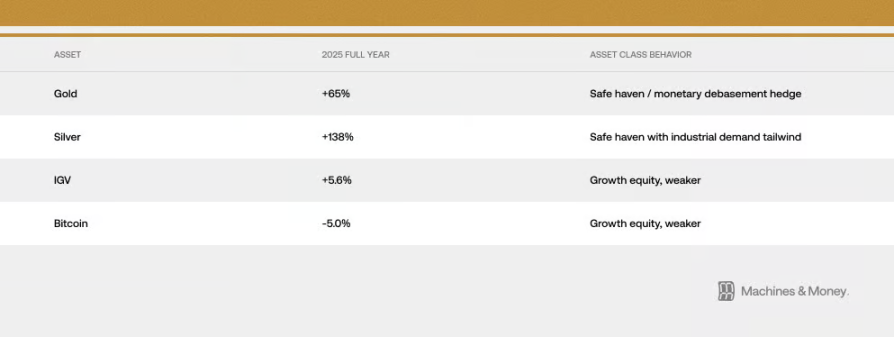
This was the perfect environment for Bitcoin to showcase its "digital gold" properties. Yet what has happened since October 2025 tells a different story: Gold rose from $4,400 to a new all-time high of $5,595, while Bitcoin fell from $126,000 to around $60,000. These two assets, assigned the same "inflation hedge" function, moved in completely opposite directions during the very conditions most favorable for that function. The result we see:
Gold hit a new all-time high of $5,595 on January 29, 2026. Central banks purchased 863 tonnes of gold in 2025, marking the third consecutive year of massive buying. Not a single central bank bought Bitcoin.
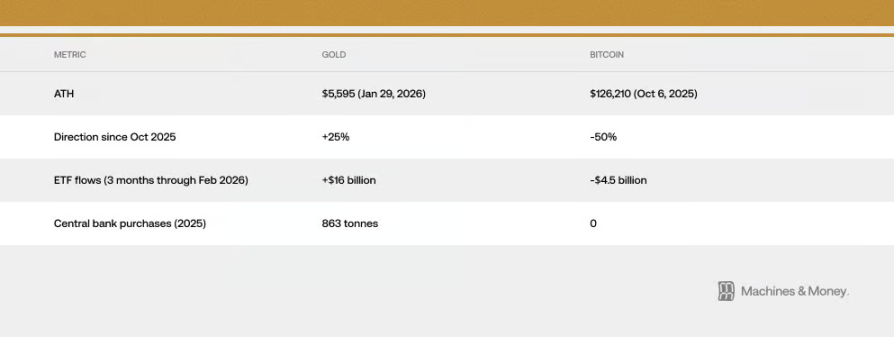
The stark divergence in fund flows is the most powerful rebuttal to the "digital gold" thesis: When large institutions and sovereign funds actually needed a safe haven against the very macro backdrop Bitcoin was supposed to protect them from, they chose gold by a margin of over three to one.
This is not to say Bitcoin will never be a safe haven. It simply means that at this point in time, given the current investor base, market structure, and liquidity environment, it is not. In 2025, both Bitcoin and software stocks delivered meager single-digit returns, while traditional hard assets performed spectacularly. In this major test, Bitcoin and tech growth stocks exhibited highly aligned behavior, one of the strongest pieces of evidence for the "convergence" argument.
Why is This Happening? Three Structural Reasons
1. The Mechanics of Institutional Capital Have Changed
The advent of Bitcoin ETFs fundamentally altered how it is traded at the institutional level.
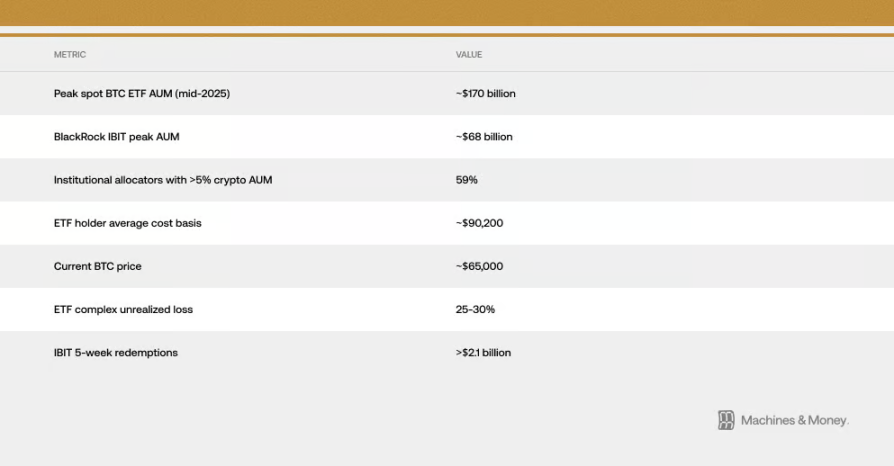
The result is that Bitcoin is now placed within the same investment decision framework as software stocks. Risk management systems treat them similarly. When portfolio adjustments are made, institutions buy or sell both asset classes in tandem, and performance is often benchmarked against a tech basket. When a multi-asset fund decides growth stocks are too risky and needs to de-risk, it sells its software holdings and its Bitcoin holdings in the same move.
This creates a self-reinforcing cycle: Because institutions categorize it as a tech stock, its fund flows align with tech stocks; this alignment, in turn, reinforces the institutional view of it as a tech stock. Estimates suggest the average cost basis for US spot Bitcoin ETF holders is around $90,000, meaning at current prices near $64,000, the entire ETF-held institutional capital is sitting on a 25-30% unrealized loss. This cost gap is significant because it turns what might have been long-term hold capital into a persistent source of selling pressure. Those who bought ETFs for diversification or as a hedge are now watching gold ETFs rise while theirs languishes. Since early 2026, we have seen this chain reaction in real-time: ETF redemptions followed by Bitcoin price declines, with the duration of outflows setting records since the ETFs launched. BlackRock's IBIT alone saw outflows exceeding $2.1 billion over the past five weeks.
2. They Share the Same Macroeconomic "Sensitivities"
Bitcoin and software stocks are sensitive to the same macroeconomic signals: changes in real interest rates, the expansion or contraction of money supply (M2), Fed liquidity operations, dollar strength, and overall market risk appetite (as seen in the VIX and credit spreads). Both are "long-duration," interest-rate-sensitive assets. They rise when real rates fall and fall when real rates rise. They benefit from abundant liquidity and suffer when it tightens.
A key question: Is Bitcoin's correlation specific to software stocks, or is it correlated with all liquidity-sensitive growth assets? Evidence points more toward the latter. Bitcoin's moves are not driven by software company earnings but by the fact that the same tightening environment that compresses software valuations also drains capital from speculative assets. This correlation reflects a shared "sensitivity" to the macroeconomic environment, not an intrinsic sameness.
Yet, sometimes the transmission mechanism is surprisingly direct. In February 2026, the release of two AI products completely unrelated to Bitcoin affected its price. How? Through the "institutional plumbing" described above. This is correlation in action.
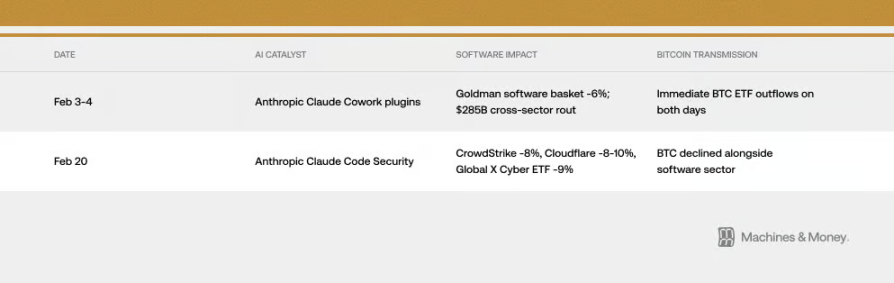
The VIX also tells a story. When the VIX spikes due to inflation data, both Bitcoin and software stocks fall. But when the VIX declines from low levels, they don't benefit much. This perfectly fits the profile of high-volatility growth stocks, not safe-haven assets.
Understanding this distinction is crucial. If the correlation is merely due to shared macro sensitivity, then Bitcoin could decouple from software stocks even if nothing changes fundamentally for Bitcoin itself, should the macro regime shift. There is precedent: Bitcoin's alignment with gold in 2017 and with tech stocks in 2021 both ended as macro conditions changed.
3. The "Amplifier" Effect of MicroStrategy
Strategy (formerly MicroStrategy) is the world's largest publicly traded corporate holder of Bitcoin and is classified as a software/technology company on the Nasdaq. This creates a direct, mechanical link tying the performance of the software sector to Bitcoin's "sentiment."
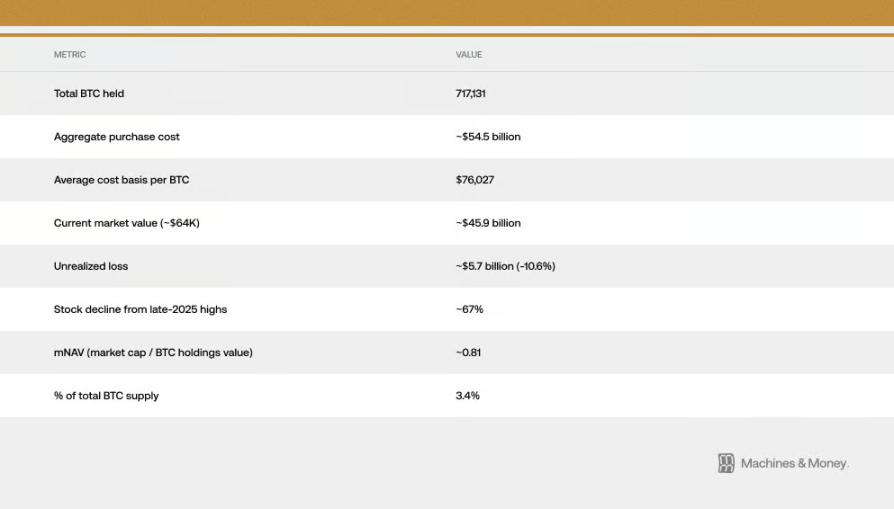
The feedback loop is two-way. Weakness in the software sector drags down Strategy's stock price. A falling Strategy stock price exacerbates negative sentiment toward Bitcoin and can even create some practical selling pressure. During market downturns, this loop tightens the relationship between Bitcoin and the software index. Strategy's stock is down about 67% from its late-2025 highs, far more than the declines in the software ETF or Bitcoin itself. The company's market cap is now even lower than the value of the Bitcoin it holds, implying it trades at a discount. This indicates an amplification effect from this single company layered on top of the broader Bitcoin-software correlation.
In January 2026, MSCI considered removing companies holding over 50% of their assets in digital assets from certain indices. If enacted, this could have forced significant selling. The episode highlights how vulnerable companies like Strategy, with large Bitcoin holdings, are to traditional financial rule changes. While MSCI ultimately paused the move, stating it would revisit the topic, the risk remains.
How to View the Future? Three Possible Frameworks
Framework 1: Bitcoin Has Become a Leveraged Software Stock (Identity Has Changed)
This view posits that Bitcoin has been permanently redefined. Evidence includes the 0.73 correlation with software stocks, near-identical price action, synchronized ETF flows, and shared institutional ownership. Under this framework, the ETF era has cemented Bitcoin within tech portfolios, permanently altering its risk profile. This correlation will persist regardless of market cycles.
The problem with this view is that history doesn't support it. Bitcoin itself hasn't changed, yet its correlation with software stocks was near zero from 2014-2019. It has exhibited high correlations with other things before (e.g., alt-tech coins in 2017-2018, the Nasdaq in 2021-2022), which proved temporary. To claim permanence, it would need to survive a full rate hike/cut cycle, which hasn't happened yet.
Framework 2: Both Are Just Manifestations of "Market Liquidity" (Cyclical Convergence)
This is a simpler explanation. Both Bitcoin and software stocks are liquidity-sensitive, long-duration assets that happen to be moving in sync in the current "tight liquidity" macro regime. This alignment began during the massive liquidity injection of 2020, intensified as tightening began in 2022, and has persisted into the current liquidity-scarce environment.
Under this framework, the synchronization could break with the onset of the next easing cycle (when the Fed turns dovish again). Historically, Bitcoin has often led software stocks by 1-2 months at major Fed policy pivots. Furthermore, Bitcoin has its own supply dynamics from the "halving" (historically leading to rallies 12-18 months post-event), which could drive a completely independent narrative by late 2026.
Framework 3: Market Stress Causes Bitcoin to "Huddle" with Stocks (Behavioral Convergence)
Bitcoin is, at its core, a high-volatility risk asset. During panic-driven sell-offs, it behaves like stocks regardless of its underlying nature. "Risk-off" or "risk-on" sentiment dominates everything. When the VIX spikes, they fall together. Sometimes, large narratives (e.g., fears that AI disruption will render many tech companies obsolete) simultaneously impact software valuations and overall market risk appetite, further synchronizing them. On February 6, the crypto Fear & Greed Index hit its lowest level ever, not due to any crypto-specific event, but because growth assets were being sold off due to macro and tech-sector concerns. Bitcoin's most pessimistic sentiment in history was caused by the same factors affecting software stocks.
Current evidence most strongly supports "Framework 2" (Cyclical Convergence), but the mechanisms described in "Framework 1" (particularly institutional capital mechanics) are indeed making this convergence more persistent in the current environment.
What's Next? Several Possible Scenarios
Frankly, we cannot be certain which outcome will materialize. But we can think through the possibilities and identify what future signals would allow us to rule some out.
**Scenario 1: Correlation Persists (The Baseline).** If market liquidity remains tight throughout 2026, Bitcoin will continue to behave like a high-volatility growth stock, maintaining a high 0.5 to 0.8 correlation with the software ETF. The question of its identity remains unanswered. This is the most likely outcome absent a major shift in Fed policy, institutional positioning, or Bitcoin's own narrative.
**Scenario 2: Decoupling.** If the Fed begins easing, combined with the lagged effects of the 2024 "halving" and a reduction in fears about AI disruption, Bitcoin could significantly outperform software stocks in the second half of 2026. Their correlation would drop to 0.3-0.5. This outcome would validate "Framework 2" (Cyclical Convergence), showing the current alignment was temporary.
**Scenario 3: Permanent Convergence.** If their correlation rises further above 0.8 and persists through the next full easing cycle, and major index providers formally reclassify it into the tech sector, it would signal a permanent change in Bitcoin's identity.
The key test is simple. If the correlation breaks when the Fed starts cutting rates and injecting liquidity, it points to cyclical convergence. If they remain tightly bound even during easing, then "identity change" becomes the primary explanation.
Until the next easing cycle in 2026-2027 provides an answer, the question remains open.
Conclusion
Bitcoin's identity has never been static. It has always been what the dominant buyers in the market believe it to be. Right now, the dominant buyers are institutional investors treating it as a growth stock. This, too, may change. Bitcoin's most fundamental properties have not changed. But markets price assets based on who holds them and why, not on their original design purpose. Until the next major shift in the market regime, this synchronization is the reality. And for anyone trying to understand what role Bitcoin actually plays in a portfolio today, reality is everything.


