Jane Street Halts "10 AM Dump," BTC Stages Strong V-Shaped Rebound, Surging Toward $70K


- Core View: Major cryptocurrencies like Bitcoin have staged a strong V-shaped rebound, signaling a recovery in market sentiment. This rally was fueled by an emotional release from the controversy surrounding Jane Street's alleged suppression of Bitcoin prices, while stronger-than-expected earnings reports from Circle and Nvidia provided fundamental confidence. Concurrently, institutional allocations and unusual movements among mining companies indicate subtle shifts in market structure.
- Key Factors:
- Market Performance: BTC surged 6.1% in 24 hours, approaching $70,000, with ETH and SOL following suit in a strong rebound. Sentiment in the crypto market has noticeably improved, with all three assets reaching key resistance levels.
- Controversial Event: Terraform Labs' liquidator sued Jane Street, accusing the firm of systematically suppressing Bitcoin prices through insider trading, algorithmic dumping, and exploiting ETF mechanisms for derivative hedging. This sparked market discussions that "Bitcoin should be worth $150,000."
- Positive Earnings: Circle's Q4 revenue and EPS exceeded expectations, with growth in USDC circulation and on-chain transaction volume. Nvidia's Q4 revenue and next-quarter guidance also surpassed forecasts, boosting market confidence in both the AI and crypto sectors.
- Institutional Moves: Endowment funds from Harvard and Brown University have begun allocating to crypto ETFs, indicating digital assets are entering mainstream investment toolkits. Publicly traded company DDC has increased its Bitcoin holdings for the seventh consecutive week.
- Mining Company Anomalies: Some mining company stocks rose against the trend during Bitcoin's decline. Analysts believe they attracted capital due to advantages in power costs and potentially triggering short squeezes.
- Capital Flows: Bitcoin spot ETFs recorded a net inflow of $250 million in a single day, potentially ending the previous streak of net outflows. The derivatives market saw $579 million in liquidations over 24 hours, with short positions dominating the liquidations.
Original | Odaily (@OdailyChina)
Author | Ding Dang (@XiaMiPP)

OKX market data shows that in the past 24 hours, BTC experienced a strong V-shaped rebound, once approaching the crucial $70,000 level. It is currently trading around $68,000, with a 24-hour gain of 6.1%. The price performance of ETH and SOL has also been very strong, showing significant upward momentum following Bitcoin's rebound. ETH once broke through $2,100, with a maximum 24-hour gain of 15%, and is currently around $2,050. SOL once surpassed $90, is currently around $87, with a 24-hour increase of 8.1%. Market sentiment has clearly improved. All three have now reached key resistance levels; attention is on whether they can consolidate and continue their upward move.
In the US stock market, the Dow Jones rose 0.63%, the S&P 500 rose 0.81%, and the Nasdaq rose 1.26%. The crypto sector collectively strengthened, with Circle surging 35.47%, recovering losses from an entire month in a single day.
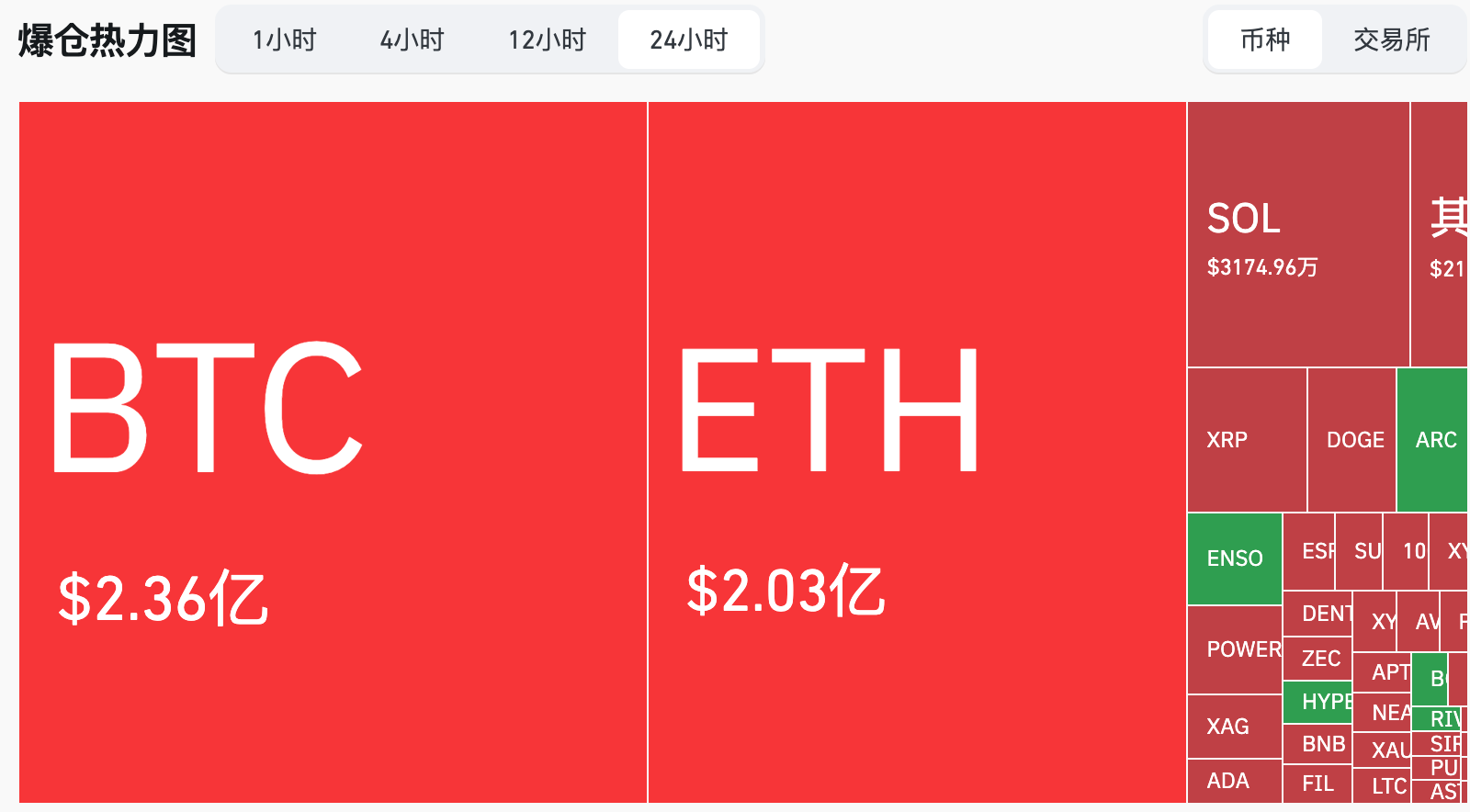
On the derivatives front, in the last 24 hours, total liquidations amounted to $579 million, with long position liquidations at $115 million and short position liquidations at $464 million. The largest single liquidation order occurred on Hyperliquid - BTC-USD, valued at $10.4154 million.
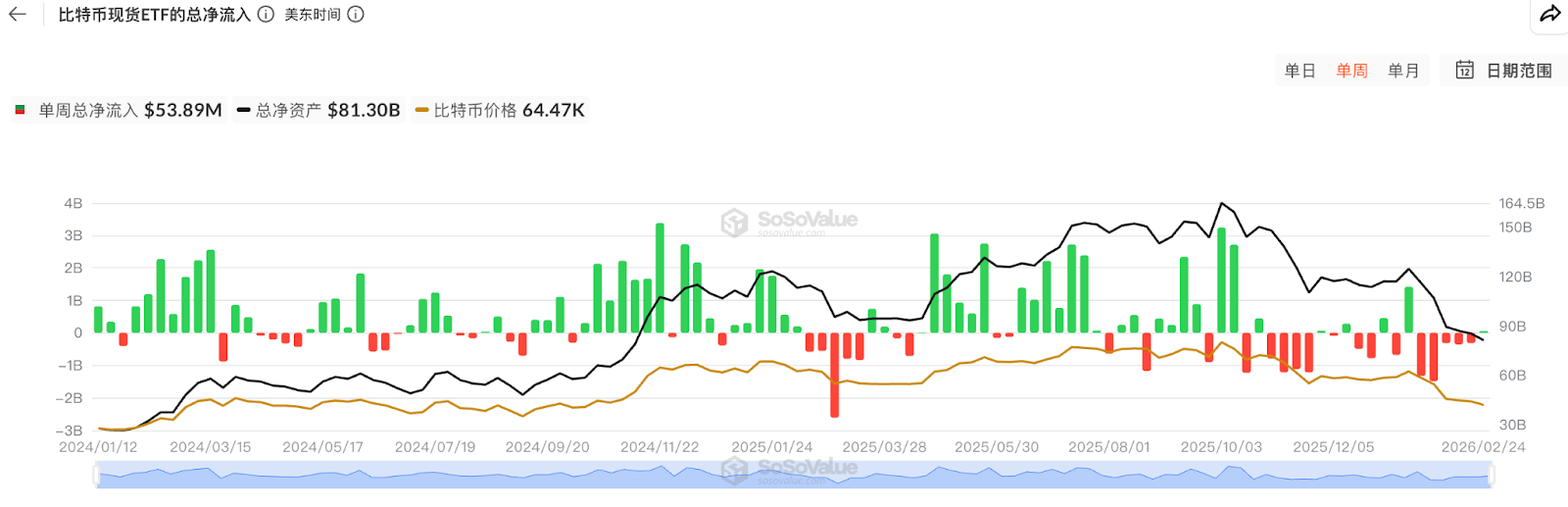
On the capital flow front, data from sosovalue shows that Bitcoin spot ETFs recorded a net inflow of $250 million yesterday, potentially ending the previous streak of five consecutive weeks of net outflows. Lookonchain monitoring revealed that in the past 5 hours, BlackRock's Bitcoin exchange-traded fund IBIT saw a net inflow of 1,225 BTC, valued at $83.92 million.
"Bitcoin Should Be Worth at Least $150,000"
This morning, an earthquake in the crypto industry started with one sentence: "As everyone knows, Bitcoin should be worth at least $150,000 right now."
The reason is that as the Terraform Labs liquidator sued the prominent US market maker Jane Street, it unveiled a months-long storm of market speculation. A lengthy post circulating rapidly on X (by Justin Bechler) connected three threads, directly accusing Jane Street of systematically suppressing the Bitcoin price through its privileged position, keeping it far below its "deserved" level.
The core allegations are divided into three acts: First, the "insider old account" of the Terra/LUNA collapse. It allegedly obtained insider information through a private group "Bryce's Secret" created by former intern Bryce Pratt, allowing it to exit at the top early and accelerate the crash. The lawsuit claims these trades "could not have been achieved without non-public information" and seeks compensation.
Second, the "precisely timed sell-off" pattern at 10 AM ET. Almost every trading day, Bitcoin would mysteriously plummet by 2-3% around this time, precisely liquidating leveraged long positions, only to recover hours later. On-chain analysis from Glassnode and others shows this algorithmic selling pressure was highly regular. Coincidentally, this "10 AM plunge" pattern briefly disappeared after the Terra lawsuit was exposed; once the spotlight faded, it returned.
Third, superficial bullishness masking potential massive net short positions. Public 13F filings show Jane Street held over 20 million shares of IBIT (once valued near $2.5 billion), with MSTR holdings surging 473%, appearing super bullish on the surface. However, industry insiders claim that while Jane Street accumulated large Bitcoin spot inventories through the ETF creation/redemption mechanism, it likely used this as a basis to issue massive Bitcoin options and hedge directionally through derivatives, maintaining neutrality. This is equivalent to continuously injecting synthetic Bitcoin supply into the market, thereby weakening Bitcoin's scarcity narrative and creating long-term upward resistance anchoring for the spot price.
The storm triggered by this statement continues to brew. Whether the Terraform liquidator's allegations against Jane Street hold water awaits court judgment. However, this controversy has provided an emotional outlet for the market.
For more insider details, refer to Odaily's recently published article: From the Terra Collapse to the "10 AM Smash," How Did Jane Street Play the Markets Across Two Continents?
However, Keone Hon, co-founder of Monad, also stated that the conspiracy theory of Jane Street suppressing Bitcoin below $150,000 doesn't hold water. Hedging short IBIT positions with long futures means that, on average, other parties end up holding short futures positions, which they must hedge with long spot positions. The sum of all positions in the market (converted to delta) always equals the total Bitcoin supply (approximately 20 million). Of course, any single party can decide to go short, thereby increasing long positions. In short, futures hedging against ETFs means there are always offsetting positions in the market; the market can be distorted short-term but can hardly defy the conservation of supply and demand long-term.
Market Confidence from Two Earnings Reports
If conspiracy theories provided emotional tension for the market, what truly drove the price upward might be two better-than-expected earnings reports.
First, Circle delivered an exceptionally strong Q4 and full-year 2025 report. Q4 revenue reached $770 million, a year-on-year increase of 77% and a quarter-on-quarter increase of 4.1%, surpassing previous market expectations of $749 million. Most importantly, EPS (earnings per share) also far exceeded expectations, indicating significantly enhanced profitability, primarily benefiting from the recovery in USDC scale and interest income from the high-interest-rate environment. Simultaneously, USDC circulation volume increased substantially year-on-year, and on-chain transaction volume continued to expand, indicating that the structural demand for stablecoins is still rising. This is the core reason for the market's positive feedback. It at least proves that the panic caused by previous whale sell-offs was more about portfolio rebalancing, and the funds remain within the crypto industry; they might just be waiting for the right moment to "buy the dip."
The second report came from NVIDIA. Its Q4 revenue of $68.1 billion and data center revenue of $62.3 billion both exceeded market expectations. Furthermore, it once again provided optimistic quarterly revenue guidance, around $78 billion, higher than the market estimate of $73 billion, indicating that large-scale AI computing infrastructure construction remains on track.
This is crucial for the AI narrative. The market needs NVIDIA to prove that the AI investment boom can translate into sustained real profits, alleviating concerns about an AI bubble.
Institutional Allocation and Miner Movements
Subtle changes have already appeared on the demand side.
Several university endowment funds are adjusting their investment strategies against the backdrop of declining returns on traditional assets and are beginning to allocate to cryptocurrency ETFs. Harvard University and Brown University have disclosed holdings of Bitcoin and Ethereum ETFs in their latest 13F filings. Although relatively small compared to their overall portfolio size, this shows digital assets have moved from the periphery of institutional finance into the mainstream toolkit.
Against the backdrop of Bitcoin's consecutive declines, many small and medium-sized DATs have surrendered one after another, choosing to sell their Bitcoin holdings or terminate buying plans. It seems Strategy remains the sole major bullish force in the market. However, DDC Enterprise Limited announced this week it purchased an additional 50 Bitcoin, bringing its total Bitcoin holdings to 2,118. This marks the company's seventh consecutive week of increasing its Bitcoin holdings, currently ranking 34th globally among publicly listed companies by Bitcoin holdings.
Movements in the mining sector are also noteworthy. While the Bitcoin price fell, several mining company stocks rose against the trend. For example, TeraWulf's stock price rose 31% cumulatively this month, Cipher Mining rose 8%, Hut 8 rose 6%, and Core Scientific remained largely flat. Analysis suggests Bitcoin mining companies are currently among the targets with high short interest from hedge funds. If fundamentals improve, it could trigger short-covering rallies. Moreover, these companies have locked in long-term, attractive power contracts, giving them a structural advantage on the energy cost side. Their strategic value extends beyond mere Bitcoin mining operations. Capital is flowing towards "structural winners," while traditional miners may face the risk of marginalization.
Conclusion
This V-shaped rebound may not be the starting point of a trend reversal, but it accomplished something more important: providing the market with a new explanatory framework. When the market regains reasons to explain price increases, the possibility of rebuilding risk appetite emerges.