Player He Yi: Since We're Here, Let's Tear Down the Door


- Key Point: Binance co-founder He Yi has been named to Fortune's "Most Powerful Women in Business" list, marking the crypto industry's transition from the periphery to the mainstream. She elaborated on Binance's long-term vision of lowering financial barriers, serving the global unbanked population, and promoting the integration of decentralized finance with AI.
- Key Elements:
- He Yi becomes the first crypto-native executive to appear on Fortune's list, representing a rise in mainstream industry recognition.
- Over the past 5 years, more than 34 million people have completed remittances via Binance Pay, with a cumulative volume exceeding $87 billion, saving users over $5 billion in transaction fees.
- Binance’s user base has surpassed 300 million, with a goal to further expand to 3 billion, covering the world's adult population without access to formal financial systems.
- Binance emphasizes a "Chief Customer Service" culture, requiring management to regularly rotate through frontline customer service roles to better understand user needs.
- He Yi's personal background (hailing from a rural area in Sichuan) highlights her motivation to promote financial inclusion, particularly in helping female users in regions like India and Brazil access the financial system.
- Binance is opening AI tools to ordinary users, aiming to break down technological monopolies and allow users to share in the value created by AI.
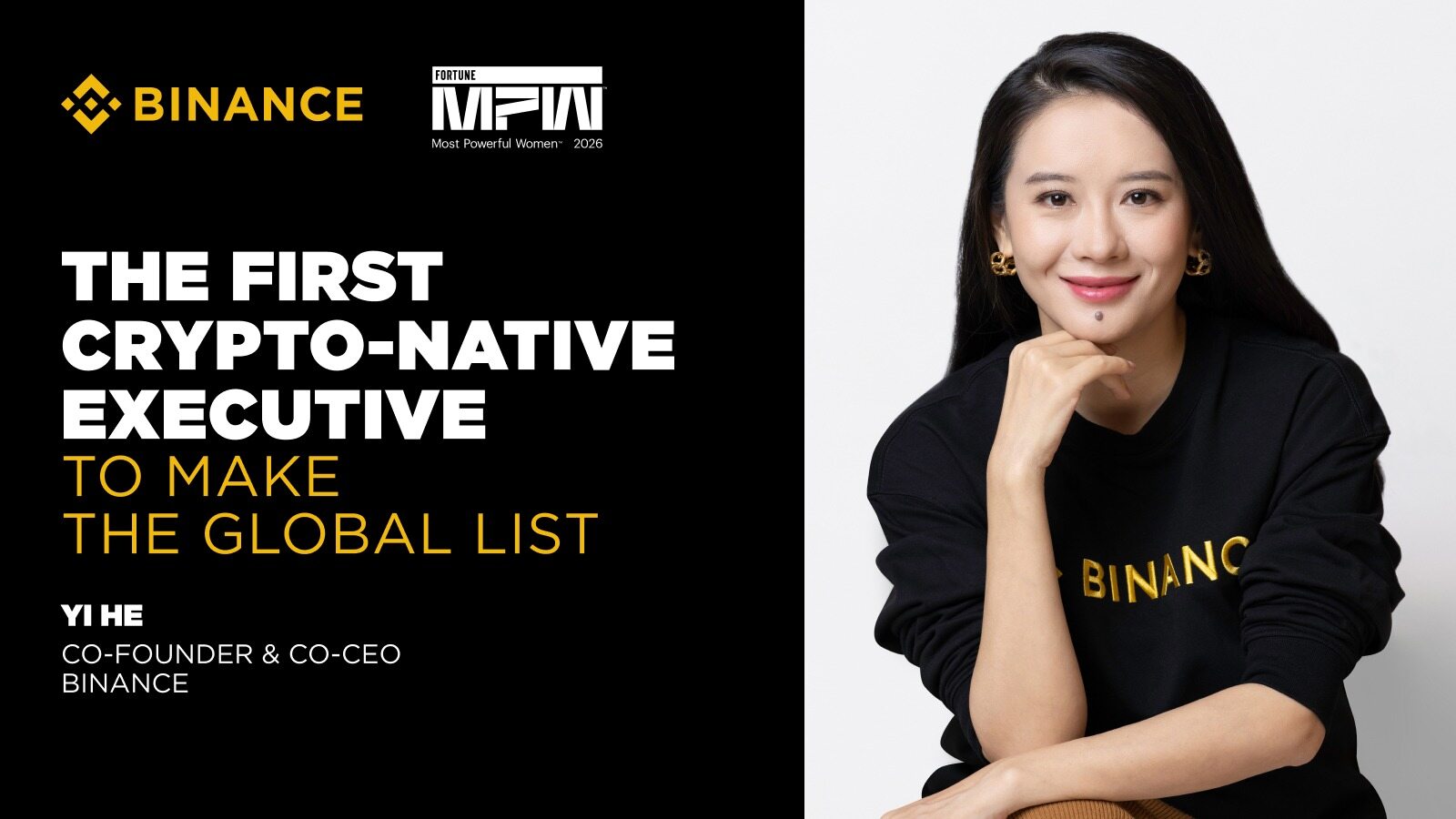
Editor’s Note: On May 27, Binance Co-founder and Co-CEO Yi He was named to Fortune magazine’s “Most Powerful Women in Business” list. Binance officially stated that Yi He’s inclusion marks the first time a crypto-native executive has been featured on this list. This is a significant milestone not only for Yi He and Binance, but for the entire industry. Yi He subsequently expressed her gratitude in a statement, reflecting on her journey. Below is the original text.
1. From the Fringe to the Spotlight
When I first learned I would be named to Fortune’s “Most Powerful Women in Business” list, my first thought was that I did not deserve it, and my second was that I carry a great responsibility.
The recognition carries my name, but it belongs to the Binance team, to Binance’s users, and more broadly, to Satoshi Nakamoto and every community member who has turned this industry from an idea into a global movement.
If, a few years ago, a native entrepreneur from the crypto industry appeared on such a list, it would have seemed unusual. Today, it feels more like our industry has gradually stepped from the fringes of finance and technology into the spotlight. This is not my ‘achievement’; I simply saw the wave coming, bravely got on the surfboard, and clumsily learned how to ride it. However, this recognition represents another step in the long journey of the blockchain industry from a niche, geek-oriented pursuit to a part of everyday life. But the road is still long; we must make incremental progress day by day, building and refining steadily. That is what we do every day.
I often call myself the “Chief Customer Service Officer.” I really like this title. At Binance, all colleagues who enter management spend their first month working on the front lines of customer service, and they must rotate back every quarter — myself included. The logic is simple: What you can’t see from your office, users see for you every day.
Last year in Dubai, a young man from Kenya stopped me as the event was winding down. He uses Binance to send his paycheck home to his mother every month. He didn’t ask about blockchain architecture or tokenomics. He just wanted me to know how much faster his mother could receive the money now, and how much less of it disappeared along the way. He doesn’t need to be ‘educated’ about what cryptocurrency is; he needs a product that works.
He is not an isolated case. Over the past five years, more than 34 million people have completed remittances through Binance Pay, totaling over $87 billion. Based on the World Bank’s global average remittance fee of 6.36%, we have helped users save more than $5 billion—money that hasn’t disappeared into the pockets of intermediaries, but has instead gone back to family dinner tables, children’s school fees, and the startup capital for small businesses.
2. That Door, We Have to Tear It Down
I was born in a small village in Sichuan, the kind of place that’s hard to find on a map. When I was little, the power occasionally went out, so I had to do my homework by the light of a kerosene lamp. Girls in the village, not yet 16, would enter factories using other people’s ID cards.
When I was 9 years old, my father passed away. My uncle told my mother, “Girls don’t need so much education; you might as well save the money for your son to find a wife.” But my mother was incredibly resilient. She worked as a substitute teacher while tending the fields, single-handedly supporting the entire family and sending me to a normal university.
Over the years, I’ve often been asked: Why, after achieving financial freedom, do you still work so hard? Honestly, not everyone has the chance to change the world, but I am making history. Since I’m here, why not give it a try? As the ancients said: “If poor, tend to your own virtue; if prosperous, help the world.”
In second- and third-tier cities in India, there is a group of women aged 36 to 50. Their mothers never had their own bank accounts in their entire lives. A year ago, they didn’t either. Over the past year, they have become one of our fastest-growing user groups. Those who are not being heard are quietly taking back control of their own judgment, their own money, and their family’s future from outdated systems—reclaiming their right to know, their right to decide, and entering a faster, more efficient, and lower-cost financial world. To me, this is more important than any grand narrative. It reminds me of myself 12 years ago, when I first started thinking: “What is money?”
Over the years, Binance has carried out tens of thousands of small initiatives in rural areas of South Africa, Brazil, and India: scholarships, training, and basic financial literacy courses. They may not be grand, but they are happening one by one. I don’t like the term “empowering women.” It sounds like someone is holding the keys and deciding whether or not to open the door for you. What I’d rather do is tear that door down so more people can walk in. They should be the ones to decide who they want to become and what kind of life they want to live.
3. From 300 Million to 3 Billion
Years ago, when we said Binance aimed to serve 1 billion users, people thought we were daydreaming. Today, with over 300 million users, 1 billion is no longer a distant dream. So this year, we raised our target to 3 billion.
Honestly, before I said it out loud, I thought: Is that number right? Are we worthy? But one thing I am certain of is this: If we don’t set this goal, no one will set it for those 3 billion people.
3 billion is roughly the number of adults worldwide who are still outside the formal financial system. This means our mission is no longer just about being a cryptocurrency exchange; it is about building a financial infrastructure capable of supporting the daily lives of 3 billion people.
AI is reshaping productivity. But if productivity only belongs to a few companies, that is not a revolution; it’s a new monopoly. Over the past year, we have steadily put tools that were once only accessible to professional institutions into the hands of ordinary users: allowing someone who doesn’t know how to code to use AI to optimize their decisions, and letting someone encountering crypto for the first time ask questions naturally. Finance should not be a language understood only by a few.
What blockchain must solve is another issue: ensuring that everyone using AI gets a fair share of the value created by it. Only by combining these two elements can we possibly pave the way from 300 million to 3 billion.
Someone once said a very simple thing: If you don’t like the world, go and change it. I have journeyed step by step from that small village in Sichuan to the county seat, to the provincial capital, and then to the world. More than anyone, I know that the world you want, like Rome, cannot be built in a day.
So let’s get back to work. Progress, inch by inch, and no effort is in vain.