UP Token Panoramic Interpretation: How Superform Builds an On-Chain Yield Coordination Layer


- Core Viewpoint: Superform (UP) is an Ethereum-based infrastructure token whose core value lies in coordinating and managing the execution and verification system of Vault strategies. Its demand is directly tied to the protocol's actual adoption rate and ecosystem activity, rather than relying on an inflationary model or external payment functions.
- Key Elements:
- Core Use: UP is primarily used for governance voting, validator staking bonding, and the daily operation and maintenance of the Vault system, making it a key coordination asset for the protocol's internal workings.
- Economic Model: It employs a fixed total supply mechanism of 1 billion tokens with no inflation. Its value logic depends on the scale of protocol usage, not on mining rewards or yield distribution.
- Operational Mechanism: It routes user funds to complex strategy combinations through a modular execution system, with validators staking UP to ensure the security and accuracy of ledger data.
- Competitive Positioning: Unlike traditional yield aggregators (like Yearn), Superform positions itself as an "infrastructure abstraction layer," focusing on optimizing the user experience for accessing multi-strategy services rather than directly generating yield.
- Main Risks: Its demand is highly sensitive to protocol usage rates, and its complex system structure faces challenges related to technical integration, market competition, and uncertainty in ecosystem adoption.
Quick Takeaways
- What it is: Superform (UP) is an Ethereum-based infrastructure token designed to coordinate the operation of the Vault execution and verification system.
- Core Use: UP underpins governance voting, staking/bonding, and daily operations, serving as a key operational asset within the Superform Vault architecture.
- Differentiating Position: UP's value stems from infrastructure participation, not from direct yield generation or payment functionality.
- How Users Participate: Users primarily engage by depositing into Vaults, staking tokens, or trading on secondary markets.
- Key Risks: The protocol's complex structure and reliance on usage demand make it sensitive to ecosystem adoption levels.
What is Superform (UP)
Superform (UP) is a cryptocurrency token built on Ethereum, designed to support a Vault infrastructure system that coordinates the execution, verification, and governance of on-chain yield strategies. Within the protocol, it primarily functions as an operational and coordination asset, rather than a general-purpose token for external service payments.
Why the "Infrastructure Abstraction Layer" is Gaining Focus in DeFi
As decentralized finance evolves, market participants demand a better user experience for complex systems. Early DeFi operations often required users to manually complete processes like lending, swapping, cross-chain transfers, and staking across multiple protocols, resulting in high barriers to entry and time costs. As the industry matures, user demand is shifting towards product interfaces that can integrate these steps into a unified workflow. This trend has given rise to a new category of protocol layer—one focused on "coordination and abstraction" rather than directly generating yield.
Superform emerged in this context. It is not a traditional lending protocol or liquidity platform but focuses on optimizing how users access these services. The key to understanding UP lies in distinguishing its underlying infrastructure role from surface-level trading behavior. This article will systematically analyze the token's operational mechanism, participation methods, and the structural factors influencing its long-term value logic.
How Superform (UP) Works
UP is the core coordination token within the Superform Vault system, primarily used to support the protocol's internal operational mechanisms rather than as a payment asset for external applications. It fulfills key functions within the ecosystem such as governance participation, validator staking/bonding, and infrastructure maintenance, making it a vital component for the system's stable operation.
In practical participation paths, different roles correspond to different usage methods. Validators can stake UP to participate in ledger data verification and updates; strategy managers can hold UP to maintain the execution system's operation; governance participants stake to obtain voting rights for adjusting protocol parameters. In other words, UP's demand is directly tied to the protocol's actual activity, not merely holding behavior.
At the execution level, Superform routes user funds into strategy combinations via a modular execution system. These combinations can include various operations like lending and swapping, executing automatically based on preset logic. Vault share price updates rely on data validation submitted by validators, ensuring the accuracy and consistency of accounting calculations.
From a technical perspective, UP is fundamentally a standard token based on Ethereum, with its transfer and balance logic following basic blockchain rules. Holding the token itself does not automatically grant yield or access; its value depends on its actual usage scenarios within the protocol's infrastructure.
In scenarios where it is already listed on centralized exchanges, such as the UP/USDT spot trading pair, user participation is more reflective of secondary market trading behavior rather than direct protocol operation. Therefore, trading activity and infrastructure usage rate represent two different dimensions of participation.
Superform Tokenomics
Core Tokenomics
UP employs a fixed total supply mechanism, with a maximum supply of 1,000,000,000 tokens. No new tokens will be minted after the initial issuance. The overall allocation structure covers categories such as ecosystem incentives, team allocation, strategic partners, and early participants, forming a pre-defined supply range rather than a continuously inflationary model.
UP also supports a governance staking mechanism. Holders who stake tokens gain voting rights to adjust key protocol parameters, such as fee structures, infrastructure configuration, or asset allocation logic. In other words, governance participation transforms the token from a mere asset into a tool for protocol decision-making, not a yield-bearing asset.
Additionally, the system includes a bonding mechanism. When performing validation or management duties, validators or managerial roles may need to lock a certain amount of UP as collateral. Failure to perform duties correctly may result in the slashing of these collateral tokens, thereby economically aligning participant incentives with system stability.
UP does not rely on mining rewards or automatic issuance mechanisms. Changes in its circulating supply primarily come from transfers, staking participation, or market trading activity. Therefore, liquidity and circulation velocity are more determined by user behavior than algorithmic issuance strategies.
Tokenomics Data Overview
MetricValueVerification BasisBlockchainEthereumNetwork DeploymentToken StandardERC-20Contract SpecificationTotal Supply1,000,000,000 UPOfficial DisclosureMax Supply1,000,000,000 UPFixed Supply ModelDecimals18Contract StandardIssuance Rate0% Continuous IssuanceNo Minting FunctionSupply TypeFixed Token DesignGovernance MechanismSupportedStaking MechanismValidator Staking SupportedProtocol MechanismInitial Circulating SupplyNot Fully DisclosedNo Complete Public Allocation Report AvailablePrimary Demand SourceProtocol UsageFunctional Structure
Allocation Structure Overview
CategoryAllocation PercentageCommunity & Ecosystem50.40%Team & Advisors24.60%Strategic Partners22.20%Sale Participants2.80%
Why Tokenomics Matters
Since UP's demand is directly tied to protocol operation rather than relying on inflationary issuance, the core of its economic value depends on the scale of system usage. Infrastructure tokens are typically driven by participation demand: as ecosystem activity increases, structural demand may rise accordingly; if usage declines, demand may also weaken. This makes its value logic more dependent on the protocol's actual adoption than on mere market sentiment.
Ecosystem and Core Use Cases
How Users Interact with UP
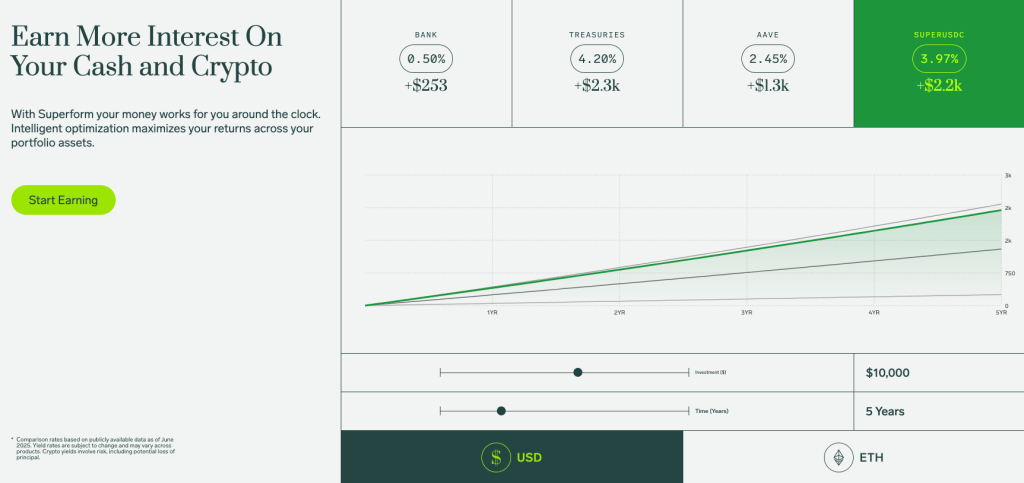
User interaction with UP typically forms a complete cycle centered around Vault participation. In most cases, users first encounter the token while exploring on-chain yield strategies; if they wish to gain governance rights or exposure to the infrastructure layer, they choose to purchase it; subsequently, they decide to stake or hold based on their role. In other words, UP's usage trigger comes from actual protocol participation behavior, not external narratives. When Vault usage scales up or governance proposals attract attention, overall activity often rises in tandem.
 Source: Superform.xyz
Core dApp Functions and Use Cases
Used to coordinate Vault infrastructure operation.
UP is used to support key processes maintaining the Vault system's operation, including validator data updates and execution coordination, ensuring accurate and consistent accounting calculations in a multi-strategy environment.
Supports governance participation mechanisms.
The token supports staking to obtain voting rights, enabling holders to participate in adjusting protocol parameters, such as configuration structures, strategy weights, or infrastructure rules, strengthening community governance participation.
Helps validators secure the ledger.
Validators can bond tokens as collateral when submitting data updates; errors or violations may trigger penalty mechanisms, economically ensuring data authenticity and system stability.
Used to strengthen incentives for strategy executors.
Strategy managers can hold or bond UP while operating Vault strategies, directly linking their economic interests to execution quality, thereby improving strategy stability and overall operational efficiency.
How to Buy, Use, and Participate in UP
UP can be acquired through centralized exchanges or decentralized markets that support the asset, depending on region and platform listings. Different trading platforms offer varying trading pairs. On listed exchanges such as XT